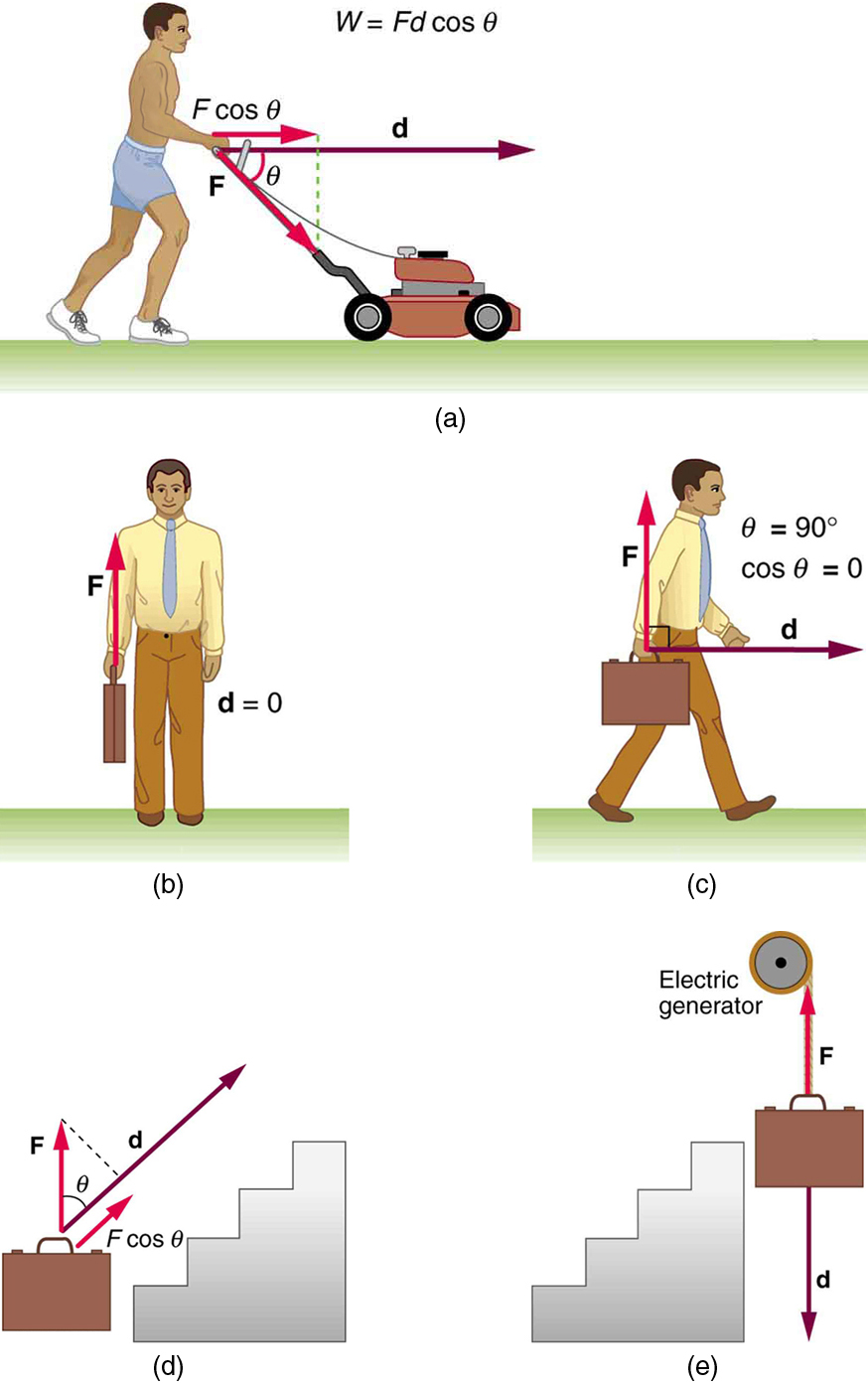
The scientific definition of work differs in some ways from its everyday meaning. Certain things we think of as hard work, such as writing an exam or carrying a heavy load on level ground, are not work as defined by a scientist. The scientific definition of work reveals its relationship to energy—whenever work is done, energy is transferred.
For work, in the scientific sense, to be done, a force must be exerted and there must be displacement in the direction of the force.
Formally, the work done on a system by a constant force is defined to be the product of the component of the force in the direction of motion times the distance through which the force acts. For one-way motion in one dimension, this is expressed in equation form as
where$W$is work,$\mag{d}$is the magnitude of the displacement of the system, and$\theta$is the angle between the force vector$\vb{F}$and the displacement vector$\vb{d}$, as in Figure 1. We can also write this as
To find the work done on a system that undergoes motion that is not one-way or that is in two or three dimensions, we divide the motion into one-way one-dimensional segments and add up the work done over each segment.
The work done on a system by a constant force is the product of the component of the force in the direction of motion times the distance through which the force acts. For one-way motion in one dimension, this is expressed in equation form as
where$W$is work, $F$is the magnitude of the force on the system, $d$is the magnitude of the displacement of the system, and$\theta$is the angle between the force vector$\vb{F}$ and the displacement vector$\vb{d}$.
To examine what the definition of work means, let us consider the other situations shown in Figure 1. The person holding the briefcase in Figure 1(b) does no work, for example. Here$d=0$, so$W=0$. Why is it you get tired just holding a load? The answer is that your muscles are doing work against one another, but they are doing no work on the system of interest (the “briefcase-Earth system”—see Gravitational Potential Energy for more details). There must be displacement for work to be done, and there must be a component of the force in the direction of the motion. For example, the person carrying the briefcase on level ground in Figure 1 (c) does no work on it, because the force is perpendicular to the motion. That is,$\cos{90^\circ} =0$, and so$W=0$.
In contrast, when a force exerted on the system has a component in the direction of motion, such as in Figure 1(d), work is done—energy is transferred to the briefcase. Finally, in Figure 1(e), energy is transferred from the briefcase to a generator. There are two good ways to interpret this energy transfer. One interpretation is that the briefcase’s weight does work on the generator, giving it energy. The other interpretation is that the generator does negative work on the briefcase, thus removing energy from it. The drawing shows the latter, with the force from the generator upward on the briefcase, and the displacement downward. This makes$\theta =180^\circ$, and$\cos 180^\circ=-1$; therefore,$W$is negative.
Work and energy have the same units. From the definition of work, we see that those units are force times distance. Thus, in SI units, work and energy are measured in newton-meters. A newton-meter is given the special name joule (J), and$1 \J =1\N \cdot \m =1\kg \cdot \mmss$. One joule is not a large amount of energy; it would lift a small 100-gram apple a distance of about 1 meter.
How much work is done on the lawn mower by the person in Figure 1 (a) if he exerts a constant force of$75.0\N$at an angle$35^\circ$ below the horizontal and pushes the mower$25.0\m$ on level ground? Convert the amount of work from joules to kilocalories and compare it with this person’s average daily intake of$10 000 \text{kJ}$(about$2400 \text{kcal}$) of food energy. One calorie (1 cal) of heat is the amount required to warm 1 g of water by$1^\circ\text{C}$, and is equivalent to$4.184 \J$, while one food calorie (1 kcal) is equivalent to$4184 \J$.
Strategy
We can solve this problem by substituting the given values into the definition of work done on a system, stated in the equation$W=F d \cos{\theta}$. The force, angle, and displacement are given, so that only the work$W$is unknown.
Solution
The equation for the work is
Substituting the known values gives
Converting the work in joules to kilocalories yields $W=\left(1536 \J \right)\left(1\text{kcal}/4184 \J \right)=0.367\text{kcal}$. The ratio of the work done to the daily consumption is
Discussion
This ratio is a tiny fraction of what the person consumes, but it is typical. Very little of the energy released in the consumption of food is used to do work. Even when we “work” all day long, less than 10% of our food energy intake is used to do work and more than 90% is converted to thermal energy or stored as chemical energy in fat.
Give an example of something we think of as work in everyday circumstances that is not work in the scientific sense. Is energy transferred or changed in form in your example? If so, explain how this is accomplished without doing work.
Give an example of a situation in which there is a force and a displacement, but the force does no work. Explain why it does no work.
Describe a situation in which a force is exerted for a long time but does no work. Explain.
How much work does a supermarket checkout attendant do on a can of soup he pushes 0.600 m horizontally with a force of 5.00 N? Express your answer in joules and kilocalories.
Strategy
The work done is given by$W = Fd\cos{\theta}$, where the force and displacement are in the same direction ($\theta = 0^\circ$), so$W = Fd$. We then convert the result to kilocalories using 1 kcal = 4184 J.
Solution
The work done is:
Converting to kilocalories:
Discussion
The work done is 3.00 J, which is a very small amount of energy. To put this in perspective, converting to kilocalories gives$7.17 \times 10^{-4}$kcal, which is less than one-thousandth of a food Calorie. This makes sense for the minimal effort required to slide a can along a checkout counter. The force applied (5.00 N) is about the weight of a 500-gram object, and the distance (0.600 m) is less than the length of an arm. Such a small amount of work would barely register as physical exertion for a person, which aligns with our everyday experience of pushing items at a checkout counter.
Answer
The checkout attendant does 3.00 J of work on the can of soup, which is equivalent to $7.17 \times 10^{-4}$kcal.
</div>
A 75.0-kg person climbs stairs, gaining 2.50 meters in height. Find the work done to accomplish this task.
Strategy
To lift the person at constant speed, the applied force must equal the person’s weight. The work done against gravity is the product of this force and the vertical displacement. We use$W = Fd\cos{\theta}$, where the force and displacement are in the same direction ($\theta = 0^\circ$), so the work done is$W = mgh$.
Solution
The work done to lift the person is:
Substituting known values:
Discussion
The work done to climb stairs is 1840 J, which represents the gravitational potential energy gained by the person. This is about 600 times more energy than pushing a can across a checkout counter (Problem 1). The result is reasonable because lifting a 75-kg person (about 165 lbs) through a height of 2.50 m requires significant work against gravity. This amount of energy (approximately 0.44 kcal) is still quite small compared to daily food intake, but climbing stairs repeatedly would add up—climbing 10 flights of similar height would consume about 4.4 kcal. The work done increases linearly with both the mass of the person and the height climbed.
Answer
The work done to lift the person climbing stairs is $1.84 \times 10^{3}$J (or 1840 J).
(a) Calculate the work done on a 1500-kg elevator car by its cable to lift it 40.0 m at constant speed, assuming friction averages 100 N? (b) What is the work done on the elevator car by the gravitational force in this process? (c) What is the total work done on the elevator car?
Strategy
At constant speed, the net force is zero. The cable must pull upward with a force equal to the weight of the elevator plus the friction force. For part (a), we calculate the work done by the cable using$W = Fd$. For part (b), gravity does negative work since it acts downward while the displacement is upward. For part (c), we sum all work done on the elevator.
Solution
Part (a): Work done by the cable
At constant speed, the upward tension force equals the downward forces (weight plus friction):
The work done by the cable (force and displacement in same direction):
Part (b): Work done by gravity
The gravitational force is$F_g = mg = 14700\N$acting downward, opposite to the upward displacement ($\theta = 180^\circ$):
Part (c): Total work done
The total work includes work by cable, gravity, and friction. The friction force opposes motion (acts downward), so:
The total work is:
Discussion
The cable does positive work ($5.92\times 10^{5}$J) to lift the elevator, while gravity does an almost equal amount of negative work ($-5.88\times 10^{5}$J). Friction does a relatively small amount of negative work ($-4000$J). The total work done on the elevator is zero, which is consistent with the elevator moving at constant speed—there is no change in kinetic energy.
This problem illustrates that even though significant forces act and significant work is done by individual forces, the net work can be zero when an object moves at constant velocity. The cable must do extra work (4000 J) beyond what’s needed just to lift the elevator, to overcome the frictional forces. Of the 592,000 J of work done by the cable, 588,000 J goes into increasing the gravitational potential energy of the elevator, while 4000 J is dissipated by friction.
Answer
(a) The cable does $5.92\times 10^{5}$J of work on the elevator.
(b) Gravity does $-5.88\times 10^{5}$J of work on the elevator.
(c) The total work done on the elevator is 0 J (consistent with constant speed motion).
Suppose a car travels 108 km at a speed of 30.0 m/s, and uses 2.0 gal of gasoline. Only 30% of the gasoline goes into useful work by the force that keeps the car moving at constant speed despite friction. (See Table 1 of Conservation Of Energy for the energy content of gasoline.) (a) What is the magnitude of the force exerted to keep the car moving at constant speed? (b) If the required force is directly proportional to speed, how many gallons will be used to drive 108 km at a speed of 28.0 m/s?
Strategy
For part (a), we need to find the work done by the force keeping the car moving at constant speed, which equals the useful energy from the gasoline. From Table 1 in Conservation of Energy, 1 gallon of gasoline contains$1.2 \times 10^{8}\J$. Only 30% of this is useful work. We can then use$W = Fd$to find the force.
For part (b), if force is proportional to speed, then$F \propto v$. We can use the ratio of speeds to find the new force, and then calculate the gasoline consumption.
Solution for (a)
The total energy available from 2.0 gallons of gasoline is:
The useful work done is 30% of this:
The distance traveled is$d = 108\text{ km} = 1.08 \times 10^{5}\m$. Using$W = Fd$:
Solution for (b)
If$F \propto v$, then:
The new force is:
The work done at this new force is:
The total energy needed (accounting for only 30% efficiency) is:
The number of gallons required is:
Discussion
The force required to overcome friction and keep the car moving at constant speed is 667 N (about 150 lbs). This seems reasonable for highway driving—it’s the combined effect of air resistance and rolling friction. The fact that only 30% of the gasoline’s energy goes into useful work reflects the inherent inefficiency of internal combustion engines, with the remaining 70% lost as heat.
For part (b), driving at a slower speed (28.0 m/s instead of 30.0 m/s) reduces the required force proportionally, resulting in less fuel consumption (1.9 gal instead of 2.0 gal). This 6.7% reduction in speed leads to a 5% reduction in fuel consumption, demonstrating that driving slower can improve fuel efficiency. The savings would be even more dramatic at highway speeds where air resistance increases as the square of velocity, but this problem assumes a simpler linear relationship between force and speed.
Answer
(a) The magnitude of the force exerted to keep the car moving at constant speed is 667 N (or $6.7 \times 10^{2}$N).
(b) At the lower speed of 28.0 m/s, approximately 1.9 gallons of gasoline will be used to drive 108 km.
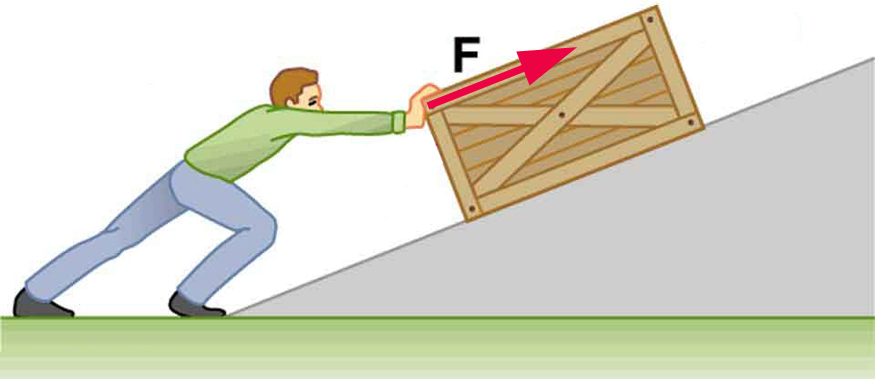
Calculate the work done by an 85.0-kg man who pushes a crate 4.00 m up along a ramp that makes an angle of$20.0^\circ$with the horizontal. (See Figure 2.) He exerts a force of 500 N on the crate parallel to the ramp and moves at a constant speed. Be certain to include the work he does on the crate and on his body to get up the ramp.
Strategy
The total work includes: (1) work done pushing the crate with force 500 N through distance 4.00 m, and (2) work done raising his own body mass. The vertical height gained is$h = d\sin{\theta} = (4.00\m)\sin{20.0^\circ}$.
Solution
Work done pushing the crate:
Vertical height gained:
Work done lifting his own body:
Total work done:
Discussion
The man does a total of 3140 J of work. About 64% of this (2000 J) goes into pushing the crate up the ramp, while 36% (1140 J) goes into lifting his own body mass against gravity. This demonstrates that when pushing objects uphill, a significant portion of the effort goes into lifting one’s own body weight.
The result is reasonable: climbing 1.37 m vertically while pushing a heavy crate requires substantial energy. If the man’s mass were comparable to the crate’s mass, the work to lift himself would be comparable to the work on the crate. The total energy of 3140 J is about 0.75 kcal, which is a small but noticeable expenditure of energy—roughly equivalent to the energy in a single potato chip.
This problem illustrates an important practical consideration: when moving heavy objects up inclines, workers expend significant energy just moving themselves, not only the object. This is why ramps at gentler angles (smaller$\theta$) can be advantageous—they reduce the vertical height gained per unit distance, though requiring longer travel.
Answer
The man does a total of 3140 J (or $3.14 \times 10^{3}$J) of work, consisting of 2000 J on the crate and 1140 J on his own body.
</div>
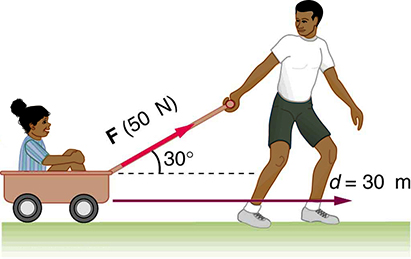
How much work is done by the boy pulling his sister 30.0 m in a wagon as shown in Figure 3? Assume no friction acts on the wagon.
Strategy
The work done is given by$W = Fd\cos{\theta}$, where$F = 50.0\N$is the magnitude of the pulling force,$d = 30.0\m$is the displacement, and$\theta = 30.0^\circ$is the angle between the force and the horizontal displacement.
Solution
Substituting the known values into the work equation:
Discussion
The boy does 1300 J of work pulling his sister in the wagon over a distance of 30.0 m. Only the horizontal component of the pulling force ($F\cos{30.0^\circ} = 43.3\N$) does work; the vertical component lifts slightly on the wagon but doesn’t contribute to horizontal displacement.
This is a good example of how the angle of applied force affects work. If the boy pulled horizontally ($\theta = 0^\circ$), he would do$(50.0\N)(30.0\m) = 1500\J$of work with the same force magnitude. By pulling at 30° above horizontal, he does only 1300 J of work—about 87% as much. However, pulling upward at an angle has the practical advantage of reducing the normal force on the wagon wheels, which would reduce friction if friction were present. Since this problem states there’s no friction, pulling horizontally would be most efficient for doing work.
Answer
The boy does 1300 J (or $1.30 \times 10^{3}$J) of work pulling the wagon.
A shopper pushes a grocery cart 20.0 m at constant speed on level ground, against a 35.0 N frictional force. He pushes in a direction$25.0^\circ$ below the horizontal. (a) What is the work done on the cart by friction? (b) What is the work done on the cart by the gravitational force? (c) What is the work done on the cart by the shopper? (d) Find the force the shopper exerts, using energy considerations. (e) What is the total work done on the cart?
Strategy
For constant speed, the net force is zero. The friction force opposes motion ($\theta = 180^\circ$), gravity is perpendicular to motion, and the shopper pushes at$25.0^\circ$below horizontal. We use$W = Fd\cos{\theta}$for each force.
Solution for (a)
The friction force is opposite to the displacement:
Solution for (b)
Gravity acts vertically downward, perpendicular to the horizontal displacement ($\theta = 90^\circ$):
Solution for (c)
At constant speed, the horizontal component of the shopper’s force must equal the friction force. From Newton’s second law:$F\cos{25.0^\circ} = 35.0\N$. The work done by the shopper must equal the negative of the work done by friction:
Solution for (d)
The horizontal component of the shopper’s force equals the friction force:
We can verify:$W = Fd\cos{25.0^\circ} = (38.6\N)(20.0\m)(0.906) = 700\J$✓
Solution for (e)
The total work is the sum of all work done:
Discussion
This problem illustrates several important concepts about work and energy. First, gravity does no work on the cart because the gravitational force is perpendicular to the horizontal displacement—this is why carrying a suitcase horizontally doesn’t require you to do work against gravity (though your muscles still work internally to maintain the upward force).
Second, the shopper does positive work (700 J) while friction does an equal amount of negative work (-700 J), resulting in zero net work. This is consistent with the work-energy theorem: since the cart moves at constant speed, its kinetic energy doesn’t change, so the net work must be zero.
Third, notice that the shopper must exert 38.6 N at an angle to overcome only 35.0 N of friction. This is because only the horizontal component of the shopper’s force ($38.6\N \times \cos{25.0^\circ} = 35.0\N$) counteracts friction. The vertical component ($38.6\N \times \sin{25.0^\circ} = 16.3\N$) pushes down on the cart, increasing the normal force and thus increasing friction. Pushing downward at an angle is less efficient than pushing horizontally—in fact, it makes the task harder by increasing friction.
The energy transferred from the shopper (700 J) is completely dissipated by friction as thermal energy, which is why the cart doesn’t speed up despite the applied force.
Answer
(a) Friction does -700 J of work on the cart.
(b) Gravity does 0 J of work on the cart (force perpendicular to displacement).
(c) The shopper does 700 J of work on the cart.
(d) The shopper exerts a force of 38.6 N at$25.0^\circ$below horizontal.
(e) The total work done on the cart is 0 J, consistent with constant speed motion.
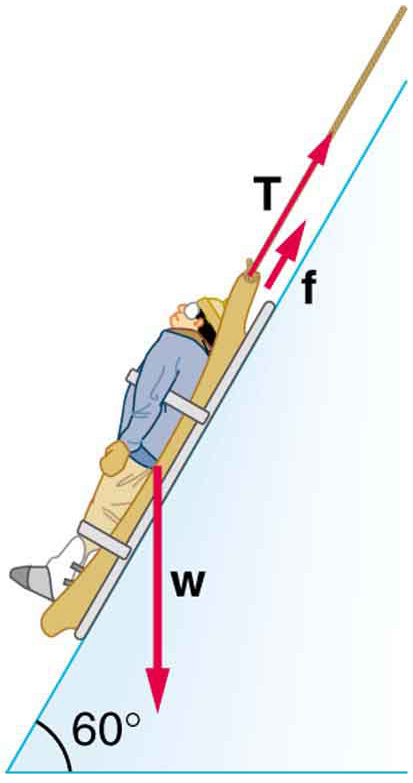
Suppose the ski patrol lowers a rescue sled and victim, having a total mass of 90.0 kg, down a$60.0^\circ$slope at constant speed, as shown in Figure 4. The coefficient of friction between the sled and the snow is 0.100. (a) How much work is done by friction as the sled moves 30.0 m along the hill? (b) How much work is done by the rope on the sled in this distance? (c) What is the work done by the gravitational force on the sled? (d) What is the total work done?
Strategy
First, we need to find the forces acting on the sled. The normal force is$N = mg\cos{\theta}$. The friction force is$f = \mu_{k}N = \mu_{k}mg\cos{\theta}$. Since the sled moves down the slope at constant speed, the net force is zero. The component of weight down the slope is$mg\sin{\theta}$. We can use$W = Fd\cos{\alpha}$for each force, where$\alpha$is the angle between the force and displacement.
Solution for (a)
The friction force opposes motion (acts up the slope), and the sled moves down the slope, so the angle between friction and displacement is$180^\circ$:
The work done by friction is:
Solution for (b)
At constant speed, the net force along the slope is zero. The tension in the rope acts up the slope:
The tension acts up the slope and the displacement is down the slope ($\theta = 180^\circ$):
Solution for (c)
The gravitational force is$W = mg = 882\N$acting vertically downward. The displacement along the slope makes an angle with the vertical. It’s easier to use the component of weight along the slope:$mg\sin{\theta}$, which acts in the direction of motion:
Solution for (d)
The total work is the sum of all work done:
Discussion
This problem demonstrates the interplay of multiple forces doing work on an object moving at constant speed. Gravity does positive work (23,000 J) because it has a component along the direction of motion down the slope. Both the rope tension and friction do negative work, removing energy from the system.
The rope does the most negative work (-21,600 J), which represents the energy absorbed by the ski patrol as they control the descent. This energy must be dissipated (often as heat in a braking mechanism) or stored (if using a winch system). Friction does a much smaller amount of negative work (-1,320 J), converting mechanical energy to thermal energy that slightly warms the sled runners and snow.
The sum of all work equals zero, confirming the work-energy theorem: at constant speed, kinetic energy is constant, so net work must be zero. This is a controlled descent—without the rope tension, the sled would accelerate down the slope, gaining kinetic energy equal to the difference between gravitational work and friction work.
Interestingly, the rope must do more work than gravity adds because friction also opposes motion. Of the 23,000 J that gravity contributes, 1,320 J is dissipated by friction, leaving 21,680 J that the rope must remove through tension. The small discrepancy (21,600 J vs 21,680 J) is due to rounding in the calculations.
The relatively small friction force (44.1 N compared to 765 N down the slope) shows why steep, icy slopes are dangerous—friction provides minimal resistance, requiring large rope tensions for safe descent.
Answer
(a) Friction does $-1.32 \times 10^{3}$J (or -1,320 J) of work on the sled.
(b) The rope does $-2.16 \times 10^{4}$J (or -21,600 J) of work on the sled.
(c) Gravity does $+2.30 \times 10^{4}$J (or +23,000 J) of work on the sled.
(d) The total work done is 0 J, consistent with the constant speed descent.