
Energy, as we have noted, is conserved, making it one of the most important physical quantities in nature. The law of conservation of energy can be stated as follows:
Total energy is constant in any process. It may change in form or be transferred from one system to another, but the total remains the same.
We have explored some forms of energy and some ways it can be transferred from one system to another. This exploration introduced mechanical energy \(\left(\KE+\PE\right)\) and showed how work done by nonconservative forces can change it. But energy takes many other forms, manifesting itself in many different ways, and we need to be able to deal with all of these before we can write an equation for the above general statement of the conservation of energy.
At this point, we group all forms of energy other than mechanical energy under other energy (\(\text{OE}\)). This includes chemical and thermal energy. First choose the system whose energy we will track. For example, include Earth when tracking gravitational potential energy, or a spring when tracking elastic potential energy. Conservation of energy then says that the initial energy plus the net energy transferred into the system equals the final energy:
Here \(E_{\text{transfer}}\) is positive for energy entering the system and negative for energy leaving it. Work is one way to transfer energy; heating and radiation are others. If no energy enters or leaves, this term is zero.
Be careful to count each energy change only once. If a sliding block and the rough surface beneath it are both in the system, friction converts kinetic energy into thermal energy within that system. The decrease in \(\KE\) is balanced by an increase in \(\text{OE}\); there is no need to subtract the work of friction again. If we track only mechanical energy instead, the previous section’s rule \(W_{\text{nc}}=\Delta\KE+\Delta\PE\) remains useful.
The fact that energy is conserved and has many forms makes it very important. You will find that energy is discussed in many contexts, because it is involved in all processes. It will also become apparent that many situations are best understood in terms of energy and that problems are often most easily conceptualized and solved by considering energy.
When does \(\text{OE}\) play a role? One example occurs when a person eats. Food is oxidized with the release of carbon dioxide, water, and energy. Some of this chemical energy is converted to kinetic energy when the person moves, to potential energy when the person changes altitude, and to thermal energy ( another form of \(\text{OE}\)).
What are some other forms of energy? You can probably name a number of forms of energy not yet discussed. Many of these will be covered in later chapters, but let us detail a few here. Electrical energy is a common form that is converted to many other forms and does work in a wide range of practical situations. Fuels, such as gasoline and food, carry chemical energy that can be transferred to a system through oxidation. Chemical fuel can also produce electrical
energy, such as in batteries. Batteries can in turn produce light, which carries radiant energy. Most energy sources on Earth are in fact stored energy from the energy we receive from the Sun. We sometimes refer to this as radiant energy, or electromagnetic radiation, which includes visible light, infrared, and ultraviolet radiation. Nuclear energy comes from processes that convert measurable amounts of mass into energy. Nuclear energy is transformed into the energy of sunlight, into electrical energy in power plants, and into the energy of the heat transfer and blast in weapons. Atoms and molecules inside all objects are in random motion. This internal mechanical energy from the random motions is called thermal energy, because it is related to the temperature of the object. These and all other forms of energy can be converted into one another and can do work.
Table 1 gives the amount of energy stored, used, or released from various objects and in various phenomena. The range of energies and the variety of types and situations is impressive.
You will find the following problem-solving strategies useful whenever you deal with energy. The strategies help in organizing and reinforcing energy concepts. In fact, they are used in the examples presented in this chapter. The familiar general problem-solving strategies presented earlier—involving identifying physical principles, knowns, and unknowns, checking units, and so on—continue to be relevant here.
Step 1. Determine the system of interest and identify what information is given and what quantity is to be calculated. A sketch will help.
Step 2. Examine all the forces involved and determine whether you know or are given the potential energy from the work done by the forces. Then use step 3 or step 4.
Step 3. If only conservative forces do work and there are no other changes in the system’s energy, apply conservation of mechanical energy in terms of potential and kinetic energy. The equation expressing conservation of energy is
Step 4. If mechanical energy changes into other forms, such as thermal energy, or energy enters or leaves the system, include those changes and transfers in the energy balance:
In most problems, one or more of the terms is zero, simplifying its solution. Do not calculate \(W_{c}\), the work done by conservative forces; it is already incorporated in the \(\PE\) terms.
Step 5. You have already identified the types of work and energy involved ( in step 2). Before solving for the unknown, eliminate terms wherever possible to simplify the algebra. For example, choose \(h=0\) at either the initial or final point, so that \(\PE_{\text{g}}\) is zero there. Then solve for the unknown in the customary manner.
Step 6. Check the answer to see if it is reasonable. Once you have solved a problem, reexamine the forms of work and energy to see if you have set up the conservation of energy equation correctly. For example, work done by friction on a sliding object should be negative, potential energy at the bottom of a hill should be less than that at the top, and so on. Also check to see that the numerical value obtained is reasonable. For example, the final speed of a skateboarder who coasts down a 3-m-high ramp could reasonably be 20 km/h, but not 80 km/h.
The transformation of energy from one form into others is happening all the time. The chemical energy in food is converted into thermal energy through metabolism; light energy is converted into chemical energy through photosynthesis. In a larger example, the chemical energy contained in coal is converted into thermal energy as it burns to turn water into steam in a boiler. This thermal energy in the steam in turn is converted to mechanical energy as it spins a turbine, which is connected to a generator to produce electrical energy. (In all of these examples, not all of the initial energy is converted into the forms mentioned. This important point is discussed later in this section.)
Another example of energy conversion occurs in a solar cell. Sunlight impinging on a solar cell (see Figure 1) produces electricity, which in turn can be used to run an electric motor. Energy is converted from the primary source of solar energy into electrical energy and then into mechanical energy.
| Object/phenomenon | Energy in joules |
|---|---|
| Big Bang | \(10^{68}\) |
| Energy released in a supernova | \(10^{44}\) |
| Fusion of all the hydrogen in Earth’s oceans | \(10^{34}\) |
| Annual world energy use | \(4×10^{20}\) |
| Large fusion bomb (9 megaton) | \(3.8×10^{16}\) |
| 1 kg hydrogen (fusion to helium) | \(6.4×10^{14}\) |
| 1 kg uranium (nuclear fission) | \(8.0×10^{13}\) |
| Fission bomb (10 kiloton) | \(4.2×10^{13}\) |
| 90 000-ton aircraft carrier at 30 knots | \(1.1×10^{10}\) |
| 1 barrel crude oil | \(5.9×10^{9}\) |
| 1 ton TNT | \(4.2×10^{9}\) |
| 1 gallon of gasoline | \(1.2×10^{8}\) |
| Daily home electricity use (developed countries) | \(7×10^{7}\) |
| Daily adult food intake (recommended) | \(1.2×10^{7}\) |
| 1000-kg car at 90 km/h | \(3.1×10^{5}\) |
| 1 g fat (9.3 kcal) | \(3.9×10^{4}\) |
| ATP hydrolysis reaction (1 mol of ATP) | \(3.2×10^{4}\) |
| 1 g carbohydrate (4.1 kcal) | \(1.7×10^{4}\) |
| 1 g protein (4.1 kcal) | \(1.7×10^{4}\) |
| Tennis ball at 100 km/h | \(22\) |
| Mosquito (\(10^{-2}\) g at 0.5 m/s) | \(1.3×10^{-6}\) |
| Single electron in a TV tube beam | \(4.0×10^{-15}\) |
| Energy to break one DNA strand | \(10^{-19}\) |
Even though energy is conserved in an energy conversion process, the output of useful energy or work will be less than the energy input. The efficiency \(\text{Eff}\) of an energy conversion process is defined as
Table 2 lists some efficiencies of mechanical devices and human activities. In a coal-fired power plant, for example, about 40% of the chemical energy in the coal becomes useful electrical energy. The other 60% transforms into other (perhaps less useful) energy forms, such as thermal energy, which is then released to the environment through combustion gases and cooling towers.
| Activity/device | Efficiency (%) |
|---|---|
| Cycling and climbing | 20 |
| Swimming, surface | 2 |
| Swimming, submerged | 4 |
| Shoveling | 3 |
| Weightlifting | 9 |
| Steam engine | 17 |
| Gasoline engine | 30 |
| Diesel engine | 35 |
| Nuclear power plant | 35 |
| Coal power plant | 42 |
| Electric motor | 85–95 |
| Compact fluorescent light | 20 |
| LED light | 40 |
| Gas heater (residential) | 90 |
| Solar cell (commercial) | 20 |
A realistic mass and spring laboratory. Hang masses from springs and adjust the spring stiffness and damping. You can even slow time. Transport the lab to different planets. A chart shows the kinetic, potential, and thermal energies for each spring.
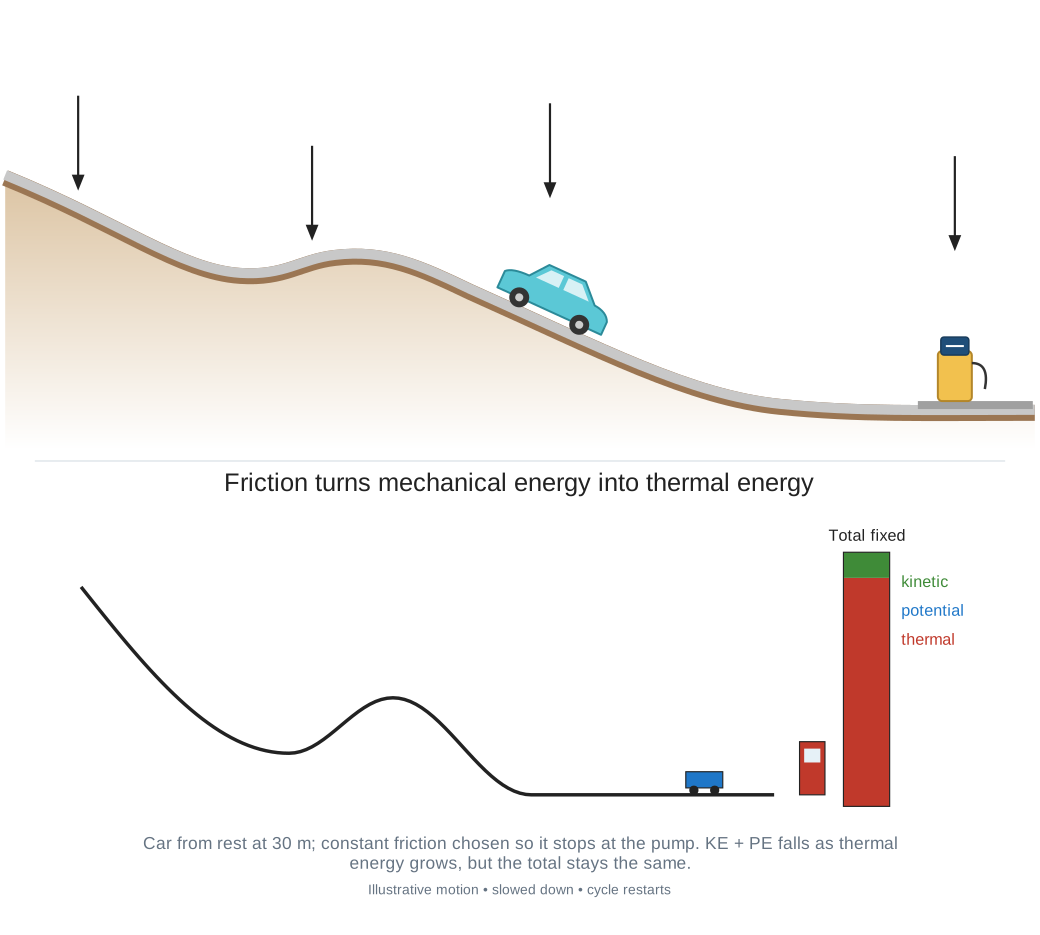
Consider the following scenario. A car for which friction is not negligible accelerates from rest down a hill, running out of gasoline after a short distance. The driver lets the car coast farther down the hill, then up and over a small crest. He then coasts down that hill into a gas station, where he brakes to a stop and fills the tank with gasoline. Identify the forms of energy the car has, and how they are changed and transferred in this series of events. (See Figure 3.)
Strategy
Follow the car through each stage of the trip and list the forms of energy that change, using the work-energy relation \(\KE_{i} + \PE_{i} + W_{nc} = \KE_{f} + \PE_{f}\).
Solution
Take \(+y\) upward, so gravitational potential energy \(mgh\) decreases as the car descends. Consider a \(1000 \kg\) car.
Throughout, the total energy is conserved. Energy is only transferred and transformed, and most of it ends up as thermal energy of the car, road, and air.
The car’s energy takes the forms of chemical energy (gasoline), kinetic energy, gravitational potential energy, and thermal energy; the engine turns chemical energy into kinetic energy, gravity exchanges potential and kinetic energy on the hills, friction and the brakes turn energy into thermal energy (for example, \(50{,}000 \J\) to stop a \(1000 \kg\) car from \(10 \ms\)), and filling the tank adds chemical energy.
Describe the energy transfers and transformations for a javelin, starting from the point at which an athlete picks up the javelin and ending when the javelin is stuck into the ground after being thrown.
Strategy
Follow the javelin from pick-up to its stop in the ground, noting at each stage where its energy comes from and where it goes. Take \(+y\) upward, so gravitational potential energy increases with height.
Solution
Consider an \(0.80 \kg\) javelin.
The javelin’s energy comes from the athlete’s chemical energy (food), becomes gravitational potential energy and kinetic energy (about \(314 \J\) at release), is exchanged between kinetic and gravitational potential energy in flight while air resistance turns some into heat, and ends as thermal energy, sound, and deformation of the ground when the javelin sticks in.
Do devices with efficiencies of less than one violate the law of conservation of energy? Explain.
Strategy
Use the definition of efficiency, \(\text{Eff} = W_{\text{out}}/E_{\text{in}}\), and account for all the energy that goes in.
Solution
No. Efficiency compares only the useful energy output with the energy input. The rest of the energy is not destroyed; it is converted into forms we do not want, mostly thermal energy, along with sound and light.
For example, a car engine with an efficiency of \(25\%\) that burns fuel containing \(1000 \J\) of chemical energy produces
of useful work. The other \(750 \J\) leaves as thermal energy in the exhaust gas, the radiator, and the surroundings. Adding everything up,
so the total energy is conserved. An efficiency less than 1 says that some energy is not put to the use we want, not that any energy has been lost from the universe.
Devices with efficiencies less than one do not violate conservation of energy, because the energy not converted into useful work (for example, \(750 \J\) of every \(1000 \J\) in a \(25\%\) efficient engine) still exists, mostly as thermal energy, so the total energy output equals the input.
List four different forms or types of energy. Give one example of a conversion from each of these forms to another form.
Strategy
Name four forms of energy, and for each give a common device or process that converts it into another form, with a typical amount.
Solution
Other forms include light (radiant) energy, which a solar cell converts into electrical energy, and elastic potential energy, which a drawn bow converts into the kinetic energy of an arrow.
Four forms of energy are chemical energy (burned in a furnace to give thermal energy), electrical energy (turned into kinetic energy by a motor), gravitational potential energy (turned into kinetic energy by falling water, \(490 \J\) per kilogram for a \(50 \m\) drop), and nuclear energy (turned into thermal energy in a reactor).
List the energy conversions that occur when riding a bicycle.
Strategy
Follow the energy from the rider’s food to the bicycle’s motion and on to its final forms, including the effects of hills and braking.
Solution
The total energy is conserved at every step; nearly all of the food energy ends up as thermal energy of the rider, the bicycle, and the air.
Riding a bicycle converts chemical energy from food into work by the muscles (with about \(80\%\) becoming body heat), the work into kinetic energy (about \(2400 \J\) at \(8.0 \ms\) for \(75 \kg\)), kinetic energy into thermal energy through air resistance, friction, and braking, and kinetic energy back and forth with gravitational potential energy on hills.
Using values from Table 1, how many DNA molecules could be broken by the energy carried by a single electron in the beam of an old-fashioned TV tube? (These electrons were not dangerous in themselves, but they did create dangerous x rays. Later model tube TVs had shielding that absorbed x rays before they escaped and exposed viewers.)
Strategy
From Table 1, the energy of a single electron in a TV tube beam is \(4.0 \times 10^{-15}\) J, and the energy to break one DNA strand is \(10^{-19}\) J. We divide the electron’s energy by the energy per DNA strand.
Solution
Discussion
A single electron in an old TV tube beam carries enough energy to break approximately 40,000 DNA strands. This illustrates why radiation damage at the molecular level can be so significant—a single high-energy particle can cause extensive damage. However, these electrons themselves don’t penetrate the glass screen; the danger came from the x-rays they produced when they struck the screen, which is why later TV models included protective shielding.
Answer
A single electron can break approximately 40,000 DNA molecules.
Using energy considerations and assuming negligible air resistance, show that a rock thrown from a bridge 20.0 m above water with an initial speed of 15.0 m/s strikes the water with a speed of 24.8 m/s independent of the direction thrown.
Strategy
Use conservation of mechanical energy. Since air resistance is negligible, only conservative forces act (gravity), so the total mechanical energy is conserved: \(\KE_{i} + \PE_{i} = \KE_{f} + \PE_{f}\). The initial kinetic energy depends only on the magnitude of velocity, not its direction, and the change in potential energy depends only on the vertical height change.
Sketch and coordinate system
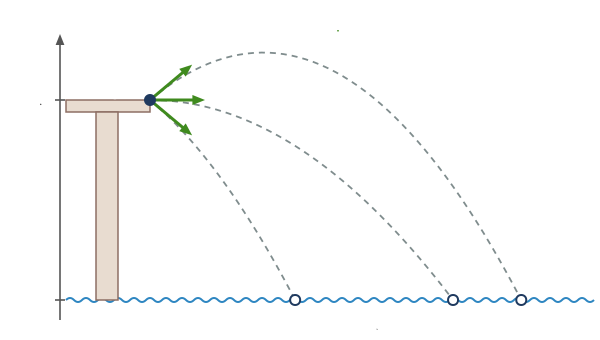
Take \(+y\) upward with \(y = 0\) at the water, so the rock starts at \(h = +20.0\m\) and ends at \(0\). Energy is a scalar, so only the speed \(v_0\) and the drop in height enter, not the direction of the throw.
Solution
Starting with conservation of energy:
where we set the water level as the zero potential energy reference (\(h_f = 0\)). Canceling mass and solving for \(v_f\):
Substituting values:
Discussion
The final speed is independent of the direction the rock is thrown because the formula \(v_f = \sqrt{v_0^2 + 2gh}\) depends only on the magnitude of the initial velocity, not its direction. Whether thrown horizontally, upward at an angle, or downward, the same initial speed and height change produce the same final speed. This is a powerful demonstration of energy conservation—the path taken doesn’t matter, only the initial and final states.
Answer
The rock strikes the water with a speed of 24.8 m/s, independent of the direction thrown.
If the energy in fusion bombs were used to supply the energy needs of the world, how many of the 9-megaton variety would be needed for a year’s supply of energy (using data from Table 1)? This is not as far-fetched as it may sound—there are thousands of nuclear bombs, and their energy can be trapped in underground explosions and converted to electricity, as natural geothermal energy is.
Strategy
From Table 1, the annual world energy use is approximately \(4 \times 10^{20}\J\) and a 9-megaton fusion bomb releases \(3.8 \times 10^{16}\J\) of energy. We divide the annual energy need by the energy per bomb.
Solution
Discussion
Approximately 10,000 nine-megaton fusion bombs would be needed to supply the world’s annual energy needs. While this seems like a large number, it illustrates the enormous energy content of nuclear fusion. However, using nuclear weapons for energy production is impractical and dangerous, which is why controlled fusion research aims to harness this energy safely.
Answer
Approximately 10,000 nine-megaton fusion bombs would be needed to supply the world’s annual energy needs.
(a) Use of hydrogen fusion to supply energy is a dream that may be realized in the next century. Fusion would be a relatively clean and almost limitless supply of energy, as can be seen from Table 1. To illustrate this, calculate how many years the present energy needs of the world could be supplied by one millionth of the oceans’ hydrogen fusion energy. (b) How does this time compare with historically significant events, such as the duration of stable economic systems?
Strategy
From Table 1, the fusion of all hydrogen in Earth’s oceans would release \(10^{34}\) J of energy, and the annual world energy use is \(4 \times 10^{20}\) J. For part (a), divide one millionth of the ocean’s fusion energy by the annual energy consumption. For part (b), compare this timescale to historical events.
Solution
(a) First, calculate one millionth of the ocean’s hydrogen fusion energy:
Now divide by annual world energy use:
(b) This timescale of 25 million years is extraordinarily long compared to human history. Recorded human civilization spans only about 5,000 years. Even stable economic systems typically last only centuries, not millennia. This time period is comparable to geological time scales—for instance, it’s roughly the time since the late Oligocene epoch when many modern mammal groups emerged.
Discussion
The calculation reveals the almost incomprehensible magnitude of energy potentially available from fusion. Even using just one millionth of the ocean’s hydrogen would power human civilization for 25 million years at current consumption rates. This is about 5,000 times longer than recorded human history and far longer than any economic or political system has ever lasted. This illustrates why controlled fusion is called the “holy grail” of energy production—it would essentially solve humanity’s energy problems for geological timescales.
Answer
(a) One millionth of the ocean’s hydrogen fusion energy could supply the world’s energy needs for approximately 25 million years.
(b) This timescale is vastly longer than any human historical period—about 5,000 times the length of recorded civilization and far exceeding the duration of any stable economic system.