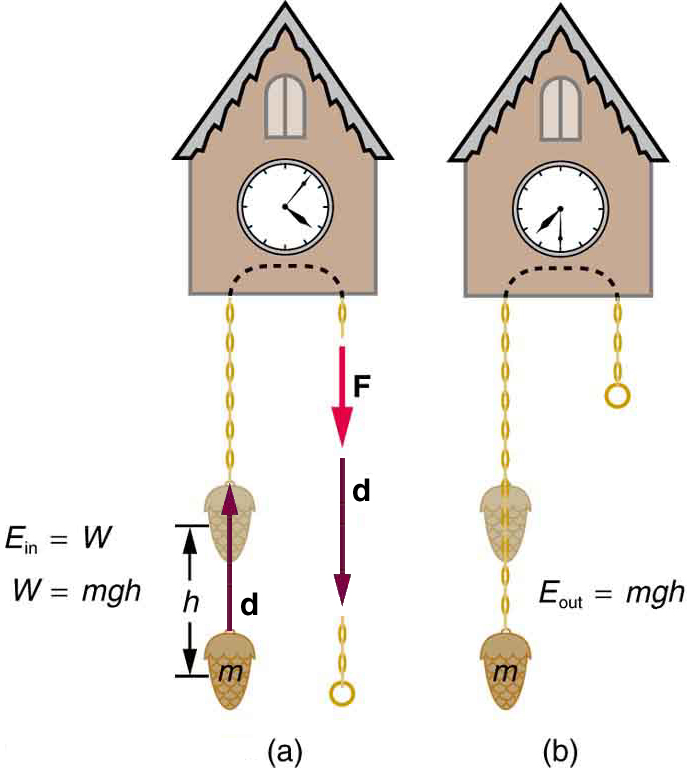
Show that the gravitational potential energy of an object of mass $m$at height$h$on Earth is given by$\PE_{\text{g}}=mgh$.
Climbing stairs and lifting objects is work in both the scientific and everyday sense—it is work done against the gravitational force. When there is work, there is a transformation of energy. The work done against the gravitational force goes into an important form of stored energy that we will explore in this section.
Let us calculate the work done in lifting an object of mass$m$through a height$h$, such as in Figure 1. If the object is lifted straight up at constant speed, then the force needed to lift it is equal to its weight$mg$. The work done on the mass is then$W = Fd = mgh$. We define this to be the gravitational potential energy$\left(\PE_{\text{g}}\right)$put into (or gained by) the object-Earth system. This energy is associated with the state of separation between two objects that attract each other by the gravitational force. For convenience, we refer to this as the$\PE_{\text{g}}$
gained by the object, recognizing that this is energy stored in the gravitational field of Earth. Why do we use the word “system”? Potential energy is a property of a system rather than of a single object—due to its physical position. An object’s gravitational potential is due to its position relative to the surroundings within the Earth-object system. The force applied to the object is an external force, from outside the system. When it does positive work it increases the gravitational potential energy of the system. Because gravitational potential energy depends on relative position, we need a reference level at which to set the potential energy equal to 0. We usually choose this point to be Earth’s surface, but this point is arbitrary; what is important is the difference in gravitational potential energy, because this difference is what relates to the work done. The difference in gravitational potential energy of an object (in the Earth-object system) between two rungs of a ladder will be the same for the first two rungs as for the last two rungs.
Gravitational potential energy may be converted to other forms of energy, such as kinetic energy. If we release the mass, gravitational force will do an amount of work equal to$mgh$on it, thereby increasing its kinetic energy by that same amount (by the work-energy theorem). We will find it more useful to consider just the conversion of$\PE_{\text{g}}$to$\KE$without explicitly considering the intermediate step of work. ( See Example 2.) This shortcut makes it is easier to solve problems using energy (if possible) rather than explicitly using forces.
More precisely, we define the change in gravitational potential energy $\Delta \PE\_{\text{g}}$ to be
where, for simplicity, we denote the change in height by $h$ rather than the usual $\Delta h$. Note that $h$ is positive when the final height is greater than the initial height, and vice versa. For example, if a 0.500-kg mass hung from a cuckoo clock is raised 1.00 m, then its change in gravitational potential energy is
Note that the units of gravitational potential energy turn out to be joules, the same as for work and other forms of energy. As the clock runs, the mass is lowered. We can think of the mass as gradually giving up its 4.90 J of gravitational potential energy, without directly considering the force of gravity that does the work.
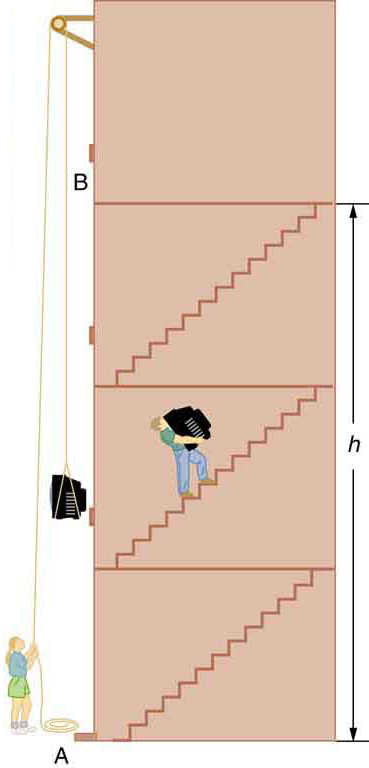
The equation$\Delta \PE\_{\text{g}}=mgh$applies for any path that has a change in height of$h$, not just when the mass is lifted straight up. ( See Figure 2.) It is much easier to calculate$mgh$ (a simple multiplication) than it is to calculate the work done along a complicated path. The idea of gravitational potential energy has the double advantage that it is very broadly applicable and it makes calculations easier. From now on, we will consider that any change in vertical position$h$of a mass$m$is accompanied by a change in gravitational potential energy$mgh$ , and we will avoid the equivalent but more difficult task of calculating work done by or against the gravitational force.
A 60.0-kg person jumps onto the floor from a height of 3.00 m. If he lands stiffly (with his knee joints compressing by 0.500 cm), calculate the force on the knee joints.
Strategy
This person’s energy is brought to zero in this situation by the work done on him by the floor as he stops. The initial$\PE_{\text{g}}$is transformed into$\KE$as he falls. The work done by the floor reduces this kinetic energy to zero.
Solution
The work done on the person by the floor as he stops is given by
with a minus sign because the displacement while stopping and the force from floor are in opposite directions$\left(\cos{\theta} =\cos{ 180^\circ }=-1\right)$. The floor removes energy from the system, so it does negative work.
The kinetic energy the person has upon reaching the floor is the amount of potential energy lost by falling through height$h$:
The distance$d$that the person’s knees bend is much smaller than the height$h$of the fall, so the additional change in gravitational potential energy during the knee bend is ignored.
The work$W$done by the floor on the person stops the person and brings the person’s kinetic energy to zero:
Combining this equation with the expression for$W$gives
Recalling that$h$is negative because the person fell down, the force on the knee joints is given by
Discussion
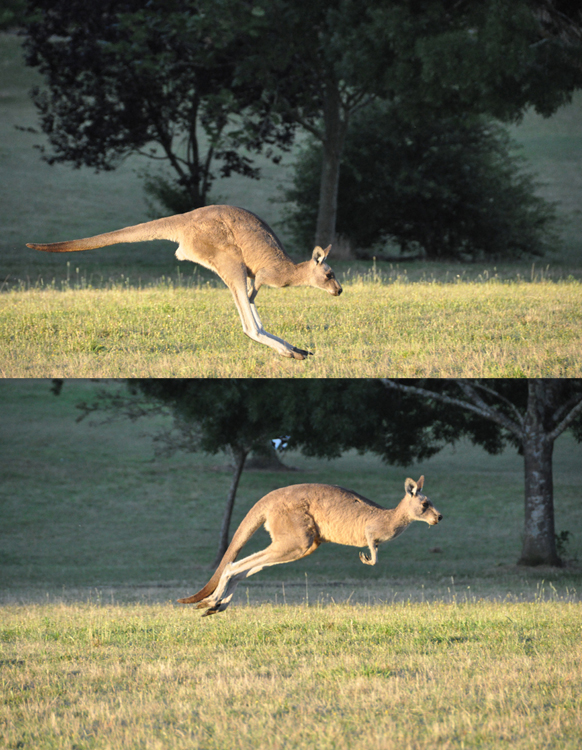
Such a large force (500 times more than the person’s weight) over the short impact time is enough to break bones. A much better way to cushion the shock is by bending the legs or rolling on the ground, increasing the time over which the force acts. A bending motion of 0.5 m this way yields a force 100 times smaller than in the example. A kangaroo's hopping shows this method in action. The kangaroo is the only large animal to use hopping for locomotion, but the shock in hopping is cushioned by the bending of its hind legs in each jump.( See Figure 3.)
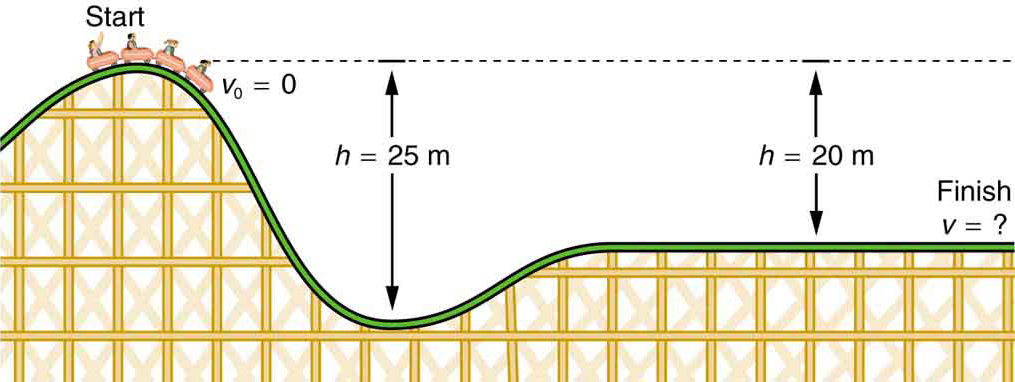
(a) What is the final speed of the roller coaster shown in Figure 3 if it starts from rest at the top of the 20.0 m hill and work done by frictional forces is negligible? (b) What is its final speed (again assuming negligible friction) if its initial speed is 5.00 m/s?
Strategy
The roller coaster loses potential energy as it goes downhill. We neglect friction, so that the remaining force exerted by the track is the normal force, which is perpendicular to the direction of motion and does no work. The net work on the roller coaster is then done by gravity alone. The loss of gravitational potential energy from moving downward through a distance$h$equals the gain in kinetic energy. This can be written in equation form as$-\Delta \PE_{\text{g}}=\Delta \KE$. Using the equations for$\PE_{\text{g}}$and$\KE$, we can solve for the final speed$v$, which is the desired quantity.
Solution for (a)
Here the initial kinetic energy is zero, so that$\Delta \KE=\frac{1}{2}m v^{2}$. The equation for change in potential energy states that$\Delta \PE_{\text{g}}=mgh$. Since$h$is negative in this case, we will rewrite this as$\Delta \PE_{\text{g}}=-mg \mid h\mid$to show the minus sign clearly. Thus,
becomes
Solving for$v$, we find that mass cancels and that
Substituting known values,
Solution for (b)
Again$-\Delta \PE_{\text{g}}=\Delta \KE$. In this case there is initial kinetic energy, so$\Delta \KE=\frac{1}{2}m v^{2}-\frac{1}{2}m v_{0}^{2}$. Thus,
Rearranging gives
This means that the final kinetic energy is the sum of the initial kinetic energy and the gravitational potential energy. Mass again cancels, and
This equation is very similar to the kinematics equation$v=\sqrt{ v_{0}^{2}+2ad}$, but it is more general—the kinematics equation is valid only for constant acceleration, whereas our equation above is valid for any path regardless of whether the object moves with a constant acceleration. Now, substituting known values gives
Discussion and Implications
First, note that mass cancels. This is quite consistent with observations made in Falling Objects that all objects fall at the same rate if friction is negligible. Second, only the speed of the roller coaster is considered; there is no information about its direction at any point. This reveals another general truth. When friction is negligible, the speed of a falling body depends only on its initial speed and height, and not on its mass or the path taken. For example, the roller coaster will have the same final speed whether it falls 20.0 m straight down or takes a more complicated path like the one in the figure. Third, and perhaps unexpectedly, the final speed in part (b) is greater than in part (a), but by far less than 5.00 m/s. Finally, note that speed can be found at any height along the way by simply using the appropriate value of$h$at the point of interest.
We have seen that work done by or against the gravitational force depends only on the starting and ending points, and not on the path between, allowing us to define the simplifying concept of gravitational potential energy. We can do the same thing for a few other forces, and we will see that this leads to a formal definition of the law of conservation of energy.
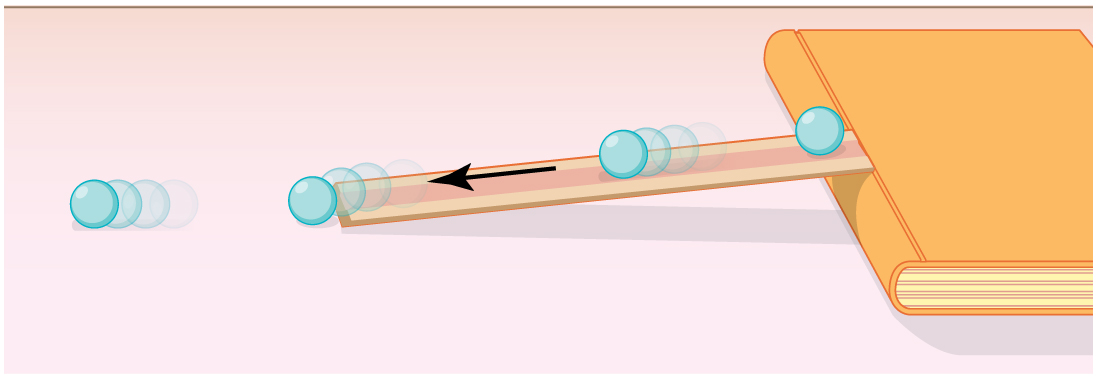
One can study the conversion of gravitational potential energy into kinetic energy in this experiment. On a smooth, level surface, use a ruler of the kind that has a groove running along its length and a book to make an incline (see Figure 5). Place a marble at the 10-cm position on the ruler and let it roll down the ruler. When it hits the level surface, measure the time it takes to roll one meter. Now place the marble at the 20-cm and the 30-cm positions and again measure the times it takes to roll 1 m on the level surface. Find the velocity of the marble on the level surface for all three positions. Plot velocity squared versus the distance traveled by the marble. What is the shape of each plot? If the shape is a straight line, the plot shows that the marble’s kinetic energy at the bottom is proportional to its potential energy at the release point.
In Example 2, we calculated the final speed of a roller coaster that descended 20 m in height and had an initial speed of 5 m/s downhill. Suppose the roller coaster had had an initial speed of 5 m/s uphill instead, and it coasted uphill, stopped, and then rolled back down to a final point 20 m below the start. We would find in that case that its final speed is the same as its initial speed. Explain in terms of conservation of energy.
Does the work you do on a book when you lift it onto a shelf depend on the path taken? On the time taken? On the height of the shelf? On the mass of the book?
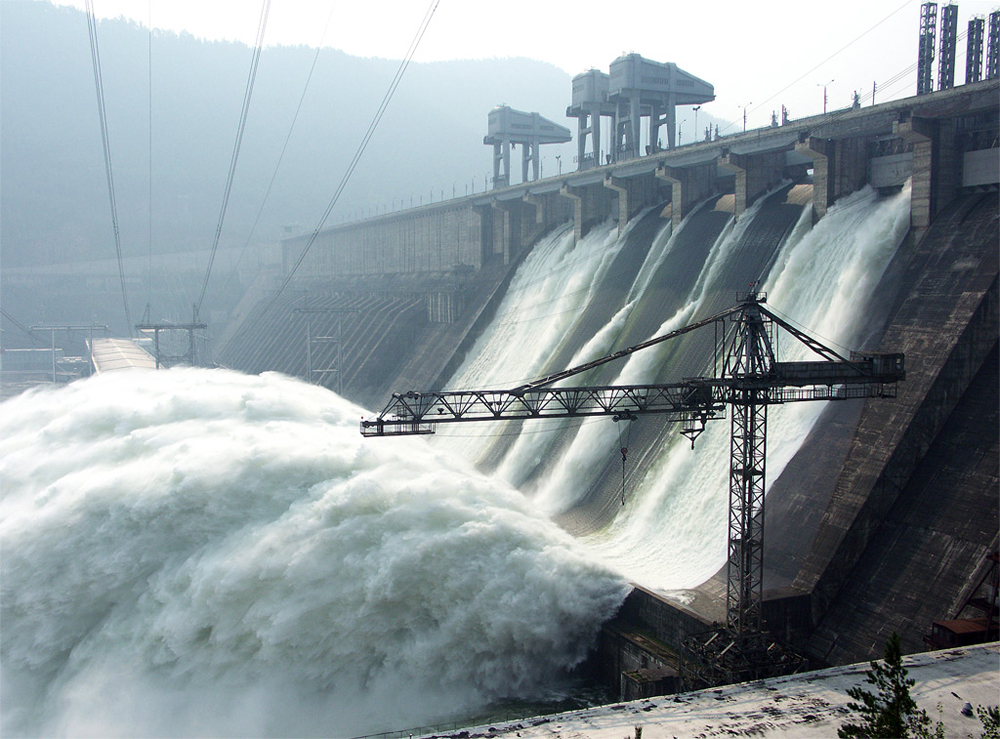
A hydroelectric power facility (see Figure 6) converts the gravitational potential energy of water behind a dam to electric energy. (a) What is the gravitational potential energy relative to the generators of a lake of volume $50.0 \text{km}^{3}$$\left( \text{mass}=5.00\times 10^{13}\kg \right)$, given that the lake has an average height of 40.0 m above the generators? (b) Compare this with the energy stored in a 9-megaton fusion bomb.
Strategy
(a) Use the gravitational potential energy formula$\PE_g = mgh$with the given mass and height. (b) Compare this to the energy of a 9-megaton fusion bomb, where 1 megaton TNT equivalent =$4.18 \times 10^{15}$J.
Solution
(a) Gravitational potential energy of the lake:
Given:
(b) Comparison with 9-megaton fusion bomb:
Energy in a 9-megaton bomb:
Ratio:
Discussion
The gravitational potential energy stored in this reservoir is enormous - about$2 \times 10^{16}$joules. This is approximately half the energy of a 9-megaton nuclear fusion bomb, which puts the scale of hydroelectric power into perspective. Unlike a bomb that releases its energy in an instant, hydroelectric facilities release this energy gradually over time, converting it to useful electrical power. A 50 km³ reservoir is quite large (for comparison, Lake Mead behind Hoover Dam holds about 35 km³), but the energy it stores demonstrates why hydroelectric power is such a significant energy source.
Answer
(a) The gravitational potential energy is$1.96 \times 10^{16}\text{ J}$.
(b) The ratio is 0.52, meaning the lake stores about half the energy of a 9-megaton fusion bomb.
(a) How much gravitational potential energy (relative to the ground on which it is built) is stored in the Great Pyramid of Cheops, given that its mass is about$7 \times 10^{9}\kg$ and its center of mass is 36.5 m above the surrounding ground? (b) How does this energy compare with the daily food intake of a person?
Strategy
For part (a), we use the gravitational potential energy formula$\PE\_{g} = mgh$, where$m$is the mass of the pyramid,$g = 9.80\mss$, and$h$is the height of the center of mass.
For part (b), we compare this energy to the typical daily food intake of about$1.2 \times 10^{7}\J$(or 2400 kcal).
Solution for (a)
Solution for (b)
The ratio of the pyramid’s potential energy to daily food intake is:
Discussion
The gravitational potential energy stored in the Great Pyramid is approximately$2.5 \times 10^{12}\J$, which is equivalent to about 210,000 days of food intake for one person, or roughly 575 years worth of food energy. This immense amount of potential energy was stored by doing work to lift millions of stone blocks to build the pyramid. The comparison with daily food intake helps illustrate the enormous amount of human labor that went into constructing this ancient monument over approximately 20 years.
Answer
(a) The gravitational potential energy of the Great Pyramid is$2.5 \times 10^{12}\text{ J}$.
(b) This energy is about 210,000 times the daily food intake of a person, equivalent to roughly 575 years of food energy.
Suppose a 350-g kookaburra (a large kingfisher bird) picks up a 75-g snake and raises it 2.5 m from the ground to a branch. (a) How much work did the bird do on the snake? (b) How much work did it do to raise its own center of mass to the branch?
Strategy
Work done against gravity equals the change in gravitational potential energy:$W = mgh$. Calculate separately for the snake and for the bird’s own mass.
Solution
Given:
(a) Work done on the snake:
(b) Work done to raise the bird’s center of mass:
Discussion
The bird does significantly more work lifting itself (8.6 J) than lifting the snake (1.8 J), even though the snake represents extra payload. The total work done is 10.4 J. This illustrates that for flying animals, the energy cost of carrying prey is relatively small compared to the energy needed for their own flight. The kookaburra, famous for eating snakes, must be strong enough to lift its own body weight repeatedly, and carrying a snake that’s about 21% of its body mass is a modest additional burden.
Answer
(a) The work done on the snake is 1.8 J.
(b) The work done to raise the bird’s center of mass is 8.6 J.
In Example 2, we found that the speed of a roller coaster that had descended 20.0 m was only slightly greater when it had an initial speed of 5.00 m/s than when it started from rest. This implies that$\Delta \PE \gg \KE_{\text{i}}$. Confirm this statement by taking the ratio of$\Delta \PE$ to$\KE_{\text{i}}$. (Note that mass cancels.)
Strategy
We calculate the change in potential energy$\Delta \PE = mg\mid h\mid$and the initial kinetic energy$\KE_{\text{i}} = \frac{1}{2}mv_{0}^{2}$, then find their ratio. The mass will cancel out.
Solution
The change in potential energy is:
The initial kinetic energy is:
The ratio is:
Discussion
The change in potential energy is approximately 16 times greater than the initial kinetic energy, confirming that$\Delta \PE \gg \KE\_{\text{i}}$. This explains why the final speed is only slightly greater when starting with an initial speed of 5.00 m/s compared to starting from rest—the gravitational potential energy converted to kinetic energy dominates over the initial kinetic energy. This result is important in many practical situations: when objects fall from significant heights, their initial velocity has little effect on the final velocity.
Answer
The ratio is 15.7 (approximately 16), confirming that$\Delta \PE \gg \KE_{\text{i}}$.
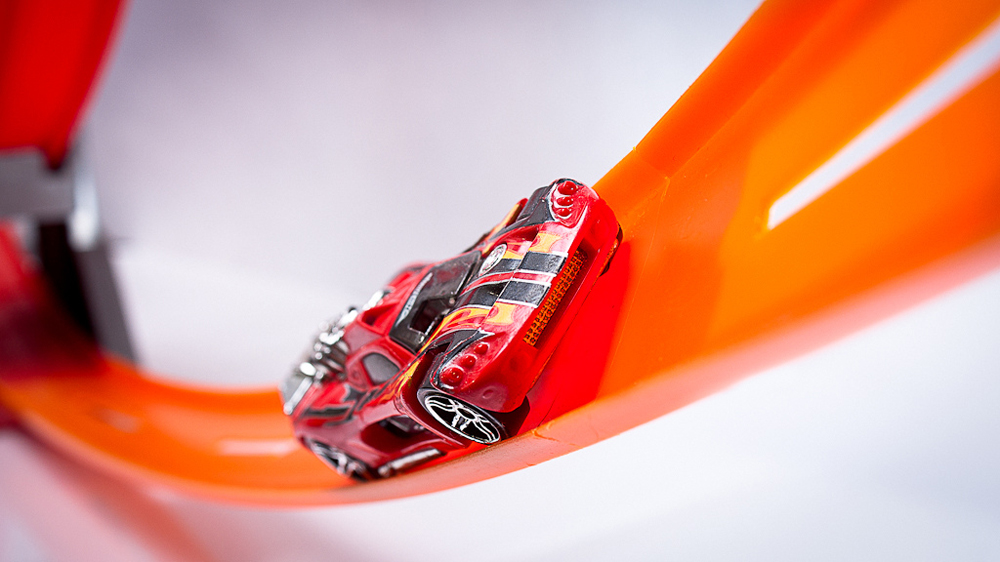
A 100-g toy car is propelled by a compressed spring that starts it moving. The car follows the curved track in Figure 7. Show that the final speed of the toy car is 0.687 m/s if its initial speed is 2.00 m/s and it coasts up the frictionless slope, gaining 0.180 m in altitude.
Strategy
Use conservation of mechanical energy for a frictionless surface. The initial kinetic energy plus initial gravitational potential energy equals the final kinetic energy plus final gravitational potential energy. Since the car goes up, it gains gravitational potential energy and loses kinetic energy.
Solution
Given:
Apply conservation of energy, taking the initial position as the reference level ($h_0 = 0$):
Divide by$m$and solve for$v_f$:
Discussion
The toy car slows from 2.00 m/s to 0.687 m/s as it climbs 0.180 m. Most of its initial kinetic energy (88%) is converted to gravitational potential energy at the top of the slope. This problem illustrates conservation of mechanical energy on a frictionless surface - the total mechanical energy (KE + PE) remains constant throughout the motion.
Answer
The final speed is$v_f = 0.687\ms$, as required.
In a downhill ski race, surprisingly, little advantage is gained by getting a running start. (This is because the initial kinetic energy is small compared with the gain in gravitational potential energy on even small hills.) To demonstrate this, find the final speed and the time taken for a skier who skies 70.0 m along a$30^\circ$ slope neglecting friction: (a) Starting from rest. (b) Starting with an initial speed of 2.50 m/s. (c) Does the answer surprise you? Discuss why it is still advantageous to get a running start in very competitive events.
Strategy
We use conservation of energy:$\KE_{\text{i}} + \PE_{\text{i}} = \KE_{\text{f}} + \PE_{\text{f}}$. The height descended is$h = d\sin{\theta} = (70.0\m)\sin{30^\circ} = 35.0\m$. For the time, we use kinematics with constant acceleration$a = g\sin{\theta}$down the slope.
Solution for (a)
Starting from rest ($v\_{0} = 0$):
For time, using$v^{2} = v\_{0}^{2} + 2ad$with$a = g\sin{30^\circ} = 4.90\mss$:
Solution for (b)
With initial speed$v\_{0} = 2.50\ms$:
For time, using$v = v\_{0} + at$:
Discussion for (c)
The answer is somewhat surprising—the final speeds differ by only 0.1 m/s! The running start saves only about 0.5 seconds. However, in very competitive events, even a fraction of a second can mean the difference between winning and losing. Additionally, in actual skiing, friction and air resistance play important roles, and starting with higher speed may provide advantages in maintaining momentum through turns and rough sections of the course. The small difference in final speeds confirms the statement that$\Delta \PE \gg \KE_{\text{i}}$for the descent.
Answer
(a) Starting from rest: final speed = 26.2 m/s, time = 5.35 s
(b) Starting with initial speed of 2.50 m/s: final speed = 26.3 m/s, time = 4.86 s
(c) The results are surprising because the running start provides only a 0.1 m/s advantage in final speed and saves just 0.5 seconds. However, this time difference can be crucial in competitive racing, and other factors like maintaining momentum through friction and turns also favor a running start.