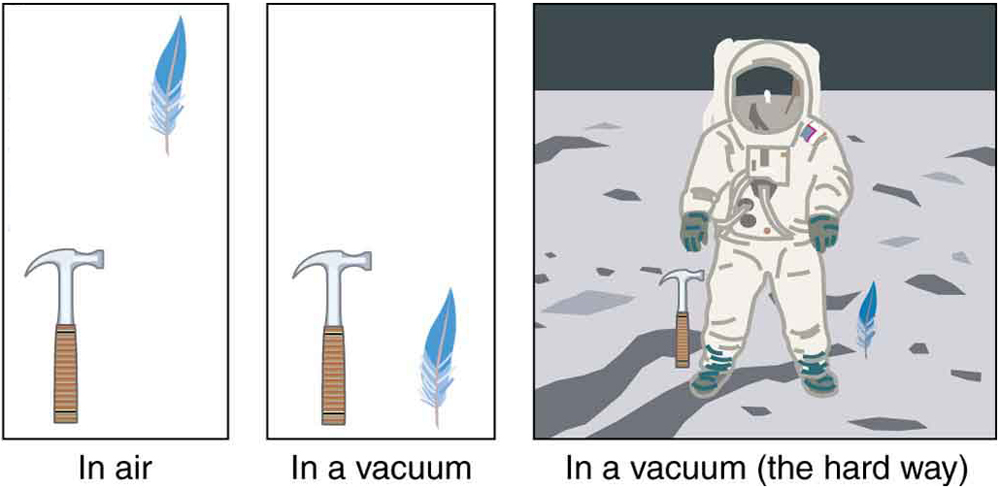
Falling objects form an interesting class of motion problems. For example, we can estimate the depth of a vertical mine shaft by dropping a rock into it and listening for the rock to hit the bottom. By applying the kinematics developed so far to falling objects, we can examine some interesting situations and learn much about gravity in the process.
The most remarkable and unexpected fact about falling objects is that, if air resistance and friction are negligible, then in a given location all objects fall toward the center of Earth with the same constant acceleration, independent of their mass. This experimentally determined fact is unexpected, because we are so accustomed to the effects of air resistance and friction that we expect light objects to fall slower than heavy ones.
In the real world, air resistance can cause a lighter object to fall slower than a heavier object of the same size. A tennis ball will reach the ground after a hard baseball dropped at the same time. (It might be difficult to observe the difference if the height is not large.) Air resistance opposes the motion of an object through the air, while friction between objects—such as between clothes and a laundry chute or between a stone and a pool into which it is dropped—also opposes motion between them. For the ideal situations of these first few chapters, an object falling without air resistance or friction is defined to be in free-fall.
The force of gravity causes objects to fall toward the center of Earth. The acceleration of free-falling objects is therefore called the acceleration due to gravity. The acceleration due to gravity is constant, which means we can apply the kinematics equations to any falling object where air resistance and friction are negligible. This opens a broad class of interesting situations to us. The acceleration due to gravity is so important that its magnitude is given its own symbol, $g$. It is constant at any given location on Earth and has the average value
Although $g$ varies from $9.78 \mss$ to $9.83 \mss$, depending on latitude, altitude, underlying geological formations, and local topography, the average value of $9.80 \mss$ will be used in this text unless otherwise specified. The direction of the acceleration due to gravity is downward ( towards the center of Earth). In fact, its direction defines what we call vertical. Note that whether the acceleration $a$ in the kinematic equations has the value $+g$ or $-g$ depends on how we define our coordinate system. If we define the upward direction as positive, then $a=-g=-9.80 \mss$, and if we define the downward direction as positive, then $a=g=9.80 \mss$.
The best way to see the basic features of motion involving gravity is to start with the simplest situations and then progress toward more complex ones. So we start by considering straight up and down motion with no air resistance or friction. These assumptions mean that the velocity (if there is any) is vertical. If the object is dropped, we know the initial velocity is zero. Once the object has left contact with whatever held or threw it, the object is in free-fall. Under these circumstances, the motion is one-dimensional and has constant acceleration of magnitude $g$. We will also represent vertical displacement with the symbol $y$ and use $x$ for horizontal displacement.
A person standing on the edge of a high cliff throws a rock straight up with an initial velocity of 13.0 m/s. The rock misses the edge of the cliff as it falls back to earth. Calculate the position and velocity of the rock 1.00 s, 2.00 s, and 3.00 s after it is thrown, neglecting the effects of air resistance.
Strategy
Draw a sketch.
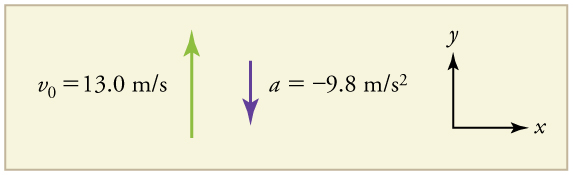
We are asked to determine the position $y$ at various times. It is reasonable to take the initial position $y_{0}$ to be zero. This problem involves one-dimensional motion in the vertical direction. We use plus and minus signs to indicate direction, with up being positive and down negative. Since up is positive, and the rock is thrown upward, the initial velocity must be positive too. The acceleration due to gravity is downward, so $a$ is negative. It is crucial that the initial velocity and the acceleration due to gravity have opposite signs. Opposite signs indicate that the acceleration due to gravity opposes the initial motion and will slow and eventually reverse it.
Since we are asked for values of position and velocity at three times, we will refer to these as $y_{1}$ and $v_{1}$; $y_{2}$ and $v_{2}$; and $y_{3}$ and $v_{3}$.
Solution for Position $y_{1}$
1. Identify the knowns. We know that $y_{0}=0$; $v_{0}=13.0 \ms$; $a=-g=-9.80 \mss$; and $t=1.00 \s$.
2. Identify the best equation to use. We will use $y=y_{0}+v_{0}t+\frac{1}{2} at^{2}$ because it includes only one unknown, $y$ (or $y_{1}$, here), which is the value we want to find.
3. Plug in the known values and solve for $y_{1}$.
Discussion
The rock is 8.10 m above its starting point at $t=1.00 \s$, since $y_{1}> y_{0}$. It could be moving up or down; the only way to tell is to calculate $v_{1}$ and find out if it is positive or negative. Solution for Velocity $v_{1}$
1. Identify the knowns. We know that $y_{0}=0$; $v_{0}=13.0 \ms$; $a=-g=-9.80 \mss$; and $t=1.00 \s$. We also know from the solution above that $y_{1}=8.10 \m$.
2. Identify the best equation to use. The most straightforward is $v=v_{0}-gt$ (from $v=v\_{0}+at$, where $a=\text{gravitational acceleration}=-g$).
3. Plug in the knowns and solve.
Discussion
The positive value for $v\_{1}$ means that the rock is still heading upward at $t=1.00\s$. However, it has slowed from its original 13.0** m/s, as expected.
Solution for Remaining Times
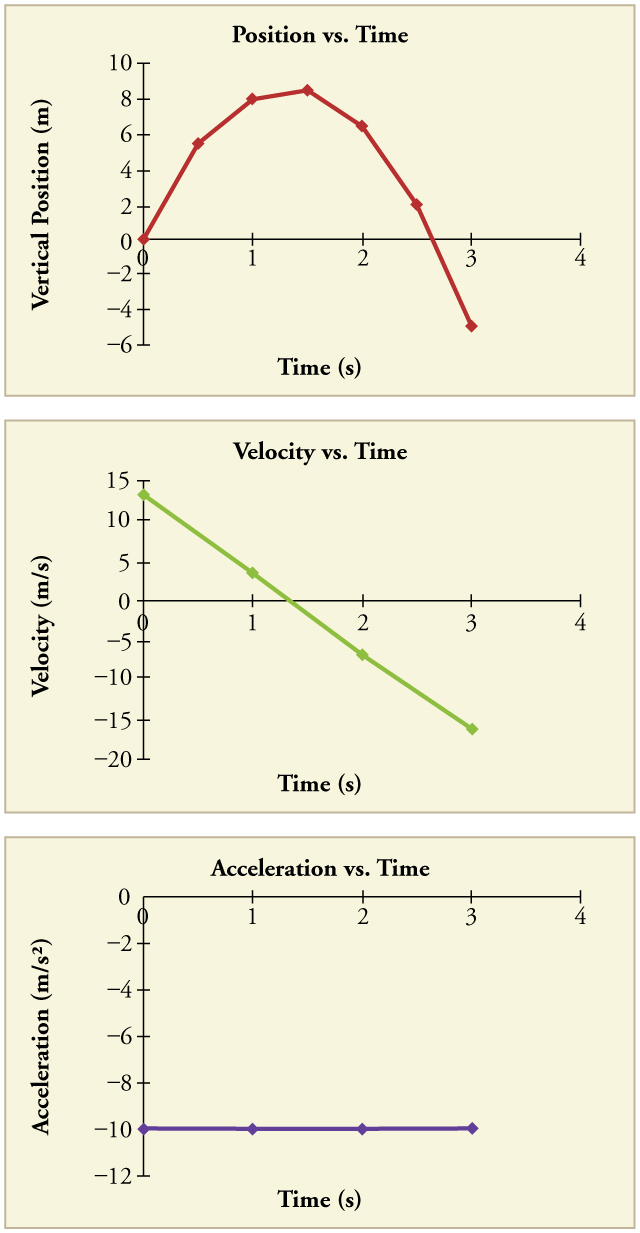
The procedures for calculating the position and velocity at $t=2.00\s$ and $3.00 \s$ are the same as those above. The results are summarized in Table 1 and illustrated in Figure 3.
| Time, t | Position, y | Velocity, v | Acceleration, a |
|---|---|---|---|
| $1.00 \s$ | $8.10 \m$ | $3.20 \ms$ | $-9.80 \mss$ |
| $2.00 \s$ | $6.40 \m$ | $-6.60 \ms$ | $-9.80 \mss$ |
| $3.00 \s$ | $-5.10 \m$ | $-16.4 \ms$ | $-9.80 \mss$ |
Graphing the data helps us understand it more clearly.
Discussion
The interpretation of these results is important. At 1.00 s the rock is above its starting point and heading upward, since $y_{1}$ and $v_{1}$ are both positive. At 2.00 s, the rock is still above its starting point, but the negative velocity means it is moving downward. At 3.00 s, both $y_{3}$ and $v_{3}$ are negative, meaning the rock is below its starting point and continuing to move downward. Notice that when the rock is at its highest point ( at 1.3 s), its velocity is zero, but its acceleration is still $-9.80 \mss$. Its acceleration is $-9.80 \mss$ for the whole trip—while it is moving up and while it is moving down. Note that the values for $y$ are the positions (or displacements) of the rock, not the total distances traveled. Finally, note that free-fall applies to upward motion as well as downward. Both have the same acceleration—the acceleration due to gravity, which remains constant the entire time. Astronauts training in the famous Vomit Comet, for example, experience free-fall while arcing up as well as down, as we will discuss in more detail later.
A simple experiment can be done to determine your reaction time. Have a friend hold a ruler between your thumb and index finger, separated by about 1 cm. Note the mark on the ruler that is right between your fingers. Have your friend drop the ruler unexpectedly, and try to catch it between your two fingers. Note the new reading on the ruler. Assuming acceleration is that due to gravity, calculate your reaction time. How far would you travel in a car (moving at 30 m/s) if the time it took your foot to go from the gas pedal to the brake was twice this reaction time?
What happens if the person on the cliff throws the rock straight down, instead of straight up? To explore this question, calculate the velocity of the rock when it is 5.10 m below the starting point, and has been thrown downward with an initial speed of 13.0 m/s.
Strategy
Draw a sketch.
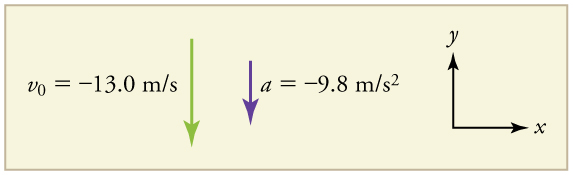
Since up is positive, the final position of the rock will be negative because it finishes below the starting point at $y\_{0}=0$. Similarly, the initial velocity is downward and therefore negative, as is the acceleration due to gravity. We expect the final velocity to be negative since the rock will continue to move downward.
Solution
1. Identify the knowns. $y_{0}=0$; $y_{1}=-5.10 \m$; $v\_{0}=-13.0 \ms$; $a=-g=-9.80 \mss$.
2. Choose the kinematic equation that makes it easiest to solve the problem. The equation $v^{2}=v_{0}^{2}+2a\left(y-y_{0}\right)$ works well because the only unknown in it is $v$. (We will plug $y\_{1}$ in for $y$.)
3. Enter the known values
where we have retained extra significant figures because this is an intermediate result.
Taking the square root, and noting that a square root can be positive or negative, gives
The negative root is chosen to indicate that the rock is still heading down. Thus,
Discussion
Note that this is exactly the same velocity the rock had at this position when it was thrown straight upward with the same initial speed. ( See Example 1 and Figure 5(a).) This is not a coincidental result. Because we only consider the acceleration due to gravity in this problem, the speed of a falling object depends only on its initial speed and its vertical position relative to the starting point. For example, if the velocity of the rock is calculated at a height of 8.10 m above the starting point (using the method from Example 1) when the initial velocity is 13.0 m/s straight up, a result of $\pm 3.20 \ms$ is obtained. Here both signs are meaningful; the positive value occurs when the rock is at 8.10 m and heading up, and the negative value occurs when the rock is at 8.10 m and heading back down. It has the same speed but the opposite direction.
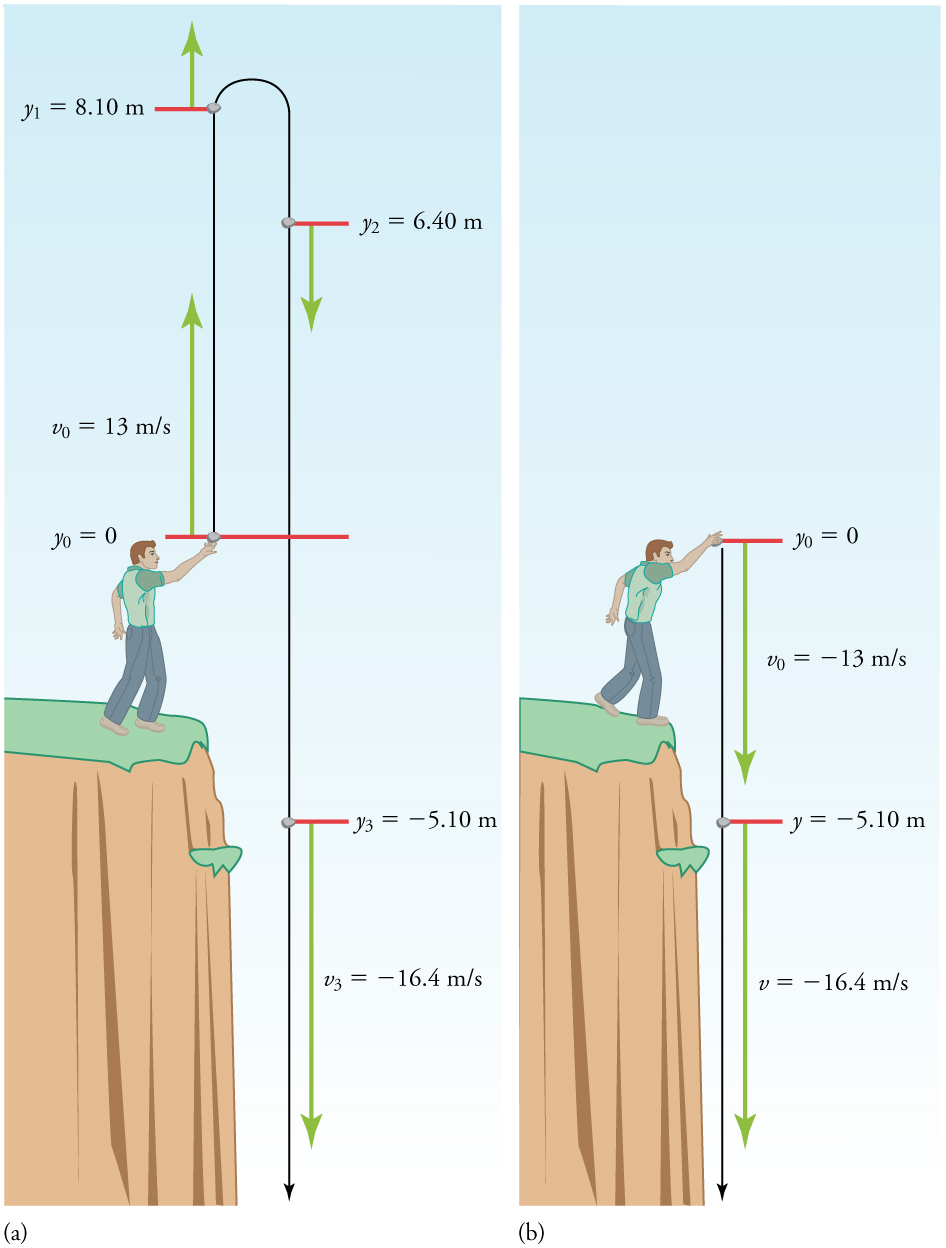
Another way to look at it is this: In Example 1, the rock is thrown up with an initial velocity of $13.0 \ms$. It rises and then falls back down. When its position is $y=0$ on its way back down, its velocity is $-13.0 \ms$. That is, it has the same speed on its way down as on its way up. We would then expect its velocity at a position of $y=-5.10 \m$ to be the same whether we have thrown it upwards at $+13.0 \ms$ or thrown it downwards at $-13.0 \ms$. The velocity of the rock on its way down from $y=0$ is the same whether we have thrown it up or down to start with, as long as the speed with which it was initially thrown is the same.
The acceleration due to gravity on Earth differs slightly from place to place, depending on topography (e.g., whether you are on a hill or in a valley) and subsurface geology (whether there is dense rock like iron ore as opposed to light rock like salt beneath you.) The precise acceleration due to gravity can be calculated from data taken in an introductory physics laboratory course. An object, usually a metal ball for which air resistance is negligible, is dropped and the time it takes to fall a known distance is measured. See, for example, Figure 6. Very precise results can be produced with this method if sufficient care is taken in measuring the distance fallen and the elapsed time.
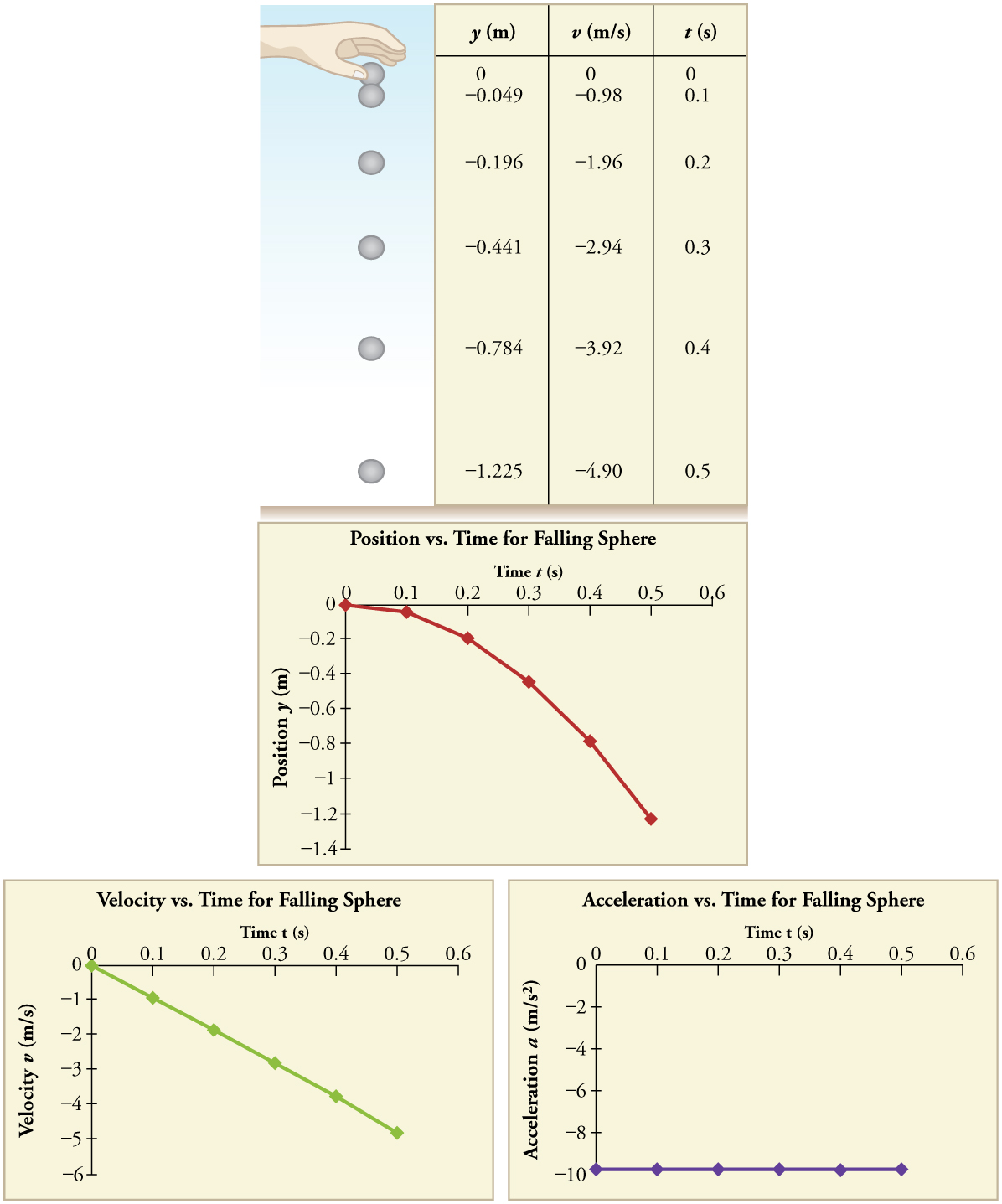
Suppose the ball falls 1.0000 m in 0.45173 s. Assuming the ball is not affected by air resistance, what is the precise acceleration due to gravity at this location?
Strategy
Draw a sketch.
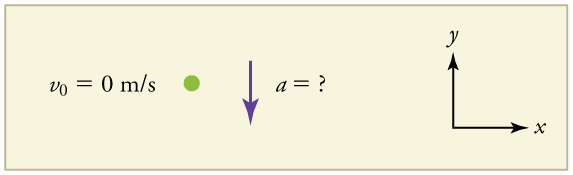
We need to solve for acceleration $a$. Note that in this case, displacement is downward and therefore negative, as is acceleration.
Solution
1. Identify the knowns. $y_{0}=0$; $y=-1.0000 \m$; $t=0.45173 \s$; $v_{0}=0$.
2. Choose the equation that allows you to solve for $a$ using the known values.
3. Substitute 0 for $v_{0}$ and rearrange the equation to solve for $a$. Substituting 0 for $v_{0}$ yields
Solving for $a$ gives
4. Substitute known values yields
so, because $a=-g$ with the directions we have chosen,
Discussion
The negative value for $a$ indicates that the gravitational acceleration is downward, as expected. We expect the value to be somewhere around the average value of $9.80 \mss$, so $9.8010 \mss$ makes sense. Since the data going into the calculation are relatively precise, this value for $g$ is more precise than the average value of $9.80 \mss$; it represents the local value for the acceleration due to gravity.
A chunk of ice breaks off a glacier and falls 30.0 meters before it hits the water. Assuming it falls freely (there is no air resistance), how long does it take to hit the water?
We know that initial position $y_{0}=0$, final position $y=−30.0 \text {m}$, and $a=-g=-9.80 \mss$. We can then use the equation $y=y_{0}+v_{0}t+\frac{1}{2}a t^{2}$ to solve for $t$. Inserting $a=-g$, we obtain
where we take the positive value as the physically relevant answer. Thus, it takes about 2.5 seconds for the piece of ice to hit the water.
The three kinematic variables, position, velocity, and acceleration are all related. See how they evolve graphically.
On Earth, all free-falling objects have an acceleration due to gravity $g$
, which averages
What is the acceleration of a rock thrown straight upward on the way up? At the top of its flight? On the way down?
An object that is thrown straight up falls back to Earth. This is one-dimensional motion. (a) When is its velocity zero? (b) Does its velocity change direction? (c) Does the acceleration due to gravity have the same sign on the way up as on the way down?
Suppose you throw a rock nearly straight up at a coconut in a palm tree, and the rock misses on the way up but hits the coconut on the way down. Neglecting air resistance, how does the speed of the rock when it hits the coconut on the way down compare with what it would have been if it had hit the coconut on the way up? Is it more likely to dislodge the coconut on the way up or down? Explain.
If an object is thrown straight up and air resistance is negligible, then its speed when it returns to the starting point is the same as when it was released. If air resistance were not negligible, how would its speed upon return compare with its initial speed? How would the maximum height to which it rises be affected?
The severity of a fall depends on your speed when you strike the ground. All factors but the acceleration due to gravity being the same, how many times higher could a safe fall on the Moon be than on Earth (gravitational acceleration on the Moon is about 1/6 that of the Earth)?
How many times higher could an astronaut jump on the Moon than on Earth if his takeoff speed is the same in both locations (gravitational acceleration on the Moon is about 1/6 of $g$ on Earth)?
Assume air resistance is negligible unless otherwise stated.
Calculate the displacement and velocity at times of (a) 0.500, (b) 1.00, (c) 1.50, and (d) 2.00 s for a ball thrown straight up with an initial velocity of 15.0 m/s. Take the point of release to be $y_{0}=0$.
Strategy
Use the kinematic equations for free-fall with upward as positive. Since the ball is thrown upward, the initial velocity is positive, while the acceleration due to gravity is negative ($a = -g = -9.80 \mss$).
Solution
For position: $y = y_0 + v_0 t + \frac{1}{2}at^2 = v_0 t - \frac{1}{2}gt^2$
For velocity: $v = v_0 + at = v_0 - gt$
(a) At t = 0.500 s:
(b) At t = 1.00 s:
(c) At t = 1.50 s:
(d) At t = 2.00 s:
Discussion
At t = 1.50 s, the velocity is nearly zero, indicating the ball is near its maximum height. The negative velocity at t = 2.00 s confirms the ball is now moving downward.
(a) At 0.500 s, the ball is at $y_1 = 6.28 \m$ with velocity $v_1 = 10.1 \ms$ upward.
(b) At 1.00 s, the ball is at $y_2 = 10.1 \m$ with velocity $v_2 = 5.20 \ms$ upward.
(c) At 1.50 s, the ball is at $y_3 = 11.5 \m$ with velocity $v_3 = 0.300 \ms$ upward.
(d) At 2.00 s, the ball is at $y_4 = 10.4 \m$ with velocity $v_4 = 4.60 \ms$ downward.
Calculate the displacement and velocity at times of (a) 0.500, (b) 1.00, (c) 1.50, (d) 2.00, and (e) 2.50 s for a rock thrown straight down with an initial velocity of 14.0 m/s from the Verrazano Narrows Bridge in New York City. The roadway of this bridge is 70.0 m above the water.
Strategy
Take downward as positive since the rock is thrown downward. This means the initial velocity $v_0 = +14.0 \ms$ and $a = +g = +9.80 \mss$. Set $y_0 = 0$ at the bridge.
Solution
For position: $y = y_0 + v_0 t + \frac{1}{2}gt^2 = v_0 t + \frac{1}{2}gt^2$
For velocity: $v = v_0 + gt$
(a) At t = 0.500 s:
(b) At t = 1.00 s:
(c) At t = 1.50 s:
(d) At t = 2.00 s:
(e) At t = 2.50 s:
Discussion
At 2.50 s, the rock has fallen 65.6 m, which is still above the water (70.0 m below the bridge). The rock continues to accelerate as it falls.
(a) At 0.500 s: displacement = 8.23 m, velocity = 18.9 m/s downward.
(b) At 1.00 s: displacement = 18.9 m, velocity = 23.8 m/s downward.
(c) At 1.50 s: displacement = 32.0 m, velocity = 28.7 m/s downward.
(d) At 2.00 s: displacement = 47.6 m, velocity = 33.6 m/s downward.
(e) At 2.50 s: displacement = 65.6 m, velocity = 38.5 m/s downward.
A basketball referee tosses the ball straight up for the starting tip-off. At what minimum velocity must a basketball player leave the ground to rise 1.25 m above the floor in an attempt to get the ball?
Strategy
At the maximum height, the player’s velocity is zero. We can use the kinematic equation relating velocity, displacement, and acceleration to find the initial velocity needed to reach 1.25 m.
Solution
Discussion
This is a reasonable jumping speed for an athlete. The calculation shows that to reach a height of 1.25 m, a player must leave the ground with a velocity of about 5 m/s (approximately 18 km/h).
The basketball player must leave the ground with a minimum velocity of $4.95 \ms$ (about 5.0 m/s) to rise 1.25 m above the floor.
A rescue helicopter is hovering over a person whose boat has sunk. One of the rescuers throws a life preserver straight down to the victim with an initial velocity of 1.40 m/s and observes that it takes 1.8 s to reach the water. (a) List the knowns in this problem. (b) How high above the water was the preserver released? Note that the downdraft of the helicopter reduces the effects of air resistance on the falling life preserver, so that an acceleration equal to that of gravity is reasonable.
Strategy
Take downward as positive since the preserver is thrown downward. Use the kinematic equation for displacement.
Solution
(a) Known values:
(b) Height above water:
Use the kinematic equation:
Substitute the known values:
Discussion
The helicopter was hovering about 18 meters above the water. This is a reasonable height for a rescue operation, allowing the crew to see the victim while staying clear of the water.
(a) The knowns are: $v_0 = 1.40 \ms$, $t = 1.8 \s$, $a = g = 9.80 \mss$, and $y_0 = 0$.
(b) The life preserver was released from a height of approximately $18 \m$ above the water.
A dolphin in an aquatic show jumps straight up out of the water at a velocity of 13.0 m/s. (a) List the knowns in this problem. (b) How high does his body rise above the water? To solve this part, first note that the final velocity is now a known and identify its value. Then identify the unknown, and discuss how you chose the appropriate equation to solve for it. After choosing the equation, show your steps in solving for the unknown, checking units, and discuss whether the answer is reasonable. (c) How long is the dolphin in the air? Neglect any effects due to his size or orientation.
(a) $a=-9.80 \mss$; $v_{0}=13.0 \ms$; $y_{0}=0 \m$ (b) $v=0 \ms$. Unknown is distance $y$ to top of trajectory, where velocity is zero. Use equation $v^{2}=v_{0}^{2}+2a\left(y-y_{0}\right)$ because it contains all known values except for $y$, so we can solve for $y$. Solving for $y$ gives
Dolphins measure about 2 meters long and can jump several times their length out of the water, so this is a reasonable result.
(c) $2.65 \s$
A swimmer bounces straight up from a diving board and falls feet first into a pool. She starts with a velocity of 4.00 m/s, and her takeoff point is 1.80 m above the pool. (a) How long are her feet in the air? (b) What is her highest point above the board? (c) What is her velocity when her feet hit the water?
Strategy
Take upward as positive. The swimmer launches upward from the diving board with initial velocity $v_0 = 4.00 \ms$, reaches a maximum height, then falls through the air until her feet hit the water 1.80 m below the starting point. Use $g = 9.80 \mss$ for the acceleration due to gravity.
Solution
(a) Time in the air:
Rearranging into standard quadratic form:
Taking the positive root:
(b) Highest point above the board:
At maximum height, velocity equals zero: $v = 0$
Use the kinematic equation:
(c) Velocity when feet hit the water:
Use the kinematic equation relating velocity, displacement, and acceleration:
Substitute known values:
Taking the negative root (downward motion):
Discussion
The swimmer is in the air for about 1.1 seconds, which is reasonable for a dive. She rises 0.816 m (about 82 cm) above the board before falling. Her final velocity of 7.16 m/s downward is greater in magnitude than her initial upward velocity because she falls through a greater distance (1.80 m) than she rises (0.82 m). The symmetry of projectile motion would give her a velocity of -4.00 m/s when passing the board on the way down; the additional 1.80 m of fall increases her speed further.
Answer
(a) The swimmer’s feet are in the air for $1.14 \s$.
(b) The highest point above the board is $0.816 \m$ (or about 81.6 cm).
(c) Her velocity when her feet hit the water is $7.16 \ms$ downward.
(a) Calculate the height of a cliff if it takes 2.35 s for a rock to hit the ground when it is thrown straight up from the cliff with an initial velocity of 8.00 m/s. (b) How long would it take to reach the ground if it is thrown straight down with the same speed?
Strategy
Take upward as positive. The rock is thrown upward, goes up, then comes back down past the cliff and hits the ground below. The final position is negative (below the starting point).
Solution
(a) Height of the cliff:
The negative sign indicates the ground is 8.26 m below the cliff top.
(b) Time if thrown straight down:
Rearranging: $4.90t^2 + 8.00t - 8.26 = 0$
Taking the positive root: $t = \frac{-8.00 + 15.03}{9.80} = 0.717 \s$
Discussion
When thrown downward, the rock takes much less time (0.717 s vs. 2.35 s) because it doesn’t have to go up first and then come back down.
(a) The cliff is $8.26 \m$ high.
(b) If thrown straight down with the same speed, it takes $0.717 \s$ to reach the ground.
A very strong, but inept, shot putter puts the shot straight up vertically with an initial velocity of 11.0 m/s. How long does he have to get out of the way if the shot was released at a height of 2.20 m, and he is 1.80 m tall?
Strategy
Take upward as positive. The shot is released at height 2.20 m with initial upward velocity of 11.0 m/s. The shot putter is 1.80 m tall, so his head is at 1.80 m. We need to find when the shot returns to this height on its way back down. Use $g = 9.80 \mss$ for the acceleration due to gravity.
Solution
Rearranging:
Rearranging into standard quadratic form:
This gives two solutions:
Discussion
The negative time solution represents when the shot would have been at head height before being released (if we extended the trajectory backward in time), which is not physically relevant. The positive solution of 2.28 s is the time when the shot passes his head height on the way back down. This gives him just over 2 seconds to move out of the way after releasing the shot - not much time! The shot goes up, reaches a maximum height above his release point, then comes back down and passes head level at 2.28 s.
Answer
The shot putter has $2.28 \s$ (about 2.3 seconds) to get out of the way before the shot comes back down to head level.
You throw a ball straight up with an initial velocity of 15.0 m/s. It passes a tree branch on the way up at a height of 7.00 m. How much additional time will pass before the ball passes the tree branch on the way back down?
Strategy
Take upward as positive. The ball passes the tree branch twice: once on the way up and once on the way down. We need to find both times when the ball is at height 7.00 m, then calculate the difference between these times.
Solution
Given:
Discussion
The ball passes the tree branch at 0.575 s on its way up and again at 2.49 s on its way down, giving an additional time of 1.91 s. This result makes sense because of the symmetry of projectile motion: the ball takes the same amount of time to go from the branch to its maximum height as it does to fall from maximum height back to the branch. Since the ball reaches its maximum height at $t = \frac{v_0}{g} = \frac{15.0}{9.80} = 1.53 \s$, the time from the first branch crossing to the peak is $1.53 - 0.575 = 0.96 \s$, and from the peak back to the branch is another 0.96 s, giving a total of 1.91 s. This symmetry is a fundamental property of motion under constant acceleration.
Answer
The ball will pass the tree branch on the way down 1.91 s after passing it on the way up.
A kangaroo can jump over an object 2.50 m high. (a) Calculate its vertical speed when it leaves the ground. (b) How long is it in the air?
Strategy
Take upward as positive. The kangaroo leaves the ground with some initial velocity, reaches a maximum height of 2.50 m where its velocity becomes zero, then returns to the ground. Use $g = 9.80 \mss$ for the acceleration due to gravity.
Solution
(a) Vertical speed when leaving the ground:
(b) Time in the air:
Method 1: Use the velocity equation to find time to reach maximum height, then double it.
Discussion
A takeoff speed of 7.00 m/s (about 25 km/h) is quite impressive for an animal jump. The kangaroo can clear a 2.50 m obstacle, which is taller than most humans. The total air time of 1.43 seconds is reasonable - the kangaroo spends about 0.71 seconds going up and 0.71 seconds coming down. This symmetric motion is characteristic of free-fall under constant gravitational acceleration.
Answer
(a) The kangaroo leaves the ground with a vertical speed of $7.00 \ms$.
(b) The kangaroo is in the air for $1.43 \s$ (about 1.4 seconds).
Standing at the base of one of the cliffs of Mt. Arapiles in Victoria, Australia, a hiker hears a rock break loose from a height of 105 m. He can’t see the rock right away but then does, 1.50 s later. (a) How far above the hiker is the rock when he can see it? (b) How much time does he have to move before the rock hits his head?
Strategy
Take downward as positive. The rock falls from rest at height 105 m. After 1.50 s, the hiker can see it. We need to find where the rock is at that time, and then how long it takes to fall the remaining distance.
Solution
(a) Height of rock when hiker sees it:
(b) Time remaining before impact:
Taking the positive root:
Discussion
The rock falls 11.0 m in the first 1.50 seconds, leaving it 94.0 m above the hiker when he first sees it. This is reasonable since falling objects don’t travel very far in the first second or two. The hiker then has 3.13 seconds to move out of the way - enough time to react if he’s alert, but not much margin for error! The total fall time is $1.50 + 3.13 = 4.63 \s$. This problem illustrates the importance of staying alert near cliffs and the accelerating nature of falling objects.
Answer
(a) When the hiker first sees the rock, it is 94.0 m above him.
(b) He has 3.13 s to move before the rock hits his head.
An object is dropped from a height of 75.0 m above ground level. (a) Determine the distance traveled during the first second. (b) Determine the final velocity at which the object hits the ground. (c) Determine the distance traveled during the last second of motion before hitting the ground.
Strategy
Take downward as positive since the object is dropped and falls downward. The initial velocity is zero (dropped, not thrown). Use $g = 9.80 \mss$ for the acceleration due to gravity.
Solution
(a) Distance traveled during the first second:
(b) Final velocity when hitting the ground:
(c) Distance traveled during the last second:
First, find the total time to fall 75.0 m:
Discussion
The object falls only 4.90 m in the first second but travels 33.5 m in the last second - nearly 7 times as far! This illustrates how falling objects accelerate continuously. The final velocity of 38.3 m/s (about 138 km/h or 86 mph) is quite fast, which explains why falling from such heights is dangerous. The asymmetry between the first and last seconds demonstrates that the object is continuously gaining speed as it falls.
Answer
(a) The object travels $4.90 \m$ during the first second.
(b) The final velocity when hitting the ground is $38.3 \ms$ (downward).
(c) The object travels $33.5 \m$ during the last second of motion before hitting the ground.
There is a 250-m-high cliff at Half Dome in Yosemite National Park in California. Suppose a boulder breaks loose from the top of this cliff. (a) How fast will it be going when it strikes the ground? (b) Assuming a reaction time of 0.300 s, how long will a tourist at the bottom have to get out of the way after hearing the sound of the rock breaking loose (neglecting the height of the tourist, which would become negligible anyway if hit)? The speed of sound is 335 m/s on this day.
Strategy
Take downward as positive. The boulder falls from rest from a height of 250 m. For part (a), we find the impact velocity. For part (b), we must account for the time it takes for the boulder to fall, plus the time for sound to travel back up, plus the reaction time. Use $g = 9.80 \mss$ for the acceleration due to gravity.
Solution
(a) Velocity when striking the ground:
Taking the coordinate system with upward as positive (more conventional):
(b) Time available to move:
Discussion
The boulder strikes the ground at 70.0 m/s (about 252 km/h or 157 mph), which is extremely fast and dangerous. For part (b), the tourist hears the sound 0.746 seconds after the boulder hits, meaning they must move before hearing the impact! By the time sound travels from the top of the cliff to the bottom (0.746 s) and the tourist reacts (0.300 s), about 1.05 seconds have elapsed. Since the boulder takes 7.14 s to fall, the tourist actually has about 6.10 seconds from when the rock breaks to when it hits. This problem illustrates an important safety consideration: at cliffs, you cannot rely on hearing falling rocks as a warning system since sound takes time to travel.
Answer
(a) The boulder will be traveling at 70.0 m/s downward (or -70.0 m/s with upward positive) when it strikes the ground.
(b) The tourist has 6.10 s to get out of the way.
A ball is thrown straight up. It passes a 2.00-m-high window 7.50 m off the ground on its path up and takes 0.312 s to go past the window. What was the ball’s initial velocity? Hint: First consider only the distance along the window, and solve for the ball’s velocity at the bottom of the window. Next, consider only the distance from the ground to the bottom of the window, and solve for the initial velocity using the velocity at the bottom of the window as the final velocity.
Strategy
Take upward as positive. We’ll solve this in two steps as suggested by the hint:
Solution
Step 1: Find velocity at the bottom of the window
The window is 2.00 m high and the ball takes 0.312 s to pass through it.
Step 2: Find initial velocity from ground to bottom of window
The bottom of the window is 7.50 m above the ground.
Discussion
The ball was thrown with an initial velocity of 14.5 m/s. By the time it reaches the bottom of the window at 7.50 m, it has slowed to 7.94 m/s due to gravity. This is reasonable - the ball is still moving upward but has lost significant speed. The two-step approach allows us to work backwards from the observable motion (passing the window) to find the initial condition.
Answer
The ball’s initial velocity was $14.5 \ms$ upward.
Suppose you drop a rock into a dark well and, using precision equipment, you measure the time for the sound of a splash to return. (a) Neglecting the time required for sound to travel up the well, calculate the distance to the water if the sound returns in 2.0000 s. (b) Now calculate the distance taking into account the time for sound to travel up the well. The speed of sound is 332.00 m/s in this well.
Strategy
Take downward as positive. For part (a), we neglect the time for sound to travel up and assume all 2.0000 s is the time for the rock to fall. For part (b), we must account for the fact that the total time includes both the fall time and the sound travel time. Use $g = 9.80 \mss$ for the acceleration due to gravity and a sound speed of 332.00 m/s.
Solution
(a) Neglecting sound travel time:
(b) Accounting for sound travel time:
The total time is the sum of the fall time $t_{\text{fall}}$ and the sound travel time $t_{\text{sound}}$:
Taking the positive root:
Discussion
When we account for the time it takes sound to travel up the well, the calculated depth is less than when we ignore it. This makes sense: if the total time is 2.0000 s and some of that time is used for sound to travel up, less time is available for the rock to fall, so it doesn’t fall as far. The sound travel time is $t\_{\text{sound}} = 2.0000 - 1.944 = 0.056 \s$, which is about 2.8% of the total time. The difference in calculated depth is about 1.1 m, or about 6% - relatively small but not negligible for precision measurements. This problem illustrates that for accurate measurements, we must consider all relevant physical processes, not just the primary one.
Answer
(a) Neglecting the time for sound to travel up the well, the distance to the water is 19.6 m.
(b) Accounting for the time sound takes to travel up the well, the distance to the water is 18.5 m.
A steel ball is dropped onto a hard floor from a height of 1.50 m and rebounds to a height of 1.45 m. (a) Calculate its velocity just before it strikes the floor. (b) Calculate its velocity just after it leaves the floor on its way back up. (c) Calculate its acceleration during contact with the floor if that contact lasts 0.0800 ms $\left(8.00\times 10^{-5}\s \right)$. (d) How much did the ball compress during its collision with the floor, assuming the floor is absolutely rigid?
Strategy
Take upward as positive. The ball falls from rest, hits the floor, and rebounds. We’ll analyze the motion in stages: before impact, during collision, and after rebound. Use $g = 9.80 \mss$ for the acceleration due to gravity.
Solution
(a) Velocity just before striking the floor:
Taking the negative root (downward motion):
(b) Velocity just after leaving the floor:
(c) Acceleration during contact with the floor:
During the collision, the ball’s velocity changes from -5.42 m/s to +5.33 m/s.
(d) Distance the ball compressed during collision:
The magnitude of compression is:
Alternatively, using $y = y_0 + v_0 t + \frac{1}{2}at^2$:
Discussion
The ball hits the floor at 5.42 m/s and rebounds at 5.33 m/s - nearly the same speed, indicating an almost elastic collision. The acceleration during contact is enormous - about 13,700 times the acceleration due to gravity (about 13,700 g’s)! Despite this huge acceleration, the ball compresses only about 4 micrometers because the contact time is so brief (0.08 milliseconds). These values are reasonable for a hard steel ball on a hard floor. The small loss in rebound height (from 1.50 m to 1.45 m) represents energy lost to heat and sound during the collision.
Answer
(a) The velocity just before striking the floor is $5.42 \ms$ downward.
(b) The velocity just after leaving the floor is $5.33 \ms$ upward.
(c) The acceleration during contact with the floor is $1.34 \times 10^{5} \mss$ (upward, or about 13,700 g’s).
(d) The ball compressed approximately $4.0 \times 10^{-6} \m$ or $4.0 \text{ μm}$ during its collision with the floor.
A coin is dropped from a hot-air balloon that is 300 m above the ground and rising at 10.0 m/s upward. For the coin, find (a) the maximum height reached, (b) its position and velocity 4.00 s after being released, and (c) the time before it hits the ground.
Strategy
Take upward as positive. The coin is released from a balloon that is already moving upward at 10.0 m/s, so the coin inherits this initial velocity. After release, the coin decelerates, reaches a maximum height, then falls back down. We’ll analyze the motion in stages using $g = 9.80 \mss$.
Solution
(a) Maximum height reached:
(b) Position and velocity at t = 4.00 s:
The negative sign indicates the coin is moving downward.
(c) Time before hitting the ground:
Taking the positive root:
Discussion
This problem demonstrates motion with an initial upward velocity. The coin doesn’t immediately fall - it first continues upward for $\frac{v_0}{g} = \frac{10.0}{9.80} = 1.02 \s$, rising an additional 5.10 m to reach 305 m. At $t = 4.00 \s$, the coin has passed through its maximum height and is falling downward at 29.2 m/s. The total time to hit the ground (8.91 s) is longer than it would be if dropped from rest at 300 m (which would take $\sqrt{\frac{2(300)}{9.80}} = 7.82 \s$) because the initial upward velocity adds extra time. The coin actually falls from a maximum height of 305 m, not 300 m.
Answer
(a) The maximum height reached by the coin is 305 m above the ground.
(b) At $t = 4.00 \s$ after release, the coin is at a position of 262 m above the ground and has a velocity of $29.2 \ms$ downward.
(c) The coin hits the ground 8.91 s after being released from the balloon.
A soft tennis ball is dropped onto a hard floor from a height of 1.50 m and rebounds to a height of 1.10 m. (a) Calculate its velocity just before it strikes the floor. (b) Calculate its velocity just after it leaves the floor on its way back up. (c) Calculate its acceleration during contact with the floor if that contact lasts 3.50 ms $\left(3.50\times 10^{-3}\s \right)$. (d) How much did the ball compress during its collision with the floor, assuming the floor is absolutely rigid?
Strategy
Take upward as positive. The tennis ball falls from rest, hits the floor, compresses, and rebounds. We’ll analyze the motion in stages: before impact, during collision, and after rebound. Note that the longer contact time and lower rebound height indicate a less elastic collision compared to the steel ball. Use $g = 9.80 \mss$ for the acceleration due to gravity.
Solution
(a) Velocity just before striking the floor:
Taking the negative root (downward motion):
(b) Velocity just after leaving the floor:
(c) Acceleration during contact with the floor:
During the collision, the ball’s velocity changes from -5.42 m/s to +4.64 m/s.
(d) Distance the ball compressed during collision:
The magnitude of compression is:
Alternatively, using average velocity:
Discussion
The soft tennis ball shows markedly different behavior from the steel ball. It hits the floor at the same speed (5.42 m/s) since both are dropped from 1.50 m, but rebounds at only 4.64 m/s compared to the steel ball’s 5.33 m/s. This represents greater energy loss during the collision. The contact time is much longer (3.50 ms vs. 0.08 ms), resulting in a much smaller acceleration (about 293 g’s vs. 13,700 g’s for the steel ball). The soft tennis ball compresses about 1.4 mm, which is over 300 times more than the steel ball (4 micrometers). This greater compression and longer contact time are characteristic of softer materials and less elastic collisions. The significant loss in rebound height (from 1.50 m to 1.10 m, a 27% loss) shows that much more energy was dissipated as heat, sound, and permanent deformation compared to the steel ball.
Answer
(a) The velocity just before striking the floor is $5.42 \ms$ downward.
(b) The velocity just after leaving the floor is $4.64 \ms$ upward.
(c) The acceleration during contact with the floor is $2.87 \times 10^{3} \mss$ (upward, or about 293 g’s).
(d) The ball compressed approximately $1.4 \times 10^{-3} \m$ or $1.4 \text{ mm}$ during its collision with the floor.