What happens to the work done on a system? Energy is transferred into the system, but in what form? Does it remain in the system or move on? The answers depend on the situation. For example, in the module Work the scientific Definition, if the lawn mower in Figure 1 of Work the Scientific Definition(a) is pushed just hard enough to keep it going at a constant speed, then energy put into the mower by the person is removed continuously by friction, and eventually leaves the system in the form of heat transfer. In contrast, work done on the briefcase by the person carrying it up stairs in Figure 1 of Work the Scientific Definition(d) is stored in the briefcase-Earth system and can be recovered at any time, as shown in Figure 1 of Work the Scientific Definition(e). In fact, the building of the pyramids in ancient Egypt is an example of storing energy in a system by doing work on the system. Some of the energy imparted to the stone blocks in lifting them during construction of the pyramids remains in the stone-Earth system and has the potential to do work.
In this section we begin the study of various types of work and forms of energy. We will find that some types of work leave the energy of a system constant, for example, whereas others change the system in some way, such as making it move. We will also develop definitions of important forms of energy, such as the energy of motion.
We know from the study of Newton’s laws in Dynamics: Force and Newton's Laws of Motion that net force causes acceleration. We will see in this section that work done by the net force gives a system energy of motion, and in the process we will also find an expression for the energy of motion.
Let us start by considering the total, or net, work done on a system. Net work is defined to be the sum of work done by all external forces—that is, net work is the work done by the net external force $\vb{F}_{\text{net}}$. In equation form, this is $W_{\text{net}}=F\_{\text{net}}d\cos{\theta}$ where $\theta$ is the angle between the force vector and the displacement vector.
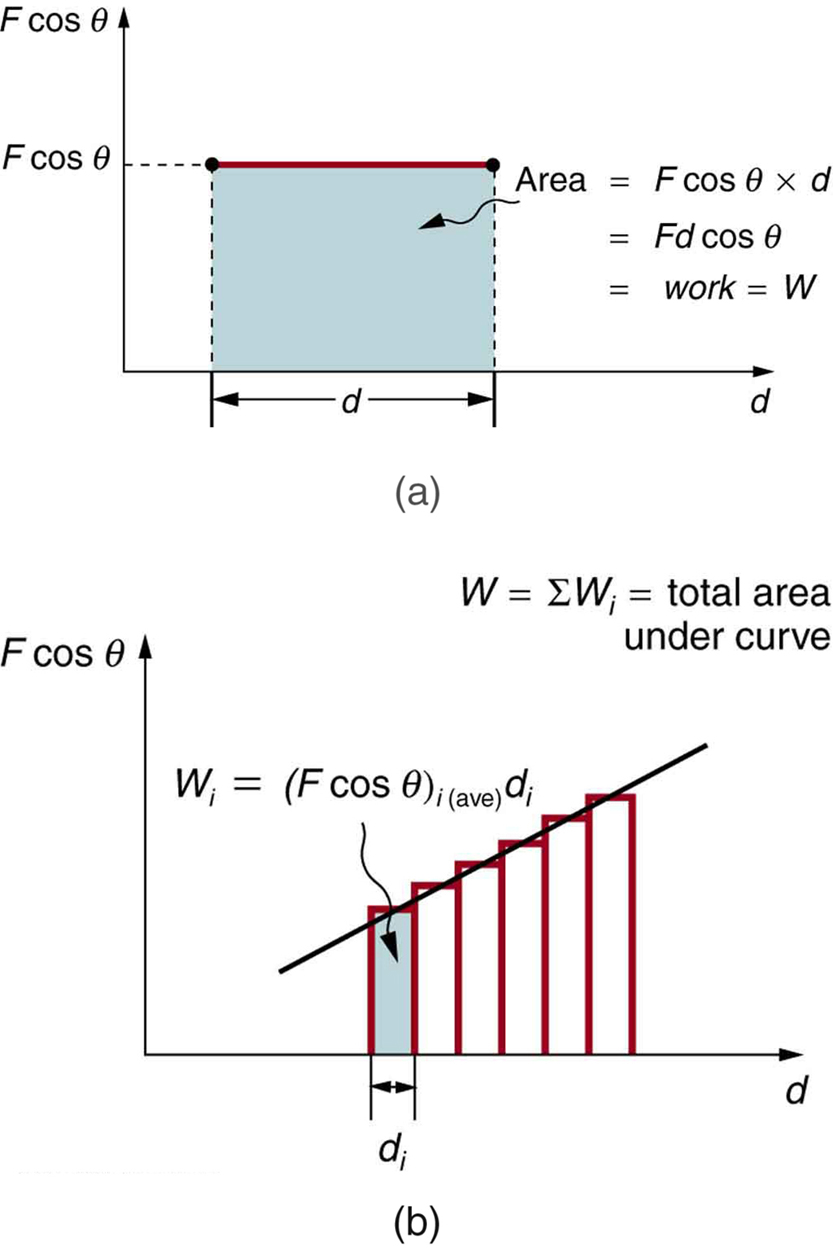
Figure 1(a) shows a graph of force versus displacement for the component of the force in the direction of the displacement—that is, an $F\cos{\theta}$ vs. $d$ graph. In this case, $F\cos{\theta}$ is constant. You can see that the area under the graph is $Fd\cos{\theta}$, or the work done. Figure 1(b) shows a more general process where the force varies. The area under the curve is divided into strips, each having an average force $\left( F\cos{\theta} \right)_{i\left(\text{ave}\right)}$. The work done is $\left( F\cos{\theta} \right)_{i\left(\text{ave}\right)}d_{i}$ for each strip, and the total work done is the sum of the $W_{i}$. Thus the total work done is the total area under the curve, a useful property to which we shall refer later.
Net work will be simpler to examine if we consider a one-dimensional situation where a force is used to accelerate an object in a direction parallel to its initial velocity. Such a situation occurs for the package on the roller belt conveyor system shown in Figure 2.
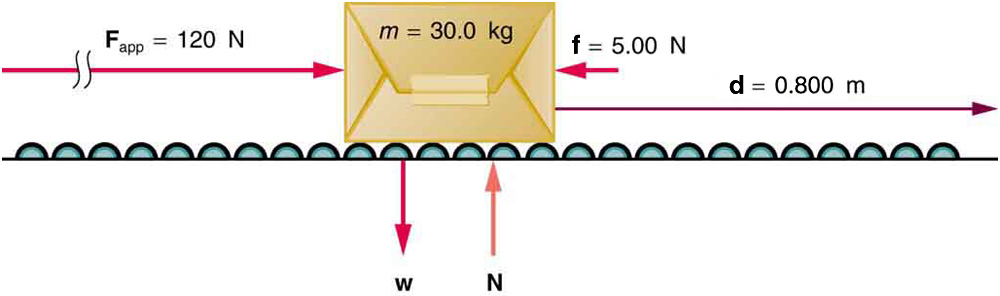
The force of gravity and the normal force acting on the package are perpendicular to the displacement and do no work. Moreover, they are also equal in magnitude and opposite in direction so they cancel in calculating the net force. The net force arises solely from the horizontal applied force $\vb{F}\_{\text{app}}$ and the horizontal friction force $\vb{f}$. Thus, as expected, the net force is parallel to the displacement, so that $\theta =0^\circ$ and $\cos{\theta} =1$, and the net work is given by
The effect of the net force $\vb{F}_{\text{net}}$ is to accelerate the package from $v_{0}$ to $v$. The kinetic energy of the package increases, indicating that the net work done on the system is positive. ( See Figure 2.) By using Newton’s second law, and doing some algebra, we can reach an interesting conclusion. Substituting $F\_{\text{net}}=ma$ from Newton’s second law gives
To get a relationship between net work and the speed given to a system by the net force acting on it, we take $d=x-x_{0}$ and use the equation studied in Motion Equations for Constant Acceleration in One Dimension for the change in speed over a distance $d$ if the acceleration has the constant value $a$; namely, $v^{2}= v_{0}^{2}+2ad$ (note that $a$ appears in the expression for the net work). Solving for acceleration gives $a=\frac{ v^{2}-v_{0}^{2}}{2d}$. When $a$ is substituted into the preceding expression for $W_{\text{net}}$, we obtain
The $d$ cancels, and we rearrange this to obtain
This expression is called the work-energy theorem, and it actually applies in general (even for forces that vary in direction and magnitude), although we have derived it for the special case of a constant force parallel to the displacement. The theorem implies that the net work on a system equals the change in the quantity $\frac{1}{2}m v^{2}$. This quantity is our first example of a form of energy.
The net work on a system equals the change in the quantity $\frac{1}{2}m v^{2}$.
The quantity $\frac{1}{2}m v^{2}$ in the work-energy theorem is defined to be the translational kinetic energy (KE) of a mass $m$ moving at a speed $v$. (Translational kinetic energy is distinct from rotational kinetic energy, which is considered later.) In equation form, the translational kinetic energy,
is the energy associated with translational motion. Kinetic energy is a form of energy associated with the motion of a particle, single body, or system of objects moving together.
We are aware that it takes energy to get an object, like a car or the package in Figure 2, up to speed, but it may be a bit surprising that kinetic energy is proportional to speed squared. This proportionality means, for example, that a car traveling at 100 km/h has four times the kinetic energy it has at 50 km/h, helping to explain why high-speed collisions are so devastating. We will now consider a series of examples to illustrate various aspects of work and energy.
Suppose a 30.0-kg package on the roller belt conveyor system in Figure 2 is moving at 0.500 m/s. What is its kinetic energy?
Strategy
Because the mass $m$ and speed $v$ are given, the kinetic energy can be calculated from its definition as given in the equation $\KE=\frac{1}{2}m v^{2}$.
Solution
The kinetic energy is given by
Entering known values gives
which yields
Discussion
Note that the unit of kinetic energy is the joule, the same as the unit of work, as mentioned when work was first defined. It is also interesting that, although this is a fairly massive package, its kinetic energy is not large at this relatively low speed. This fact is consistent with the observation that people can move packages like this without exhausting themselves.
Suppose that you push on the 30.0-kg package in Figure 2 with a constant force of 120 N through a distance of 0.800 m, and that the opposing friction force averages 5.00 N. (a) Calculate the net work done on the package. (b) Solve the same problem as in part (a), this time by finding the work done by each force that contributes to the net force.
Strategy and Concept for (a)
This is a motion in one dimension problem, because the downward force (from the weight of the package) and the normal force have equal magnitude and opposite direction, so that they cancel in calculating the net force, while the applied force, friction, and the displacement are all horizontal. ( See Figure 2.) As expected, the net work is the net force times distance.
Solution for (a)
The net force is the push force minus friction, or $F\_{\text{net}} = 120 N - 5.00\N = 115 \N$. Thus the net work is
Discussion for (a)
This value is the net work done on the package. The person actually does more work than this, because friction opposes the motion. Friction does negative work and removes some of the energy the person expends and converts it to thermal energy. The net work equals the sum of the work done by each individual force.
Strategy and Concept for (b)
The forces acting on the package are gravity, the normal force, the force of friction, and the applied force. The normal force and force of gravity are each perpendicular to the displacement, and therefore do no work.
Solution for (b)
The applied force does work.
The friction force and displacement are in opposite directions, so that $\theta =180^\circ$, and the work done by friction is
So the amounts of work done by gravity, by the normal force, by the applied force, and by friction are, respectively,
The total work done as the sum of the work done by each force is then seen to be
Discussion for (b)
The calculated total work $W_{\text{total}}$ as the sum of the work by each force agrees, as expected, with the work $W_{\text{net}}$ done by the net force. The work done by a collection of forces acting on an object can be calculated by either approach.
Find the speed of the package in Figure 2 at the end of the push, using work and energy concepts.
Strategy
Here the work-energy theorem can be used, because we have just calculated the net work, $W_{\text{net}}$, and the initial kinetic energy, $\frac{1}{2}{mv_{0}}^{2}$. These calculations allow us to find the final kinetic energy, $\frac{1}{2}m v^{2}$, and thus the final speed $v$.
Solution
The work-energy theorem in equation form is
Solving for $\frac{1}{2}m v^{2}$ gives
Thus,
Solving for the final speed as requested and entering known values gives
Discussion
Using work and energy, we not only arrive at an answer, we see that the final kinetic energy is the sum of the initial kinetic energy and the net work done on the package. This means that the work indeed adds to the energy of the package.
How far does the package in Figure 2 coast after the push, assuming friction remains constant? Use work and energy considerations.
Strategy
We know that once the person stops pushing, friction will bring the package to rest. In terms of energy, friction does negative work until it has removed all of the package’s kinetic energy. The work done by friction is the force of friction times the distance traveled times the cosine of the angle between the friction force and displacement; hence, this gives us a way of finding the distance traveled after the person stops pushing.
Solution
The normal force and force of gravity cancel in calculating the net force. The horizontal friction force is then the net force, and it acts opposite to the displacement, so $\theta =180^\circ$. To reduce the kinetic energy of the package to zero, the work $W_{\text{fr}}$ by friction must be minus the kinetic energy that the package started with plus what the package accumulated due to the pushing. Thus $W_{\text{fr}}=-95.75 \J$. Furthermore, $W\_{\text{fr}}=fd^{\prime} \cos{\theta} = -fd^{\prime}$, where $d^{\prime}$ is the distance it takes to stop. Thus,
and so
Discussion
This is a reasonable distance for a package to coast on a relatively friction-free conveyor system. Note that the work done by friction is negative ( the force is in the opposite direction of motion), so it removes the kinetic energy.
Some of the examples in this section can be solved without considering energy, but at the expense of missing out on gaining insights about what work and energy are doing in this situation. On the whole, solutions involving energy are generally shorter and easier than those using kinematics and dynamics alone.
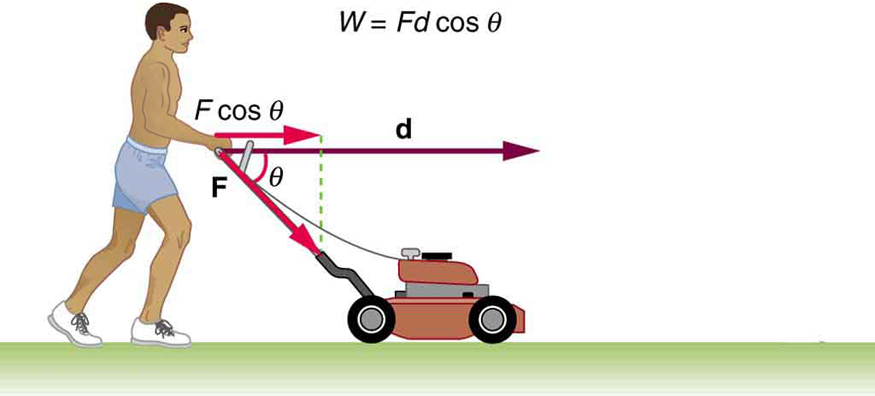
The person in Figure 3 does work on the lawn mower. Under what conditions would the mower gain energy? Under what conditions would it lose energy?
Work done on a system puts energy into it. Work done by a system removes energy from it. Give an example for each statement.
When solving for speed in Example 3, we kept only the positive root. Why?
Compare the kinetic energy of a 20 000-kg truck moving at 110 km/h with that of an 80.0-kg astronaut in orbit moving at 27 500 km/h.
Strategy
We calculate the kinetic energy of both using $\KE = \frac{1}{2}mv^{2}$, converting speeds to m/s first, then find the ratio.
Solution
Convert speeds to m/s:
Kinetic energy of truck:
Kinetic energy of astronaut:
The ratio is:
Discussion
The truck’s kinetic energy is only 1/250th that of the astronaut in orbit. Even though the truck is 250 times more massive than the astronaut, the astronaut’s much higher orbital speed (250 times faster) results in vastly more kinetic energy, since kinetic energy depends on the square of velocity. This demonstrates why orbital velocities represent such enormous energies.
Answer
The truck has a kinetic energy of $9.37 \times 10^{6} \J$, while the astronaut has $2.33 \times 10^{9} \J$. The astronaut’s kinetic energy is approximately 250 times greater than the truck’s.
(a) How fast must a 3000-kg elephant move to have the same kinetic energy as a 65.0-kg sprinter running at 10.0 m/s? (b) Discuss how the larger energies needed for the movement of larger animals would relate to metabolic rates.
Strategy
For part (a), we use the kinetic energy formula $\KE = \frac{1}{2}mv^{2}$ for both the elephant and the sprinter. Setting them equal allows us to solve for the elephant’s velocity. For part (b), we consider the relationship between body mass, movement energy, and metabolic rate.
Solution
(a) First, calculate the sprinter’s kinetic energy:
Setting the elephant’s kinetic energy equal to this:
Solving for the elephant’s velocity:
(b) The relationship between body mass and metabolic rate is discussed below.
Discussion
The elephant must move at only 1.47 m/s to have the same kinetic energy as the sprinter running at 10.0 m/s. This is because the elephant’s mass (3000 kg) is about 46 times greater than the sprinter’s mass (65.0 kg), so by the kinetic energy formula $\KE = \frac{1}{2}mv^{2}$, the elephant’s velocity only needs to be $1/\sqrt{46} \approx 1/6.8$ times the sprinter’s velocity.
Even though the elephant moves more slowly, it requires significant energy to move its large mass. Larger animals need proportionally larger metabolic rates to generate the energy required for movement. Metabolic rate generally scales with body mass to approximately the 3/4 power (Kleiber’s law), meaning that while a 3000-kg elephant requires much more total energy than a 65-kg human, its metabolic rate per unit mass is actually lower. However, the elephant still needs substantial energy intake to maintain its basic functions and enable movement of such a massive body.
Answer
(a) The elephant must move at $1.47 \ms$ to have the same kinetic energy as the sprinter.
(b) Larger animals require greater absolute metabolic rates to move their larger masses, though metabolic rate per unit mass decreases with increasing body size according to Kleiber’s law.
Confirm the value given for the kinetic energy of an aircraft carrier in Table 1 of Conservation of Energy. You will need to look up the definition of a nautical mile (1 knot = 1 nautical mile/h).
Strategy
From Table 1, the aircraft carrier has mass 90,000 tons (90,000,000 kg) moving at 30 knots. We need to convert knots to m/s: 1 knot = 1 nautical mile/h, where 1 nautical mile = 1852 m.
Solution
Convert speed to m/s:
Calculate kinetic energy:
Discussion
The calculated kinetic energy of $1.1 \times 10^{10}$ J confirms the value in Table 1. This enormous energy—about 11 billion joules—is equivalent to the energy in about 90 gallons of gasoline. It demonstrates the massive amount of energy required to move such a large vessel, and explains why aircraft carriers need powerful propulsion systems.
Answer
The kinetic energy of the aircraft carrier is $1.1 \times 10^{10} \J$ (11 billion joules), confirming the value given in Table 1.
(a) Calculate the force needed to bring a 950-kg car to rest from a speed of 90.0 km/h in a distance of 120 m (a fairly typical distance for a non-panic stop). (b) Suppose instead the car hits a concrete abutment at full speed and is brought to a stop in 2.00 m. Calculate the force exerted on the car and compare it with the force found in part (a).
Strategy
We use the work-energy theorem: the net work done equals the change in kinetic energy. The work done by the braking force is $W = -Fd$ (negative because it opposes motion), and this must equal the change in kinetic energy, which is $\Delta \KE = 0 - \frac{1}{2}mv_{0}^{2} = -\frac{1}{2}mv_{0}^{2}$. We apply this to both scenarios—normal braking and hitting an abutment—to compare the forces.
Solution
First, convert the speed: $v\_{0} = 90.0\text{ km/h} = 90.0 \times \frac{1000\m}{3600\s} = 25.0\ms$
The initial kinetic energy is:
(a) For normal braking over 120 m:
Using the work-energy theorem ($W\_{\text{net}} = \Delta \KE$):
Solving for F:
(b) For hitting the abutment with $d = 2.00\m$:
The ratio of forces is:
Discussion
The force needed for normal braking over 120 m is approximately 2500 N, which is substantial but manageable for a car’s braking system. However, when the car hits an abutment and stops in only 2.00 m, the force increases to approximately 150,000 N—60 times larger than the normal braking force.
This dramatic increase demonstrates the inverse relationship between stopping distance and force: when the stopping distance is reduced by a factor of 60 (from 120 m to 2 m), the force increases by the same factor. This explains why high-speed collisions are so catastrophic—the forces involved become enormous when the stopping distance is very small, causing severe damage to both the vehicle and occupants.
Answer
(a) The force needed to bring the car to rest in 120 m is $2.5 \times 10^{3} \N$ (2500 N).
(b) The force when hitting the abutment is $1.5 \times 10^{5} \N$ (150,000 N), which is 60 times larger than the braking force.
A car’s bumper is designed to withstand a 4.0-km/h (1.1-m/s) collision with an immovable object without damage to the body of the car. The bumper cushions the shock by absorbing the force over a distance. Calculate the magnitude of the average force on a bumper that collapses 0.200 m while bringing a 900-kg car to rest from an initial speed of 1.1 m/s.
Strategy
We use the work-energy theorem: the work done by the bumper force equals the change in kinetic energy. The work is $W = -Fd$ (negative because it opposes motion), and this equals $\Delta \KE = 0 - \frac{1}{2}mv^{2}$.
Solution
The initial kinetic energy is:
Using the work-energy theorem:
Discussion
The average force on the bumper is approximately 2700 N (about 610 pounds). This is a substantial force, but it’s distributed over the 0.200 m crumple distance, which protects the car body from damage. This design principle—absorbing impact energy over a larger distance—is the basis of modern automotive safety features like crumple zones.
Answer
The average force on the bumper is $2.7 \times 10^{3} \N$ (approximately 2700 N or 610 pounds).
Boxing gloves are padded to lessen the force of a blow. (a) Calculate the force exerted by a boxing glove on an opponent’s face, if the glove and face compress 7.50 cm during a blow in which the 7.00-kg arm and glove are brought to rest from an initial speed of 10.0 m/s. (b) Calculate the force exerted by an identical blow in the gory old days when no gloves were used and the knuckles and face would compress only 2.00 cm. (c) Discuss the magnitude of the force with glove on. Does it seem high enough to cause damage even though it is lower than the force with no glove?
Strategy
We use the work-energy theorem. The kinetic energy of the arm and glove is converted to work done in stopping over distance $d$. The work done by the stopping force is $W = -Fd$, which equals the change in kinetic energy $\Delta \KE = 0 - \frac{1}{2}mv^{2}$. We calculate the force for two scenarios: with gloves (larger stopping distance) and without gloves (smaller stopping distance).
Solution
The initial kinetic energy is:
(a) With gloves, using $d = 7.50\text{ cm} = 0.0750\m$:
Using the work-energy theorem:
(b) Without gloves, using $d = 2.00\text{ cm} = 0.0200\m$:
Discussion
With a glove, the force is approximately 4700 N, while without a glove, the force increases to approximately 17,500 N—about 3.7 times larger. This dramatic difference occurs because the glove increases the stopping distance by a factor of 3.75 (from 2.00 cm to 7.50 cm), and since force is inversely proportional to stopping distance, the force decreases by the same factor.
However, even with a glove, 4700 N is still a very substantial force—equivalent to about 1000 pounds! This is certainly enough to cause significant damage. The human face and brain are not designed to withstand such forces. The glove reduces the force by increasing the stopping distance, but the blow can still be devastating. This explains why even padded boxing gloves can cause concussions, facial fractures, and other serious injuries. The comparison highlights why modern boxing regulations require gloves—they reduce the force substantially, though not enough to eliminate all danger.
Answer
(a) The force exerted with a boxing glove is $4.7 \times 10^{3} \N$ (approximately 4700 N).
(b) The force exerted without a glove is $1.8 \times 10^{4} \N$ (approximately 17,500 N).
(c) Yes, even the reduced force with a glove (4700 N or about 1000 pounds) is high enough to cause significant damage including concussions and facial injuries.
Using energy considerations, calculate the average force a 60.0-kg sprinter exerts backward on the track to accelerate from 2.00 to 8.00 m/s in a distance of 25.0 m, if he encounters a headwind that exerts an average force of 30.0 N against him.
Strategy
The net work done equals the change in kinetic energy. The net work is the work done by the sprinter minus the work done by the headwind: $W_{\text{net}} = (F_{\text{sprinter}} - F\_{\text{wind}})d = \Delta \KE$.
Solution
Calculate the change in kinetic energy:
Using the work-energy theorem:
Discussion
The sprinter exerts an average force of 102 N backward on the track (by Newton’s third law, the track pushes forward on the sprinter with 102 N). Of this, 30 N is needed to overcome the headwind, while the remaining 72 N provides the net force that accelerates the sprinter. This demonstrates how additional resistance forces require proportionally more effort to achieve the same acceleration.
Answer
The average force the sprinter exerts backward on the track is $102 \N$.