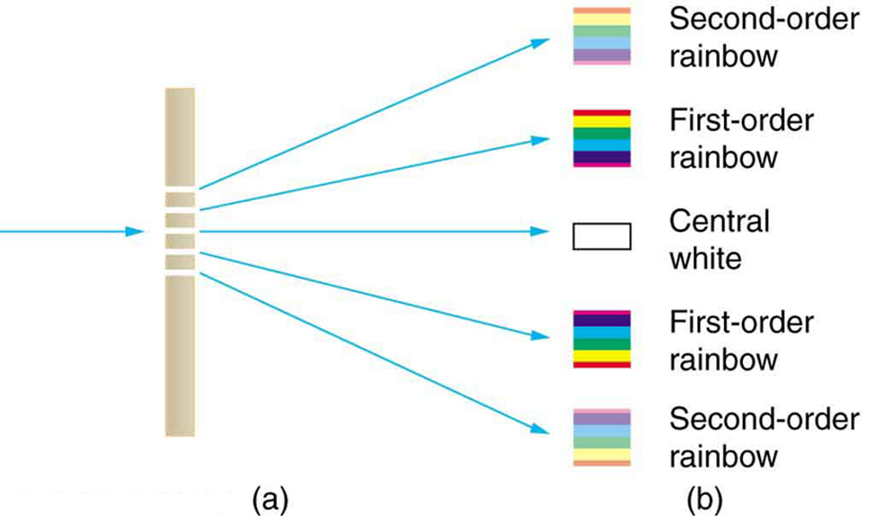
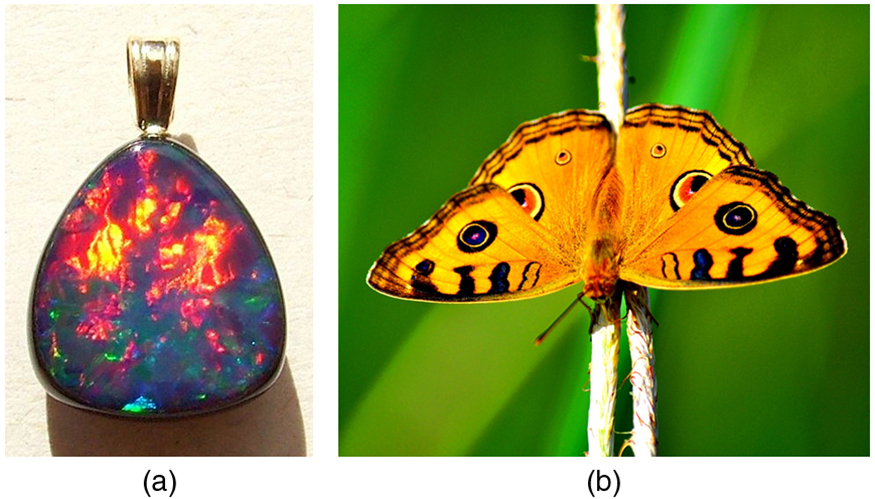
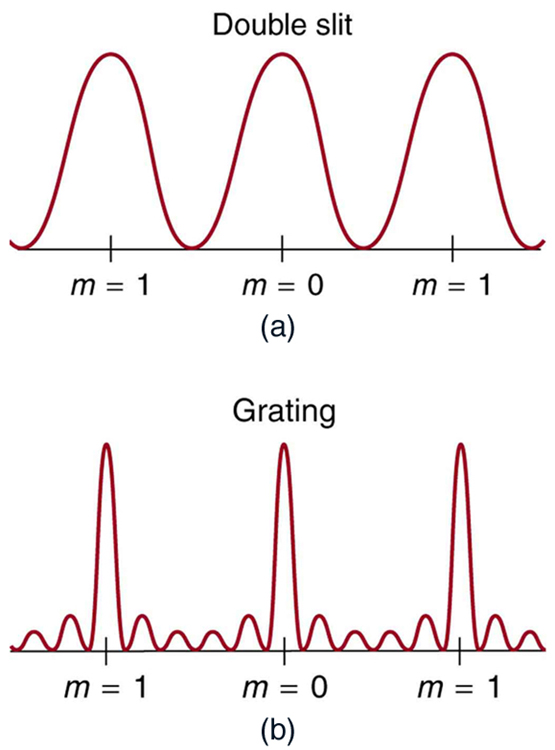
An interesting thing happens if you pass light through a large number of evenly spaced parallel slits, called a diffraction grating. An interference pattern is created that is very similar to the one formed by a double slit ( see [Figure 1]). A diffraction grating can be manufactured by scratching glass with a sharp tool in a number of precisely positioned parallel lines, with the untouched regions acting like slits. These can be photographically mass produced rather cheaply. Diffraction gratings work both for transmission of light, as in [Figure 1], and for reflection of light, as on butterfly wings and the Australian opal in [Figure 2] or the CD pictured in the opening photograph of this chapter, [Figure 1]. In addition to their use as novelty items, diffraction gratings are commonly used for spectroscopic dispersion and analysis of light. What makes them particularly useful is the fact that they form a sharper pattern than double slits do. That is, their bright regions are narrower and brighter, while their dark regions are darker. [Figure 3] shows idealized graphs demonstrating the sharper pattern. Natural diffraction gratings occur in the feathers of certain birds. Tiny, finger-like structures in regular patterns act as reflection gratings, producing constructive interference that gives the feathers colors not solely due to their pigmentation. This is called iridescence.
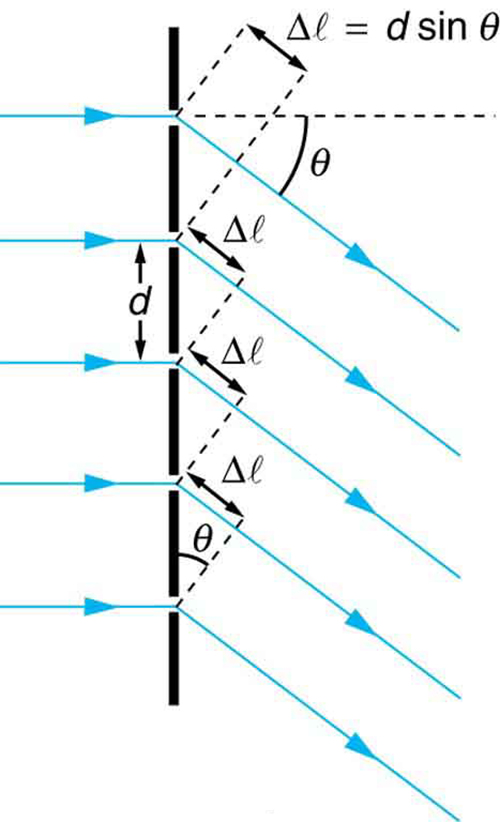
The analysis of a diffraction grating is very similar to that for a double slit (see [Figure 4]). As we know from our discussion of double slits in Young's Double Slit Experiment, light is diffracted by each slit and spreads out after passing through. Rays traveling in the same direction (at an angle $\theta$ relative to the incident direction) are shown in the figure. Each of these rays travels a different distance to a common point on a screen far away. The rays start in phase, and they can be in or out of phase when they reach a screen, depending on the difference in the path lengths traveled. As seen in the figure, each ray travels a distance $d\sin \theta$ different from that of its neighbor, where $d$ is the distance between slits. If this distance equals an integral number of wavelengths, the rays all arrive in phase, and constructive interference (a maximum) is obtained. Thus, the condition necessary to obtain constructive interference for a diffraction grating is
where $d$ is the distance between slits in the grating, $\lambda$ is the wavelength of light, and $m$ is the order of the maximum. Note that this is exactly the same equation as for double slits separated by $d$ . However, the slits are usually closer in diffraction gratings than in double slits, producing fewer maxima at larger angles.
Where are diffraction gratings used? Diffraction gratings are key components of monochromators used, for example, in optical imaging of particular wavelengths from biological or medical samples. A diffraction grating can be chosen to specifically analyze a wavelength emitted by molecules in diseased cells in a biopsy sample or to help excite strategic molecules in the sample with a selected frequency of light. Another vital use is in optical fiber technologies where fibers are designed to provide optimum performance at specific wavelengths. A range of diffraction gratings are available for selecting specific wavelengths for such use.
The spacing $d$ of the grooves in a CD or DVD can be well determined by using a laser and the equation $d \sin \theta =m \lambda, \text{ for } m=0 \text{,} 1 \text{,} -1 \text{,} 2 \text{,} -2 \text{,}\dots$ . However, we can still make a good estimate of this spacing by using white light and the rainbow of colors that comes from the interference. Reflect sunlight from a CD onto a wall and use your best judgment of the location of a strongly diffracted color to find the separation $d$.
Diffraction gratings with 10 000 lines per centimeter are readily available. Suppose you have one, and you send a beam of white light through it to a screen 2.00 m away. (a) Find the angles for the first-order diffraction of the shortest and longest wavelengths of visible light (380 and 760 nm). (b) What is the distance between the ends of the rainbow of visible light produced on the screen for first-order interference? (See [Figure 5].)
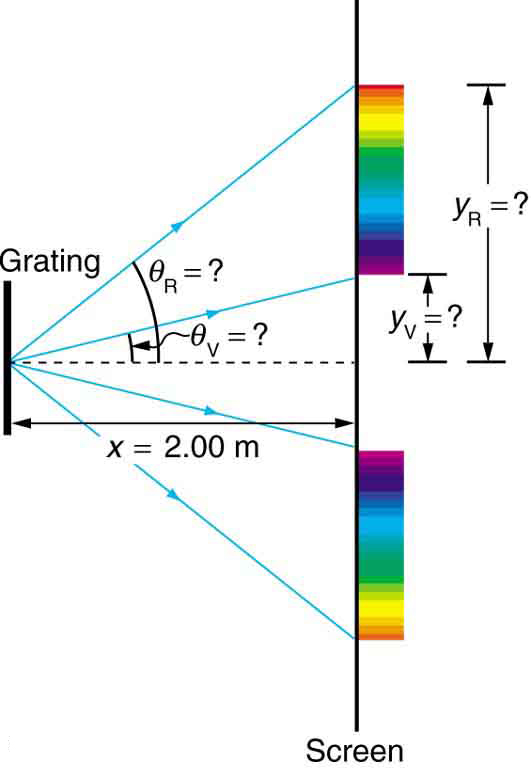
Strategy
The angles can be found using the equation
once a value for the slit spacing $d$ has been determined. Since there are 10 000 lines per centimeter, each line is separated by $1/10 000$ of a centimeter. Once the angles are found, the distances along the screen can be found using simple trigonometry.
Solution for (a)
The distance between slits is $d=\left(1\text{ cm}\right)/10 000= 1.00 \times 10^{-4} \text{cm}$ or $1.00 \times 10^{-6} \text{m}$ . Let us call the two angles ${\theta }_{\text{V}}$ for violet (380 nm) and ${\theta }_{\text{R}}$ for red (760 nm). Solving the equation $d\sin {\theta }_{\text{V}}=\mathrm{m\lambda }$ for $\sin {\theta }_{\text{V}}$ ,
where $m=1$ for first order and ${\lambda }_{\text{V}}=380 \text{nm}= 3.80 \times 10^{-7} \text{m}$ . Substituting these values gives
Thus the angle ${\theta }_{\text{V}}$ is
Similarly,
Thus the angle ${\theta }_{\text{R}}$ is
Notice that in both equations, we reported the results of these intermediate calculations to four significant figures to use with the calculation in part (b).
Solution for (b)
The distances on the screen are labeled ${y}_{\text{V}}$ and ${y}_{\text{R}}$ in [Figure 5]. Noting that $\tan \theta =y/x$ , we can solve for ${y}_{\text{V}}$ and ${y}_{\text{R}}$ . That is,
and
The distance between them is therefore
Discussion
The large distance between the red and violet ends of the rainbow produced from the white light indicates the potential this diffraction grating has as a spectroscopic tool. The more it can spread out the wavelengths (greater dispersion), the more detail can be seen in a spectrum. This depends on the quality of the diffraction grating—it must be very precisely made in addition to having closely spaced lines.
What is the advantage of a diffraction grating over a double slit in dispersing light into a spectrum?
What are the advantages of a diffraction grating over a prism in dispersing light for spectral analysis?
Can the lines in a diffraction grating be too close together to be useful as a spectroscopic tool for visible light? If so, what type of EM radiation would the grating be suitable for? Explain.
If a beam of white light passes through a diffraction grating with vertical lines, the light is dispersed into rainbow colors on the right and left. If a glass prism disperses white light to the right into a rainbow, how does the sequence of colors compare with that produced on the right by a diffraction grating?
Suppose pure-wavelength light falls on a diffraction grating. What happens to the interference pattern if the same light falls on a grating that has more lines per centimeter? What happens to the interference pattern if a longer-wavelength light falls on the same grating? Explain how these two effects are consistent in terms of the relationship of wavelength to the distance between slits.
Suppose a feather appears green but has no green pigment. Explain in terms of diffraction.
It is possible that there is no minimum in the interference pattern of a single slit. Explain why. Is the same true of double slits and diffraction gratings?
A diffraction grating has 2000 lines per centimeter. At what angle will the first-order maximum be for 520-nm-wavelength green light?
Strategy
For a diffraction grating, maxima occur at angles satisfying $d \sin \theta = m\lambda$, where d is the spacing between adjacent slits (grating constant), m is the order, and λ is the wavelength. First, calculate d from the line density, then solve for θ with m = 1.
Solution
Given:
Calculate the grating constant (slit separation):
For the first-order maximum:
The first-order maximum for 520-nm green light occurs at 5.97°.
Discussion
The small angle (5.97°) for the first-order maximum indicates that the grating constant (5.00 μm) is about 10 times the wavelength (520 nm). Diffraction gratings with 2000 lines/cm are relatively coarse gratings. Finer gratings (e.g., 10,000 lines/cm) would produce larger diffraction angles and better spectral separation. The green wavelength (520 nm) falls in the middle of the visible spectrum. Higher orders (m = 2, 3, …) would appear at larger angles: the second order at about 11.96° and the third at about 18.05°.
Find the angle for the third-order maximum for 580-nm-wavelength yellow light falling on a diffraction grating having 1500 lines per centimeter.
Strategy
For a diffraction grating, we use $d \sin \theta = m\lambda$ where d is the distance between lines. First, find d from the line density, then solve for θ with m = 3.
Solution
Given:
Step 1: Find the distance between lines
Step 2: Find the angle
Using $d \sin \theta = m\lambda$:
Discussion
The third-order maximum appears at 15.1°. With a grating spacing of 6.67 μm (about 11.5 wavelengths), this grating can produce several orders of maxima. We can check: the maximum order would be m_max = d/λ = 6.67/0.580 ≈ 11.5, so up to 11 orders are theoretically possible (though higher orders become very dim and widely separated).
How many lines per centimeter are there on a diffraction grating that gives a first-order maximum for 470-nm blue light at an angle of $25.0º$ ?
Strategy
Use $d \sin \theta = m\lambda$ to find the grating spacing d, then calculate the number of lines per centimeter as N = 1/d.
Solution
Given:
Step 1: Find the grating spacing
Using $d \sin \theta = m\lambda$:
Step 2: Find the number of lines per centimeter
Discussion
A grating with approximately 9000 lines/cm is a moderately fine diffraction grating. This spacing of about 1.11 μm (about 2.4 wavelengths of blue light) produces the first-order maximum at 25.0°, which is a convenient angle for observation. This is close to commercial gratings often available with 5000-10,000 lines/cm. Higher orders would appear at larger angles: the second order at about 57.1° and the third order at about 80.8°, with a maximum possible order of m_max = d/λ ≈ 2.4, meaning only orders 0, 1, and 2 would be fully observable.
What is the distance between lines on a diffraction grating that produces a second-order maximum for 760-nm red light at an angle of $60.0º$ ?
Strategy
Use $d \sin \theta = m\lambda$ with m = 2 (second-order) to solve for the line spacing d.
Solution
Given:
Using $d \sin \theta = m\lambda$:
Discussion
The line spacing of 1.76 μm is very small - just over twice the wavelength of red light. This close spacing is necessary to produce the second-order maximum at the relatively large angle of 60°.
We can verify this makes sense: if the second-order maximum is at 60°, the first-order would be at θ₁ where sin θ₁ = (1)(760)/(1.76 × 10³) = 0.432, giving θ₁ = 25.6°. This seems reasonable.
For this grating, the maximum order observable would be: m_max = d/λ = 1.76/0.76 ≈ 2.3, so only second-order maxima (and possibly a dim third-order) would be observable before reaching 90°.
Calculate the wavelength of light that has its second-order maximum at $45.0º$ when falling on a diffraction grating that has 5000 lines per centimeter.
Strategy
Use $d \sin \theta = m\lambda$ with m = 2 (second-order) to solve for the wavelength λ. First, find the grating spacing d from the line density.
Solution
Given:
Step 1: Find the grating spacing
Step 2: Find the wavelength
Using $d \sin \theta = m\lambda$:
Discussion
The wavelength of 707 nm falls in the red region of the visible spectrum (near the long-wavelength end). This is close to deep red light. The second-order maximum appears at 45.0°, which is a reasonably large angle, making it easy to observe and measure.
We can verify this is reasonable: the first-order maximum would appear at an angle where sin θ₁ = λ/d = 707/2000 = 0.354, giving θ₁ = 20.7°. The third-order would be at sin θ₃ = 3λ/d = 2121/2000 = 1.06 > 1, which is impossible, so no third-order maximum exists. This grating can show at most the zeroth, first, and second orders for this wavelength.
An electric current through hydrogen gas produces several distinct wavelengths of visible light. What are the wavelengths of the hydrogen spectrum, if they form first-order maxima at angles of $24.2º$ , $25.7º$ , $29.1º$ , and $41.0º$ when projected on a diffraction grating having 10 000 lines per centimeter? Explicitly show how you follow the steps in Problem-Solving Strategies for Wave Optics
Strategy
Following the Problem-Solving Strategies for Wave Optics:
Step 1: This involves a diffraction grating. Step 2: We use $d \sin \theta = m\lambda$ for constructive interference. Step 3: We need to find the wavelengths λ for each angle. Step 4: Given: 10,000 lines/cm, m = 1, four angles. Step 5: First find d, then solve $\lambda = d \sin \theta / m$ for each angle.
Solution
Find the grating spacing:
For each angle, calculate λ using $\lambda = \frac{d \sin \theta}{m}$ with m = 1:
Angle 1: θ = 24.2°
Angle 2: θ = 25.7°
Angle 3: θ = 29.1°
Angle 4: θ = 41.0°
Step 6: All results are in the visible range (380-760 nm), which is reasonable for hydrogen emission lines.
Discussion
These wavelengths correspond to prominent lines in the hydrogen Balmer series:
The H-alpha line at 656 nm is the brightest and most famous line in the visible hydrogen spectrum. These emission lines result from electrons transitioning from higher energy levels (n = 3, 4, 5, 6) down to n = 2. This spectral “fingerprint” is characteristic of hydrogen and is observed in stars, nebulae, and laboratory hydrogen discharge tubes. The precision of diffraction gratings makes them invaluable tools for spectroscopy and identifying elements.
(a) What do the four angles in the above problem become if a 5000-line-per-centimeter diffraction grating is used? (b) Using this grating, what would the angles be for the second-order maxima? (c) Discuss the relationship between integral reductions in lines per centimeter and the new angles of various order maxima.
Strategy
Use the four hydrogen wavelengths from the previous problem (410, 434, 486, and 656 nm) with the new grating. For part (a), find first-order angles with the 5000 lines/cm grating. For part (b), find second-order angles. For part (c), compare how changing the grating spacing by a factor affects the angles.
Solution
The four hydrogen wavelengths are: 410 nm, 434 nm, 486 nm, and 656 nm.
For the 5000-line-per-centimeter grating:
(a) First-order angles with 5000 lines/cm grating:
Using $\sin \theta = \frac{m\lambda}{d}$ with m = 1:
For λ = 410 nm:
For λ = 434 nm:
For λ = 486 nm:
For λ = 656 nm:
First-order angles: 11.8°, 12.5°, 14.1°, 19.2°
(b) Second-order angles with 5000 lines/cm grating:
Using $\sin \theta = \frac{m\lambda}{d}$ with m = 2:
For λ = 410 nm:
For λ = 434 nm:
For λ = 486 nm:
For λ = 656 nm:
Second-order angles: 24.2°, 25.7°, 29.1°, 41.0°
(c) Relationship between line density and angles:
Notice that the second-order angles for the 5000 lines/cm grating (24.2°, 25.7°, 29.1°, 41.0°) are exactly the same as the first-order angles for the 10,000 lines/cm grating from the previous problem!
This demonstrates a general principle: When you decrease the number of lines per centimeter by a factor of n (thereby increasing d by a factor of n), the angles for the n-th order maximum with the new grating equal the angles for the first-order maximum with the original grating.
Mathematically: If $d_2 = n \cdot d_1$, then $\sin \theta_{m=1, d_1} = \frac{\lambda}{d_1}$ equals $\sin \theta_{m=n, d_2} = \frac{n\lambda}{n \cdot d_1} = \frac{\lambda}{d_1}$.
In this case, halving the line density (10,000 → 5000 lines/cm) means doubling d, so the second-order (n=2) angles with the coarser grating equal the first-order angles with the finer grating.
Discussion
This scaling relationship is very useful in diffraction grating design. It shows that using a coarser grating with higher-order maxima can produce the same angular positions as using a finer grating with lower-order maxima. However, higher orders are generally dimmer and may suffer from overlapping spectra from different orders. The 5000 lines/cm grating produces more widely spaced orders, making them easier to observe separately, while the 10,000 lines/cm grating provides better resolution within each order.
What is the maximum number of lines per centimeter a diffraction grating can have and produce a complete first-order spectrum for visible light?
Strategy
For a complete first-order spectrum, both the shortest (violet, ~380 nm) and longest (red, ~760 nm) wavelengths of visible light must have first-order maxima at angles less than 90°. The limiting condition is for the longest wavelength (red) at θ = 90°.
Solution
For the complete visible spectrum to be observable in first order, the red end (longest wavelength) must appear before 90°. Using $d \sin \theta = m\lambda$ with m = 1 and $\theta = 90°$ (where $\sin 90° = 1$):
This is the minimum spacing needed. The maximum number of lines per centimeter is:
Rounding to appropriate significant figures:
Discussion
If the grating had more than ~13,200 lines/cm, the line spacing would be smaller than 760 nm, and the first-order maximum for red light would require $\sin \theta > 1$, which is impossible. The red end of the spectrum would not be observable in first order.
Let’s verify: with d = 760 nm:
This grating would spread the complete visible spectrum from 30° to 90° in first order. Commercial gratings often have fewer lines/cm (~5000-10,000) to ensure good visibility of the complete spectrum at more convenient angles.
The yellow light from a sodium vapor lamp seems to be of pure wavelength, but it produces two first-order maxima at $36.093 ^\circ$ and $36.129 ^\circ$ when projected on a 10 000 line per centimeter diffraction grating. What are the two wavelengths to an accuracy of 0.1 nm?
Strategy
Use $d \sin \theta = m\lambda$ to find each wavelength from its angle. First, calculate the grating spacing d from the line density, then solve for λ at each angle.
Solution
Given:
Step 1: Find the grating spacing
Step 2: Find the first wavelength
Using $\lambda = d \sin \theta / m$:
Step 3: Find the second wavelength
Discussion
These two wavelengths, 589.1 nm and 589.6 nm, form the famous sodium D-line doublet. The two lines are separated by only 0.5 nm (or about 6 nm), which is why sodium light appears to be pure yellow to the eye - the two wavelengths are too close for the eye to distinguish.
The doublet arises from the fine structure of sodium’s electron energy levels: transitions from two closely spaced upper states (²P₃/₂ and ²P₁/₂) to the same ground state (²S₁/₂) produce the D₂ line (589.0 nm) and D₁ line (589.6 nm).
This problem demonstrates the high resolving power of diffraction gratings. The angular separation is only 0.036°, yet the grating cleanly separates the two lines. The ability to resolve such closely spaced wavelengths is crucial for spectroscopic analysis in astronomy, chemistry, and physics.
What is the spacing between structures in a feather that acts as a reflection grating, given that they produce a first-order maximum for 525-nm light at a $30.0º$ angle?
Strategy
For a reflection grating, we use the same equation as for a transmission grating: $d \sin \theta = m\lambda$. We solve for d with m = 1.
Solution
Given:
Using $d \sin \theta = m\lambda$:
Discussion
The spacing of 1.05 μm (1050 nm) is about twice the wavelength of the green light being diffracted. This is typical for structural coloration in bird feathers and insect wings.
The iridescent colors in peacock feathers, hummingbird feathers, and butterfly wings are produced by such natural diffraction gratings. The spacing is created by regular arrangements of microscopic structures like barbules (in feathers) or scales (in butterfly wings). The color changes with viewing angle because different angles produce constructive interference for different wavelengths according to $d \sin \theta = m\lambda$.
This biological “engineering” produces brilliant colors without pigments - the colors are purely structural and result from wave interference. These colors often don’t fade over time like pigment-based colors do, which is why museum specimens of iridescent birds and butterflies remain colorful for centuries.
Structures on a bird feather act like a reflection grating having 8000 lines per centimeter. What is the angle of the first-order maximum for 600-nm light?
Strategy
Use $d \sin \theta = m\lambda$ with m = 1 to find the angle. First, calculate the spacing d from the line density, then solve for θ.
Solution
Given:
Step 1: Find the structure spacing
Step 2: Find the angle
Using $d \sin \theta = m\lambda$:
Discussion
The first-order maximum for orange-red light (600 nm) appears at 28.7° from the normal. This angle is typical for structural coloration in bird feathers. The spacing of 1.25 μm is roughly twice the wavelength, which is ideal for producing visible diffraction patterns.
Birds with iridescent feathers (like hummingbirds, peacocks, and starlings) have microscopic structures on their feather barbules that act as natural diffraction gratings. As the bird moves and the viewing angle changes, different wavelengths satisfy the constructive interference condition, causing the brilliant color shifts characteristic of iridescence. For this feather, shorter wavelengths (blue, violet) would appear at smaller angles, while longer wavelengths (red) would appear at larger angles, creating a rainbow effect with changing perspective.
An opal such as that shown in [Figure 2] acts like a reflection grating with rows separated by about $8 \text{μm}$ . If the opal is illuminated normally, (a) at what angle will red light be seen and (b) at what angle will blue light be seen?
Strategy
Use $d \sin \theta = m\lambda$ for the first-order maximum (m = 1) with d = 8 μm. Use λ ≈ 700 nm for red and λ ≈ 450 nm for blue.
Solution
Given:
(a) Red light (λ ≈ 700 nm):
(b) Blue light (λ ≈ 450 nm):
Discussion
The diffraction angles are quite small (3.2° for blue, 5.0° for red) because the grating spacing (8 μm) is much larger than the wavelengths of visible light. Red light appears at a larger angle than blue light, which is why when you rotate an opal, you see different colors from different angles - this is the source of opal’s famous “play of color” or iridescence.
The complete visible spectrum would spread from about 3° (violet) to 5° (red). Higher orders (m = 2, 3, etc.) would appear at larger angles but with decreasing intensity. The maximum order possible is m_max = d/λ_max ≈ 8000/700 ≈ 11, so many orders are theoretically possible, though in practice only the first few are bright enough to see.
Opals contain tiny silica spheres arranged in regular patterns, creating these natural diffraction gratings. The spacing of 8 μm is roughly 10-20 wavelengths of visible light, perfect for producing brilliant iridescent colors.
At what angle does a diffraction grating produces a second-order maximum for light having a first-order maximum at $20.0º$ ?
Strategy
Use $d \sin \theta = m\lambda$ for both orders. From the first-order angle, find the ratio λ/d, then use this to find the second-order angle.
Solution
Given:
Step 1: Find the ratio λ/d from the first-order condition
For the first-order maximum (m = 1):
Step 2: Find the second-order angle
For the second-order maximum (m = 2):
Discussion
The second-order maximum appears at 43.2°, more than twice the first-order angle (20.0°). This is because the sine function is nonlinear - while sin θ doubles from first to second order, the angle itself more than doubles.
This result is general: for any diffraction grating, if the first-order maximum is at angle θ₁, the second-order maximum is at θ₂ = sin⁻¹(2 sin θ₁). Notice that the second-order angle exists only if 2 sin θ₁ ≤ 1, which requires θ₁ ≤ 30°. Since 20° < 30°, the second-order maximum is observable. If θ₁ were greater than 30°, no second-order maximum would exist (consistent with our earlier proof).
Show that a diffraction grating cannot produce a second-order maximum for a given wavelength of light unless the first-order maximum is at an angle less than $30.0º$.
Strategy
We use $d \sin \theta = m\lambda$ for both first and second orders. For the second-order to exist, it must occur at θ < 90°.
Solution
For the first-order maximum (m = 1):
For the second-order maximum (m = 2) to be observable, it must occur at some angle θ₂ < 90°. At the limiting case where θ₂ = 90°:
With $\sin \theta_2 = \sin 90° = 1$:
Now substitute this back into the first-order equation:
Therefore: If θ₁ = 30.0°, the second-order maximum just barely appears at θ₂ = 90°. If θ₁ > 30.0°, then d < 2λ, which would require $\sin \theta_2 > 1$ for the second-order maximum - which is impossible.
Conclusion: A second-order maximum can only exist if the first-order maximum appears at θ₁ < 30.0°. Q.E.D.
Discussion
This result has important practical implications for diffraction grating design. If you observe that a first-order maximum appears at an angle greater than 30°, you immediately know that:
For example, if violet light (380 nm) produces its first maximum at 35°, the grating spacing is only about 600 nm, and no higher orders can be observed for visible light.
If a diffraction grating produces a first-order maximum for the shortest wavelength of visible light at $30.0º$ , at what angle will the first-order maximum be for the longest wavelength of visible light?
Strategy
Use $d \sin \theta = m\lambda$ for both wavelengths. Find d from the violet condition, then use it to find the angle for red light.
Solution
Given:
Step 1: Find the grating spacing from the violet condition
Step 2: Find the angle for red light
Discussion
The remarkable result is that the red end of the visible spectrum appears at exactly 90°! This is the limiting case where the first-order maximum just barely exists.
Notice that the grating spacing d = 760 nm exactly equals the wavelength of red light. This is the critical condition: when d = λ_max, the longest wavelength appears at 90°. If the grating had even slightly finer spacing (d < 760 nm), red light would not produce a first-order maximum at all.
This grating with d = 760 nm produces a complete visible spectrum spreading from 30° (violet) to 90° (red) in first order. The complete visible spectrum is compressed into a 60° angular range. This is actually the finest-spacing grating that can show the complete visible spectrum in first order - any finer and the red end would be cut off.
(a) Find the maximum number of lines per centimeter a diffraction grating can have and produce a maximum for the smallest wavelength of visible light. (b) Would such a grating be useful for ultraviolet spectra? (c) For infrared spectra?
Strategy
For part (a), the smallest visible wavelength (violet, ~380 nm) must produce at least a first-order maximum before θ = 90°. For parts (b) and (c), we check if UV and IR wavelengths can produce maxima with this grating spacing.
Solution
(a) Maximum lines per centimeter:
The smallest visible wavelength is approximately λ = 380 nm (violet). For a first-order maximum to just barely exist at θ = 90°:
Maximum number of lines per centimeter:
Rounding: N ≈ 26,300 lines/cm
(b) Useful for ultraviolet spectra?
UV wavelengths are shorter than visible light (λ < 380 nm). For example, UV-A is around 315-380 nm.
Since d = 380 nm and λ_UV < 380 nm, we have d > λ_UV, so:
For first order (m = 1), sin θ < 1, so maxima will exist for UV light.
Yes, this grating would be useful for UV spectra. In fact, UV wavelengths would produce maxima at smaller angles than violet light, making them easier to observe.
(c) Useful for infrared spectra?
IR wavelengths are longer than visible light. For example, near-IR is around 760 nm - 2500 nm.
For λ_IR = 760 nm with d = 380 nm:
Since sin θ cannot exceed 1, no first-order maximum exists for 760 nm IR light.
No, this grating would NOT be useful for infrared spectra because d < λ for all IR wavelengths, making it impossible to produce even first-order maxima.
Discussion
This problem illustrates an important principle: gratings with very fine spacing (high line density) are excellent for short wavelengths (UV, violet) but useless for long wavelengths (IR, red). The ideal grating depends on the wavelength range of interest. For IR spectroscopy, gratings with much wider spacing (fewer lines/cm) are needed.
(a) Show that a 30 000-line-per-centimeter grating will not produce a maximum for visible light. (b) What is the longest wavelength for which it does produce a first-order maximum? (c) What is the greatest number of lines per centimeter a diffraction grating can have and produce a complete second-order spectrum for visible light?
Strategy
For part (a), find the grating spacing d, then determine the maximum wavelength that can produce a first-order maximum (at θ = 90°). For part (b), this maximum wavelength is the answer. For part (c), the longest visible wavelength (760 nm) must produce a second-order maximum at θ < 90°.
Solution
(a) Show that 30,000 lines/cm won’t produce visible light maxima:
First, find the grating spacing:
For a first-order maximum to exist, we need θ ≤ 90°. At the limiting case (θ = 90°):
Since the visible spectrum ranges from 380 nm (violet) to 760 nm (red), and the maximum wavelength this grating can diffract is 333.3 nm (which is in the ultraviolet range), no visible light wavelengths can produce even a first-order maximum. All visible wavelengths exceed the grating spacing, making sin θ > 1, which is impossible.
(b) Longest wavelength for first-order maximum:
From part (a), the longest wavelength that can produce a first-order maximum is:
This is in the ultraviolet (UV) range.
(c) Greatest number of lines/cm for complete second-order visible spectrum:
For a complete second-order spectrum, the longest visible wavelength (760 nm, red) must have its second-order maximum at θ ≤ 90°. At the limiting case:
With m = 2 and λ_red = 760 nm:
Maximum number of lines per centimeter:
Rounding to three significant figures: N ≈ 6.58 × 10³ lines/cm
Discussion
Part (a) demonstrates an important limitation: extremely fine gratings (like 30,000 lines/cm with d = 333 nm) cannot diffract visible light at all because the wavelengths exceed the grating spacing. Such fine gratings are useful only for short-wavelength radiation like UV or X-rays.
For part (c), the result shows that to observe a complete second-order visible spectrum, the grating cannot have more than about 6,580 lines/cm. If it had more lines, the red end of the spectrum wouldn’t appear in second order. This is roughly half the maximum for a first-order spectrum (~13,200 lines/cm), which makes sense because second-order requires twice the path difference (2λ instead of λ).
Practical commercial gratings typically have 300-10,000 lines/cm, comfortably within the range to show complete visible spectra in both first and second orders.
A He–Ne laser beam is reflected from the surface of a CD onto a wall. The brightest spot is the reflected beam at an angle equal to the angle of incidence. However, fringes are also observed. If the wall is 1.50 m from the CD, and the first fringe is 0.600 m from the central maximum, what is the spacing of grooves on the CD?
Strategy
The CD acts as a reflection grating. We use $d \sin \theta = m\lambda$ with m = 1 for the first fringe. First, find the angle θ from the geometry, then solve for d. He-Ne laser wavelength is 633 nm.
Solution
Given:
Step 1: Find the angle
From geometry:
Step 2: Find the groove spacing
Using $d \sin \theta = m\lambda$:
Discussion
The groove spacing of 1.71 μm is typical for CDs. The actual standard spacing for CDs is 1.6 μm (corresponding to about 625 grooves per mm). Our calculated value of 1.71 μm is quite close, with the small difference possibly due to:
This demonstrates how CDs can be used as inexpensive diffraction gratings for educational demonstrations. The regular spacing of pits and lands on a CD creates a periodic structure that diffracts laser light, producing the colorful iridescent patterns you see when white light reflects from a CD surface.
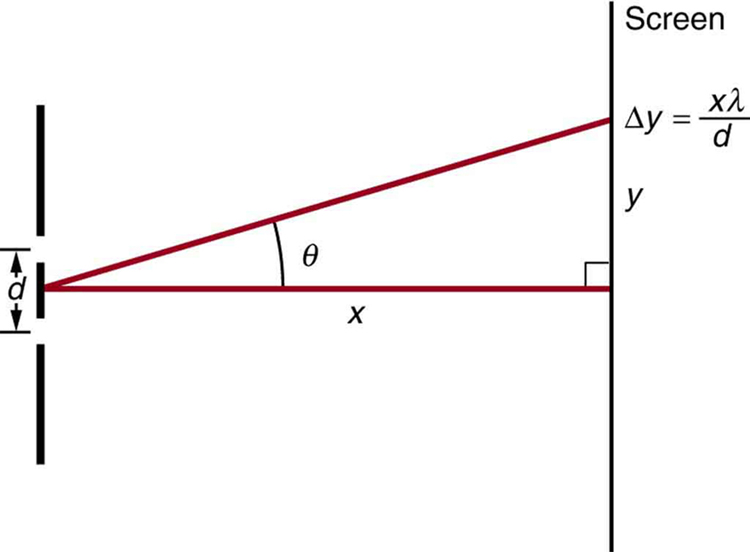
The analysis shown in the figure below also applies to diffraction gratings with lines separated by a distance $d$ . What is the distance between fringes produced by a diffraction grating having 125 lines per centimeter for 600-nm light, if the screen is 1.50 m away?
Strategy
Use the formula for fringe spacing: $\Delta y = x\lambda/d$, where x is the distance to the screen. First, find d from the line density, then calculate Δy.
Solution
Given:
Step 1: Find the grating spacing
Step 2: Calculate the fringe spacing
Using $\Delta y = \frac{x\lambda}{d}$:
Discussion
The fringe spacing of 1.13 cm is quite large and easily observable. This is because the grating has a relatively coarse spacing (125 lines/cm = 80 μm between lines), which is about 133 wavelengths. The formula Δy = xλ/d shows that:
With adjacent fringes separated by over 1 cm at a distance of 1.5 m, this pattern would be very easy to observe and measure. Finer gratings (more lines/cm) would produce smaller fringe spacings. For example, a 1000 lines/cm grating would have fringes separated by only 1.4 mm at the same distance.
Unreasonable Results
Red light of wavelength of 700 nm falls on a double slit separated by 400 nm. ( a) At what angle is the first-order maximum in the diffraction pattern? (b) What is unreasonable about this result? (c) Which assumptions are unreasonable or inconsistent?
Strategy
Use $d \sin \theta = m\lambda$ for double-slit interference with m = 1. Examine whether the result is physically possible.
Solution
(a) Angle for first-order maximum:
Given:
Using $d \sin \theta = m\lambda$:
This requires $\theta = \sin^{-1}(1.75)$, which is undefined (no solution exists).
(b) What is unreasonable about this result?
The sine function can only have values between -1 and +1 for real angles. A value of sin θ = 1.75 is impossible - there is no real angle whose sine equals 1.75. This means no first-order maximum can exist for this configuration.
(c) Which assumptions are unreasonable or inconsistent?
The unreasonable assumption is that a slit separation of 400 nm can produce an interference pattern for 700-nm light.
For a double-slit interference pattern to show at least one maximum (besides the central maximum), we need:
In this problem, d = 400 nm < λ = 700 nm. When the slit separation is smaller than the wavelength, no off-axis maxima can occur. The only observable feature would be the central maximum (m = 0), which exists for all wavelengths.
The inconsistency is assuming that red light (700 nm) with a relatively long wavelength can create a normal double-slit pattern with slits separated by only 400 nm. Either:
Discussion
This problem illustrates an important physical limitation: you cannot create interference patterns of a certain order if the wavelength exceeds the slit separation. In practical terms, attempting this experiment would result in only seeing a broad central diffraction maximum with no side fringes - essentially no interference pattern. This is why diffraction gratings and double-slit apparatus must have appropriate spacing for the wavelength being studied.
Unreasonable Results
(a) What visible wavelength has its fourth-order maximum at an angle of $25.0 \text{º}$ when projected on a 25 000-line-per-centimeter diffraction grating? (b) What is unreasonable about this result? (c) Which assumptions are unreasonable or inconsistent?
Strategy
Use $d \sin \theta = m\lambda$ to find the wavelength. First, calculate the grating spacing d from the line density, then solve for λ with m = 4. Examine whether the result makes sense.
Solution
(a) Calculate the wavelength:
Given:
Step 1: Find the grating spacing
Step 2: Find the wavelength
Using $d \sin \theta = m\lambda$:
(b) What is unreasonable about this result?
The calculated wavelength of 42.3 nm is NOT visible light. The visible spectrum ranges from approximately 380 nm (violet) to 760 nm (red). A wavelength of 42.3 nm falls in the extreme ultraviolet (EUV) range, which is far beyond what the human eye can detect. The problem asks for a “visible wavelength,” but the result is not visible at all.
(c) Which assumptions are unreasonable or inconsistent?
There are two unreasonable aspects to this problem:
1. The grating is too fine for visible light diffraction:
The grating spacing is only 400 nm, which is barely larger than the shortest visible wavelength (380 nm). For a fourth-order maximum to exist for visible light, we would need:
For the shortest visible wavelength (380 nm):
No visible wavelength can produce even a first-order maximum with a 400 nm grating spacing at any reasonable angle, let alone a fourth-order maximum at 25°.
2. Practical manufacturing limitations:
A grating with 25,000 lines/cm (d = 400 nm) is at the very edge of what can be manufactured using advanced nanofabrication techniques. While modern electron-beam lithography can achieve features around 50 nm, creating uniform, large-area diffraction gratings with such fine spacing is extremely challenging and expensive. Such gratings would be more suitable for X-ray or EUV spectroscopy, not visible light.
The inconsistent assumptions are:
Discussion
This problem highlights the importance of matching grating spacing to wavelength. The grating spacing should be several times larger than the wavelength of interest to produce observable higher-order maxima. A grating with d = 400 nm is appropriate for ultraviolet or extreme ultraviolet radiation (wavelengths < 100 nm), not for visible light. For visible light and fourth-order maxima, a grating with d ≥ 4 × 760 nm = 3040 nm (corresponding to ~3300 lines/cm or fewer) would be more appropriate.
Construct Your Own Problem
Consider a spectrometer based on a diffraction grating. Construct a problem in which you calculate the distance between two wavelengths of electromagnetic radiation in your spectrometer. Among the things to be considered are the wavelengths you wish to be able to distinguish, the number of lines per meter on the diffraction grating, and the distance from the grating to the screen or detector. Discuss the practicality of the device in terms of being able to discern between wavelengths of interest.