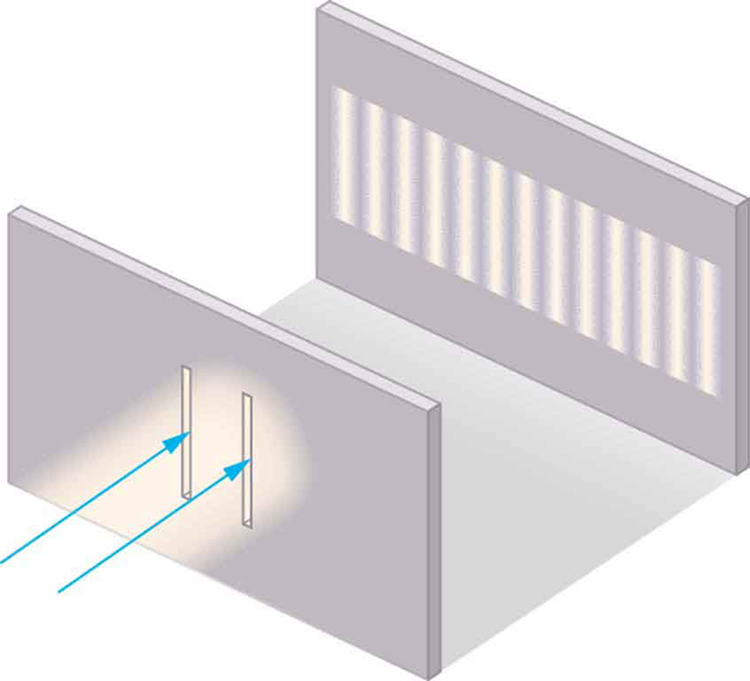
Although Christiaan Huygens thought that light was a wave, Isaac Newton did not. Newton felt that there were other explanations for color, and for the interference and diffraction effects that were observable at the time. Owing to Newton’s tremendous stature, his view generally prevailed. The fact that Huygens’s principle worked was not considered evidence that was direct enough to prove that light is a wave. The acceptance of the wave character of light came many years later when, in 1801, the English physicist and physician Thomas Young (1773–1829) did his now-classic double slit experiment ( see [Figure 1]).
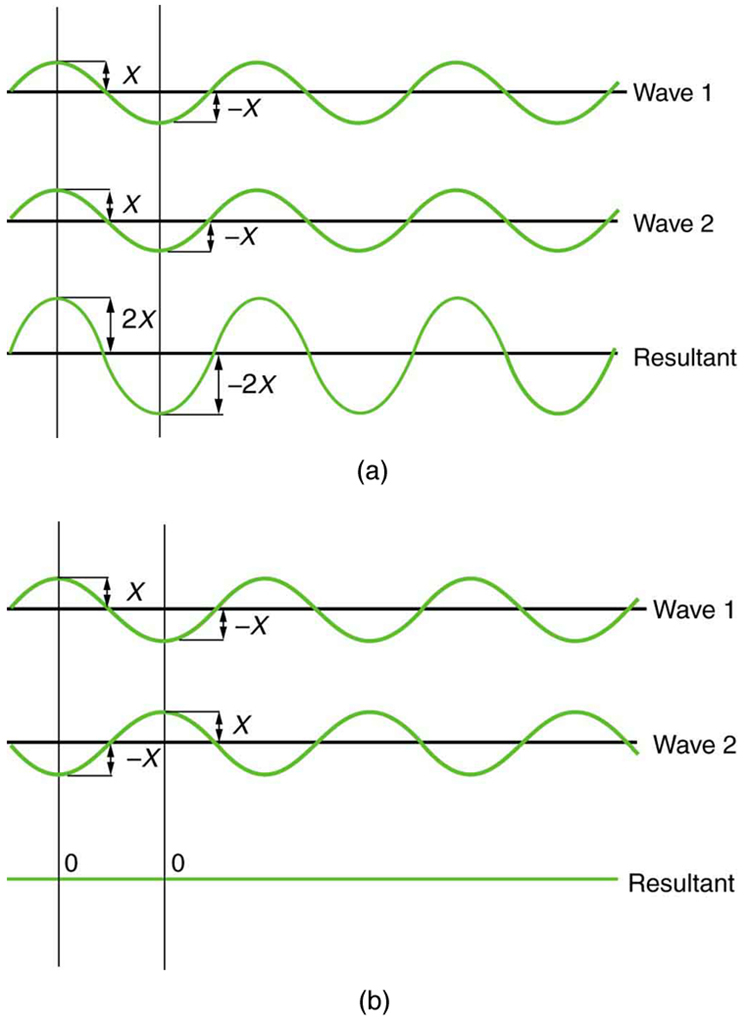
Why do we not ordinarily observe wave behavior for light, such as observed in Young’s double slit experiment? First, light must interact with something small, such as the closely spaced slits used by Young, to show pronounced wave effects. Furthermore, Young first passed light from a single source (the Sun) through a single slit to make the light somewhat coherent. By coherent, we mean waves are in phase or have a definite phase relationship. Incoherent means the waves have random phase relationships. Why did Young then pass the light through a double slit? The answer to this question is that two slits provide two coherent light sources that then interfere constructively or destructively. Young used sunlight, where each wavelength forms its own pattern, making the effect more difficult to see. We illustrate the double slit experiment with monochromatic (single $\lambda$ ) light to clarify the effect. [Figure 2] shows the pure constructive and destructive interference of two waves having the same wavelength and amplitude.
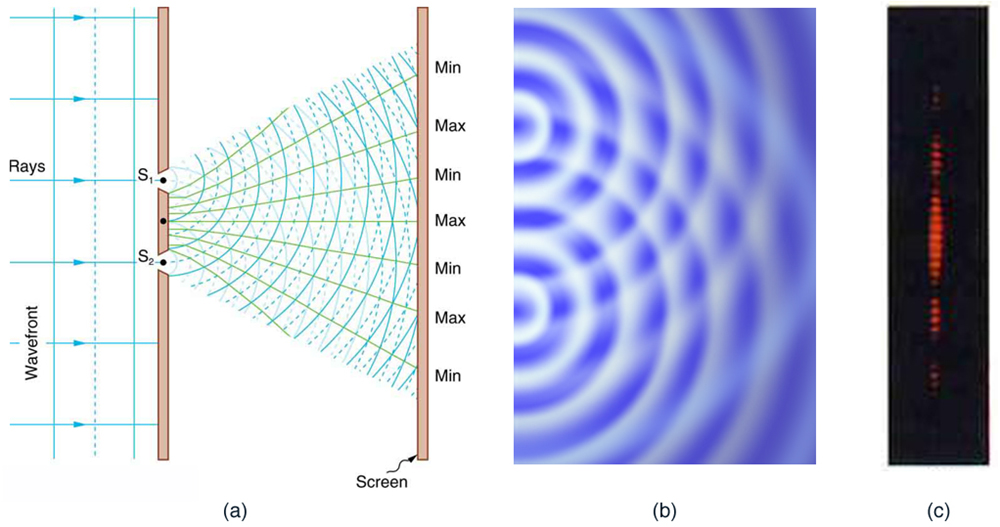
When light passes through narrow slits, it is diffracted into semicircular waves, as shown in [Figure 3](a). Pure constructive interference occurs where the waves are crest to crest or trough to trough. Pure destructive interference occurs where they are crest to trough. The light must fall on a screen and be scattered into our eyes for us to see the pattern. An analogous pattern for water waves is shown in [Figure 3](b). Note that regions of constructive and destructive interference move out from the slits at well-defined angles to the original beam. These angles depend on wavelength and the distance between the slits, as we shall see below.
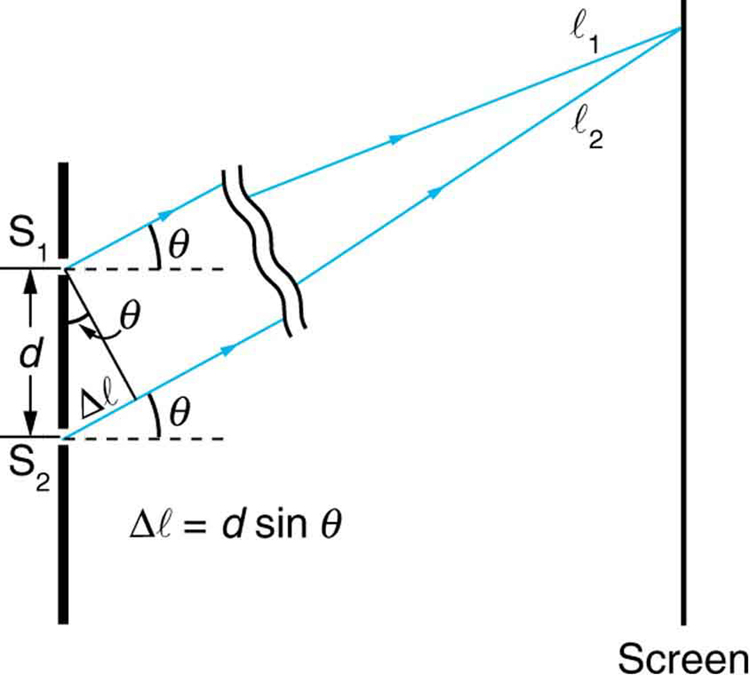
To understand the double slit interference pattern, we consider how two waves travel from the slits to the screen, as illustrated in [Figure 4]. Each slit is a different distance from a given point on the screen. Thus different numbers of wavelengths fit into each path. Waves start out from the slits in phase (crest to crest), but they may end up out of phase (crest to trough) at the screen if the paths differ in length by half a wavelength, interfering destructively as shown in [Figure 4](a). If the paths differ by a whole wavelength, then the waves arrive in phase (crest to crest) at the screen, interfering constructively as shown in [Figure 4](b). More generally, if the paths taken by the two waves differ by any half-integral number of wavelengths [ $\left(1/2\right)\lambda$ , $\left(3/2\right) \lambda$ , $\left(5/2\right)\lambda$ , etc.], then destructive interference occurs. Similarly, if the paths taken by the two waves differ by any integral number of wavelengths ( $\lambda$ , $2\lambda$ , $3\lambda$ , etc.), then constructive interference occurs.
Look at a light, such as a street lamp or incandescent bulb, through the narrow gap between two fingers held close together. What type of pattern do you see? How does it change when you allow the fingers to move a little farther apart? Is it more distinct for a monochromatic source, such as the yellow light from a sodium vapor lamp, than for an incandescent bulb?
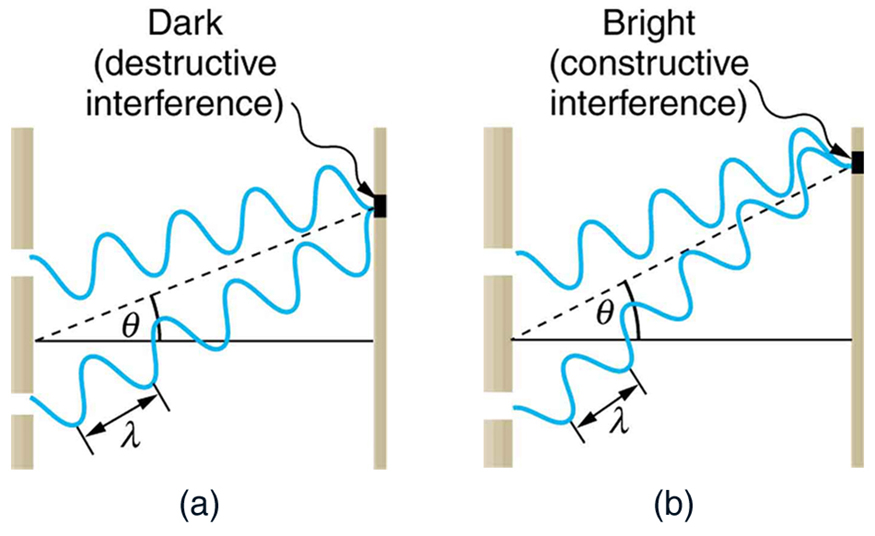
[Figure 5] shows how to determine the path length difference for waves traveling from two slits to a common point on a screen. If the screen is a large distance away compared with the distance between the slits, then the angle $\theta$ between the path and a line from the slits to the screen (see the figure) is nearly the same for each path. The difference between the paths is shown in the figure; simple trigonometry shows it to be $d \sin \theta$ , where $d$ is the distance between the slits. To obtain constructive interference for a double slit, the path length difference must be an integral multiple of the wavelength, or
Similarly, to obtain destructive interference for a double slit, the path length difference must be a half-integral multiple of the wavelength, or
where $\lambda$ is the wavelength of the light, $d$ is the distance between slits, and $\theta$ is the angle from the original direction of the beam as discussed above. We call $m$ the order of the interference. For example, $m=4$ is fourth-order interference.
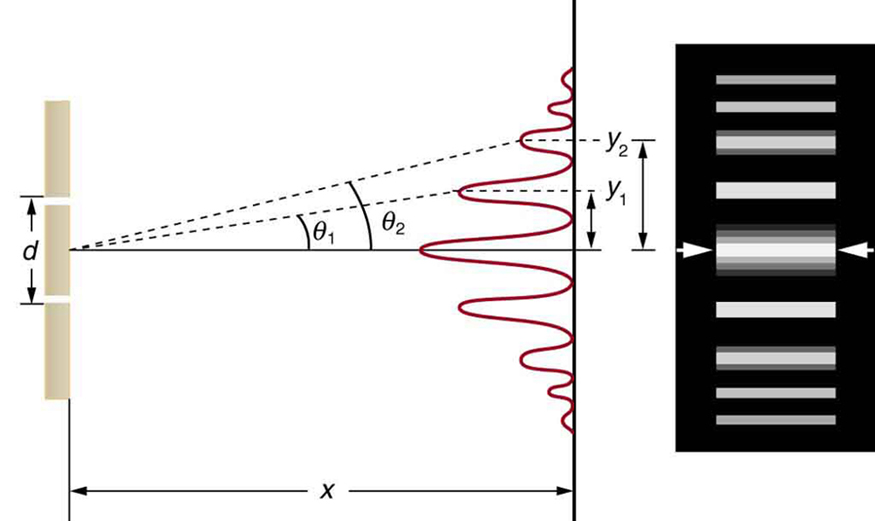
The equations for double slit interference imply that a series of bright and dark lines are formed. For vertical slits, the light spreads out horizontally on either side of the incident beam into a pattern called interference fringes, illustrated in [Figure 6]. The intensity of the bright fringes falls off on either side, being brightest at the center. The closer the slits are, the more is the spreading of the bright fringes. We can see this by examining the equation
For fixed $\lambda$ and $m$ , the smaller $d$ is, the larger $\theta$ must be, since $\sin \theta =m \lambda/d$ . This is consistent with our contention that wave effects are most noticeable when the object the wave encounters (here, slits a distance $d$ apart) is small. Small $d$ gives large $\theta$ , hence a large effect.
Suppose you pass light from a He-Ne laser through two slits separated by 0.0100 mm and find that the third bright line on a screen is formed at an angle of $10.95\text{º}$ relative to the incident beam. What is the wavelength of the light?
Strategy
The third bright line is due to third-order constructive interference, which means that $m=3$ . We are given $d= 0.0100 \text{mm}$ and $\theta =10.95\text{º}$ . The wavelength can thus be found using the equation $d \sin \theta =m \lambda$ for constructive interference.
Solution
The equation is $d \sin \theta =m \lambda$ . Solving for the wavelength $\lambda$ gives
Substituting known values yields
Discussion
To three digits, this is the wavelength of light emitted by the common He-Ne laser. Not by coincidence, this red color is similar to that emitted by neon lights. More important, however, is the fact that interference patterns can be used to measure wavelength. Young did this for visible wavelengths. This analytical technique is still widely used to measure electromagnetic spectra. For a given order, the angle for constructive interference increases with $\lambda$ , so that spectra (measurements of intensity versus wavelength) can be obtained.
Interference patterns do not have an infinite number of lines, since there is a limit to how big $m$ can be. What is the highest-order constructive interference possible with the system described in the preceding example?
Strategy and Concept
The equation $d \sin \theta =m \lambda \left( \text{ for } m=0, 1, -1, 2, -2, \dots \right)$ describes constructive interference. For fixed values of $d$ and $\lambda$ , the larger $m$ is, the larger $\sin \theta$ is. However, the maximum value that $\sin \theta$ can have is 1, for an angle of $90 ^\circ$ . (Larger angles imply that light goes backward and does not reach the screen at all.) Let us find which $m$ corresponds to this maximum diffraction angle.
Solution
Solving the equation $d\sin \theta =m \lambda$ for $m$ gives
Taking $\sin \theta =1$ and substituting the values of $d$ and $\lambda$ from the preceding example gives
Therefore, the largest integer $m$ can be is 15, or
Discussion
The number of fringes depends on the wavelength and slit separation. The number of fringes will be very large for large slit separations. However, if the slit separation becomes much greater than the wavelength, the intensity of the interference pattern changes so that the screen has two bright lines cast by the slits, as expected when light behaves like a ray. We also note that the fringes get fainter further away from the center. Consequently, not all 15 fringes may be observable.
Young’s double slit experiment breaks a single light beam into two sources. Would the same pattern be obtained for two independent sources of light, such as the headlights of a distant car? Explain.
Suppose you use the same double slit to perform Young’s double slit experiment in air and then repeat the experiment in water. Do the angles to the same parts of the interference pattern get larger or smaller? Does the color of the light change? Explain.
Is it possible to create a situation in which there is only destructive interference? Explain.
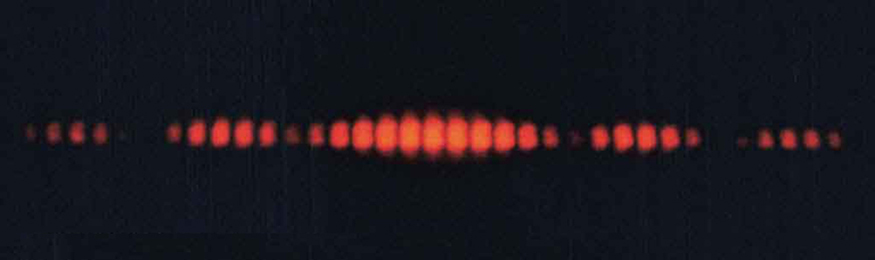
[Figure 7] shows the central part of the interference pattern for a pure wavelength of red light projected onto a double slit. The pattern is actually a combination of single slit and double slit interference. Note that the bright spots are evenly spaced. Is this a double slit or single slit characteristic? Note that some of the bright spots are dim on either side of the center. Is this a single slit or double slit characteristic? Which is smaller, the slit width or the separation between slits? Explain your responses.
At what angle is the first-order maximum for 450-nm wavelength blue light falling on double slits separated by 0.0500 mm?
Strategy
For constructive interference in a double slit experiment, we use $d \sin \theta = m\lambda$, where $m = 1$ for the first-order maximum. We need to solve for $\theta$.
Solution
Given:
Using the equation for constructive interference:
Solving for $\sin \theta$:
Therefore:
Discussion
The first-order maximum appears at a very small angle of 0.516°, which is typical for double slit experiments where the slit separation is much larger than the wavelength. The ratio $d/\lambda = 5.00 \times 10^{-5}/450 \times 10^{-9} \approx 111$, meaning the slit separation is about 111 wavelengths. This produces a closely-spaced interference pattern with many orders visible. The small angle validates using the small-angle approximation ($\sin \theta \approx \tan \theta \approx \theta$ in radians) commonly employed in double-slit calculations.
The first-order maximum for 450-nm blue light occurs at an angle of 0.516°.
Calculate the angle for the third-order maximum of 580-nm wavelength yellow light falling on double slits separated by 0.100 mm.
Strategy
For constructive interference in a double slit experiment, we use the equation $d \sin \theta = m\lambda$, where m = 3 for the third-order maximum. We need to solve for θ.
Solution
Given:
Using the equation for constructive interference:
Solving for $\sin \theta$:
Therefore:
Discussion
The angle is quite small, which is typical for double slit experiments where the slit separation is much larger than the wavelength. The third-order maximum appears at about 1°, meaning the maxima are closely spaced. This small angle justifies using the small angle approximation ($\sin \theta \approx \tan \theta \approx \theta$ in radians) in many double slit calculations.
What is the separation between two slits for which 610-nm orange light has its first maximum at an angle of $30.0º$ ?
Strategy
For constructive interference, we use $d \sin \theta = m\lambda$, where $m = 1$ for the first-order maximum. We solve for the slit separation $d$.
Solution
Given:
Using the equation for constructive interference:
Solving for $d$:
Discussion
The slit separation of 1.22 μm is only about twice the wavelength of the orange light (610 nm). This very small slit separation causes the interference pattern to spread out significantly - the first maximum appears at a large angle of 30°. With such a small $d$, only a few orders of maxima would be observable before reaching $\theta = 90°$. This demonstrates the inverse relationship between slit separation and angular spread: smaller $d$ produces larger angles for a given order.
The slit separation is $1.22 \times 10^{-6}$ m or 1.22 μm.
Find the distance between two slits that produces the first minimum for 410-nm violet light at an angle of $45.0º$.
Strategy
For destructive interference (minima) in a double slit experiment, we use $d \sin \theta = (m + \frac{1}{2})\lambda$. For the first minimum, m = 0, so $d \sin \theta = \frac{\lambda}{2}$. We solve for d.
Solution
Given:
Using the equation for destructive interference:
Solving for d:
Discussion
This slit separation is remarkably small - less than the wavelength of visible light! At such a small separation (d < λ), only the central maximum and perhaps one or two orders would be visible before reaching 90°. The fact that the first minimum occurs at 45° indicates that this is a very closely spaced double slit. Such small separations are at the limits of conventional optical fabrication and would require specialized techniques like electron beam lithography to create.
Calculate the wavelength of light that has its third minimum at an angle of $30.0º$ when falling on double slits separated by $3.00 \text{μm}$ . Explicitly, show how you follow the steps in Problem-Solving Strategies for Wave Optics.
Strategy
Following the Problem-Solving Strategy for Wave Optics:
Step 1: This is a double-slit interference problem involving destructive interference (minimum).
Step 2: For destructive interference (minima) in double-slit experiments: $d \sin \theta = \left(m + \frac{1}{2}\right)\lambda$, where m = 0, 1, 2, … For the third minimum, m = 2.
Step 3: We need to find the wavelength λ.
Step 4: Given information: θ = 30.0°, d = 3.00 μm, m = 2 (third minimum).
Solution
For the third minimum, m = 2. Using the destructive interference equation:
Solving for λ:
Substituting the values:
Step 5: Check reasonableness: The wavelength of 600 nm is in the orange part of the visible spectrum (visible light ranges from ~380-760 nm), which is reasonable.
Discussion
The calculated wavelength of 600 nm corresponds to orange light, which is within the visible spectrum. The third minimum occurs at the relatively large angle of 30°, indicating that the slit separation (3.00 μm) is only a few wavelengths wide (specifically, d/λ = 5). This configuration produces a well-spread interference pattern.
It’s important to note that for minima (destructive interference), we use $d \sin \theta = \left(m + \frac{1}{2}\right)\lambda$ with m = 0, 1, 2, … so the third minimum corresponds to m = 2. This gives us 2.5λ path difference, which produces destructive interference when the two waves arrive 180° out of phase.
Answer
The wavelength is 600 nm (orange light).
What is the wavelength of light falling on double slits separated by $2.00 \text{μm}$ if the third-order maximum is at an angle of $60.0º$ ?
Strategy
For constructive interference at the third-order maximum (m = 3), we use $d \sin \theta = m\lambda$ and solve for the wavelength λ.
Solution
Given:
Using the equation for constructive interference:
Solving for λ:
Discussion
This wavelength of 577 nm corresponds to yellow-green light, in the middle of the visible spectrum. The relatively large angle (60°) for the third-order maximum indicates that the slit separation (2.00 μm) is only a few wavelengths wide. This setup would produce a well-spread interference pattern with several visible orders. The result is reasonable because visible light wavelengths range from about 380-760 nm, and our answer falls within this range.
At what angle is the fourth-order maximum for the situation in [Exercise 1]?
Strategy
From Exercise 1, we have 450-nm wavelength blue light falling on double slits separated by 0.0500 mm. We use the constructive interference equation $d \sin \theta = m\lambda$ with m = 4 for the fourth-order maximum.
Solution
Given (from Exercise 1):
Using the equation for constructive interference:
Solving for $\sin \theta$:
Therefore:
Discussion
The fourth-order maximum appears at 2.06°, which is four times the angle of the first-order maximum (0.516° from Exercise 1). This linear relationship ($\theta_m \approx m\theta_1$ for small angles) is characteristic of the small-angle approximation, where $\sin \theta \approx \theta$ in radians. The angle is still quite small, confirming that many orders of maxima are visible in this double-slit configuration. The slit separation being about 111 wavelengths allows for many observable interference fringes.
Answer
The fourth-order maximum occurs at 2.06°.
What is the highest-order maximum for 400-nm light falling on double slits separated by $25.0 \text{μm}$ ?
Strategy
The highest-order maximum occurs when $\sin \theta$ approaches its maximum value of 1 (at θ = 90°). We use $d \sin \theta = m\lambda$ with $\sin \theta = 1$ and solve for the maximum integer value of m.
Solution
Given:
The condition for constructive interference is:
For the maximum order, $\sin \theta = 1$, so:
Since m must be an integer, the highest-order maximum is:
Discussion
With such a large slit separation compared to the wavelength (d/λ ≈ 62.5), this double slit system can produce 62 orders of maxima on each side of the central maximum, plus the central maximum itself, for a total of 125 bright fringes. This large number of fringes would be very closely spaced. In practice, not all of these might be observable due to:
The 62nd order maximum would appear at $\theta = \sin^{-1}(62 \times 400/25000) = \sin^{-1}(0.992) \approx 82.9°$.
Find the largest wavelength of light falling on double slits separated by $1.20 \text{μm}$ for which there is a first-order maximum. Is this in the visible part of the spectrum?
Strategy
For a first-order maximum to exist, the angle θ must be less than or equal to 90° (where $\sin \theta \leq 1$). The largest wavelength occurs when $\sin \theta = 1$ at θ = 90°. We use $d \sin \theta = m\lambda$ with m = 1 and $\sin \theta = 1$ to find the maximum wavelength.
Solution
Given:
Using the equation for constructive interference:
Solving for the maximum wavelength:
Is this visible?
The visible spectrum ranges from approximately 380 nm (violet) to 760 nm (red). Since 1200 nm > 760 nm, this wavelength is not in the visible part of the spectrum. It falls in the near-infrared region.
Discussion
The result shows that the largest wavelength for which a first-order maximum can occur equals the slit separation itself. Any wavelength larger than 1200 nm would require $\sin \theta > 1$ for the first-order maximum, which is physically impossible.
At 1200 nm, the first-order maximum would appear at exactly 90° (parallel to the slits), making it impossible to observe in practice. Wavelengths just slightly smaller than this would have first-order maxima at angles approaching 90°, also difficult to detect.
This wavelength is in the near-infrared part of the electromagnetic spectrum, which is invisible to the human eye but can be detected by infrared cameras or sensors. Such wavelengths are used in applications like night vision and infrared spectroscopy.
Answer
The largest wavelength is 1200 nm, which is not visible (it’s in the near-infrared region).
What is the smallest separation between two slits that will produce a second-order maximum for 720-nm red light?
Strategy
For a second-order maximum to be observable, it must occur at an angle less than 90°. The smallest slit separation occurs when the second-order maximum appears at exactly θ = 90° (where $\sin \theta = 1$). We use $d \sin \theta = m\lambda$ with m = 2 and $\sin \theta = 1$.
Solution
Given:
Using the equation for constructive interference:
With $\sin 90° = 1$:
Discussion
If the slit separation were smaller than 1.44 μm, the second-order maximum would require $\sin \theta > 1$, which is impossible. Therefore, 1.44 μm is the minimum separation needed to observe a second-order maximum with 720-nm light.
For this minimum separation:
This means the second-order maximum would barely be observable at the edge of the interference pattern. For practical observation, the slit separation should be somewhat larger than this minimum value. This principle is important in designing diffraction gratings and other optical devices where specific orders need to be observable.
(a) What is the smallest separation between two slits that will produce a second-order maximum for any visible light? (b) For all visible light?
Strategy
The visible spectrum ranges from approximately 380 nm (violet) to 760 nm (red). For part (a), we need the smallest slit separation that allows a second-order maximum for any visible wavelength - this means at least one wavelength can show a second-order maximum. For part (b), we need the smallest separation for all visible wavelengths - meaning even the longest wavelength (red, 760 nm) can show a second-order maximum.
Solution
For a second-order maximum at the limiting angle of 90°:
(a) For ANY visible light:
The shortest visible wavelength (violet, ~380 nm) requires the smallest slit separation to produce a second-order maximum:
With this separation, violet light can just produce a second-order maximum at 90°. Longer wavelengths (green, red, etc.) would require even larger separations, so they would not have visible second-order maxima.
(b) For ALL visible light:
To ensure all visible wavelengths (including the longest, red at ~760 nm) can produce a second-order maximum:
With this separation:
Discussion
Part (a) asks for the minimum separation to observe any visible second-order maximum. Since violet has the shortest wavelength, it requires the smallest slit separation (760 nm). With slits separated by 760 nm, only violet light would show a second-order maximum (at 90°), while longer wavelengths would not.
Part (b) asks for the minimum separation to observe second-order maxima for all visible wavelengths. This requires accommodating the longest wavelength (red at 760 nm), giving d = 1520 nm. With this separation:
All visible wavelengths would have observable second-order maxima.
Answer
(a) 760 nm (for any visible light)
(b) 1520 nm or 1.52 μm (for all visible light)
(a) If the first-order maximum for pure-wavelength light falling on a double slit is at an angle of $10.0º$ , at what angle is the second-order maximum? (b) What is the angle of the first minimum? (c) What is the highest-order maximum possible here?
Strategy
From the first-order maximum, we can find the ratio d/λ. We then use this ratio to find (a) the second-order maximum angle, (b) the first minimum angle, and (c) the highest possible order.
Solution
(a) Second-order maximum:
For the first-order maximum:
So:
For the second-order maximum (m = 2):
(b) First minimum:
For the first minimum, $m = 0$, so:
(c) Highest-order maximum:
The maximum order occurs when $\sin \theta = 1$:
Since m must be an integer:
Discussion
The results show logical progression: the first minimum at 5.0° falls between the central maximum (0°) and the first-order maximum (10.0°). The second-order maximum at 20.3° is roughly twice the angle of the first-order (this approximation works well for small angles). The system can support up to 5 orders on each side of center. We can verify: $\sin^{-1}(5/5.759) = \sin^{-1}(0.868) = 60.2°$, which is less than 90°, confirming that the 5th order is observable.
[Figure 8] shows a double slit located a distance $x$ from a screen, with the distance from the center of the screen given by $y$ . When the distance $d$ between the slits is relatively large, there will be numerous bright spots, called fringes. Show that, for small angles (where $\sin \theta \approx \theta$ , with $\theta$ in radians), the distance between fringes is given by $\Delta y= x\lambda /d$.
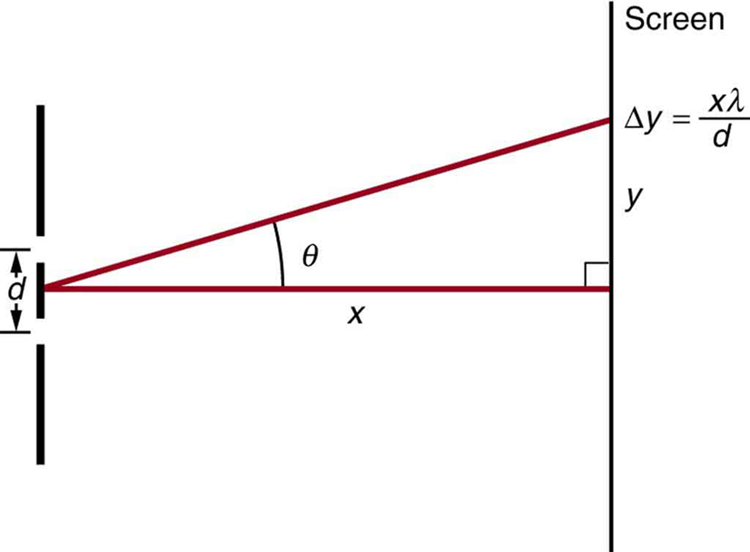
For small angles $\sin \theta -\tan \theta \approx \theta \left(\text{in radians}\right)$.
For two adjacent fringes we have,
and
Subtracting these equations gives
Using the result of the problem above, calculate the distance between fringes for 633-nm light falling on double slits separated by 0.0800 mm, located 3.00 m from a screen as in [Figure 8].
Strategy
From the previous problem, we derived that the fringe spacing is $\Delta y = \frac{x\lambda}{d}$ for small angles. We apply this formula with the given values.
Solution
Given:
Using the fringe spacing formula:
Discussion
The fringe spacing of 23.7 mm (about 2.4 cm) is easily observable with the naked eye. This relatively large spacing results from:
The ratio x/d = 3.00 m / 0.0800 mm = 37,500 is very large, which greatly magnifies the fringe pattern.
We can verify our result makes sense by checking the small angle approximation. For the first-order maximum: $\sin \theta_1 = \lambda/d = 633 \times 10^{-9} / 8.00 \times 10^{-5} = 7.91 \times 10^{-3}$
This gives $\theta_1 = 0.453°$, which is indeed small, validating our use of the small angle approximation. The angle can also be found from $\tan \theta_1 = y_1/x = 0.0237/3.00 = 7.90 \times 10^{-3}$, confirming our calculation.
Using the result of the problem two problems prior, find the wavelength of light that produces fringes 7.50 mm apart on a screen 2.00 m from double slits separated by 0.120 mm (see [Figure 8]).
Strategy
From the problem two problems prior, the distance between adjacent fringes is given by $\Delta y = \frac{x\lambda}{d}$, where x is the distance to the screen, λ is the wavelength, and d is the slit separation. We solve for λ.
Solution
Given:
Using the fringe spacing formula:
Solving for λ:
Substituting the values:
Discussion
The wavelength of 450 nm corresponds to blue light, which is in the visible spectrum (approximately 380-760 nm). The fringe spacing of 7.50 mm is quite large and easily observable, making this a practical double-slit experiment setup.
The relatively large fringe separation results from the combination of:
This formula $\Delta y = x\lambda/d$ is derived from the small-angle approximation and shows that fringe spacing is directly proportional to both the wavelength and screen distance, and inversely proportional to the slit separation. This relationship is fundamental to understanding interference patterns in double-slit experiments.
Answer
The wavelength is 450 nm (blue light).