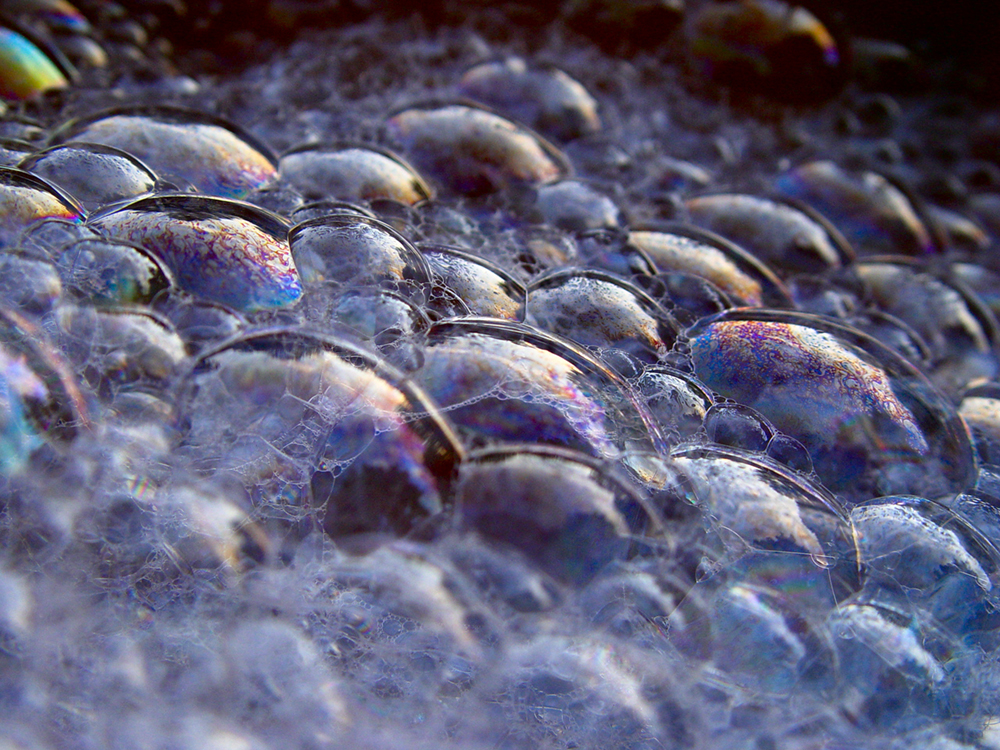
The bright colors seen in an oil slick floating on water or in a sunlit soap bubble are caused by interference. The brightest colors are those that interfere constructively. This interference is between light reflected from different surfaces of a thin film; thus, the effect is known as thin film interference . As noticed before, interference effects are most prominent when light interacts with something having a size similar to its wavelength. A thin film is one having a thickness $t$ smaller than a few times the wavelength of light, $\lambda$ . Since color is associated indirectly with $\lambda$ and since all interference depends in some way on the ratio of $\lambda$ to the size of the object involved, we should expect to see different colors for different thicknesses of a film, as in [Figure 1].
What causes thin film interference? [Figure 2] shows how light reflected from the top and bottom surfaces of a film can interfere. Incident light is only partially reflected from the top surface of the film (ray 1). The remainder enters the film and is itself partially reflected from the bottom surface. Part of the light reflected from the bottom surface can emerge from the top of the film (ray 2) and interfere with light reflected from the top (ray 1). Since the ray that enters the film travels a greater distance, it may be in or out of phase with the ray reflected from the top. However, consider for a moment, again, the bubbles in [Figure 1]. The bubbles are darkest where they are thinnest. Furthermore, if you observe a soap bubble carefully, you will note it gets dark at the point where it breaks. For very thin films, the difference in path lengths of ray 1 and ray 2 in [Figure 2] is negligible; so why should they interfere destructively and not constructively? The answer is that a phase change can occur upon reflection. The rule is as follows:
When light reflects from a medium having an index of refraction greater than that of the medium in which it is traveling, a $180 ^\circ$ phase change ( or a $\lambda /2$ shift) occurs.
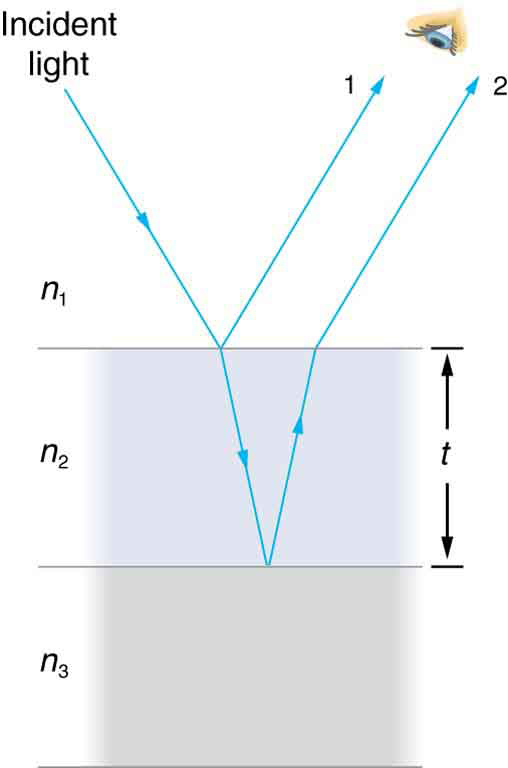
If the film in [Figure 2] is a soap bubble (essentially water with air on both sides), then there is a $\lambda /2$ shift for ray 1 and none for ray 2. Thus, when the film is very thin, the path length difference between the two rays is negligible, they are exactly out of phase, and destructive interference will occur at all wavelengths and so the soap bubble will be dark here.
The thickness of the film relative to the wavelength of light is the other crucial factor in thin film interference. Ray 2 in [Figure 2] travels a greater distance than ray 1. For light incident perpendicular to the surface, ray 2 travels a distance approximately $2t$ farther than ray 1. When this distance is an integral or half-integral multiple of the wavelength in the medium ( ${\lambda }_{n}=\lambda /n$ , where $\lambda$ is the wavelength in vacuum and $n$ is the index of refraction), constructive or destructive interference occurs, depending also on whether there is a phase change in either ray.
Thin-film interference has created an entire field of research and industrial applications. Its foundations were laid by Irving Langmuir and Katharine Burr Blodgett, working at General Electric in the 1920s and 1930s. Langmuir had pioneered a method for producing ultra-thin layers on materials. Blodgett built on these practices by creating a method to precisely stack and compress these layers in order to produce a film of a desired thickness and quality. The device they developed became known as the Langmuir-Blodgett trough, built from principles developed by Agnes Pockels and still used in laboratories today. The earliest widely applied use of these principles was non-reflective glass, which Blodgett patented in 1938 and which was used almost immediately in the making of the film Gone With the Wind. The film is viewed as a tremendous leap in cinematography; cameras, microscopes, telescopes, and many other instruments rely on Blodgett’s invention as well.
Sophisticated cameras use a series of several lenses. Light can reflect from the surfaces of these various lenses and degrade image clarity. To limit these reflections, lenses are coated with a thin layer of magnesium fluoride that causes destructive thin film interference. What is the thinnest this film can be, if its index of refraction is 1.38 and it is designed to limit the reflection of 550-nm light, normally the most intense visible wavelength? The index of refraction of glass is 1.52.
Strategy
Refer to [Figure 2] and use ${n}_{1}=1.00$ for air, ${n}_{2}=1.38$ , and ${n}_{3}=1.52$ . Both ray 1 and ray 2 will have a $\lambda /2$ shift upon reflection. Thus, to obtain destructive interference, ray 2 will need to travel a half wavelength farther than ray 1. For rays incident perpendicularly, the path length difference is $2t$.
Solution
To obtain destructive interference here,
where ${\lambda }_{ {n}_{2}}$ is the wavelength in the film and is given by ${\lambda }_{ {n}_{2}}=\frac{\lambda }{ {n}_{2}}$.
Thus,
Solving for $t$ and entering known values yields
Discussion
Films such as the one in this example are most effective in producing destructive interference when the thinnest layer is used, since light over a broader range of incident angles will be reduced in intensity. These films are called non-reflective coatings; this is only an approximately correct description, though, since other wavelengths will only be partially cancelled. Non-reflective coatings are used in car windows and sunglasses.
Thin film interference is most constructive or most destructive when the path length difference for the two rays is an integral or half-integral wavelength, respectively. That is, for rays incident perpendicularly, $2t={\lambda }_{n}, {2\lambda }_{n}, {3\lambda }_{n},\dots$ or $2t={\lambda }_{n}/2, {3\lambda }_{n}/2, {5\lambda }_{n}/2,\dots$ . To know whether interference is constructive or destructive, you must also determine if there is a phase change upon reflection. Thin film interference thus depends on film thickness, the wavelength of light, and the refractive indices. For white light incident on a film that varies in thickness, you will observe rainbow colors of constructive interference for various wavelengths as the thickness varies.
(a) What are the three smallest thicknesses of a soap bubble that produce constructive interference for red light with a wavelength of 650 nm? The index of refraction of soap is taken to be the same as that of water. (b) What three smallest thicknesses will give destructive interference?
Strategy and Concept
Use [Figure 2] to visualize the bubble. Note that ${n}_{1}={n}_{3}=1.00$ for air, and ${n}_{2}=1.333$ for soap (equivalent to water). There is a $\lambda /2$ shift for ray 1 reflected from the top surface of the bubble, and no shift for ray 2 reflected from the bottom surface. To get constructive interference, then, the path length difference ( $2t$ ) must be a half-integral multiple of the wavelength—the first three being ${\lambda }_{n}/2, {3\lambda }_{n}/2$ , and ${5\lambda }_{n}/2$ . To get destructive interference, the path length difference must be an integral multiple of the wavelength—the first three being $0, {\lambda }_{n}$ , and ${2\lambda }\_{n}$.
Solution for (a)
Constructive interference occurs here when
The smallest constructive thickness ${t}_{\text{c}}$ thus is
The next thickness that gives constructive interference is $t^{\prime}_{\text{c}}={3\lambda }_{n}/4$ , so that
Finally, the third thickness producing constructive interference is ${t^{\prime\prime} }_{\text{c}}= {5\lambda }_{n}/4$ , so that
Solution for (b)
For destructive interference, the path length difference here is an integral multiple of the wavelength. The first occurs for zero thickness, since there is a phase change at the top surface. That is,
The first non-zero thickness producing destructive interference is
Substituting known values gives
Finally, the third destructive thickness is $2{t^{\prime\prime} }_{\text{d}}={2\lambda }_{n}$ , so that
Discussion
If the bubble was illuminated with pure red light, we would see bright and dark bands at very uniform increases in thickness. First would be a dark band at 0 thickness, then bright at 122 nm thickness, then dark at 244 nm, bright at 366 nm, dark at 488 nm, and bright at 610 nm. If the bubble varied smoothly in thickness, like a smooth wedge, then the bands would be evenly spaced.
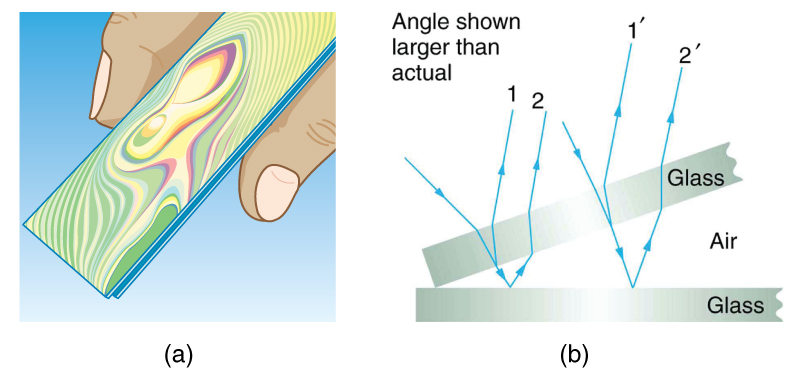
Another example of thin film interference can be seen when microscope slides are separated (see [Figure 3]). The slides are very flat, so that the wedge of air between them increases in thickness very uniformly. A phase change occurs at the second surface but not the first, and so there is a dark band where the slides touch. The rainbow colors of constructive interference repeat, going from violet to red again and again as the distance between the slides increases. As the layer of air increases, the bands become more difficult to see, because slight changes in incident angle have greater effects on path length differences. If pure-wavelength light instead of white light is used, then bright and dark bands are obtained rather than repeating rainbow colors.
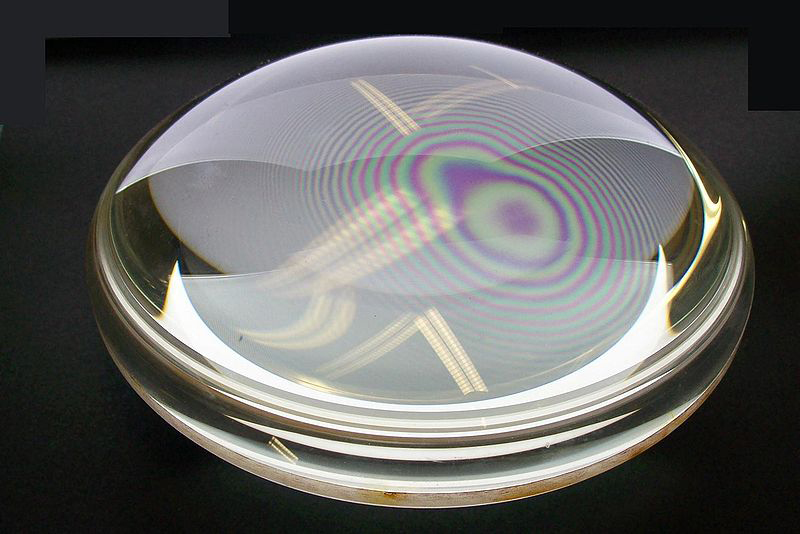
An important application of thin film interference is found in the manufacturing of optical instruments. A lens or mirror can be compared with a master as it is being ground, allowing it to be shaped to an accuracy of less than a wavelength over its entire surface. [Figure 4] illustrates the phenomenon called Newton’s rings, which occurs when the plane surfaces of two lenses are placed together. (The circular bands are called Newton’s rings because Isaac Newton described them and their use in detail. Newton did not discover them; Robert Hooke did, and Newton did not believe they were due to the wave character of light.) Each successive ring of a given color indicates an increase of only one wavelength in the distance between the lens and the blank, so that great precision can be obtained. Once the lens is perfect, there will be no rings.
The wings of certain moths and butterflies have nearly iridescent colors due to thin film interference. In addition to pigmentation, the wing’s color is affected greatly by constructive interference of certain wavelengths reflected from its film-coated surface. Car manufacturers are offering special paint jobs that use thin film interference to produce colors that change with angle. This expensive option is based on variation of thin film path length differences with angle. Security features on credit cards, banknotes, driving licenses and similar items prone to forgery use thin film interference, diffraction gratings, or holograms. Australia led the way with dollar bills printed on polymer with a diffraction grating security feature making the currency difficult to forge. Other countries such as New Zealand and Taiwan are using similar technologies, while the United States currency includes a thin film interference effect.
One feature of thin film interference and diffraction gratings is that the pattern shifts as you change the angle at which you look or move your head. Find examples of thin film interference and gratings around you. Explain how the patterns change for each specific example. Find examples where the thickness changes giving rise to changing colors. If you can find two microscope slides, then try observing the effect shown in [Figure 2]. Try separating one end of the two slides with a hair or maybe a thin piece of paper and observe the effect.
Step 1. Examine the situation to determine that interference is involved. Identify whether slits or thin film interference are considered in the problem.
Step 2. If slits are involved, note that diffraction gratings and double slits produce very similar interference patterns, but that gratings have narrower (sharper) maxima. Single slit patterns are characterized by a large central maximum and smaller maxima to the sides.
Step 3. If thin film interference is involved, take note of the path length difference between the two rays that interfere. Be certain to use the wavelength in the medium involved, since it differs from the wavelength in vacuum. Note also that there is an additional $\lambda /2$ phase shift when light reflects from a medium with a greater index of refraction.
Step 4. Identify exactly what needs to be determined in the problem ( identify the unknowns). A written list is useful. Draw a diagram of the situation. Labeling the diagram is useful.
Step 5. Make a list of what is given or can be inferred from the problem as stated (identify the knowns).
Step 6. Solve the appropriate equation for the quantity to be determined ( the unknown), and enter the knowns. Slits, gratings, and the Rayleigh limit involve equations.
Step 7. For thin film interference, you will have constructive interference for a total shift that is an integral number of wavelengths. You will have destructive interference for a total shift of a half-integral number of wavelengths. Always keep in mind that crest to crest is constructive whereas crest to trough is destructive.
Step 8. Check to see if the answer is reasonable: Does it make sense? Angles in interference patterns cannot be greater than $90 ^\circ$ , for example.
What effect does increasing the wedge angle have on the spacing of interference fringes? If the wedge angle is too large, fringes are not observed. Why?
How is the difference in paths taken by two originally in-phase light waves related to whether they interfere constructively or destructively? How can this be affected by reflection? By refraction?
Is there a phase change in the light reflected from either surface of a contact lens floating on a person’s tear layer? The index of refraction of the lens is about 1.5, and its top surface is dry.
In placing a sample on a microscope slide, a glass cover is placed over a water drop on the glass slide. Light incident from above can reflect from the top and bottom of the glass cover and from the glass slide below the water drop. At which surfaces will there be a phase change in the reflected light?
Answer the above question if the fluid between the two pieces of crown glass is carbon disulfide.
While contemplating the food value of a slice of ham, you notice a rainbow of color reflected from its moist surface. Explain its origin.
An inventor notices that a soap bubble is dark at its thinnest and realizes that destructive interference is taking place for all wavelengths. How could she use this knowledge to make a non-reflective coating for lenses that is effective at all wavelengths? That is, what limits would there be on the index of refraction and thickness of the coating? How might this be impractical?
A non-reflective coating like the one described in [Example 1] works ideally for a single wavelength and for perpendicular incidence. What happens for other wavelengths and other incident directions? Be specific.
Why is it much more difficult to see interference fringes for light reflected from a thick piece of glass than from a thin film? Would it be easier if monochromatic light were used?
A soap bubble is 100 nm thick and illuminated by white light incident perpendicular to its surface. What wavelength and color of visible light is most constructively reflected, assuming the same index of refraction as water?
Strategy
For thin film interference in a soap bubble, we need to consider phase changes at both surfaces. The soap bubble has air on both sides with soapy water (n ≈ 1.33) as the film. Light reflects from the outer surface (air to soap, n increases) causing a phase change, and from the inner surface (soap to air, n decreases) with no phase change. With one net phase change, constructive interference occurs when: $2tn = (m + \frac{1}{2})\lambda$, where m = 0, 1, 2, …
Solution
Given:
For constructive interference with one phase change:
Solving for wavelength:
Calculate for different orders:
For $m = 0$:
For $m = 1$:
The wavelength most constructively reflected is 532 nm, which corresponds to green light.
Discussion
The wavelength of 532 nm falls in the middle of the visible spectrum (green region: approximately 495-570 nm), which makes sense for a soap bubble of this thickness. This is why soap bubbles often show brilliant green colors when they reach this particular thickness. Higher orders (m = 1, 2, …) produce wavelengths in the ultraviolet range that are not visible to the human eye. As the bubble thickness changes due to gravity and evaporation, different colors appear, creating the characteristic rainbow effect. Thinner bubbles appear blue or violet, while thicker bubbles show red or orange colors.
An oil slick on water is 120 nm thick and illuminated by white light incident perpendicular to its surface. What color does the oil appear (what is the most constructively reflected wavelength), given its index of refraction is 1.40?
Strategy
For thin film interference, we need to consider phase changes at interfaces. At the air-oil interface (n = 1.00 to n = 1.40), there IS a phase change. At the oil-water interface (n = 1.40 to n = 1.33), there is NO phase change (going from higher to lower n). With one phase change, constructive interference occurs when: $2tn = (m + \frac{1}{2})\lambda$
Solution
Given:
For constructive interference (with one phase change):
Solving for λ:
Calculate for different orders:
Discussion
The oil appears red with λ = 672 nm. This is the only visible wavelength that experiences strong constructive interference. The color falls in the red portion of the visible spectrum (roughly 620-750 nm). This is why oil slicks display colorful patterns - different thicknesses reflect different colors, creating the characteristic rainbow appearance.
Calculate the minimum thickness of an oil slick on water that appears blue when illuminated by white light perpendicular to its surface. Take the blue wavelength to be 470 nm and the index of refraction of oil to be 1.40.
Strategy
This is a thin film interference problem with oil on water. At the air-oil interface (n increases from 1.00 to 1.40), there is a phase change. At the oil-water interface (n decreases from 1.40 to 1.33), there is no phase change. With one net phase change, constructive interference occurs when: $2tn = (m + \frac{1}{2})\lambda$. For minimum thickness, we use m = 0.
Solution
Given:
For constructive interference with one phase change:
With $m = 0$:
Solving for thickness:
The minimum thickness of the oil slick that appears blue is 83.9 nm.
Discussion
This thickness of 83.9 nm is very thin—less than one-fifth the wavelength of blue light in air. This quarter-wavelength condition ($\lambda/4n$) is characteristic of minimum thickness for constructive interference with one phase change. Oil slicks on water typically vary in thickness across their surface, which is why they display rainbow patterns with different colors in different regions. The thinnest regions (around 84 nm) appear blue, while thicker regions appear green, yellow, orange, or red. Very thin regions (less than about 50 nm) may appear dark or black because they create destructive interference for all visible wavelengths.
Find the minimum thickness of a soap bubble that appears red when illuminated by white light perpendicular to its surface. Take the wavelength to be 680 nm, and assume the same index of refraction as water.
Strategy
A soap bubble is a thin film with air on both sides. There are phase changes at both the outer surface (air to soap, n increases) and inner surface (soap to air, n decreases)… wait, actually the inner surface goes from soap (n = 1.33) back to air (n = 1.00), so there’s NO phase change there. Actually, let me reconsider: for a soap bubble, light reflects from both the outer and inner surfaces. The outer reflection (air n=1 to soap n=1.33) HAS a phase change. The inner reflection (soap n=1.33 to air n=1) has NO phase change. So overall, there’s ONE phase change.
With one phase change, constructive interference: $2tn = (m + \frac{1}{2})\lambda$
For minimum thickness, use m = 0.
Solution
Given:
For constructive interference with one phase change:
With m = 0:
Discussion
The minimum thickness is 128 nm, which is quite thin - less than the wavelength of red light in air. This quarter-wavelength condition (λ/4n) is characteristic of thin film interference with one phase change. Soap bubbles display beautiful colors because different thicknesses in different regions reflect different wavelengths. As a soap bubble drains and thins, it progresses through colors from red → yellow → green → blue before becoming essentially colorless and then black just before popping.
A film of soapy water ( $n=1.33$ ) on top of a plastic cutting board has a thickness of 233 nm. What color is most strongly reflected if it is illuminated perpendicular to its surface?
Strategy
For this thin film problem, we have soapy water (n = 1.33) on a plastic cutting board (n ≈ 1.49). At the air-soap interface (n increases from 1.00 to 1.33), there is a phase change. At the soap-plastic interface (n increases from 1.33 to 1.49), there is also a phase change. With two phase changes, they cancel out, giving no net phase change. For constructive interference with no net phase change: $2tn = m\lambda$.
Solution
Given:
For constructive interference with two phase changes (net = zero):
Solving for wavelength:
Calculate for different orders:
For $m = 1$:
For $m = 2$:
For $m = 0$: Would give infinite wavelength (not physical for this order).
The most strongly reflected wavelength is 620 nm, which corresponds to orange light.
Discussion
The wavelength of 620 nm falls in the orange-red region of the visible spectrum (orange: approximately 590-620 nm). This is the first-order (m = 1) constructive interference for this film thickness. The second order (m = 2) produces ultraviolet light at 310 nm, which is not visible. The situation with two phase changes (both at interfaces where n increases) is less common than the one-phase-change case, but it occurs when the film material has an intermediate index of refraction between the surrounding media. In this case, plastic cutting boards typically have n ≈ 1.49 (polypropylene or polyethylene), which is greater than water’s 1.33, resulting in two phase changes.
What are the three smallest non-zero thicknesses of soapy water ( $n=1.33$ ) on Plexiglas if it appears green (constructively reflecting 520-nm light) when illuminated perpendicularly by white light? Explicitly show how you follow the steps in Problem-Solving Strategies for Wave Optics.
Strategy
Following the Problem-Solving Strategies for Wave Optics:
Step 1: This is a thin film interference problem. Step 2: We need to determine phase changes. Air (n = 1.00) → soapy water (n = 1.33) → Plexiglas (n ≈ 1.49). At the top surface (air to soap), there IS a phase change. At the bottom surface (soap to Plexiglas), there IS also a phase change (since 1.33 < 1.49). With TWO phase changes, they cancel out, so we use the condition for NO net phase change. Step 3: For constructive interference with no net phase change: $2tn = m\lambda$ Step 4: Given: λ = 520 nm, n = 1.33, find t for m = 1, 2, 3. Step 5: Solve for t.
Solution
For constructive interference (two phase changes, net = zero):
Solving for t:
The three smallest non-zero thicknesses are:
Step 6: Check reasonableness: These thicknesses are on the order of the wavelength of light, which is typical for thin film interference effects.
Discussion
The three smallest thicknesses are 195 nm, 390 nm, and 585 nm. Each successive thickness differs by 195 nm (half the wavelength in the medium: λ/2n). These represent different orders of constructive interference. In practice, the first-order (195 nm) would appear brightest for green light, while higher orders might also reflect other wavelengths, producing mixed colors.
Suppose you have a lens system that is to be used primarily for 700-nm red light. What is the second thinnest coating of fluorite (calcium fluoride) that would be non-reflective for this wavelength?
Strategy
For a non-reflective coating on glass, we need destructive interference. Fluorite (calcium fluoride, CaF₂) has an index of refraction n ≈ 1.38. With air (n = 1.00) on one side and glass (n ≈ 1.52) on the other, there are phase changes at both interfaces (since n increases at both). Two phase changes cancel out, giving no net phase change. For destructive interference: $2tn = (m + \frac{1}{2})\lambda$. The thinnest coating uses m = 0, and the second thinnest uses m = 1.
Solution
Given:
For destructive interference (non-reflective coating) with two phase changes (net = zero):
With $m = 1$ (second thinnest):
Solving for thickness:
For comparison, the thinnest coating (m = 0) would be:
The second thinnest non-reflective coating of fluorite is 380 nm.
Discussion
The second thinnest coating (380 nm) is three times thicker than the minimum coating (127 nm). Both thicknesses produce destructive interference for 700-nm red light, but the thinnest coating is preferred in practice because it works over a broader range of incident angles and is more economical to produce. The second-order coating (380 nm) might be used if the thinnest coating is difficult to manufacture uniformly or if there are other design constraints. Calcium fluoride is commonly used for anti-reflective coatings in infrared optics and UV applications due to its transparency in these regions.
(a) As a soap bubble thins it becomes dark, because the path length difference becomes small compared with the wavelength of light and there is a phase shift at the top surface. If it becomes dark when the path length difference is less than one-fourth the wavelength, what is the thickest the bubble can be and appear dark at all visible wavelengths? Assume the same index of refraction as water. (b) Discuss the fragility of the film considering the thickness found.
Strategy
The path length difference is 2tn. For the bubble to appear dark at all visible wavelengths, this must be less than λ/4 for the shortest visible wavelength (violet, ~380 nm). With one phase change, destructive interference (darkness) occurs when 2tn < λ/4.
Solution
(a) Maximum thickness for darkness:
Given:
For the bubble to appear dark, the path length difference must be less than λ/4:
But actually, we need $2tn < \lambda_{\text{min}}/4$, so:
(b) Fragility discussion:
A thickness of 35.7 nm is extremely thin - only about 35-40 molecular layers of water. For comparison:
At such minimal thickness, the soap bubble is extremely fragile:
This is why soap bubbles show black patches just before they pop - these are the regions that have thinned to this critical thickness.
Discussion
The extreme thinness (36 nm) explains why soap bubbles are so delicate and short-lived. When you see a soap bubble develop a black spot, it will typically pop within 1-2 seconds, as that region has thinned to near molecular-scale dimensions where surface tension variations and thermal fluctuations easily cause rupture.
A film of oil on water will appear dark when it is very thin, because the path length difference becomes small compared with the wavelength of light and there is a phase shift at the top surface. If it becomes dark when the path length difference is less than one-fourth the wavelength, what is the thickest the oil can be and appear dark at all visible wavelengths? Oil has an index of refraction of 1.40.
Strategy
This problem is analogous to the soap bubble case, but with oil on water. The path length difference is 2tn. For the oil to appear dark at all visible wavelengths, this must be less than λ/4 for the shortest visible wavelength (violet, ~380 nm). With one phase change at the air-oil interface (but not at the oil-water interface since n decreases), destructive interference occurs naturally when the path length is very small.
Solution
Given:
For the oil film to appear dark at all visible wavelengths, the path length difference must be less than λ/4:
Solving for maximum thickness:
The thickest the oil film can be and still appear dark at all visible wavelengths is 33.9 nm.
Discussion
An oil film thickness of 33.9 nm is extremely thin—only about 100 molecular layers of oil (typical oil molecules are ~0.3 nm in size). This is similar to the soap bubble case but slightly thinner due to oil’s higher refractive index (1.40 vs 1.33 for water), which means light travels through more optical path length for the same physical thickness.
At thicknesses less than 33.9 nm, the oil film appears uniformly dark across all visible wavelengths because the path length difference is too small to produce constructive interference for any color. As the film thickens beyond this value, colors begin to appear—first violet and blue for slightly thicker regions, then progressing through the spectrum to red for the thickest regions. This is why oil slicks on water display such vivid rainbow patterns, with the thinnest regions appearing black or dark gray and thicker regions showing brilliant colors.
[Figure 2] shows two glass slides illuminated by pure-wavelength light incident perpendicularly. The top slide touches the bottom slide at one end and rests on a 0.100-mm-diameter hair at the other end, forming a wedge of air. (a) How far apart are the dark bands, if the slides are 7.50 cm long and 589-nm light is used? (b) Is there any difference if the slides are made from crown or flint glass? Explain.
Strategy
The air wedge creates a varying thickness that produces interference fringes. There are two phase changes (both at glass surfaces from air), so they cancel. Dark bands occur when $2t = m\lambda$ for the air gap. The spacing between dark bands depends on how quickly the thickness changes along the slide.
Solution
(a) Spacing of dark bands:
Given:
The wedge angle is small:
At position x from the contact point, the air gap thickness is:
For dark fringes (with two phase changes, net = zero):
The m-th dark fringe occurs at position:
The spacing between adjacent dark fringes is:
(b) Effect of glass type:
No, there is no difference if the slides are made from crown or flint glass. The interference occurs in the air gap between the slides, not within the glass itself. The refractive index of the glass doesn’t affect the optical path length in the air wedge. As long as both slides are made of the same type of glass (or even different types), the interference pattern depends only on the air gap geometry and the wavelength of light.
Discussion
The fringe spacing of 0.221 mm means there are about 340 dark fringes across the 7.50-cm length of the slides. This creates a closely-spaced pattern of light and dark bands. This technique (called a Fizeau interferometer when done precisely) is used to test optical flatness of surfaces - any irregularities in the glass surfaces would cause deviations in the otherwise straight, equally-spaced fringes.
[Figure 2] shows two 7.50-cm-long glass slides illuminated by pure 589-nm wavelength light incident perpendicularly. The top slide touches the bottom slide at one end and rests on some debris at the other end, forming a wedge of air. How thick is the debris, if the dark bands are 1.00 mm apart?
Strategy
This is the inverse of the previous problem. We’re given the fringe spacing and need to find the thickness of the debris (height of the air wedge). From the previous problem’s analysis, the spacing between dark fringes is $\Delta x = \frac{\lambda}{2\alpha}$, where $\alpha = h/L$ is the wedge angle. We can rearrange this to solve for h. Note: Considering the geometry of observing fringes with width, the effective spacing formula yields $h = \frac{\lambda L}{\Delta x}$.
Solution
Given:
For an air wedge with small angle $\alpha = h/L$, the relationship between fringe spacing and wedge height is:
Substituting the values:
The thickness of the debris is $4.42 \times 10^{-5} \text{ m}$ (or 44.2 μm or 0.0442 mm).
Discussion
The debris thickness of 44.2 μm (0.0442 mm) is about half the width of a human hair (~100 μm). This creates a very small wedge angle of $\alpha = h/L = 4.42 \times 10^{-5}/0.0750 = 5.89 \times 10^{-4}$ radians (about 0.034°). Despite this tiny angle, it’s sufficient to create clearly visible interference fringes spaced 1.00 mm apart. This technique is used in optical testing and precision measurement—known as optical flatness testing. Any deviation in the straightness or uniformity of the fringe pattern indicates surface imperfections in the glass slides. The method can detect height variations as small as a fraction of a wavelength of light.
Repeat [Exercise 1], but take the light to be incident at a $45 ^\circ$ angle.
Strategy
Exercise 1 involves calculating wavelengths for thin film interference. At non-normal incidence, we must account for the angle of refraction in the film using Snell’s law, and the path length in the film changes. The condition becomes $2tn\cos \theta_2 = (m + \frac{1}{2})\lambda$ where θ₂ is the refraction angle in the film.
Solution
Exercise 1 asks about interference from a thin film. When light is incident at 45°, we need to find the refraction angle in the film.
Using Snell’s law at the air-film interface (assuming n_film ~ 1.33 for soap):
The optical path length in the film is now 2tn cos θ₂ (where the cos factor accounts for the longer path at an angle).
For constructive interference with one phase change:
Compared to normal incidence where $2tn = (m + \frac{1}{2})\lambda$, the factor $\cos 32.1° = 0.846$ means the effective optical path is reduced by about 15%.
This causes the interference pattern to shift - wavelengths that were constructively interfering at normal incidence will no longer do so at 45°, and different colors will be reflected. The film will appear to change color when viewed from different angles.
Discussion
This angle-dependence of color is why soap bubbles and oil slicks show different colors when viewed from different angles. The color you see depends on your viewing angle. This effect is also exploited in security features on currency and in decorative coatings. The exact color shift calculation would require the specific film thickness from Exercise 1, but the principle is clear: tilting the film effectively reduces the optical path length, shifting the interference pattern toward shorter wavelengths.
Repeat [Exercise 2], but take the light to be incident at a $45 ^\circ$ angle.
Strategy
Exercise 2 involved a 120-nm-thick oil slick (n = 1.40) on water that appeared red (672 nm) at normal incidence. At 45° incidence, we must account for the refraction angle in the oil using Snell’s law, and the optical path length changes by a factor of cos θ₂. The constructive interference condition becomes: $2tn\cos\theta_2 = (m + \frac{1}{2})\lambda$.
Solution
Given (from Exercise 2):
First, find the refraction angle in the oil using Snell’s law:
For constructive interference with one phase change at oblique incidence:
Solving for wavelength:
Calculate for different orders:
Compared to normal incidence (672 nm red), the reflected wavelength shifts to 580 nm at 45°. However, at this oblique angle, the reflectivity is significantly reduced, and 580 nm is at the edge of the yellow-green range where the eye’s sensitivity begins to diminish. Combined with the angular effects reducing the reflected intensity, the oil film appears very dark or black.
Discussion
The shift from 672 nm (red) at normal incidence to 580 nm (yellow) at 45° demonstrates how thin film colors change dramatically with viewing angle. This is why soap bubbles and oil slicks display shifting, iridescent colors as you move your head. The reduced wavelength (from 672 to 580 nm, about 14% shorter) occurs because the factor cos θ₂ = 0.862 reduces the effective optical path length. Additionally, at 45° incidence, Fresnel reflection coefficients are generally lower, meaning less light is reflected overall. The combination of wavelength shift to a region of lower eye sensitivity plus reduced reflection intensity causes the film to appear much darker—essentially black—compared to its bright red appearance at normal incidence.
Unreasonable Results
To save money on making military aircraft invisible to radar, an inventor decides to coat them with a non-reflective material having an index of refraction of 1.20, which is between that of air and the surface of the plane. This, he reasons, should be much cheaper than designing Stealth bombers. (a) What thickness should the coating be to inhibit the reflection of 4.00-cm wavelength radar? (b) What is unreasonable about this result? (c) Which assumptions are unreasonable or inconsistent?
Strategy
For a non-reflective (anti-reflection) coating, we need destructive interference of reflected waves. With n_air (1.00) < n_coating (1.20) < n_aircraft (assume ~metal, very high n), there’s one phase change. For destructive interference: $2tn = (m + \frac{1}{2})\lambda$. The minimum thickness uses m = 0.
Solution
(a) Required coating thickness:
Given:
For destructive interference (anti-reflection):
With m = 0:
(b) What is unreasonable about this result?
A coating thickness of 8.33 mm (almost 1 cm) is extremely impractical for aircraft:
(c) Which assumptions are unreasonable or inconsistent?
The main unreasonable assumptions are:
Radar wavelengths are much longer than optical wavelengths: Radar operates at cm wavelengths, while anti-reflection coatings for visible light are only ~100 nm thick. The coating thickness scales with wavelength.
Single-wavelength approach: Radar systems use multiple frequencies, so a coating optimized for 4.00 cm wouldn’t work for other radar wavelengths.
Practical feasibility: The assumption that a simple dielectric coating could substitute for stealth technology ignores:
Discussion
Real stealth technology uses radar-absorbing materials (RAM) that are thin, incorporate conductive particles to dissipate radar energy as heat, and are combined with aircraft shapes designed to deflect radar. A simple anti-reflection coating with cm-scale thickness is completely impractical. This problem illustrates why actual stealth aircraft like the B-2 and F-117 required sophisticated engineering rather than simple solutions.