Momentum is an important quantity because it is conserved. Yet it was not conserved in the examples in Impulse and Linear Momentum and Force, where large changes in momentum were produced by forces acting on the system of interest. Under what circumstances is momentum conserved?
The answer to this question entails considering a sufficiently large system. It is always possible to find a larger system in which total momentum is constant, even if momentum changes for components of the system. If a football player runs into the goalpost in the end zone, there will be a force on him that causes him to bounce backward. However, the Earth also recoils —conserving momentum—because of the force applied to it through the goalpost. Because Earth is many orders of magnitude more massive than the player, its recoil is immeasurably small and can be neglected in any practical sense, but it is real nevertheless.
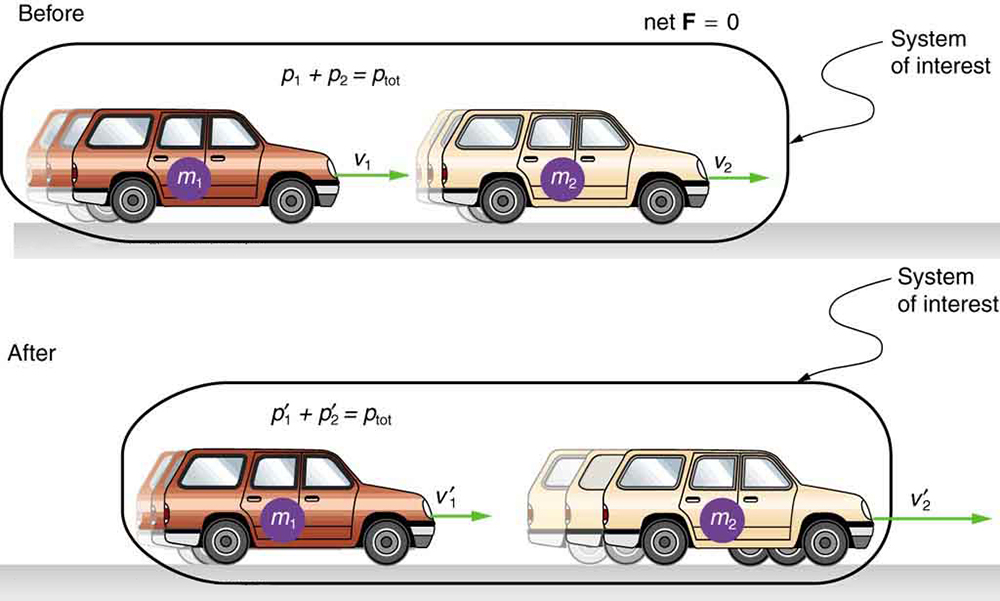
Consider what happens if the masses of two colliding objects are more similar than the masses of a football player and Earth—for example, one car bumping into another, as shown in Figure 1. Both cars are coasting in the same direction when the lead car (labeled $m_{2}$) is bumped by the trailing car (labeled $m_{1}$ ). The only unbalanced force on each car is the force of the collision. (Assume that the effects due to friction are negligible.) Car 1 slows down as a result of the collision, losing some momentum, while car 2 speeds up and gains some momentum. We shall now show that the total momentum of the two-car system remains constant.
Using the definition of impulse, the change in momentum of car 1 is given by
where $F\_{1}$ is the force on car 1 due to car 2, and $\Delta t$ is the time the force acts (the duration of the collision). Intuitively, it seems obvious that the collision time is the same for both cars, but it is only true for objects traveling at ordinary speeds. This assumption must be modified for objects travelling near the speed of light, without affecting the result that momentum is conserved.
Similarly, the change in momentum of car 2 is
where $F_{2}$ is the force on car 2 due to car 1, and we assume the duration of the collision $\Delta t$ is the same for both cars. We know from Newton’s third law that $F_{2}=- F\_{1}$, and so
Thus, the changes in momentum are equal and opposite, and
Because the changes in momentum add to zero, the total momentum of the two-car system is constant. That is,
where $p^{\prime}_{1}$ and $p^{\prime}_{2}$ are the momenta of cars 1 and 2 after the collision. (We often use primes to denote the final state.)
This result—that momentum is conserved—has validity far beyond the preceding one-dimensional case. It can be similarly shown that total momentum is conserved for any isolated system, with any number of objects in it. In equation form, the conservation of momentum principle for an isolated system is written
or
where $\vb{p}_{\text{tot}}$ is the total momentum (the sum of the momenta of the individual objects in the system) and ${\vb{p}^{\prime} }_{\text{tot}}$ is the total momentum some time later. (The total momentum can be shown to be the momentum of the center of mass of the system.) An isolated system is defined to be one for which the net external force is zero $\left(\vb{F}\_{\text{net}}=0\right).$
An isolated system is defined to be one for which the net external force is zero $\left(\vb{F}_{\text{net}}=0\right).$
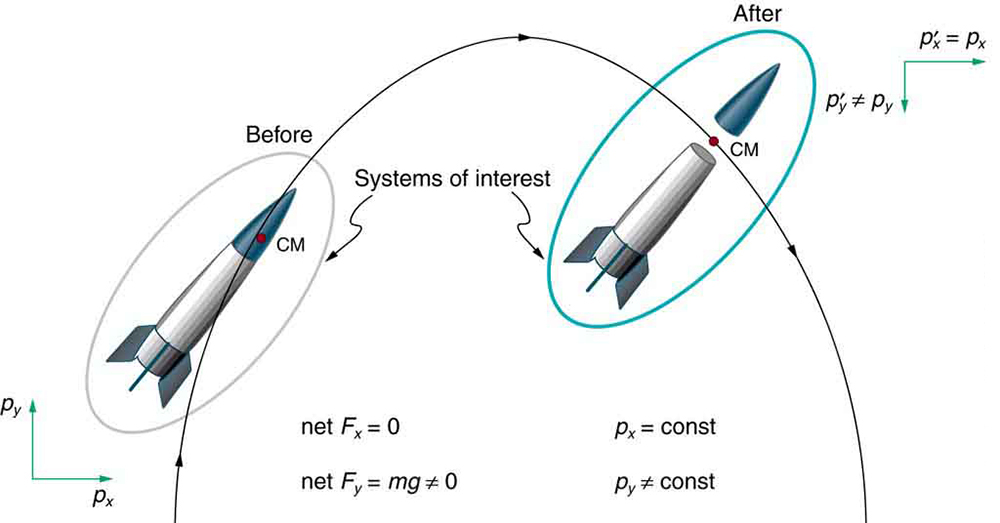
Perhaps an easier way to see that momentum is conserved for an isolated system is to consider Newton’s second law in terms of momentum, $\vb{F}_{\text{net}}=\frac{ \Delta \vb{p}_{\text{tot}}}{\Delta t}$. For an isolated system, $\left(\vb{F}_{\text{net}}=0\right)$; thus, $\Delta \vb{p}_{\text{tot}}=0$, and $\vb{p}_{\text{tot}}$ is constant. We have noted that the three length dimensions in nature— $x$, $y$, and $z$—are independent, and it is interesting to note that momentum can be conserved in different ways along each dimension. For example, during projectile motion and where air resistance is negligible, momentum is conserved in the horizontal direction because horizontal forces are zero and momentum is unchanged. But along the vertical direction, the net vertical force is not zero and the momentum of the projectile is not conserved. ( See Figure 2 .) However, if the momentum of the projectile-Earth system is considered in the vertical direction, we find that the total momentum is conserved.
The conservation of momentum principle can be applied to systems as different as a comet striking Earth and a gas containing huge numbers of atoms and molecules. Conservation of momentum is violated only when the net external force is not zero. But another larger system can always be considered in which momentum is conserved by simply including the source of the external force. For example, in the collision of two cars considered above, the two-car system conserves momentum while each one-car system does not.
Hold a tennis ball side by side and in contact with a basketball. Drop the balls together. (Be careful!) What happens? Explain your observations. Now hold the tennis ball above and in contact with the basketball. What happened? Explain your observations. What do you think will happen if the basketball ball is held above and in contact with the tennis ball?
Tie two tennis balls together with a string about a foot long. Hold one ball and let the other hang down and throw it in a ballistic trajectory. Explain your observations. Now mark the center of the string with bright ink or attach a brightly colored sticker to it and throw again. What happened? Explain your observations.
Some aquatic animals such as jellyfish move around based on the principles of conservation of momentum. A jellyfish fills its umbrella section with water and then pushes the water out resulting in motion in the opposite direction to that of the jet of water. Squids propel themselves in a similar manner but, in contrast with jellyfish, are able to control the direction in which they move by aiming their nozzle forward or backward. Typical squids can move at speeds of 8 to 12 km/h.
The ballistocardiograph (BCG) was a diagnostic tool used in the second half of the 20th century to study the strength of the heart. About once a second, your heart beats, forcing blood into the aorta. A force in the opposite direction is exerted on the rest of your body (recall Newton’s third law). A ballistocardiograph is a device that can measure this reaction force. This measurement is done by using a sensor (resting on the person) or by using a moving table suspended from the ceiling. This technique can gather information on the strength of the heart beat and the volume of blood passing from the heart. However, the electrocardiogram (ECG or EKG) and the echocardiogram ( cardiac ECHO or ECHO; a technique that uses ultrasound to see an image of the heart) are more widely used in the practice of cardiology.
Conservation of momentum is quite useful in describing collisions. Momentum is crucial to our understanding of atomic and subatomic particles because much of what we know about these particles comes from collision experiments.
The conservation of momentum principle not only applies to the macroscopic objects, it is also essential to our explorations of atomic and subatomic particles. Giant machines hurl subatomic particles at one another, and researchers evaluate the results by assuming conservation of momentum (among other things).
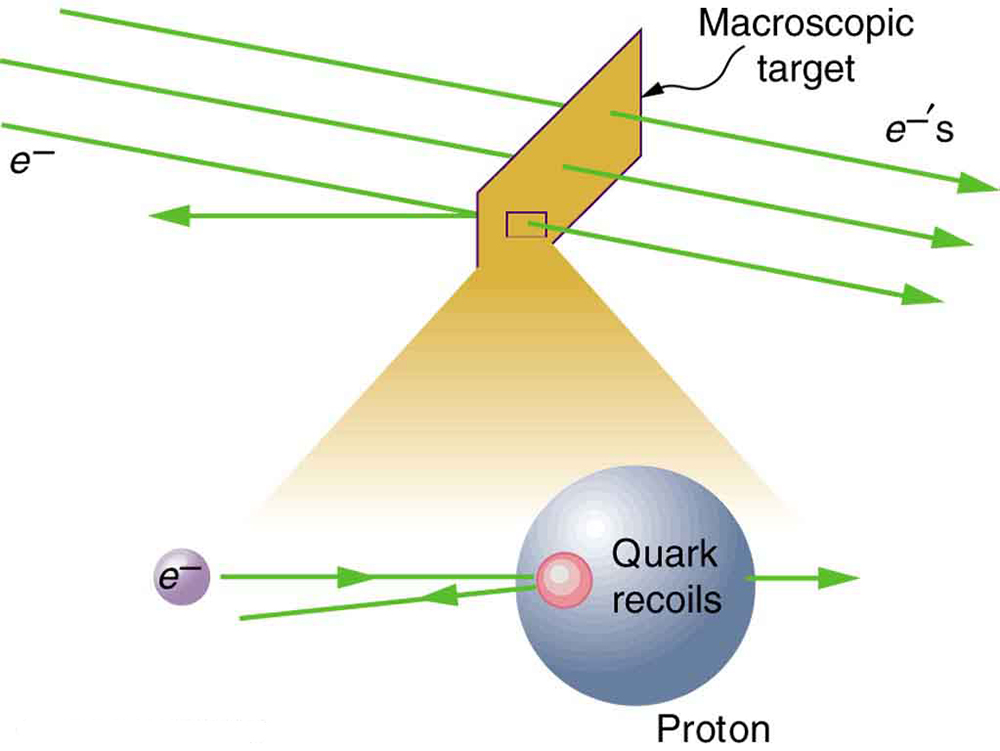
On the small scale, we find that particles and their properties are invisible to the naked eye but can be measured with our instruments, and models of these subatomic particles can be constructed to describe the results. Momentum is found to be a property of all subatomic particles including massless particles such as photons that compose light. Momentum being a property of particles hints that momentum may have an identity beyond the description of an object’s mass multiplied by the object’s velocity. Indeed, momentum relates to wave properties and plays a fundamental role in what measurements are taken and how we take these measurements. Furthermore, we find that the conservation of momentum principle is valid when considering systems of particles. We use this principle to analyze the masses and other properties of previously undetected particles, such as the nucleus of an atom and the existence of quarks that make up particles of nuclei. Figure 3 below illustrates how a particle scattering backward from another implies that its target is massive and dense. Experiments seeking evidence that quarks make up protons (one type of particle that makes up nuclei) scattered high-energy electrons off
of protons (nuclei of hydrogen atoms). Electrons occasionally scattered straight backward in a manner that implied a very small and very dense particle makes up the proton—this observation is considered nearly direct evidence of quarks. The analysis was based partly on the same conservation of momentum principle that works so well on the large scale.
or
$\vb{p}_{\text{tot}}$ is the initial total momentum and ${\vb{p}^{\prime} }_{\text{tot}}$ is the total momentum some time later.
Professional Application
If you dive into water, you reach greater depths than if you do a belly flop. Explain this difference in depth using the concept of conservation of energy. Explain this difference in depth using what you have learned in this chapter.
Under what circumstances is momentum conserved?
Can momentum be conserved for a system if there are external forces acting on the system? If so, under what conditions? If not, why not?
Momentum for a system can be conserved in one direction while not being conserved in another. What is the angle between the directions? Give an example.
Professional Application
Explain in terms of momentum and Newton’s laws how a car’s air resistance is due in part to the fact that it pushes air in its direction of motion.
Can objects in a system have momentum while the momentum of the system is zero? Explain your answer.
Must the total energy of a system be conserved whenever its momentum is conserved? Explain why or why not.
Professional Application
Train cars are coupled together by being bumped into one another. Suppose two loaded train cars are moving toward one another, the first having a mass of 150 000 kg and a velocity of 0.300 m/s, and the second having a mass of 110 000 kg and a velocity of $-0.120 \ms$. (The minus indicates direction of motion.) What is their final velocity?
Strategy
When the cars couple together, they undergo a perfectly inelastic collision. We apply conservation of momentum, with the final velocity being the same for both cars since they stick together.
Solution
Apply conservation of momentum:
Substitute the known values:
Calculate each term:
Solve for the final velocity:
The final velocity of the coupled train cars is 0.122 m/s in the direction of the first car’s initial motion.
Discussion
The positive final velocity indicates the coupled cars move in the direction of the heavier, faster car (car 1). The first car had more momentum (45,000 kg·m/s) than the second car (13,200 kg·m/s), so the net momentum is in the direction of the first car. This is a typical coupling operation where cars are gently bumped together at low speeds to minimize damage.
Suppose a clay model of a koala bear has a mass of 0.200 kg and slides on ice at a speed of 0.750 m/s. It runs into another clay model, which is initially motionless and has a mass of 0.350 kg. Both being soft clay, they naturally stick together. What is their final velocity?
Strategy
This is a perfectly inelastic collision where two objects stick together. We apply conservation of momentum, recognizing that one object is initially at rest.
Solution
Apply conservation of momentum:
Since the second clay model is initially at rest ($v_2 = 0$):
Solve for the final velocity:
The final velocity of the combined clay models is 0.273 m/s in the direction of the first model’s initial motion.
Discussion
The final velocity is less than the initial velocity of the moving koala, as expected when momentum is shared with a stationary object. The combined mass is 2.75 times the moving koala’s mass, so the final velocity is reduced by approximately this factor (0.750/2.75 ≈ 0.273). This is a classic example of a perfectly inelastic collision where objects stick together and move as one unit afterward.
Professional Application
Consider the following question: A car moving at 10 m/s crashes into a tree and stops in 0.26 s. Calculate the force the seatbelt exerts on a passenger in the car to bring him to a halt. The mass of the passenger is 70 kg. Would the answer to this question be different if the car with the 70-kg passenger had collided with a car that has a mass equal to and is traveling in the opposite direction and at the same speed? Explain your answer.
Strategy
First, solve the tree collision problem using impulse-momentum. Then, analyze the car-car collision using conservation of momentum to determine if the passenger experiences the same momentum change.
Solution
For the tree collision, calculate the force on the passenger:
The seatbelt exerts approximately 2700 N on the passenger.
For the car-car collision with identical cars moving at equal speeds in opposite directions:
By conservation of momentum:
Both cars come to rest. The passenger’s change in momentum is the same: from $+700 \kg \cdot \ms$ to 0.
Discussion
The change in momentum is identical in both cases—the passenger goes from 10 m/s to 0. However, the force depends on the collision time, which may differ between the two scenarios. A car-car collision might have different deformation characteristics than hitting a rigid tree, potentially changing the stopping time. If the collision time in the car-car crash were longer (due to crumple zones in both cars absorbing energy over a longer distance), the force would be reduced. If shorter, the force would be greater. Without knowing the collision time for the car-car scenario, we cannot definitively compare the forces, but the momentum change remains the same.
What is the velocity of a 900-kg car initially moving at 30.0 m/s, just after it hits a 150-kg deer initially running at 12.0 m/s in the same direction? Assume the deer remains on the car.
Strategy
This is a perfectly inelastic collision where the deer remains on the car. Both objects are moving in the same direction initially. We apply conservation of momentum.
Solution
Apply conservation of momentum:
Substitute the known values:
Calculate the initial momenta:
Solve for the final velocity:
The velocity of the car with the deer is 27.4 m/s in the original direction of motion.
Discussion
The final velocity (27.4 m/s) is less than the car’s initial velocity (30.0 m/s) but greater than the deer’s initial velocity (12.0 m/s), as expected when two objects moving in the same direction collide and stick together. The car loses about 2.6 m/s of speed. Since both were moving in the same direction, the velocity change is less severe than a head-on collision would produce.
A 1.80-kg falcon catches a 0.650-kg dove from behind in midair. What is their velocity after impact if the falcon’s velocity is initially 28.0 m/s and the dove’s velocity is 7.00 m/s in the same direction?
Strategy
When the falcon catches the dove, they move together as one object—a perfectly inelastic collision. Both birds are moving in the same direction, so we apply conservation of momentum with all velocities positive.
Solution
Apply conservation of momentum:
Substitute the known values:
Calculate each term:
Solve for the final velocity:
The velocity of the falcon and dove after impact is 22.4 m/s in the same direction as the original motion.
Discussion
The final velocity (22.4 m/s) is between the initial velocities of the falcon (28.0 m/s) and the dove (7.00 m/s), as expected for a perfectly inelastic collision where both objects are moving in the same direction. The falcon slows down from 28.0 m/s to 22.4 m/s upon catching the dove. The falcon dominates the outcome because it has both greater mass and greater velocity, contributing 92% of the total initial momentum.