The effect of a force on an object depends on how long it acts, as well as how great the force is. In Example 2, a very large force acting for a short time had a great effect on the momentum of the tennis ball. A small force could cause the same change in momentum, but it would have to act for a much longer time. For example, if the ball were thrown upward, the gravitational force (which is much smaller than the tennis racquet’s force) would eventually reverse the momentum of the ball. Quantitatively, the effect we are talking about is the change in momentum $\Delta \vb{p}$.
By rearranging the equation $\vb{F}\_{\text{net} }=\frac{ \Delta \vb{p} }{\Delta t}$ to be
we can see how the change in momentum equals the average net external force multiplied by the time this force acts. The quantity $\vb{F}\_{\text{net} }\Delta t$ is given the name impulse. Impulse is the same as the change in momentum.
Change in momentum equals the average net external force multiplied by the time this force acts.
The quantity $\vb{F}_{\text{net} }\Delta t$ is given the name impulse.
There are many ways in which an understanding of impulse can save lives, or at least limbs. The dashboard padding in a car, and certainly the airbags, allow the net force on the occupants in the car to act over a much longer time when there is a sudden stop. The momentum change is the same for an occupant, whether an airbag is deployed or not, but the force (to bring the occupant to a stop) will be much less if it acts over a larger time. Cars today have many plastic components. One advantage of plastics is their lighter weight, which results in better gas mileage. Another advantage is that a car will crumple in a collision, especially in the event of a head-on collision. A longer collision time means the force on the car will be less. Deaths during car races decreased dramatically when the rigid frames of racing cars were replaced with parts that could crumple or collapse in the event of an accident.
Bones in a body will fracture if the force on them is too large. If you jump onto the floor from a table, the force on your legs can be immense if you land stiff-legged on a hard surface. Rolling on the ground after jumping from the table, or landing with a parachute, extends the time over which the force (on you from the ground) acts.
Two identical billiard balls strike a rigid wall with the same speed, and are reflected without any change of speed. The first ball strikes perpendicular to the wall. The second ball strikes the wall at an angle of $30^\circ$ from the perpendicular, and bounces off at an angle of $30^\circ$ from perpendicular to the wall.
(a) Determine the direction of the force on the wall due to each ball.
(b) Calculate the ratio of the magnitudes of impulses on the two balls by the wall.
Strategy for (a)
In order to determine the force on the wall, consider the force on the ball due to the wall using Newton’s second law and then apply Newton’s third law to determine the direction. Assume the $x$ -axis to be normal to the wall and to be positive in the initial direction of motion. Choose the $y$-axis to be along the wall in the plane of the second ball’s motion. The momentum direction and the velocity direction are the same.
Solution for (a)
The first ball bounces directly into the wall and exerts a force on it in the $+x$ direction. Therefore, the wall exerts a force on the ball in the $-x$ direction. The second ball continues with the same momentum component in the $y$ direction, but reverses its $x$-component of momentum, as seen by sketching a diagram of the angles involved and keeping in mind the proportionality between velocity and momentum.
These changes mean the change in momentum for both balls is in the $-x$ direction, so the force of the wall on each ball is along the $-x$ direction.
Strategy for (b)
Calculate the change in momentum for each ball, which is equal to the impulse imparted to the ball.
Solution for (b)
Let $u$ be the speed of each ball before and after collision with the wall, and $m$ the mass of each ball. Choose the $x$-axis and $y$-axis as previously described, and consider the change in momentum of the first ball which strikes perpendicular to the wall.
Impulse is the change in momentum vector. Therefore the $x$-component of impulse is equal to $-2\text{ m} u$ and the $y$-component of impulse is equal to zero.
Now consider the change in momentum of the second ball.
It should be noted here that while $p_{x}$ changes sign after the collision, $p_{y}$ does not. Therefore the $x$-component of impulse is equal to $-2m u\cos{30^\circ }$ and the $y$-component of impulse is equal to zero.
The ratio of the magnitudes of the impulse imparted to the balls is
Discussion
The direction of impulse and force is the same as in the case of (a); it is normal to the wall and along the negative * $x$ -*direction. Making use of Newton’s third law, the force on the wall due to each ball is normal to the wall along the positive $x$ -direction.
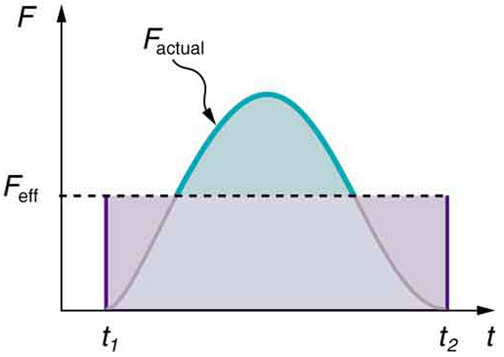
Our definition of impulse includes an assumption that the force is constant over the time interval $\Delta t$. Forces are usually not constant. Forces vary considerably even during the brief time intervals considered. It is, however, possible to find an average effective force $F_{\text{eff}}$ that produces the same result as the corresponding time-varying force. Figure 1 shows a graph of what an actual force looks like as a function of time for a ball bouncing off the floor. The area under the curve has units of momentum and is equal to the impulse or change in momentum between times $t_{1}$ and $t_{2}$. That area is equal to the area inside the rectangle bounded by $F_{\text{eff}}$, $t_{1}$, and $t_{2}$. Thus, the impulses and their effects are the same for both the actual and effective forces.
Try catching a ball while “giving” with the ball, pulling your hands toward your body. Then, try catching a ball while keeping your hands still. Hit water in a tub with your full palm. After the water has settled, hit the water again by diving your hand with your fingers first into the water. (Your full palm represents a swimmer doing a belly flop and your diving hand represents a swimmer doing a dive.) Explain what happens in each case and why. Which orientations would you advise people to avoid and why?
The assumption of a constant force in the definition of impulse is analogous to the assumption of a constant acceleration in kinematics. In both cases, nature is adequately described without the use of calculus.
Professional Application
Explain in terms of impulse how padding reduces forces in a collision. State this in terms of a real example, such as the advantages of a carpeted vs. tile floor for a day care center.
While jumping on a trampoline, sometimes you land on your back and other times on your feet. In which case can you reach a greater height and why?
Professional Application
Tennis racquets have “sweet spots.” If the ball hits a sweet spot then the player’s arm is not jarred as much as it would be otherwise. Explain why this is the case.
A bullet is accelerated down the barrel of a gun by hot gases produced in the combustion of gun powder. What is the average force exerted on a 0.0300-kg bullet to accelerate it to a speed of 600 m/s in a time of 2.00 ms (milliseconds)?
Strategy
We use the impulse-momentum theorem: $F\_{\text{net}} \Delta t = \Delta p$. The bullet starts from rest and reaches a final velocity, so we can calculate the change in momentum and divide by the time interval to find the average force.
Solution
The bullet starts at rest, so $v_i = 0$.
Calculate the change in momentum:
Convert time to seconds:
Apply the impulse-momentum theorem to find the average force:
The average force exerted on the bullet is $9.00 \times 10^{3} \N$ (9000 N, or about 2000 pounds of force).
Discussion
This is an enormous force—about 30,000 times the bullet’s weight! However, the force acts for only 2 milliseconds, which is why the impulse (and thus momentum change) is manageable. By Newton’s third law, an equal and opposite force acts on the gun, causing the recoil felt by the shooter.
Professional Application
A car moving at 10 m/s crashes into a tree and stops in 0.26 s. Calculate the force the seat belt exerts on a passenger in the car to bring him to a halt. The mass of the passenger is 70 kg.
Strategy
We apply the impulse-momentum theorem. The passenger has initial momentum from moving with the car and must be brought to rest. The seat belt provides the force over the collision time to change the passenger’s momentum.
Solution
Calculate the initial momentum of the passenger:
The final momentum is zero (passenger comes to rest):
Calculate the change in momentum:
Apply the impulse-momentum theorem:
The magnitude of the force is approximately $2.7 \times 10^{3} \N$ (about 600 pounds), directed opposite to the passenger’s initial motion.
Discussion
While 2700 N is a substantial force (roughly 4 times the passenger’s weight), this is survivable because the seat belt distributes the force across the chest and pelvis. Without a seat belt, the passenger would continue at 10 m/s until hitting the dashboard or windshield, stopping in a much shorter time (perhaps 0.01 s), resulting in forces 26 times larger—likely fatal.
A person slaps her leg with her hand, bringing her hand to rest in 2.50 milliseconds from an initial speed of 4.00 m/s. (a) What is the average force exerted on the leg, taking the effective mass of the hand and forearm to be 1.50 kg? (b) Would the force be any different if the woman clapped her hands together at the same speed and brought them to rest in the same time? Explain why or why not.
Strategy
We use the impulse-momentum theorem to find the force. The hand has initial momentum and comes to rest, so we calculate the momentum change and divide by the collision time.
Solution
(a) Force on the leg:
By Newton’s third law, the force on the leg equals the force on the hand in magnitude but opposite in direction.
(b) Force when clapping hands:
The force on each hand would have the same magnitude as that found in part (a) because:
By Newton’s third law, the forces on the two hands are equal in magnitude but opposite in direction—each hand exerts 2400 N on the other.
Discussion
This force of 2400 N is about 540 pounds—explaining why a hard slap hurts! The short collision time (2.5 ms) results in a large force despite the modest speed and mass involved. This is why padding and cushioning help reduce impact forces: they extend the collision time, reducing the force for the same momentum change.
(a) The average force exerted on the leg is $2.40 \times 10^{3} \N$ toward the leg.
(b) The force on each hand when clapping is the same: $2.40 \times 10^{3} \N$.
Professional Application
A professional boxer hits his opponent with a 1000-N horizontal blow that lasts for 0.150 s. (a) Calculate the impulse imparted by this blow. (b) What is the opponent’s final velocity, if his mass is 105 kg and he is motionless in midair when struck near his center of mass? (c) Calculate the recoil velocity of the opponent’s 10.0-kg head if hit in this manner, assuming the head does not initially transfer significant momentum to the boxer’s body. (d) Discuss the implications of your answers for parts (b) and (c).
Strategy
Impulse equals force times time: $J = F \Delta t$. Once we have the impulse, we can find the velocity change using $J = \Delta p = m \Delta v$.
Solution
(a) Impulse from the blow:
(b) Final velocity if struck at center of mass:
The opponent starts at rest, so $v_i = 0$.
Using the impulse-momentum theorem:
Solving for final velocity:
(c) Recoil velocity if struck in the head:
If the same impulse is delivered to just the head:
(d) Implications:
The head velocity (15.0 m/s) is more than 10 times greater than the body velocity (1.43 m/s). This dramatic difference explains why head punches are so dangerous in boxing:
Discussion
This analysis explains the fundamental danger of head trauma in contact sports. The same impulse produces vastly different effects depending on the mass involved. Protective headgear works by increasing collision time and distributing force, not by changing the impulse delivered.
(a) The impulse imparted by the blow is $150 \N \cdot \s$ (or $150 \kg \cdot \ms$).
(b) If struck in the body’s center of mass, the opponent’s final velocity is $1.43 \ms$ in the direction of the blow.
(c) If hit in the head, the head would recoil at $15.0 \ms$.
(d) See explanation above.
Professional Application
Suppose a child drives a bumper car head on into the side rail, which exerts a force of 4000 N on the car for 0.200 s. (a) What impulse is imparted by this force? (b) Find the final velocity of the bumper car if its initial velocity was 2.80 m/s and the car plus driver have a mass of 200 kg. You may neglect friction between the car and floor.
Strategy
For part (a), impulse is force times time. For part (b), we apply the impulse-momentum theorem, noting that the force from the wall opposes the car’s motion.
Solution
(a) Impulse from the rail:
(b) Final velocity of the bumper car:
Let positive direction be toward the wall (initial direction of motion). The wall exerts a force in the negative direction.
Discussion
The car reverses direction after hitting the rail, which is exactly what we expect from a bumper car collision. The wall delivers enough impulse to not only stop the car (which would require 560 kg·m/s) but also to give it momentum in the opposite direction. This is the fun of bumper cars—the collisions are designed to be bouncy while the padding extends the collision time to keep forces at safe levels.
(a) The impulse imparted is $800 \kg \cdot \ms$ directed away from the wall (opposite to the car’s initial motion).
(b) The final velocity is $1.20 \ms$ away from the wall (the car bounces back).
Professional Application
One hazard of space travel is debris left by previous missions. There are several thousand objects orbiting Earth that are large enough to be detected by radar, but there are far greater numbers of very small objects, such as flakes of paint. Calculate the force exerted by a 0.100-mg chip of paint that strikes a spacecraft window at a relative speed of $4.00\times 10^{3} \ms$, given the collision lasts $6.00\times 10^{-8} \s$.
Strategy
We use the impulse-momentum theorem. The paint chip comes to rest upon impact (or embeds in the window), so its entire momentum is transferred. We need to convert the mass to kg and apply $F = \frac{\Delta p}{\Delta t}$.
Solution
Convert mass to kilograms:
Calculate the change in momentum (assuming the chip stops):
Apply the impulse-momentum theorem:
The force exerted by the paint chip on the spacecraft window is approximately $6.67 \times 10^{3} \N$ (about 1500 pounds of force).
Discussion
This result is remarkable—a tiny paint flake weighing just 0.1 milligrams exerts a force of nearly 7000 N! This occurs because:
This explains why spacecraft windows are made of multiple layers of reinforced glass and why space debris is a serious hazard. The International Space Station has had windows replaced due to damage from such impacts.
Professional Application
A 75.0-kg person is riding in a car moving at 20.0 m/s when the car runs into a bridge abutment. (a) Calculate the average force on the person if he is stopped by a padded dashboard that compresses an average of 1.00 cm. (b) Calculate the average force on the person if he is stopped by an air bag that compresses an average of 15.0 cm.
Strategy
We need to find the stopping time from the distance and velocity, then use the impulse-momentum theorem. Using kinematics with constant deceleration: $v^2 = v_0^2 + 2a\Delta x$ gives us acceleration, then $\Delta t = \frac{\Delta v}{a}$ gives time.
Solution
(a) Force with padded dashboard:
(b) Force with airbag:
Discussion
The airbag reduces the force by a factor of 15—exactly the ratio of the stopping distances! The padded dashboard force of 1.5 million N (about 2000 times body weight) would likely be fatal, while the airbag force of 100,000 N (about 135 times body weight), though still very large, is survivable because it’s distributed across the body. This dramatically illustrates why airbags save lives: they increase the stopping distance and time, reducing the peak force.
(a) The force on the person from the padded dashboard is $1.50 \times 10^{6} \N$ (about 337,000 pounds).
(b) The force on the person from the airbag is $1.00 \times 10^{5} \N$ (about 22,500 pounds).
Professional Application
Military rifles have a mechanism for reducing the recoil forces of the gun on the person firing it. An internal part recoils over a relatively large distance and is stopped by damping mechanisms in the gun. The larger distance reduces the average force needed to stop the internal part. (a) Calculate the recoil velocity of a 1.00-kg plunger that directly interacts with a 0.0200-kg bullet fired at 600 m/s from the gun. (b) If this part is stopped over a distance of 20.0 cm, what average force is exerted upon it by the gun? (c) Compare this to the force exerted on the gun if the bullet is accelerated to its velocity in 10.0 ms (milliseconds).
Strategy
For part (a), we use conservation of momentum between the bullet and plunger. For part (b), we use kinematics and Newton’s second law to find the stopping force. For part (c), we calculate the force from the bullet’s acceleration.
Solution
(a) Recoil velocity of the plunger:
By conservation of momentum (initial momentum is zero):
Solving for the plunger velocity:
(b) Force exerted on the plunger:
(c) Comparison with bullet acceleration force:
Discussion
The recoil-reducing mechanism decreases the force felt by the shooter by a factor of more than 3. This is achieved by allowing the internal plunger to recoil over a larger distance (20 cm) compared to the short distance over which the bullet accelerates. The same momentum must be absorbed, but extending the distance (and time) reduces the force. This principle is used in many firearms to improve accuracy and reduce shooter fatigue.
(a) The recoil velocity of the plunger is $12.0 \ms$ in the direction opposite to the bullet.
(b) The average force exerted on the plunger is $360 \N$.
(c) The force on the gun from accelerating the bullet ($1200 \N$) is 3.33 times larger than the force on the plunger mechanism ($360 \N$).
A cruise ship with a mass of $1.00\times 10^{7}\kg$ strikes a pier at a speed of 0.750 m/s. It comes to rest 6.00 m later, damaging the ship, the pier, and the tugboat captain’s finances. Calculate the average force exerted on the pier using the concept of impulse. (Hint: First calculate the time it took to bring the ship to rest.)
Strategy
First, we use kinematics to find the stopping time, then apply the impulse-momentum theorem. The average velocity during uniform deceleration is half the initial velocity.
Solution
Find the stopping time using the average velocity:
Calculate the ship’s initial momentum:
Apply the impulse-momentum theorem:
The average force exerted on the pier is $4.69 \times 10^{5} \N$ (about 105,000 pounds or 53 tons) in the ship’s original direction of motion.
Discussion
Despite the relatively slow speed of 0.750 m/s (about 1.5 mph—walking pace), the ship’s enormous mass results in a force of nearly half a million newtons! The 16-second stopping time helps reduce this force—if the ship stopped more abruptly (say, in 1 second), the force would be 16 times larger (7.5 million N). This illustrates why docking procedures are so careful and why tugboats are essential for maneuvering large vessels.
Calculate the final speed of a 110-kg rugby player who is initially running at 8.00 m/s but collides head-on with a padded goalpost and experiences a backward force of $1.76\times 10^{4}\N$ for $5.50\times 10^{-2}\s$.
Strategy
We apply the impulse-momentum theorem. The backward force produces a negative impulse that changes the player’s momentum. We calculate the impulse and use it to find the change in velocity.
Solution
Calculate the impulse (force is backward, so negative):
Calculate the initial momentum:
Find the final momentum:
Calculate the final velocity:
The final speed of the rugby player is 0.80 m/s, moving backward (away from the goalpost).
Discussion
The player not only stops but bounces back at 0.80 m/s. The impulse of 968 kg·m/s is larger than the initial momentum of 880 kg·m/s, causing the reversal. The padded goalpost extends the collision time to 55 ms, limiting the force to about 17,600 N—still a substantial 16 times body weight, but survivable due to the padding. Without padding, the collision time would be much shorter and the force could cause serious injury.
Water from a fire hose is directed horizontally against a wall at a rate of 50.0 kg/s and a speed of 42.0 m/s. Calculate the magnitude of the force exerted on the wall, assuming the water’s horizontal momentum is reduced to zero.
Strategy
This is a continuous flow problem. We use the rate form of Newton’s second law: $F = \frac{\Delta p}{\Delta t} = \frac{\Delta m}{\Delta t} \times \Delta v$. The mass flow rate and velocity change give us the force directly.
Solution
The mass flow rate is:
The velocity change for each bit of water (comes to rest):
Calculate the force using the momentum flow rate:
The force exerted on the wall is $2.10 \times 10^{3} \N$ (about 470 pounds) directed away from the hose.
Discussion
This force of 2100 N is substantial—equivalent to the weight of about 210 kg (460 lbs). This explains why firefighters must brace themselves when using high-pressure hoses. The force arises because 50 kg of water per second (about 50 liters) is having its momentum completely absorbed by the wall. If the water bounced back (as it partially does in reality), the force would be even greater because the momentum change would be larger.
A 0.450-kg hammer is moving horizontally at 7.00 m/s when it strikes a nail and comes to rest after driving the nail 1.00 cm into a board. (a) Calculate the duration of the impact. (b) What was the average force exerted on the nail?
Strategy
For part (a), we use kinematics with the stopping distance to find the time. For part (b), we apply the impulse-momentum theorem.
Solution
(a) Duration of the impact:
Using the average velocity during deceleration:
Calculate the duration:
(b) Average force exerted on the nail:
Discussion
A force of 1100 N—over 2000 times the hammer’s weight—is exerted on the nail during the brief 3-millisecond impact. This force is sufficient to drive the nail into wood. The short stopping distance (1 cm) is key to generating such a large force. If the hammer bounced or the stopping distance were larger, the force would be reduced. This is why hammers are made of hard materials—they don’t compress on impact, maximizing the force transmitted to the nail.
(a) The duration of the impact is approximately $2.86 \times 10^{-3} \s$ (about 3 milliseconds).
(b) The average force exerted on the nail is approximately $1.10 \times 10^{3} \N$ (about 250 pounds).
Starting with the definitions of momentum and kinetic energy, derive an equation for the kinetic energy of a particle expressed as a function of its momentum.
Strategy
We start with the definitions of momentum ($p = mv$) and kinetic energy ($\KE = \frac{1}{2}mv^2$) and algebraically eliminate velocity to express kinetic energy in terms of momentum and mass.
Solution
Start with the definition of momentum:
Solve for velocity:
Substitute into the kinetic energy equation:
Therefore, the kinetic energy expressed as a function of momentum is:
Discussion
This relationship $\KE = \frac{p^2}{2m}$ is very useful in physics. It shows that for a given momentum, a less massive object has more kinetic energy (since $m$ is in the denominator). This explains why, in collisions with equal momentum transfer, lighter objects move faster and carry more kinetic energy. The relationship is particularly important in particle physics where momentum is often conserved while kinetic energy may not be.
A ball with a mass of 55g with an initial velocity of 10 m/s moves at an angle $60^\circ$ above the $+x$-direction. The ball hits a vertical wall and bounces off so that it is moving $60^\circ$ above the $-x$ -direction with the same speed. What is the impulse delivered by the wall?
Strategy
The impulse equals the change in momentum: $\vb{J} = \Delta \vb{p} = \vb{p}\_f - \vb{p}\_i$. We need to find the x and y components of momentum before and after the collision, then calculate the change.
Solution
Convert mass to kg: $m = 55 \text{ g} = 0.055 \kg$
Find the initial velocity components:
Find the final velocity components (moving at $60^\circ$ above $-x$):
Calculate the change in momentum components:
Find the magnitude of the impulse:
The impulse delivered by the wall is 0.55 kg·m/s in the $-x$ direction (perpendicular to the wall, away from the ball’s initial approach).
Discussion
The wall only changes the x-component of momentum, reversing it completely. The y-component remains unchanged because the wall exerts no vertical force (assuming a frictionless wall). The impulse magnitude of 0.55 kg·m/s represents twice the initial x-momentum, which is characteristic of a perfectly elastic bounce where the perpendicular velocity component reverses.
When serving a tennis ball, a player hits the ball when its velocity is zero (at the highest point of a vertical toss). The racquet exerts a force of 540 N on the ball for 5.00 ms, giving it a final velocity of 45.0 m/s. Using these data, find the mass of the ball.
Strategy
We use the impulse-momentum theorem. The impulse from the racquet equals the change in momentum of the ball. Since the ball starts from rest, the final momentum equals the impulse.
Solution
Calculate the impulse:
Since the ball starts at rest ($v_i = 0$):
Solve for mass:
The mass of the tennis ball is 60.0 g.
Discussion
This result is consistent with official tennis ball specifications, which require balls to have a mass between 56.0 and 59.4 grams. Our calculated value of 60.0 g is very close to this range. The short contact time of 5 ms, combined with the 540 N force, produces an impulse sufficient to accelerate this light ball to serve speeds of 45 m/s (162 km/h or about 100 mph)—a respectable recreational serve.
A punter drops a 0.075kg-ball from rest vertically 1 meter down onto his foot. The ball leaves the foot with a speed of 18 m/s at an angle $55^\circ$ above the horizontal. What is the impulse delivered by the foot (magnitude and direction)?
Strategy
We need to find the ball’s velocity just before impact (using free fall kinematics), then calculate the change in momentum vector from just before to just after the kick.
Solution
First, find the velocity just before impact using free fall:
Initial momentum components (taking +x horizontal, +y upward):
Final momentum components (18 m/s at 55° above horizontal):
Calculate the impulse components:
Find the magnitude and direction:
The impulse delivered by the foot is 1.64 kg·m/s at 61.7° above the horizontal.
Discussion
The impulse angle (61.7°) is steeper than the final ball trajectory (55°) because the foot must also reverse the downward momentum of the falling ball. The foot provides both horizontal momentum (to send the ball forward) and upward momentum (to reverse the fall and launch the ball upward). This is a more complex momentum change than simply launching a stationary ball.