
Power—the word conjures up many images: a professional football player muscling aside his opponent, a dragster roaring away from the starting line, a volcano blowing its lava into the atmosphere, or a rocket blasting off, as in Figure 1.
These images of power have in common the rapid performance of work, consistent with the scientific definition of power ( \(P\) ) as the rate at which work is done.
Power is the rate at which work is done.
The SI unit for power is the watt (\(\text{W}\)), where 1 watt equals 1 joule/second \(\left(1 \text{W}=1 \text{J/s}\right)\).
Because work is energy transfer, power is also the rate at which energy is expended. A 60-W light bulb, for example, expends 60 J of energy per second. Great power means a large amount of work or energy developed in a short time. For example, when a powerful car accelerates rapidly, it does a large amount of work and consumes a large amount of fuel in a short time.
What is the power output for a 60.0-kg woman who runs up a 3.00 m high flight of stairs in 3.50 s, starting from rest but having a final speed of 2.00 m/s? (See Figure 2.)

Strategy and Concept
The work going into mechanical energy is \(W=\KE + \PE\). At the bottom of the stairs, we take both \(\KE\) and \(\PE_{g}\) as initially zero; thus, \(W=\KE_{f}+\PE_{g}=\frac{1}{2} m v_{f}^{2}+mgh\), where \(h\) is the vertical height of the stairs. Because all terms are given, we can calculate \(W\) and then divide it by time to get power.
Solution
Substituting the expression for \(W\) into the definition of power given in the previous equation, \(P=W/t\) yields
Entering known values yields
Discussion
The woman does 1764 J of work to move up the stairs compared with only 120 J to increase her kinetic energy; thus, most of her power output is required for climbing rather than accelerating.
It is impressive that this woman’s useful power output is slightly less than 1 horsepower \(\left(1 \text{hp}=746 \text{W}\right)\) ! People can generate more than a horsepower with their leg muscles for short periods of time by drawing on energy stores in the muscles that do not need oxygen right away ( anaerobic metabolism). (A horse can put out about 1 hp for hours on end.) These stores last only seconds, so power output soon decreases; sustained effort relies on aerobic metabolism, which uses oxygen and supports a lower power, and the rapid breathing after a sprint repays the oxygen needed to restore the muscles. If the woman climbed the stairs slowly, then her power output would be much less, although the amount of work done would be the same.
Determine your own power rating by measuring the time it takes you to climb a flight of stairs. We will ignore the gain in kinetic energy, as the above example showed that it was a small portion of the energy gain. Don’t expect that your output will be much more than about 1 hp.
Examples of power are limited only by the imagination, because there are as many types as there are forms of work and energy. ( See Table 1 for some examples.) Sunlight reaching Earth’s surface carries a maximum power of about 1.0 kilowatt per square meter \(\left( {\text{kW/m} }^{2}\right)\). A tiny fraction of this is retained by Earth over the long term. Our consumption rate of fossil fuels is far greater than the rate at which they are stored, so it is inevitable that they will be depleted. Power implies that energy is transferred, perhaps changing form. Real devices usually convert some of their input energy into thermal energy that is not useful for their intended purpose. For example, a 60-W incandescent bulb converts only 5 W of electrical power to light, with 55 W dissipating into thermal energy. Furthermore, the typical electric power plant converts only 35 to 40% of its fuel into electricity. The remainder becomes a huge amount of thermal energy that must be dispersed as heat transfer, as rapidly as it is created. A coal-fired power plant may produce 1000 megawatts; 1 megawatt (MW) is \(10^{6}\text{W}\) of electric power. But the power plant consumes chemical energy at a rate of about 2500 MW, creating heat transfer to the surroundings at a rate of 1500 MW. ( See Figure 3.)

| Object or Phenomenon | Power in Watts |
|---|---|
| Supernova (at peak) | \(5\times 10^{37}\) |
| Milky Way galaxy | \(10^{37}\) |
| Crab Nebula pulsar | \(5\times 10^{31}\) |
| The Sun | \(4\times 10^{26}\) |
| Volcanic eruption (maximum) | \(4\times 10^{15}\) |
| Lightning bolt | \(2\times 10^{12}\) |
| Nuclear power plant (total electric and heat transfer) | \(3\times 10^{9}\) |
| Aircraft carrier (total useful and heat transfer) | \(10^{8}\) |
| Dragster (total useful and heat transfer) | \(2\times 10^{6}\) |
| Car (total useful and heat transfer) | \(8\times 10^{4}\) |
| Football player (total useful and heat transfer) | \(5\times 10^{3}\) |
| Clothes dryer | \(4\times 10^{3}\) |
| Person at rest (all heat transfer) | \(100\) |
| Typical incandescent light bulb (total useful and heat transfer) | \(60\) |
| Heart, person at rest (total useful and heat transfer) | \(8\) |
| Pocket calculator | \(10^{-3}\) |
We usually have to pay for the energy we use. It is interesting and easy to estimate the cost of energy for an electrical appliance if its power consumption rate and time used are known. The higher the power consumption rate and the longer the appliance is used, the greater the cost of that appliance. The power consumption rate is \(P=W/t=E/t\), where \(E\) is the energy supplied by the electricity company. So the energy consumed over a time \(t\) is
Electricity bills state the energy used in units of kilowatt-hours \(\left( \text{kW}\cdot h\right),\) which is the product of power in kilowatts and time in hours. This unit is convenient because electrical power consumption at the kilowatt level for hours at a time is typical.
What is the cost of running a 0.200-kW computer 6.00 h per day for 30.0 d if the cost of electricity is \(0.120 \$ \text{ per kW}\cdot h\) ?
Strategy
Cost is based on energy consumed; thus, we must find \(E\) from \(E=Pt\) and then calculate the cost. Because electrical energy is expressed in \(\text{kW}\cdot h\), at the start of a problem such as this it is convenient to convert the units into \(\text{kW}\) and hours.
Solution
The energy consumed in \(\text{kW}\cdot \text{h}\) is
and the cost is simply given by
Discussion
The cost of using the computer in this example is neither exorbitant nor negligible. It is clear that the cost is a combination of power and time. When both are high, such as for an air conditioner in the summer, the cost is high.
The motivation to save energy has become more compelling with its ever-increasing price. Armed with the knowledge that energy consumed is the product of power and time, you can estimate costs for yourself and make the necessary value judgments about where to save energy. Either power or time must be reduced. It is most cost-effective to limit the use of high-power devices that normally operate for long periods of time, such as water heaters and air conditioners. This would not include relatively high power devices like toasters, because they are on only a few minutes per day. It would also not include electric clocks, in spite of their 24-hour-per-day usage, because they are very low power devices. It is sometimes possible to use devices that have greater efficiencies—that is, devices that consume less power to accomplish the same task. One example is the LED light bulb, which produces several times more light per watt of power consumed than its incandescent cousin.
Modern civilization depends on energy, but current levels of energy consumption and production are not sustainable. Greenhouse gases released by human activities, chiefly the burning of fossil fuels, are causing global warming. This makes reducing energy use and shifting to non-fossil sources important. Even though energy in an isolated system is a conserved quantity, the final result of most energy transformations is waste heat transfer to the environment, which is no longer useful for doing work.
Most electrical appliances are rated in watts. Does this rating depend on how long the appliance is on? (When off, it is a zero-watt device.) Explain in terms of the definition of power.
Strategy
Use the definition of power, \(P = W/t\) or \(P = E/t\): the rate at which energy is converted.
Solution
No. The wattage rating is a power, the rate at which the appliance converts electrical energy into other forms, in joules per second (\(1 \text{ W} = 1 \J/\s\)). It is fixed by the design of the appliance and does not depend on how long the appliance runs. A \(1200 \text{ W}\) hair dryer uses \(1200 \J\) every second it is on, whether it runs for \(1 \text{ min}\) or \(10 \text{ min}\).
What does depend on the running time is the energy used, \(E = Pt\):
The power rating does not depend on how long the appliance is on, because power is the rate of energy use (a \(1200 \text{ W}\) dryer uses \(1200 \J\) every second it runs); the time on determines only the total energy used, \(E = Pt\).
Explain, in terms of the definition of power, why energy consumption is sometimes listed in kilowatt-hours rather than joules. What is the relationship between these two energy units?
Strategy
From \(P = E/t\), energy is power times time, \(E = Pt\). A power unit multiplied by a time unit is therefore an energy unit. Convert the kilowatt-hour to joules.
Solution
Electrical energy is used at a rate given in kilowatts, and appliances run for hours, so multiplying power in kilowatts by time in hours gives a convenient energy unit, the kilowatt-hour. Its value in joules is
A household might use \(900 \text{ kW} \cdot \text{h}\) in a month. That is \(3.2 \times 10^{9} \J\), an awkwardly large number. The kilowatt-hour also makes bills easy to check: a \(1.5 \text{ kW}\) heater running for \(4.0 \text{ h}\) uses \(6.0 \text{ kW} \cdot \text{h}\) directly.
Energy consumption is listed in kilowatt-hours because energy is power times time and household devices use kilowatts for hours, which makes the kilowatt-hour a convenient size, and \(1 \text{ kW} \cdot \text{h} = (1000 \J/\s)(3600 \s) = 3.6 \times 10^{6} \J\).
A spark of static electricity, such as that you might receive from a doorknob on a cold dry day, may carry a few hundred watts of power. Explain why you are not injured by such a spark.
Strategy
Power is the rate of energy transfer. Harm depends on how much energy is actually delivered, \(E = Pt\), so consider how long the spark lasts.
Solution
A static spark may carry a few hundred watts, say \(300 \text{ W}\), but it lasts only about a microsecond, \(t = 1 \times 10^{-6} \s\). The energy delivered is
That is a tiny amount of energy. For comparison, lifting a \(1 \text{ g}\) paper clip by \(3 \text{ cm}\) takes about \(3 \times 10^{-4} \J\). It is enough to stimulate nerves, so you feel a sharp sting, but far too little to heat or damage tissue, and the current does not last long enough to disturb the heart. A \(300 \text{ W}\) source sustained for many seconds would deliver thousands of joules and could cause serious injury.
You are not injured by a static spark because, although its power is a few hundred watts, it lasts only about a microsecond, so it delivers only about \(3 \times 10^{-4} \J\) of energy, far too little to damage tissue.
The Crab Nebula (see Figure 4) pulsar is the remnant of a supernova that occurred in A.D. 1054. Using data from Table 1, calculate the approximate factor by which the power output of this astronomical object has declined since its explosion.

Strategy
From Table 1, we can find the power outputs of a supernova at peak and the Crab Nebula pulsar today. The factor of decline is the ratio of current power to initial power.
Solution
From Table 1:
The factor by which power has declined:
Discussion
The current output is \(1 \times 10^{-6}\) of the peak supernova power—equivalently, the power has decreased by a factor of \(10^{6}\). (Saying it “declined by a factor of \(1 \times 10^{-6}\)” reverses the usual reduction-factor convention.) Despite this massive reduction, the pulsar still outputs about \(5 \times 10^{31}\) W, roughly \(10^{5}\) times the Sun’s \(4 \times 10^{26}\) W. The pulsar’s rotation slows as it emits electromagnetic radiation and particles, converting rotational kinetic energy into other forms.
Answer
The Crab Nebula pulsar’s present power is about \(1 \times 10^{-6}\) of the peak (a decrease by a factor of about \(10^{6}\)) since the A.D. 1054 supernova.
Suppose a star 1000 times brighter than our Sun (that is, emitting 1000 times the power) suddenly goes supernova. Using data from Table 1: (a) By what factor does its power output increase? (b) How many times brighter than our entire Milky Way galaxy is the supernova? (c) Based on your answers, discuss whether it should be possible to observe supernovas in distant galaxies. Note that there are on the order of \(10^{11}\) observable galaxies, the average brightness of which is somewhat less than our own galaxy.
Strategy
From Table 1: Sun’s power = \(4 \times 10^{26}\text{W}\), Supernova (at peak) = \(5 \times 10^{37}\text{W}\), Milky Way galaxy = \(10^{37}\text{W}\).
Solution for (a)
The star’s initial power is:
The power increase factor is:
Solution for (b)
The ratio of supernova power to galaxy power:
Solution for (c)
Based on the calculations above, we can analyze the observability of supernovas. Since a supernova at peak can be 5 times brighter than an entire galaxy containing billions of stars, and considering there are approximately \(10^{11}\) observable galaxies, supernovas should be readily detectable in distant galaxies. A supernova that outshines its host galaxy by a factor of 5 would stand out dramatically against the background, even at great distances.
Discussion
Part (a) shows that the supernova increases in brightness by a factor of about \(10^{8}\) (100 million times). This enormous increase in power output occurs in a matter of hours to days, making supernovas among the most dramatic events in the universe.
Part (b) demonstrates that at peak, the supernova is 5 times brighter than the entire Milky Way galaxy. This is remarkable considering a galaxy contains hundreds of billions of stars. This result explains why supernovas were historically called “new stars”—they could suddenly appear in the sky where nothing visible existed before.
Part (c): Since a single supernova can outshine an entire galaxy, it should definitely be possible to observe supernovas in distant galaxies, even those billions of light-years away. In fact, astronomers routinely observe and catalog supernovas in remote galaxies. Type Ia supernovas, which have consistent peak luminosities, serve as “standard candles” for measuring cosmic distances and were instrumental in the 1998 discovery that the universe’s expansion is accelerating—a finding that led to the 2011 Nobel Prize in Physics.
Answer
(a) The star’s power output increases by a factor of approximately \(1.25 \times 10^{8}\) when it goes supernova. (b) The supernova is 5 times brighter than the entire Milky Way galaxy. (c) Yes, supernovas should be observable in distant galaxies because they can outshine their entire host galaxy.
A person in good physical condition can put out 100 W of useful power for several hours at a stretch, perhaps by pedaling a mechanism that drives an electric generator. Neglecting any problems of generator efficiency and practical considerations such as resting time: (a) How many people would it take to run a 4.00-kW electric clothes dryer? (b) How many people would it take to replace a large electric power plant that generates 800 MW?
Strategy
Divide the required power by the power output per person to find the number of people needed.
Solution
(a) For the 4.00-kW clothes dryer:
(b) For the 800-MW power plant:
Discussion
Part (a) shows that 40 people would be needed to continuously pedal to run a single 4.00-kW clothes dryer. This seems reasonable when we consider that a person producing 100 W of sustained power is working fairly hard—about the level of moderate cycling. Forty such people working together could indeed power a clothes dryer, though it would be highly impractical.
Part (b) reveals the enormous scale of modern power generation. Eight million people would be needed to replace an 800-MW power plant—roughly the population of New York City. This calculation dramatically illustrates why human power is completely impractical for meeting modern society’s energy demands. Even for smaller countries, the entire working-age population would need to pedal continuously just to replace a handful of power plants. This comparison helps explain why the Industrial Revolution, which introduced mechanical power sources far exceeding human capabilities, so dramatically transformed human society. It also underscores the enormous energy consumption of modern civilization and the challenge of transitioning to sustainable energy sources.
Answer
(a) It would take 40 people to run a 4.00-kW clothes dryer. (b) It would take 8 million people to replace an 800-MW power plant.
What is the cost of operating a 3.00-W electric clock for a year if the cost of electricity is \(0.0900 \$ \text{per kW}\cdot h\) ?
Strategy
The energy consumed is \(E = Pt\), where \(P = 3.00\text{W} = 0.00300\text{kW}\) and \(t = 1\text{ year} = 365 \times 24\text{ h} = 8760\text{ h}\). The cost is then energy times the rate.
Solution
Energy consumed in one year:
Cost:
Discussion
The annual cost of operating a 3.00-W electric clock is approximately $2.37, which is quite economical. This low cost makes sense because although the clock runs continuously (24 hours per day, 365 days per year), its power consumption is very small—only 3 watts. This problem illustrates an important principle in energy conservation: the total energy cost depends on both power and time. While devices like clocks run constantly, their extremely low power consumption means they contribute very little to electricity bills. In contrast, high-power devices like air conditioners (which may use 15,000\text{ W} or more) can cost over $100 per month even when used only a few hours daily. This is why energy conservation efforts should focus on limiting high-power devices rather than worrying about low-power devices that run continuously.
Answer
The cost of operating a 3.00-W electric clock for one year is approximately $2.37.
A large household air conditioner may consume 15.0 kW of power. What is the cost of operating this air conditioner 3.00 h per day for 30.0 d if the cost of electricity is \(0.110 \$ \text{per kW} \cdot h\) ?
Strategy
Calculate the energy consumed using \(E = Pt\), then multiply by the cost per kW·h.
Solution
Total operating time:
Energy consumed:
Cost:
Discussion
Operating a large 15.0-kW air conditioner for 3 hours per day for 30 days costs approximately $149. This substantial cost explains why electricity bills spike dramatically during summer months when air conditioning is heavily used. The high cost results from the combination of high power consumption (15,000\text{ W} is equivalent to running 250 sixty-watt light bulbs simultaneously) and extended usage time. Even though the air conditioner runs only 3 hours per day (12.5% of the time), the cost is significant because of its high power rating. This calculation demonstrates why air conditioners are often the largest contributor to residential electricity costs in warm climates. It also highlights why improving air conditioner efficiency (for example, by using higher SEER ratings) and reducing usage (through better insulation, programmable thermostats, or raising temperature settings by a few degrees) can lead to substantial cost savings. A 20% reduction in air conditioner usage could save about $30 per month in this example.
Answer
The cost of operating a 15.0-kW air conditioner for 3.00 hours per day for 30.0 days is approximately $149.
(a) What is the average power consumption in watts of an appliance that uses \(5.00 \text{kW}\cdot h\) of energy per day? (b) How many joules of energy does this appliance consume in a year?
Strategy
For part (a), we use \(P = E/t\), where \(E = 5.00\text{ kW}\cdot\text{h}\) per day and \(t = 24\text{ h}\).
For part (b), we find the yearly energy and convert to joules.
Solution for (a)
Solution for (b)
Energy per year:
Converting to joules (1 kW·h = 3.6 × 10⁶ J):
Discussion
Part (a): The average power consumption of 208 W is reasonable for a mid-sized appliance such as a refrigerator, dehumidifier, or home entertainment system. This calculation shows how to convert energy consumption expressed in kW·h per day (common on energy labels) into average power in watts. The 208-W average means the appliance draws this amount continuously when averaged over 24 hours, though actual instantaneous power may vary (for example, a refrigerator compressor cycles on and off).
Part (b): The appliance consumes approximately \(6.6 \times 10^{9}\) J (6.6 gigajoules) of energy annually. This large number in joules illustrates why electrical energy is more conveniently expressed in kilowatt-hours rather than joules for everyday applications. The conversion factor is 1 kW·h = 3.6 × 10⁶ J, so we can verify: 1825 kW·h × 3.6 × 10⁶ J/(kW·h) ≈ 6.6 × 10⁹ J. At a typical electricity rate of \$0.10 per kW·h, this appliance would cost about \$183 per year to operate, representing a significant ongoing expense.
Answer
(a) The average power consumption is 208 W. (b) The appliance consumes approximately \(6.57 \times 10^{9}\) J of energy per year.
(a) What is the average useful power output of a person who does \(6.00\times 10^{6} \J\) of useful work in 8.00 h? (b) Working at this rate, how long will it take this person to lift 2000 kg of bricks 1.50 m to a platform? (Work done to lift his body can be omitted because it is not considered useful output here.)
Strategy
For part (a), use \(P = W/t\) to find power. For part (b), calculate the work needed to lift the bricks and use \(t = W/P\).
Solution
(a) Calculate the average power output:
(b) Calculate the work to lift the bricks:
Calculate the time required:
Discussion
Part (a): The average useful power output of 208 W (approximately 0.28 hp) is reasonable for sustained physical labor over an 8-hour workday. This is consistent with the estimate used in Problem 3 that a person can sustain about 100 W for extended periods. A construction worker or laborer performing useful work at 208 W is working at a moderate to vigorous level, which would require rest breaks and proper nutrition to maintain throughout a full work shift. The total useful work of \(6.00 \times 10^{6}\) J (6.00 MJ) over 8 hours represents significant physical effort.
Part (b): Lifting 2000 kg of bricks 1.50 m requires 29,400 J of work and takes 141 s (about 2.4 minutes) at the sustained power level of 208 W. This seems reasonable—a worker could lift this mass of bricks in small batches over this time period. For example, lifting 20 kg per trip would require 100 trips, or about one trip every 1.4 seconds, which is physically feasible but demanding. This calculation demonstrates how knowing the power output allows us to predict the time required for specific tasks, which is valuable for project planning and estimating labor requirements.
Answer
(a) The average useful power output is 208 W. (b) It will take 141 s (approximately 2.4 minutes) to lift the bricks.
A 500-kg dragster accelerates from rest to a final speed of 110 m/s in 400 m (about a quarter of a mile) and encounters an average frictional force of 1200 N. What is its average power output in watts and horsepower if this takes 7.30 s?
Strategy
The total work done by the dragster equals the change in kinetic energy plus the work done against friction. Power is the total work divided by time.
Sketch and coordinate system
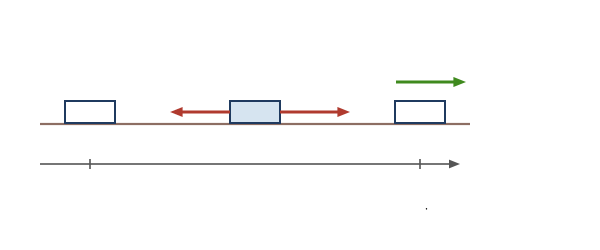
Take \(+x\) in the direction of motion. The driving force acts along \(+x\) and friction along \(-x\), so the dragster must supply the kinetic energy it gains plus the work \(fd\) done against friction over \(d = +400\m\).
Solution
The change in kinetic energy is:
The work done against friction is:
The total work done by the dragster is:
The average power output is:
Converting to horsepower:
Discussion
The dragster’s average power output of 480 kW (644 hp) is reasonable for a high-performance racing vehicle, though it’s worth noting this is the average power over the acceleration period. Top fuel dragsters can actually produce peak powers exceeding 10,000 hp (7.5 MW), but this calculation gives us the average sustained power needed to achieve the stated performance.
The total work done by the dragster is 3.51 MJ, with about 86% going into kinetic energy and 14% overcoming friction. This shows that even with the significant frictional force of 1200 N over 400 m, the dominant energy requirement is still accelerating the dragster’s mass to 110 m/s (nearly 250 mph).
The power output of 644 hp is actually modest by drag racing standards, suggesting this might be a lower-class dragster rather than a top fuel dragster. Professional top fuel dragsters can accelerate even faster (covering a quarter mile in under 4 seconds at over 330 mph), requiring the much higher peak powers mentioned above. This problem illustrates how power requirements scale with both the desired speed and the time available to reach it—faster acceleration times demand proportionally greater power.
Answer
The average power output is approximately \(4.80 \times 10^{5}\) W (480 kW) or 644 hp.
(a) How long will it take an 850-kg car with a useful power output of 40.0 hp (1 hp = 746 W) to reach a speed of 15.0 m/s, neglecting friction? (b) How long will this acceleration take if the car also climbs a 3.00-m-high hill in the process?
Strategy
Use the work-energy theorem: the work done by the engine equals the change in kinetic energy (plus change in potential energy for part b). Then use \(t = W/P\).
Solution
(a) Neglecting friction, the work needed is just the kinetic energy gained:
Convert power to watts: \(P = 40.0\text{ hp} \times 746\text{ W/hp} = 29840\text{ W}\)
Time required:
(b) When also climbing a 3.00-m hill, the work includes potential energy:
Time required:
Discussion
Part (a): On level ground, the 850-kg car with a 40.0-hp (29,840-W) engine reaches 15.0 m/s in 3.20 s. This acceleration time seems reasonable for a car with moderate power. For comparison, 40 hp is relatively modest by modern standards (typical cars have 100-200 hp), so a 3.2-second acceleration to 15 m/s (about 34 mph or 54 km/h) represents moderate performance.
Part (b): When climbing a 3.00-m hill while accelerating, the time increases to 4.04 s, which is about 26% longer than on level ground. This increase makes physical sense: the engine must now do additional work against gravity (24,990 J for the potential energy gain) on top of the kinetic energy work (95,600 J). The ratio of total work is 120,590 J / 95,600 J ≈ 1.26, which directly translates to the 26% time increase when power is constant.
This problem illustrates an important practical consideration: vehicles need extra power when climbing hills, which is why cars often downshift (increasing engine RPM and power output) when ascending steep grades. The calculation also shows that at highway speeds, the power needed to climb grades becomes substantial—one reason why fuel economy decreases significantly in mountainous terrain. The additional 25 kJ of potential energy gained might seem modest, but when sustained over long climbs, it represents significant energy consumption.
Answer
(a) The time to reach 15.0 m/s on level ground is 3.20 s. (b) The time to reach 15.0 m/s while climbing a 3.00-m hill is 4.04 s.
(a) Find the useful power output of an elevator motor that lifts a 2500-kg load a height of 35.0 m in 12.0 s, if it also increases the speed from rest to 4.00 m/s. Note that the total mass of the counterbalanced system is 10 000 kg—so that only 2500 kg is raised in height, but the full 10 000 kg is accelerated. (b) What does it cost, if electricity is \(0.0900 \text{per kW}\cdot h\) ?
Strategy
The work done includes raising 2500 kg to height 35.0 m and accelerating the full 10,000 kg mass to 4.00 m/s. Power is total work divided by time.
Solution for (a)
Work to raise the load:
Work to accelerate the system:
Total work:
Power output:
Solution for (b)
Energy consumed in kW·h:
Cost:
Discussion
Part (a): The elevator motor’s useful power output is 78.1 kW (approximately 105 hp), which is reasonable for a commercial elevator. The majority of the work (858 kJ out of 938 kJ total, or 91%) goes into lifting the 2500-kg load against gravity, while only 9% goes into accelerating the 10,000-kg system to its final speed of 4.00 m/s. This distribution is typical for elevators, where the primary energy expenditure is overcoming gravitational potential energy.
The counterbalancing system is an important practical feature mentioned in this problem. By counterbalancing most of the elevator’s weight, the system ensures that the motor only needs to lift the net load (2500 kg) rather than the entire elevator plus passengers. However, the full mass (10,000 kg) must still be accelerated and decelerated, which is why we use the total mass when calculating kinetic energy. Without counterbalancing, elevator motors would need to be much more powerful and would consume far more energy.
Part (b): The electricity cost for this single elevator trip is approximately 2.3 cents. While this seems small, consider that a busy office building elevator might make hundreds of trips per day. At 200 trips per day, the daily cost would be about \$4.68, or roughly \$140 per month for continuous operation. In a large building with multiple elevators, these costs add up significantly, which is why modern buildings invest in energy-efficient elevator systems with regenerative braking that can recover energy during descent.
Answer
(a) The useful power output is approximately 78.1 kW. (b) The electricity cost for this elevator trip is approximately \$0.023 (2.3 cents).
(a) What is the available energy content, in joules, of a battery that operates a 2.00-W electric clock for 18 months? (b) How long can a battery that can supply \(8.00\times 10^{4} \J\) run a pocket calculator that consumes energy at the rate of \(1.00\times 10^{-3}\text{W}\) ?
Strategy
For part (a), use \(E = Pt\) where the clock runs for 18 months, taking each month to be 30 days. (Using 1.5 average years of \(3.156 \times 10^{7}\) s instead gives \(9.47 \times 10^{7}\) J; either convention is fine if used consistently.) For part (b), use \(t = E/P\).
Solution
(a) Convert 18 months to seconds:
Energy content of the battery:
(b) Calculate how long the calculator can run:
Converting to years:
Discussion
Part (a): The battery contains approximately \(9.33 \times 10^{7}\) J (about 26 kW·h) of energy. This is a substantial amount of energy—roughly equivalent to the energy in about 0.78 gallons (about 3 liters) of gasoline, using \(1.2 \times 10^{8}\) J/gal. A battery storing 26 kW·h is far from a small clock battery; it is comparable to the battery pack of a small electric car. Real clocks use far less than 2.00 W, which is why their small batteries last so long. This calculation shows why batteries are practical for low-power devices but become large and heavy for high-power applications like electric vehicles.
Part (b): The calculator can run for \(8.00 \times 10^{7}\) s, which is approximately 2.54 years of continuous operation. This extraordinarily long runtime is possible because pocket calculators consume power at an extremely low rate—only 1.00 mW (0.001 W). Modern calculator chips use CMOS technology specifically designed for minimal power consumption. In practice, calculators often last even longer than this calculation suggests because they spend much of their time in sleep mode, consuming even less power. Additionally, many calculators use solar cells that recharge the battery during use.
The stark contrast between the clock battery (2 W for 18 months) and the calculator battery (0.001 W for 2.5 years) illustrates how power consumption, not just energy storage, determines battery life. The calculator’s battery stores only about 0.0857% of the energy of the clock battery, yet it lasts about 1.7 times longer because the calculator consumes 2000 times less power.
Answer
(a) The battery contains approximately \(9.33 \times 10^{7}\) J of energy. (b) The battery can run the calculator for approximately \(8.00 \times 10^{7}\) s, or about 2.54 years.
(a) How long would it take a \(1.50\times 10^{5}\)-kg airplane with engines that produce 100 MW of power to reach a speed of 250 m/s and an altitude of 12.0 km if air resistance were negligible? (b) If it actually takes 900 s to reach that same speed and altitude, what is the average useful power delivered to the plane’s mechanical energy (\(E/t\))? (With drag present, this need not equal the engines’ full output.) (c) Using that useful-power value from (b) as the average rate of work done on the plane’s mechanical energy plus against drag, what is the average force of air resistance if the airplane takes 1200 s? (Hint: You must find the distance the plane travels in 1200 s assuming constant acceleration.)
Strategy
For part (a), the total energy needed is kinetic plus potential energy. With constant power, \(W = Pt = \Delta E\).
For part (b), divide the mechanical-energy increase from (a) by the actual 900 s to get the average useful power \(E/t\). That is the rate at which the plane’s kinetic plus potential energy grows; it is not automatically the engines’ shaft power when drag is present.
For part (c), take that useful power from (b) as the average engine work rate used in this calculation, and apply the work–energy theorem including air resistance.
Solution for (a)
Total energy needed:
Time with 100 MW power:
Solution for (b)
Actual power:
Solution for (c)
With constant acceleration over 1200 s, the average velocity is \(v_{avg} = v/2 = 125\ms\), so distance is:
Work done by engines:
Work against air resistance:
Average air resistance force:
Discussion
Part (a): Without air resistance, the airplane would reach its target speed and altitude in 223 s (about 3.7 minutes) using its full 100 MW of engine power. This represents the theoretical minimum time based purely on energy requirements. The total energy needed is 22.3 GJ, with about 79% going to potential energy (climbing to 12 km altitude) and only 21% to kinetic energy (reaching 250 m/s). This distribution shows that for this scenario, climbing is the dominant energy requirement.
Part (b): Reaching the same mechanical energy in 900 s gives an average useful power of 24.8 MW—about one-quarter of the 100 MW engine rating. With drag, the engines must supply more than 24.8 MW; the 24.8 MW figure is only \(E/t\) for the plane’s KE + PE. Part (c) then uses that 24.8 MW as the work-rate input in the model (rather than retaining the full 100 MW) to estimate average drag over a 1200 s climb.
Part (c): With that modeling choice, the average air resistance is about \(5.0 \times 10^{4}\) N. Roughly 25% of the work counted in the model goes into overcoming drag (7.5 GJ of 29.8 GJ), with the rest going into the airplane’s kinetic and potential energy.
Answer
(a) Without air resistance, it would take 223 s to reach the target speed and altitude. (b) The average useful power (mechanical-energy increase per unit time) is 24.8 MW. (c) Using that 24.8 MW in the work–energy model, the average air resistance is approximately \(5.0 \times 10^{4}\) N (50,000 N).
Calculate the power output needed for a 950-kg car to climb a \(2.00^\circ\) slope at a constant 30.0 m/s while encountering wind resistance and friction totaling 600 N. Explicitly show how you follow the steps in the Problem-Solving Strategies for Energy.
Strategy
Following the problem-solving strategy for energy:
Sketch and coordinate system
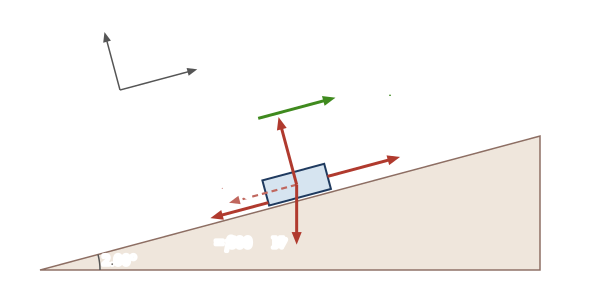
Use tilted axes with \(+x\) up the slope (the direction of motion) and \(+y\) perpendicular to it. With \(a = 0\), \(\sum F_x = F - f - mg\sin{\theta} = 0\), so \(F = f + mg\sin{\theta}\), and the power is \(P = Fv\) with \(v = +30.0\ms\) along \(+x\).
Solution
Since the car moves at constant velocity, the net force is zero. The driving force \(F\) must balance both the resistive forces and the gravitational component along the slope:
where \(mg\sin\theta\) is the component of the car’s weight parallel to the incline.
Power is the rate of doing work, which for constant velocity equals:
Substituting the expression for \(F\):
Now substitute the known values:
Converting to horsepower:
Discussion
The power output of approximately 27.7 kW (37 hp) is reasonable for a car climbing a gentle 2° incline at highway speed. This is well within the capability of most car engines, which typically produce 75-150 kW (100-200 hp).
Interestingly, the gravitational component (325 N) is smaller than the resistive forces (600 N) for this gentle slope. At 30.0 m/s (108 km/h or 67 mph), wind resistance dominates. About 65% of the power (600/925) goes to overcoming air resistance and friction, while 35% (325/925) goes to climbing the slope.
If the slope were steeper or the speed lower, the gravitational term would become more significant. For example, on a 10° slope, \(mg\sin(10^\circ)\) would be about 1620 N, making it the dominant resistance. This explains why cars must downshift and use more engine power on steep hills.
The constant-velocity condition is key to this solution’s simplicity. If the car were accelerating, we would need to account for the rate of change of kinetic energy as well.
Answer
The power output needed is approximately \(2.77 \times 10^{4}\) W (27.7 kW or 37.1 hp).
(a) Calculate the power per square meter reaching Earth’s upper atmosphere from the Sun. (Take the power output of the Sun to be \(4.00\times 10^{26} \text{W}\).) (b) Part of this is absorbed and reflected by the atmosphere, so that a maximum of \(1.30 \text{kW/m}^2\) reaches Earth’s surface. Calculate the area in \({\text{km} }^{2}\) of solar energy collectors needed to replace an electric power plant that generates 750 MW if the collectors convert an average of 2.00% of the maximum power into electricity. (This small conversion efficiency is due to the devices themselves, and the fact that the sun is directly overhead only briefly.) With the same assumptions, what area would be needed to meet the United States’ energy needs \(\left( 1.05\times 10^{20} \J \right)\) ? Australia’s energy needs \(\left(5.4\times 10^{18} \J \right)\)? China’s energy needs \(\left(6.3\times 10^{19} \J \right)\) ? (These energy consumption values are from 2006.)
Strategy
For part (a), the Sun’s power spreads over a sphere with radius equal to Earth’s orbital radius (1 AU = \(1.50 \times 10^{11}\m\)). Power per unit area is \(P/(4\pi r^{2})\).
For part (b), the actual power collected per m² is \((1300\text{ W/m}^2)(0.02) = 26\text{ W/m}^2\).
Solution for (a)
Solution for (b)
Power collected per m²: \(1300\text{ W/m}^2 \times 0.02 = 26\text{ W/m}^2\)
Area for 750 MW plant:
For annual energy needs, we need power in watts. Using 1 year = \(3.156 \times 10^{7}\s\):
U.S. power = \(\frac{1.05 \times 10^{20}\J}{3.156 \times 10^{7}\s} = 3.33 \times 10^{12}\text{ W}\)
Australia: \(A_{\text{Aus}} = \frac{5.4 \times 10^{18}\J/(3.156 \times 10^{7}\s)}{26\text{ W/m}^2} = 6.6 \times 10^{3}\text{ km}^2\)
China: \(A_{\text{China}} = \frac{6.3 \times 10^{19}\J/(3.156 \times 10^{7}\s)}{26\text{ W/m}^2} = 7.7 \times 10^{4}\text{ km}^2\)
Discussion
Part (a): The calculated power per square meter at Earth’s upper atmosphere is approximately 1.41 kW/m². This value, known as the solar constant, is in excellent agreement with measured values. The slight difference from the maximum 1.30 kW/m² mentioned in the problem as reaching Earth’s surface is due to atmospheric absorption and reflection. About 30% of incoming solar radiation is reflected back into space by clouds, atmospheric particles, and Earth’s surface (this is Earth’s albedo), while additional energy is absorbed by the atmosphere. The calculation demonstrates that solar energy is distributed over an enormous sphere (with radius equal to Earth’s orbital distance), which is why the power per unit area decreases so dramatically from the Sun’s total output of \(4 \times 10^{26}\) W.
Part (b): The area calculations reveal both the promise and challenge of solar energy:
A 750-MW power plant requires approximately 28.8 km² of 2%-efficient solar collectors (about 5.4 km × 5.4 km). While this seems large, it’s equivalent to about 7,100 acres, which is comparable to the land area used by large coal plants when including mining operations.
The U.S. energy needs would require about 128,000 km² (roughly 350 km × 365 km), which is approximately 1.3% of U.S. land area. For perspective, this is similar to the area of the state of Louisiana.
Australia needs about 6,600 km², roughly 0.09% of its land area—quite feasible given Australia’s vast desert regions with excellent solar exposure.
China needs about 77,000 km², approximately 0.8% of its land area.
These calculations assume only 2% efficiency (accounting for panel efficiency, sun angle, nighttime, and weather). Modern solar panels achieve 15-20% efficiency under ideal conditions, which would reduce required areas by a factor of 7-10, though real-world capacity factors (accounting for nighttime and weather) typically range from 15-25% in good locations. Even so, the calculations demonstrate that meeting national energy needs with solar power is technically feasible from an area perspective, though energy storage for nighttime use remains a significant challenge.
The comparison also highlights regional differences: Australia’s low population and abundant sunshine make solar particularly attractive, while more densely populated or less sunny regions face greater challenges.
Answer
(a) The power per square meter reaching Earth’s upper atmosphere is approximately 1.41 kW/m². (b) The area required for a 750-MW plant is approximately 28.8 km². To meet annual energy needs with 2% efficient collectors: U.S. ≈ 128,000 km², Australia ≈ 6,600 km², China ≈ 77,000 km².