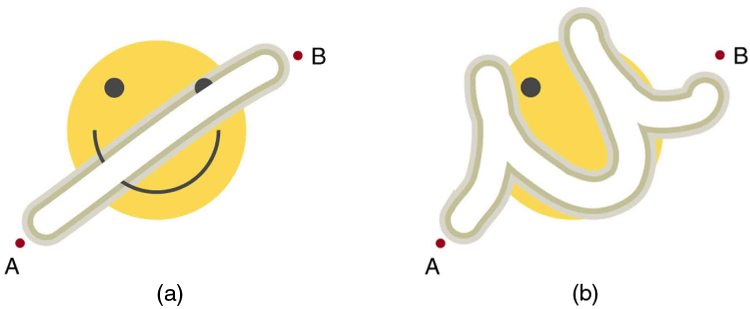
Forces are either conservative or nonconservative. Conservative forces were discussed in Conservative Forces and Potential Energy . A nonconservative force is one for which work depends on the path taken. Friction is a good example of a nonconservative force. As illustrated in Figure 1, work done against friction depends on the length of the path between the starting and ending points. Because of this dependence on path, there is no potential energy associated with nonconservative forces. An important characteristic is that the work done by a nonconservative force adds or removes mechanical energy from a system. Friction, for example, creates thermal energy that dissipates, removing energy from the system. Furthermore, even if the thermal energy is retained or captured, it cannot be fully converted back to work, so it is lost or not recoverable in that sense as well.
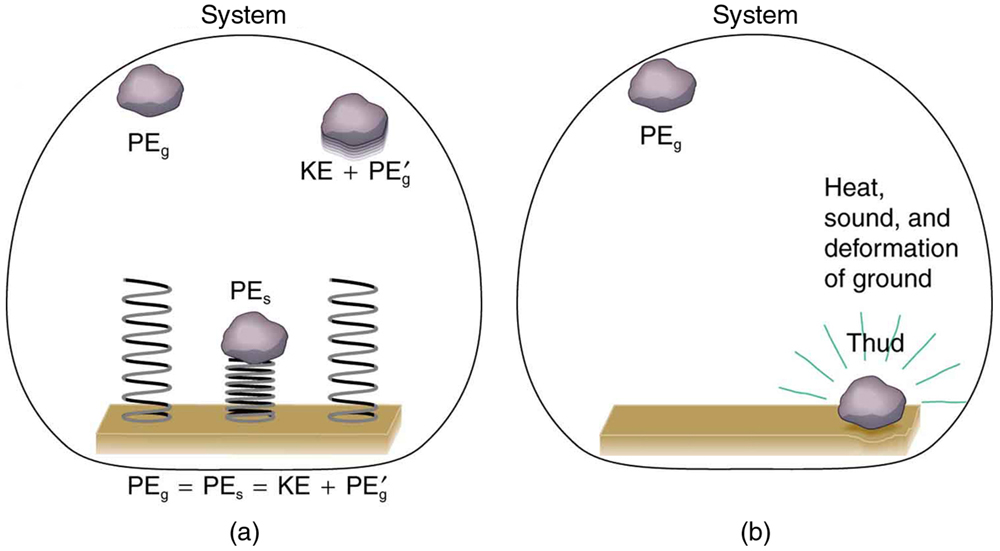
Mechanical energy may not be conserved when nonconservative forces act. For example, when a car is brought to a stop by friction on level ground, it loses kinetic energy, which is dissipated as thermal energy, reducing its mechanical energy. Figure 2 compares the effects of conservative and nonconservative forces. We often choose to understand simpler systems such as that described in Figure 2(a) first before studying more complicated systems as in Figure 2(b).
Now let us consider what form the work-energy theorem takes when both conservative and nonconservative forces act. We will see that the work done by nonconservative forces equals the change in the mechanical energy of a system. As noted in Kinetic Energy and the Work-Energy Theorem , the work-energy theorem states that the net work on a system equals the change in its kinetic energy, or $W\_{\text{net}}=\Delta \KE$. The net work is the sum of the work by nonconservative forces plus the work by conservative forces. That is,
so that
where $W_{\text{nc}}$ is the total work done by all nonconservative forces and $W_{\text{c}}$ is the total work done by all conservative forces.
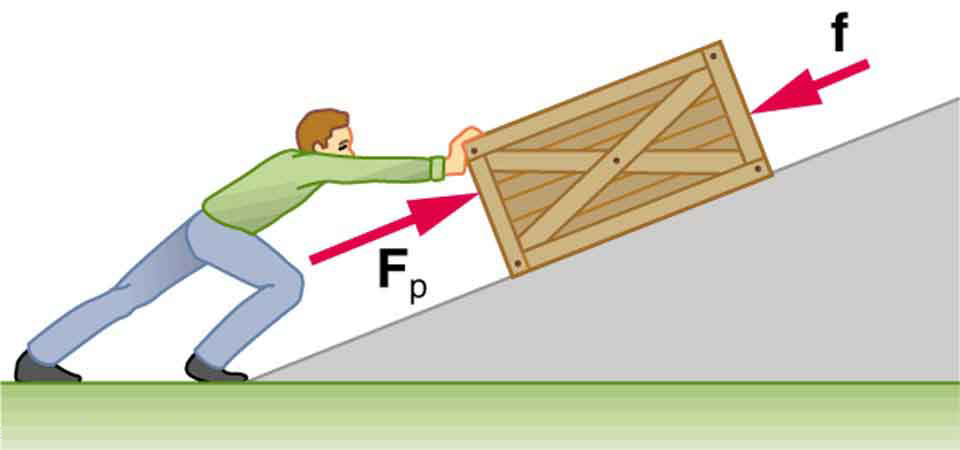
Consider Figure 3, in which a person pushes a crate up a ramp and is opposed by friction. As in the previous section, we note that work done by a conservative force comes from a loss of gravitational potential energy, so that $W_{\text{c}}=-\Delta \PE$. Substituting this equation into the previous one and solving for $W_{\text{nc}}$ gives
This equation means that the total mechanical energy $\left(\KE + \PE \right)$
changes by exactly the amount of work done by nonconservative forces. In Figure 3, this is the work done by the person minus the work done by friction. So even if energy is not conserved for the system of interest ( such as the crate), we know that an equal amount of work was done to cause the change in total mechanical energy.
We rearrange $W_{\text{nc}}=\Delta \KE+\Delta \PE$ to obtain
This means that the amount of work done by nonconservative forces adds to the mechanical energy of a system. If $W_{\text{nc}}$ is positive, then mechanical energy is increased, such as when the person pushes the crate up the ramp in Figure 3. If $W_{\text{nc}}$ is negative, then mechanical energy is decreased, such as when the rock hits the ground in Figure 2( b). If $W_{\text{nc}}$ is zero, then mechanical energy is conserved, and nonconservative forces are balanced. For example, when you push a lawn mower at constant speed on level ground, your work done is removed by the work of friction, and the mower has a constant energy.
When no change in potential energy occurs, applying $\KE_{\text{i}}+\PE_{\text{i}}+ W_{\text{nc}}=\KE_{\text{f}}+\PE_{\text{f}}$ amounts to applying the work-energy theorem by setting the change in kinetic energy to be equal to the net work done on the system, which in the most general case includes both conservative and nonconservative forces. But when seeking instead to find a change in total mechanical energy in situations that involve changes in both potential and kinetic energy, the previous equation $\KE_{\text{i}}+\PE_{\text{i}}+ W_{\text{nc}}=\KE_{\text{f}}+\PE_{\text{f}}$ says that you can start by finding the change in mechanical energy that would have resulted from just the conservative forces, including the potential energy changes, and add to it the work done, with the proper sign, by any nonconservative forces involved.
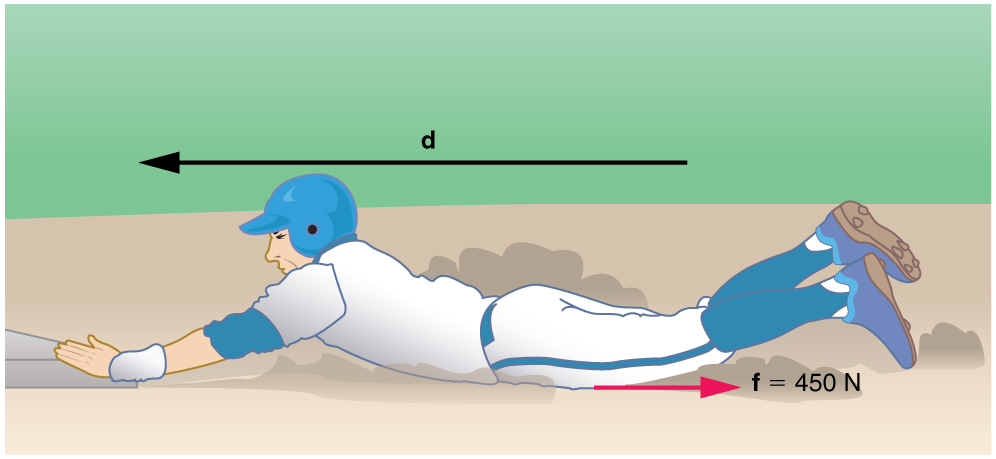
Consider the situation shown in Figure 4, where a baseball player slides to a stop on level ground. Using energy considerations, calculate the distance the 65.0-kg baseball player slides, given that his initial speed is 6.00 m/s and the force of friction against him is a constant 450 N.
Strategy
Friction stops the player by converting his kinetic energy into other forms, including thermal energy. In terms of the work-energy theorem, the work done by friction, which is negative, is added to the initial kinetic energy to reduce it to zero. The work done by friction is negative, because $\vb{f}$ is in the opposite direction of the motion (that is, $\theta =180^\circ$, and so $\cos{\theta} =-1$). Thus $W_{\text{nc}}=-F d$. The equation simplifies to
or
This equation can now be solved for the distance $d$.
Solution
Solving the previous equation for $d$ and substituting known values yields
Discussion
The most important point of this example is that the amount of nonconservative work equals the change in mechanical energy. For example, you must work harder to stop a truck, with its large mechanical energy, than to stop a mosquito.
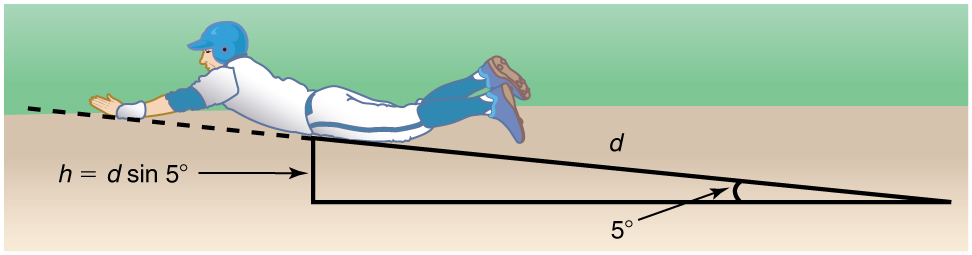
Suppose that the player from the previous example is running up a hill having a $5.00^\circ$ incline upward with a surface similar to that in the baseball stadium (see Figure 5). The player slides with the same initial speed, and the frictional force is still 450 N. Determine how far he slides.
Strategy
In this case, the work done by the nonconservative friction force on the player reduces the mechanical energy he has from his kinetic energy at zero height, to the final mechanical energy he has by moving through distance $d$ to reach height $h$ along the hill, with $h=d\sin{5.00^\circ}$. This is expressed by the equation
Solution
The work done by friction is again $W_{\text{nc}}=-f d$; initially the potential energy is $\PE_{i}=mg \cdot 0=0$ and the kinetic energy is $\KE_{i}=\frac{1}{2} m v_{i}^{2}$; the final energy contributions are $\KE_{f}=0$ for the kinetic energy and $\PE\_{f}=mgh = m g d \sin{\theta}$ for the potential energy.
Substituting these values gives
Solve this for $d$ to obtain
Discussion
As might have been expected, the player slides a shorter distance by sliding uphill. Note that the problem could also have been solved in terms of the forces directly and the work energy theorem, instead of using the potential energy. This method would have required combining the normal force and force of gravity vectors, which no longer cancel each other because they point in different directions, and friction, to find the net force. You could then use the net force and the net work to find the distance $d$ that reduces the kinetic energy to zero. By applying conservation of energy and using the potential energy instead, we need only consider the gravitational potential energy $mgh$
, without combining and resolving force vectors. This simplifies the solution considerably.
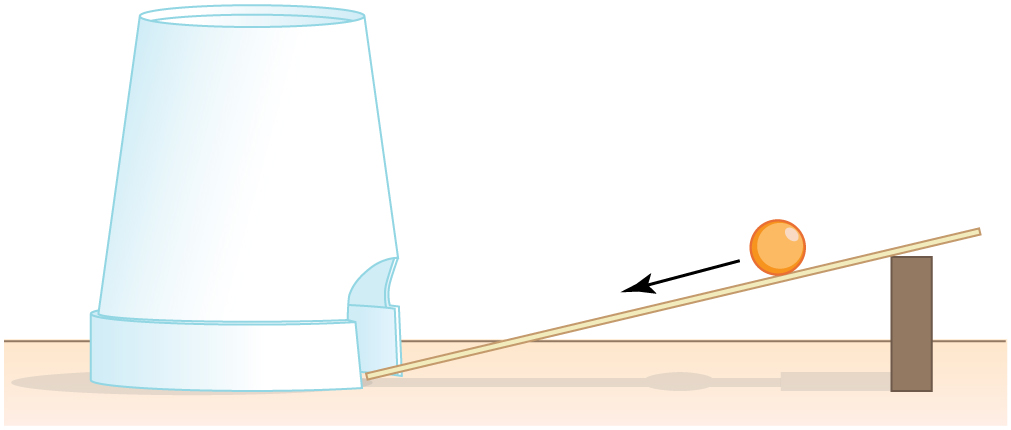
This experiment involves the conversion of gravitational potential energy into thermal energy. Use the ruler, book, and marble from Take-Home Investigation—Converting Potential to Kinetic Energy. In addition, you will need a foam cup with a small hole in the side, as shown in Figure 6. From the 10-cm position on the ruler, let the marble roll into the cup positioned at the bottom of the ruler. Measure the distance $d$ the cup moves before stopping. What forces caused it to stop? What happened to the kinetic energy of the marble at the bottom of the ruler? Next, place the marble at the 20-cm and the 30-cm positions and again measure the distance the cup moves after the marble enters it. Plot the distance the cup moves versus the initial marble position on the ruler. Is this relationship linear?
With some simple assumptions, you can use these data to find the coefficient of kinetic friction $\mu_{\text{k} }$ of the cup on the table. The force of friction $f$ on the cup is $\mu_{\text{k} } N$, where the normal force $N$ is just the weight of the cup plus the marble. The normal force and force of gravity do no work because they are perpendicular to the displacement of the cup, which moves horizontally. The work done by friction is $f d$. You will need the mass of the marble as well to calculate its initial kinetic energy.
It is interesting to do the above experiment also with a steel marble (or ball bearing). Releasing it from the same positions on the ruler as you did with the glass marble, is the velocity of this steel marble the same as the velocity of the marble at the bottom of the ruler? Is the distance the cup moves proportional to the mass of the steel and glass marbles?
Explore forces, energy and work as you push household objects up and down a ramp. Lower and raise the ramp to see how the angle of inclination affects the parallel forces acting on the file cabinet. Graphs show forces, energy and work.
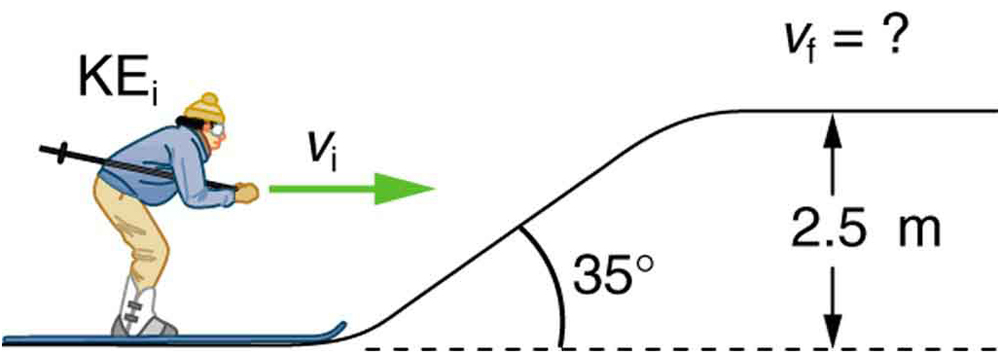
A 60.0-kg skier with an initial speed of 12.0 m/s coasts up a 2.50-m-high rise as shown in Figure 8. Find her final speed at the top, given that the coefficient of friction between her skis and the snow is 0.0800. (Hint: Find the distance traveled up the incline assuming a straight-line path as shown in the figure.)
Strategy
Use the work-energy theorem including friction. The initial kinetic energy is converted to gravitational potential energy plus thermal energy (work done against friction). First find the distance traveled along the incline using trigonometry, then apply energy conservation.
Solution
Given:
Step 1: Find the distance traveled along the incline
Step 2: Calculate the friction force
The normal force on an incline: $N = mg\cos\theta$
Friction force:
Step 3: Calculate work done by friction
Step 4: Apply the work-energy theorem
Calculate each term:
Discussion
The skier loses speed from 12.0 m/s to 9.46 m/s while coasting up the hill, which represents about a 21% reduction in speed. However, examining the energy distribution provides deeper insight: the initial kinetic energy of 4320 J is split between final kinetic energy (2682 J, or 62%), gravitational potential energy (1470 J, or 34%), and thermal energy from friction (168 J, or 4%).
The friction accounts for only about 4% of the energy loss, with most of the speed reduction coming from the gain in height. This low friction is characteristic of well-waxed skis on snow and explains why skiing is such an efficient sport. The coefficient of friction of 0.0800 is quite realistic for this scenario—typical values for waxed skis on snow range from 0.04 to 0.10 depending on temperature and snow conditions.
Notice that even though the skier retains 62% of the kinetic energy, the speed only decreases by 21%. This demonstrates that kinetic energy depends on the square of velocity: $\KE \propto v^2$. Small changes in speed result in much larger fractional changes in energy, which is why high-speed impacts are so much more dangerous than low-speed ones.
Answer
The skier’s final speed at the top is 9.46 m/s.
(a) How high a hill can a car coast up (engine disengaged) if work done by friction is negligible and its initial speed is 110 km/h? (b) If, in actuality, a 750-kg car with an initial speed of 110 km/h is observed to coast up a hill to a height 22.0 m above its starting point, how much thermal energy was generated by friction? (c) What is the average force of friction if the hill has a slope $2.5^\circ$ above the horizontal?
Strategy
For part (a), with no friction, all kinetic energy converts to gravitational potential energy: $\frac{1}{2}mv^{2} = mgh$.
For part (b), the difference between the initial kinetic energy and final potential energy equals the thermal energy generated.
For part (c), we use the work-energy theorem including friction over the distance traveled along the slope.
Solution for (a)
First, convert speed: $v = 110\text{ km/h} = 110 \times \frac{1000}{3600}\ms = 30.6\ms$
Using energy conservation:
Solution for (b)
The initial kinetic energy is:
The final potential energy is:
The thermal energy generated by friction is:
Solution for (c)
The distance along the slope is:
The work done by friction equals the thermal energy:
Discussion
Part (a) reveals that without friction, the car could coast up to 47.8 m—roughly the height of a 15-story building. This is a surprisingly large height, demonstrating the significant amount of energy contained in a moving car. At 110 km/h (about 68 mph), typical highway speed, the car possesses $3.51 \times 10^5$ J of kinetic energy.
In part (b), we see that friction dissipates $1.9 \times 10^5$ J, which is 54% of the car’s initial kinetic energy. This means friction removes more than half the car’s energy, reducing the maximum coasting height from 47.8 m to only 22.0 m—less than half the frictionless height. This substantial energy loss illustrates why cars cannot coast very far uphill with the engine off, and why fuel efficiency is so important in hilly terrain.
Part (c) shows the friction force is about 380 N (approximately 85 pounds). This might seem modest for a 750-kg car, but it acts over a long distance of 504 m. The shallow $2.5°$ slope means the car travels a horizontal distance of nearly 500 m while climbing 22 m vertically. The work done by friction, $W_f = fd = (380\text{ N})(504\text{ m}) = 1.9 \times 10^5\text{ J}$, accumulates to a substantial amount over this distance.
Comparing parts (a) and (b) demonstrates that friction is a major factor in real-world motion. Engineers must account for these losses when designing vehicles, which is why modern cars use low-friction tires, aerodynamic shapes, and efficient drivetrains to minimize energy waste.
Answer
(a) Without friction, the car could coast to a height of 47.8 m.
(b) The thermal energy generated by friction is $1.9 \times 10^{5}$ J.
(c) The average force of friction is $3.8 \times 10^{2}$ N (or 380 N).