Analytical methods of vector addition and subtraction employ geometry and simple trigonometry rather than the ruler and protractor of graphical methods. Part of the graphical technique is retained, because vectors are still represented by arrows for easy visualization. However, analytical methods are more concise, accurate, and precise than graphical methods, which are limited by the accuracy with which a drawing can be made. Analytical methods are limited only by the accuracy and precision with which physical quantities are known.
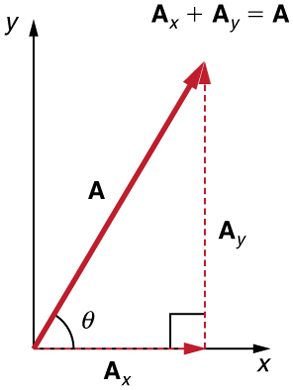
Analytical techniques and right triangles go hand-in-hand in physics because ( among other things) motions along perpendicular directions are independent. We very often need to separate a vector into perpendicular components. For example, given a vector like $\vb{A}$ in Figure 1, we may wish to find which two perpendicular vectors, $\vb{A}_{x}$ and $\vb{A}_{y}$, add to produce it.
$\vb{A}_{x}$ and $\vb{A}_{y}$ are defined to be the components of $\vb{A}$ along the x- and y-axes. The three vectors $\vb{A}$, $\vb{A}_{x}$, and $\vb{A}_{y}$ form a right triangle:
Note that this relationship between vector components and the resultant vector holds only for vector quantities (which include both magnitude and direction). The relationship does not apply for the magnitudes alone. For example, if $\vb{A}_{x}=3 \m$ east, $\vb{A}_{y}=4 \m$ north, and $\vb{A}=5 \m$ north-east, then it is true that the vectors $\vb{A}_{x} +\vb{A}\_{y} =\vb{A}$
. However, it is not true that the sum of the magnitudes of the vectors is also equal. That is,
Thus,
If the vector $\vb{A}$ is known, then its magnitude $A$ (its length) and its angle $\theta$ (its direction) are known. To find $A_{x}$ and $A_{y}$, its x- and y-components, we use the following relationships for a right triangle.
and
![]A dotted vector A sub x whose magnitude is equal to A cosine theta is drawn from the origin along the x axis. From the head of the vector A sub x another vector A sub y whose magnitude is equal to A sine theta is drawn in the upward direction. Their resultant vector A is drawn from the tail of the vector A sub x to the head of the vector A-y at an angle theta from the x axis. Therefore vector A is the sum of the vectors A sub x and A sub y.](../resources/Figure_03_03_02.jpg "The magnitudes of the vector components \( A_x \) and \( A_y \) can be related to the resultant vector \( A \) and the angle \( \theta \) with trigonometric identities. Here we see that \( A_x = A \cos{\theta } \) and \( A_y=A \sin{\theta} \) .")
Suppose, for example, that $\vb{A}$ is the vector representing the total displacement of the person walking in a city considered in Kinematics in Two Dimensions: An Introduction and Vector Addition and Subtraction: Graphical Methods .
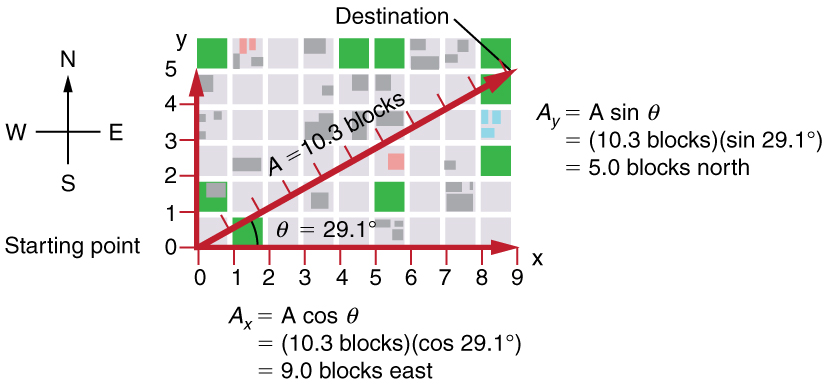
Then $A=10.3$ blocks and $\theta =29.1^\circ$, so that
If the perpendicular components $\vb{A}_{x}$ and $\vb{A}_{y}$ of a vector $\vb{A}$ are known, then $\vb{A}$ can also be found analytically. To find the magnitude $A$ and direction $\theta$ of a vector from its perpendicular components $\vb{A}_{x}$ and $\vb{A}_{y}$, we use the following relationships:
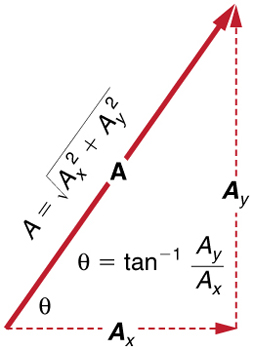
Note that the equation $A=\sqrt{ A_{x}^{2}+ A_{y}^{2}}$ is just the Pythagorean theorem relating the legs of a right triangle to the length of the hypotenuse. For example, if $A_{x}$ and $A_{y}$ are 9 and 5 blocks, respectively, then $A=\sqrt{ 9^{2}+5^{2}}=10.3$ blocks, again consistent with the example of the person walking in a city. Finally, the direction is
$\theta ={\tan}^{-1}\left(5/9 \right) =29.1^\circ$, as before.
Equations $A_{x}=A\cos{\theta}$ and $A_{y}=A\sin{\theta}$ are used to find the perpendicular components of a vector—that is, to go from $A$ and $\theta$ to $A_{x}$ and $A_{y}$. Equations $A=\sqrt{ A_{x}^{2}+ A_{y}^{2}}$ and $\theta ={\tan}^{-1} \left( \frac{ A_{y}}{ A_{x}} \right)$ are used to find a vector from its perpendicular components—that is, to go from $A_{x}$ and $A_{y}$ to $A$ and $\theta$. Both processes are crucial to analytical methods of vector addition and subtraction.
To see how to add vectors using perpendicular components, consider Figure 5, in which the vectors $\vb{A}$ and $\vb{B}$ are added to produce the resultant $\vb{R}$.
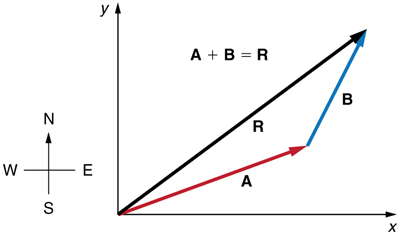
If $\vb{A}$ and $\vb{B}$ represent two legs of a walk (two displacements), then $\vb{R}$ is the total displacement. The person taking the walk ends up at the tip of $\vb{R}$. There are many ways to arrive at the same point. In particular, the person could have walked first in the x -direction and then in the y-direction. Those paths are the x- and y-components of the resultant, $\vb{R}_{x}$ and $\vb{R}_{y}$. If we know $\vb{R}_{x}$ and $\vb{R}_{y}$, we can find $R$ and $\theta$ using the equations $A=\sqrt{ A_{x}^{2}+ A_{y}^{2}}$ and $\theta ={\tan}^{-1}\left( A_{y}/ A_{x}\right)$. When you use the analytical method of vector addition, you can determine the components or the magnitude and direction of a vector.
Step 1. Identify the x- and y-axes that will be used in the problem. Then, find the components of each vector to be added along the chosen perpendicular axes. Use the equations $A_{x}=A\cos{\theta}$ and $A_{y}=A\sin{\theta}$ to find the components. In Figure 6, these components are $A_{x}$, $A_{y}$, $B_{x}$, and $B_{y}$. The angles that vectors $\vb{A}$ and $\vb{B}$ make with the x-axis are $\theta_{\text{A}}$ and $\theta_{\text{B}}$, respectively.
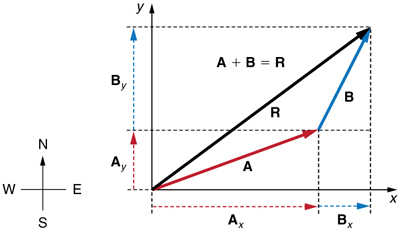
Step 2. Find the components of the resultant along each axis by adding the components of the individual vectors along that axis. That is, as shown in Figure 7,
and
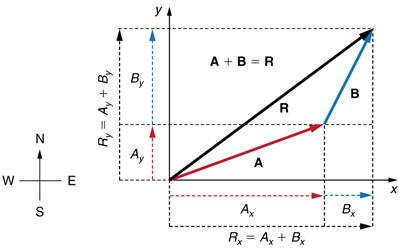
Components along the same axis, say the x-axis, are vectors along the same line and, thus, can be added to one another like ordinary numbers. The same is true for components along the y-axis. (For example, a 9-block eastward walk could be taken in two legs, the first 3 blocks east and the second 6 blocks east, for a total of 9, because they are along the same direction.) So resolving vectors into components along common axes makes it easier to add them. Now that the components of $\vb{R}$ are known, its magnitude and direction can be found.
Step 3. To get the magnitude $R$ of the resultant, use the Pythagorean theorem:
Step 4. To get the direction of the resultant:
The following example illustrates this technique for adding vectors using perpendicular components.
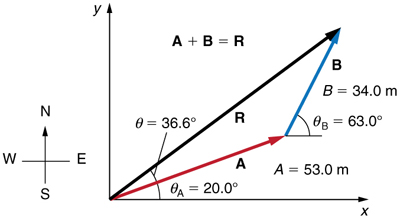
Add the vector $\vb{A}$ to the vector $\vb{B}$ shown in Figure 8, using perpendicular components along the x- and y-axes. The x- and y-axes are along the east–west and north–south directions, respectively. Vector $\vb{A}$ represents the first leg of a walk in which a person walks $53.0 \m$ in a direction $20.0^\circ$ north of east. Vector $\vb{B}$ represents the second leg, a displacement of $34.0 \m$ in a direction $63.0^\circ$ north of east.
Strategy
The components of $\vb{A}$ and $\vb{B}$ along the x- and y-axes represent walking due east and due north to get to the same ending point. Once found, they are combined to produce the resultant.
Solution
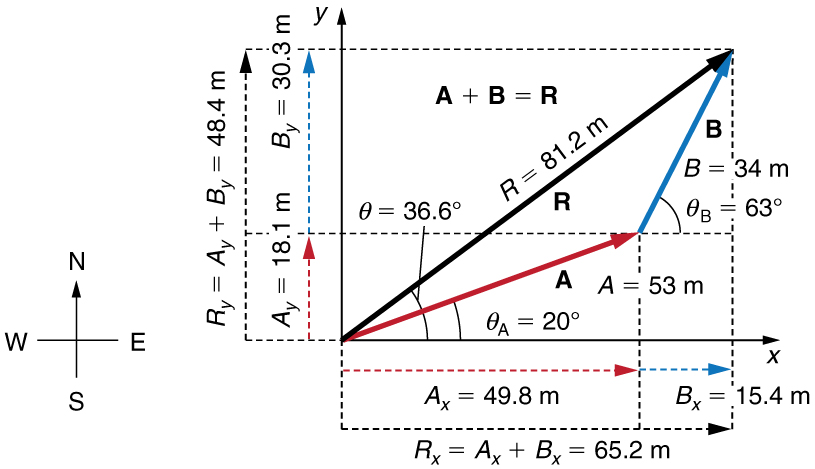
Following the method outlined above, we first find the components of $\vb{A}$ and $\vb{B}$ along the x- and y-axes. Note that $A=53.0 \m$, $\theta_{\text{A}}=20.0^\circ$, $B=34.0 \m$, and $\theta_{\text{B}}=63.0^\circ$. We find the x-components by using $A_{x}=A\cos{\theta}$, which gives
and
Similarly, the y-components are found using $A_{y}=A\sin{\theta_{A}}$:
and
The x- and y-components of the resultant are thus
and
Now we can find the magnitude of the resultant by using the Pythagorean theorem:
so that
Finally, we find the direction of the resultant:
Thus,
Discussion
This example illustrates the addition of vectors using perpendicular components. Vector subtraction using perpendicular components is very similar—it is just the addition of a negative vector.
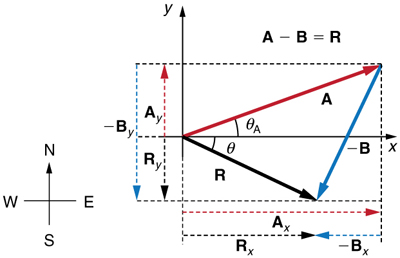
Subtraction of vectors is accomplished by the addition of a negative vector. That is, $\vb{A}-\vb{B}\equiv \vb{A}+\left( -\vb{B} \right)$. Thus, the method for the subtraction of vectors using perpendicular components is identical to that for addition. The components of $-\vb{B}$ are the negatives of the components of $\vb{B}$. The x- and y-components of the resultant $\vb{A}-\vb{B} = \vb{R}$ are thus
and
and the rest of the method outlined above is identical to that for addition. (See Figure 10.)
Analyzing vectors using perpendicular components is very useful in many areas of physics, because perpendicular quantities are often independent of one another. The next module, Projectile Motion, is one of many in which using perpendicular components helps make the picture clear and simplifies the physics.
Learn how to add vectors. Drag vectors onto a graph, change their length and angle, and sum them together. The magnitude, angle, and components of each vector can be displayed in several formats.
The steps to add vectors $\vb{A}$ and $\vb{B}$ using the analytical method are as follows: Step 1: Determine the coordinate system for the vectors. Then, determine the horizontal and vertical components of each vector using the equations
and
Step 2: Add the horizontal and vertical components of each vector to determine the components $R_{x}$ and $R_{y}$ of the resultant vector, $\vb{R}$ :
and
Step 3: Use the Pythagorean theorem to determine the magnitude, $R$, of the resultant vector $\vb{R}$:
Step 4: Use a trigonometric identity to determine the direction, $\theta$, of $\vb{R}$:
Suppose you add two vectors $\vb{A}$ and $\vb{B}$. What relative direction between them produces the resultant with the greatest magnitude? What is the maximum magnitude? What relative direction between them produces the resultant with the smallest magnitude? What is the minimum magnitude?
Give an example of a nonzero vector that has a component of zero.
Explain why a vector cannot have a component greater than its own magnitude.
If the vectors $\vb{A}$ and $\vb{B}$ are perpendicular, what is the component of $\vb{A}$ along the direction of $\vb{B}$ ? What is the component of $\vb{B}$ along the direction of $\vb{A}$ ?
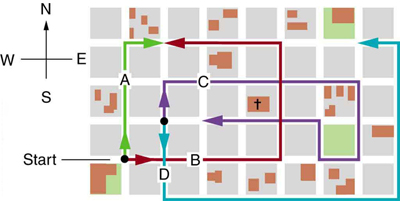
Find the following for path C in Figure 11: (a) the total distance traveled and (b) the magnitude and direction of the displacement from start to finish. In this part of the problem, explicitly show how you follow the steps of the analytical method of vector addition.
Strategy
For part (a), add up the lengths of all individual segments. For part (b), use the analytical method of vector addition: break the path into east-west and north-south components, sum each component separately, then find the magnitude and direction of the resultant displacement.
Solution
(a) Total distance traveled:
From Figure 11, path C consists of:
Total distance:
(b) Displacement using analytical method:
Step 1: Break path into components
East-West components (taking east as positive):
North-South components (taking north as positive):
Step 2: Calculate magnitude
Step 3: Calculate direction
Since the north component is zero and the east component is positive, the displacement is directly east.
Discussion
Despite traveling 1560 m along a winding path, the person ends up only 120 m from where they started! This demonstrates the difference between distance (total path length) and displacement (straight-line distance from start to finish). The analytical method shows clearly why: the north and south movements exactly cancel (120 + 120 - 240 = 0), while the eastward movements exceed westward movements by exactly one block (600 - 120 - 360 = 120 m). This is a beautiful example of how vectors add: you can take any complicated path, but the net displacement depends only on the vector sum of all the individual displacements.
Answer
(a) The total distance traveled along path C is 1.56 km.
(b) The displacement is 120 m directed due east.
Find the following for path D in Figure 11: (a) the total distance traveled and (b) the magnitude and direction of the displacement from start to finish. In this part of the problem, explicitly show how you follow the steps of the analytical method of vector addition.
Strategy
Path D consists of multiple straight-line segments. For (a), sum the lengths of all segments. For (b), break each segment into components, sum components, then find resultant magnitude and direction using the analytical method.
Solution
From Figure 11, Path D consists of (reading the figure):
Using the scale where 1 block ≈ 100 m:
(a) Total distance:
(b) Displacement using analytical method:
Step 1: Identify components of each segment
Step 2: Sum the components
Step 3: Calculate magnitude
Step 4: Calculate direction
Since east is positive and north is negative, the direction is 18.4° south of east.
Discussion
The total distance (1600 m) is much greater than the displacement magnitude (949 m) because the path includes backtracking—going north then south. The displacement represents the straight-line distance and direction from start to finish.
Answer
(a) The total distance traveled is 1600 m (or 1.60 km).
(b) The displacement is 949 m (or 0.949 km) at 18.4° south of east.
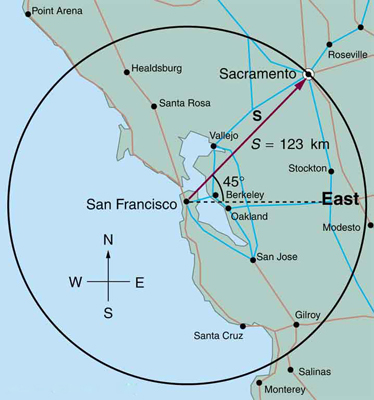
Find the north and east components of the displacement from San Francisco to Sacramento shown in Figure 12.
Strategy
The displacement from San Francisco to Sacramento is 123 km at 45° north of east. We’ll use trigonometry to find the north and east components: east component = R cos θ, north component = R sin θ, where θ is measured from the east direction.
Solution
Given:
East component:
North component:
Discussion
At 45°, the displacement is equally divided between the north and east directions, which is why both components are equal (87.0 km each). This makes sense geometrically: a 45° angle bisects the right angle between north and east, so the components must be equal. We can verify: $\sqrt{(87.0)^2 + (87.0)^2} = \sqrt{7569 + 7569} = \sqrt{15,138} = 123 \text{ km}$ ✓. This confirms our component calculations are correct. The fact that Sacramento is northeast of San Francisco at exactly 45° creates this symmetric result.
Answer
The north component of the displacement is 87.0 km, and the east component is 87.0 km.
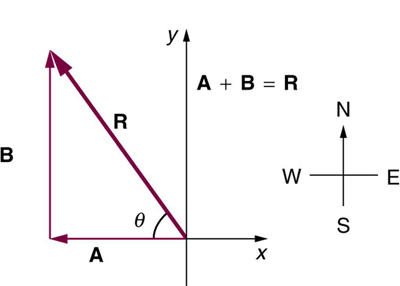
Solve the following problem using analytical techniques: Suppose you walk 18.0 m straight west and then 25.0 m straight north. How far are you from your starting point, and what is the compass direction of a line connecting your starting point to your final position? (If you represent the two legs of the walk as vector displacements $\vb{A}$ and $\vb{B}$, as in Figure 13, then this problem asks you to find their sum
$\vb{R}=\vb{A}+\vb{B}$.)
Note that you can also solve this graphically. Discuss why the analytical technique for solving this problem is potentially more accurate than the graphical technique.
Strategy
Use the analytical method: identify components of each displacement vector, sum the components, then calculate the resultant magnitude and direction. Compare this to graphical methods.
Solution
Vector A (18.0 m west):
Vector B (25.0 m north):
Resultant R = A + B:
Magnitude:
Direction:
Since RE is negative (west) and RN is positive (north), the compass direction is 35.8° west of north (or equivalently, N35.8°W).
Discussion
Why analytical is more accurate than graphical:
The graphical method would involve drawing vectors to scale, measuring with a ruler, and using a protractor—each step introduces potential error.
Answer
You are 30.8 m from your starting point, in a compass direction of 35.8° west of north. The analytical technique is more accurate because it eliminates drawing and measurement errors inherent in graphical solutions.
Repeat the previous Problem using analytical techniques, but reverse the order of the two legs of the walk and show that you get the same final result. (This problem shows that adding them in reverse order gives the same result—that is, $\vb{B} + \vb{A} = \vb{A} + \vb{B}$.) Discuss how taking another path to reach the same point might help to overcome an obstacle blocking your other path.
Strategy
We’ll solve this problem by reversing the order: first walk 25.0 m north (B), then 18.0 m west (A). Using the analytical method, we’ll find the components, sum them, and calculate the resultant. The result should match the previous problem, demonstrating that vector addition is commutative: A + B = B + A.
Solution
Vector B (25.0 m north):
Vector A (18.0 m west):
Resultant R = B + A:
Magnitude:
Direction:
Since the east component is negative and the north component is positive, the direction is 35.8° west of north.
Discussion
As expected, we get exactly the same result as the previous problem: 30.8 m at 35.8° west of north. This confirms the commutative property of vector addition: the order doesn’t matter. Whether you walk west then north, or north then west, you end up at the same location.
Regarding obstacles: if one path is blocked, you can take another path to reach the same destination. For example, if you can’t walk directly west (maybe there’s a building), you could first go north to get around the obstacle, then west. The final displacement is identical—only the path differs. This flexibility is useful in navigation: as long as the vector sum is the same, any combination of movements in the component directions will get you to the same endpoint.
Answer
The displacement is 30.8 m at 35.8° west of north, confirming that B + A = A + B.
You drive $7.50 \text{km}$ in a straight line in a direction $15^\circ$ east of north. (a) Find the distances you would have to drive straight east and then straight north to arrive at the same point. (This determination is equivalent to find the components of the displacement along the east and north directions.) (b) Show that you still arrive at the same point if the east and north legs are reversed in order.
Strategy
Resolve the displacement into east and north components using trigonometry. The angle is 15° east of north, meaning we measure 15° from the north axis toward the east.
Solution
Given:
(a) Finding components:
North component:
East component:
(b) Reversed order:
If we first drive east, then north:
If we first drive north, then east:
The final position is the same in both cases because vector addition is commutative.
Discussion
The angle is measured from north toward east, so we use cosine for the north component (adjacent to the angle from north) and sine for the east component (opposite to the angle from north). The north component (7.24 km) is much larger than the east component (1.94 km) because the direction is only slightly east of due north.
Answer
(a) To arrive at the same point, you would drive 1.94 km east and 7.24 km north.
(b) Reversing the order (north then east, or east then north) results in the same final position, confirming the commutative property of vector addition.
Do Problem again using analytical techniques and change the second leg of the walk to $25.0 \m$ straight south. (This is equivalent to subtracting $\vb{B}$ from $\vb{A}$ —that is, finding $\vb{R}^\prime =\vb{A} - \vb{B}$)
(b) Repeat again, but now you first walk $25.0 \m$ north and then $18.0 \m$ east. (This is equivalent to subtract $\vb{A}$ from $\vb{B}$ —that is, to find $\vb{A}=\vb{B}+\vb{C}$. Is that consistent with your result?)
Strategy
For part (a), we’re finding R’ = A - B, where A is 18.0 m west and B is now 25.0 m south (instead of north). This is equivalent to adding A and -B (where -B is 25.0 m north). For part (b), we reverse the order to find B - A, which should give the opposite result.
Solution
(a) Finding R’ = A - B:
Vector A (18.0 m west):
Vector -B (25.0 m north, since B is south):
Resultant R’ = A - B:
Wait, this doesn’t give the right answer. Let me recalculate. If the original B was 25.0 m north, and now we’re subtracting it, we actually walk 25.0 m south.
Let me restart:
Vector A (18.0 m west):
Vector B (now 25.0 m south):
Resultant R’ = A - B:
Magnitude:
Direction:
Hmm, this gives west of north, not south of west. Let me reconsider the problem. The problem says to change the second leg to 25.0 m straight south, which means we walk west then south.
Actually, I need to recalculate more carefully:
Vector A (18.0 m west):
Now walking 25.0 m south (not north as in the original):
Resultant:
Magnitude:
Direction:
Since both components are negative (west and south), the angle is measured from the south or west axis. It’s $90^\circ - 35.8^\circ = 54.2^\circ$ south of west.
(b) Finding B - A (walking 25.0 m north then 18.0 m east):
Vector B (25.0 m north):
Vector A-like (18.0 m east):
Resultant:
Magnitude:
Direction: $54.2^\circ$ north of east (or $35.8^\circ$ east of north).
Discussion
Part (a) and part (b) give opposite results, as expected for vector subtraction: one points southwest, the other northeast. The magnitude is the same (30.8 m) but the directions are exactly opposite, demonstrating that reversing the order of subtraction reverses the direction of the result.
Answer
(a) Walking 18.0 m west then 25.0 m south gives a displacement of 30.8 m at 54.2° south of west.
(b) Walking 25.0 m north then 18.0 m east gives a displacement of 30.8 m at 54.2° north of east.
A new landowner has a triangular piece of flat land she wishes to fence. Starting at the west corner, she measures the first side to be 80.0 m long and the next to be 105 m. These sides are represented as displacement vectors $\vb{A}$ from $\vb{B}$ in Figure 14. She then correctly calculates the length and orientation of the third side $\text{C}$. What is her result?
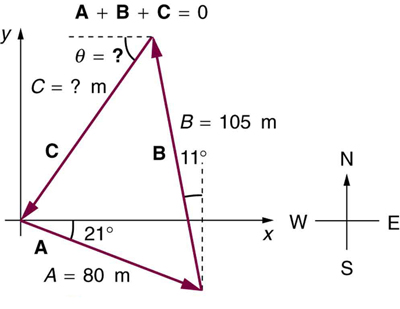
Strategy
The three sides form a closed triangle: A + B + C = 0, so C = -(A + B). Find components of A and B, sum them, then find the magnitude and direction of -C.
Solution
Vector A (80.0 m at 21° south of east):
Vector B (105 m at 11° east of north):
Sum A + B:
Vector C = -(A + B):
Magnitude:
Direction:
Since both components are negative, the direction is 38.1° south of west (or equivalently, W38.1°S).
Discussion
The third side closes the triangle by connecting the end of B back to the start of A. Its direction (southwest) makes sense geometrically: A goes southeast, B goes mostly north, so C must go back southwest to complete the triangle.
Answer
The third side C is 121 m long at 38.1° south of west.
You fly $32.0 \text{km}$ in a straight line in still air in the direction $35.0^\circ$ south of west. (a) Find the distances you would have to fly straight south and then straight west to arrive at the same point. (This determination is equivalent to finding the components of the displacement along the south and west directions.) (b) Find the distances you would have to fly first in a direction $45.0^\circ$ south of west and then in a direction $45.0^\circ$ west of north. These are the components of the displacement along a different set of axes—one rotated $45^\circ$.
Strategy
For part (a), resolve the 32.0 km displacement into south and west components. For part (b), resolve into components along axes rotated 45°.
Solution
Given: $R = 32.0 \text{ km}$ at $35.0°$ south of west
(a) South and west components:
West component:
South component:
(b) Components along rotated axes (45° south of west and 45° west of north):
The new x’-axis is at 45° south of west. The displacement makes an angle of 35° - 45° = -10° with this axis (10° toward the west-north axis).
Actually, let me recalculate: The displacement is 35° south of west. The new axes are at 45° south of west (x’) and 45° west of north (y’).
Angle with x’-axis: 45° - 35° = 10° (toward y’)
Component along 45° south of west:
Component along 45° west of north:
The negative sign means the component is opposite to 45° west of north, which is 45° east of south, or equivalently 5.56 km at 45° south of east.
Discussion
Part (a) gives standard components. Part (b) shows that the same vector has different component values when described in a rotated coordinate system. The first component (31.5 km) is nearly equal to the total displacement because the new x’-axis is nearly aligned with the displacement direction.
Answer
(a) You would fly 18.4 km south, then 26.2 km west.
(b) In the rotated axes: 31.5 km at 45.0° south of west, then 5.56 km at 45.0° east of south (or equivalently, away from 45° west of north).
A farmer wants to fence off their four-sided plot of flat land. They measure the first three sides, shown as $\vb{A},$ $\vb{B},$ and $\vb{C}$ in Figure 15, and then correctly calculate the length and orientation of the fourth side $\vb{D}$. What is their result?
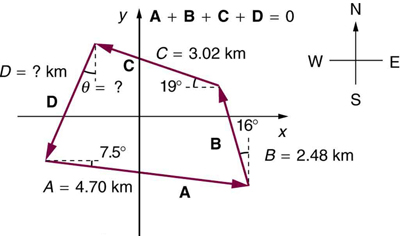
Strategy
For a closed quadrilateral, A + B + C + D = 0, so D = -(A + B + C). Calculate components of A, B, and C, sum them, then find -D.
Solution
Vector A (4.70 km at 7.5° south of west):
Vector B (2.48 km at 16° west of north):
Vector C (3.02 km at 19° north of west):
Sum A + B + C:
Vector D = -(A + B + C):
Magnitude:
Direction:
Since east is positive and north is negative, direction is 18.5° south of east.
Discussion
The fourth side closes the quadrilateral, connecting C back to the start. Its eastward and slightly southward direction makes sense given that the other three sides have predominantly westward and mixed north-south components.
Answer
The fourth side D is 8.65 km long at 18.5° south of east.
In an attempt to escape his island, Gilligan builds a raft and sets to sea. The wind shifts a great deal during the day, and he is blown along the following straight lines: $2.50 \text{km}$, $45.0^\circ$ north of west; then $4.70 \text{km}$, $60.0^\circ$ south of east; then $1.30\text{km}$,$25.0^\circ$ south of west; then $5.10 \text{km}$ straight east; then $1.70\text{km}$, $5.00^\circ$ east of north; then $7.20 \text{km}$, $55.0^\circ$ south of west; and finally $2.80 \text{km}$, $10.0^\circ$ north of east. What is his final position relative to the island?
Strategy
Add all seven displacement vectors using components. Sum east-west and north-south components separately, then find the resultant magnitude and direction.
Solution
Breaking down each displacement:
Sum of components:
Magnitude:
Direction:
Since east is positive and north is negative, the direction is 63.5° south of east.
Discussion
After seven displacements totaling 25.3 km of travel, Gilligan ends up only 7.34 km from his starting point—less than 30% of the distance traveled. The shifting winds caused him to zigzag considerably. His final position is southeast of the island, despite significant westward movements.
Answer
Gilligan’s final position is 7.34 km at 63.5° south of east from the island.
Suppose a pilot flies $40.0 \text{km}$ in a direction $60^\circ$ north of east and then flies $30.0 \text{km}$ in a direction $15^\circ$ north of east as shown in Figure 16. Find her total distance $R$ from the starting point and the direction $\theta$ of the straight-line path to the final position. Discuss qualitatively how this flight would be altered by a wind from the north and how the effect of the wind would depend on both wind speed and the speed of the plane relative to the air mass.
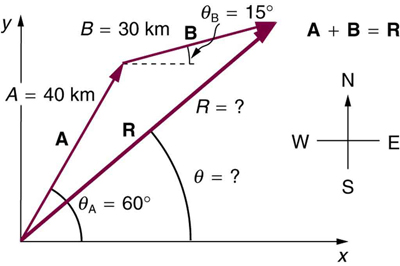
Strategy
Find components of both flight segments, sum them, then calculate the resultant magnitude and direction. Discuss how wind affects the flight path.
Solution
Vector A (40.0 km at 60° north of east):
Vector B (30.0 km at 15° north of east):
Resultant R = A + B:
Magnitude:
Direction:
The direction is 40.9° north of east.
Wind effect discussion:
A wind from the north would blow southward, affecting the flight as follows:
The ratio of plane speed to wind speed determines the severity. If the plane flies at 200 km/h and the wind is 20 km/h, the drift is relatively small. But if the wind is 100 km/h, the drift becomes significant.
Discussion
The total displacement (64.8 km) is less than the sum of individual displacements (70.0 km) because the pilot doesn’t fly in a straight line. The final direction (40.9°) lies between the two segment directions (60° and 15°), weighted toward the longer first segment.
Answer
The pilot’s total distance from the starting point is 64.8 km at 40.9° north of east. A wind from the north would push the plane southward, requiring the pilot to aim more northward to compensate, with the effect depending on the ratio of wind speed to airspeed.