As we have seen, any change in magnetic flux induces an emf opposing that change—a process known as induction. Motion is one of the major causes of induction. For example, a magnet moved toward a coil induces an emf, and a coil moved toward a magnet produces a similar emf. In this section, we concentrate on motion in a magnetic field that is stationary relative to the Earth, producing what is loosely called motional emf.
One situation where motional emf occurs is known as the Hall effect and has already been examined. Charges moving in a magnetic field experience the magnetic force $F=qvB \sin \theta$ , which moves opposite charges in opposite directions and produces an $\text{emf}=B\ell v$ . We saw that the Hall effect has applications, including measurements of $B$ and $v$ . We will now see that the Hall effect is one aspect of the broader phenomenon of induction, and we will find that motional emf can be used as a power source.
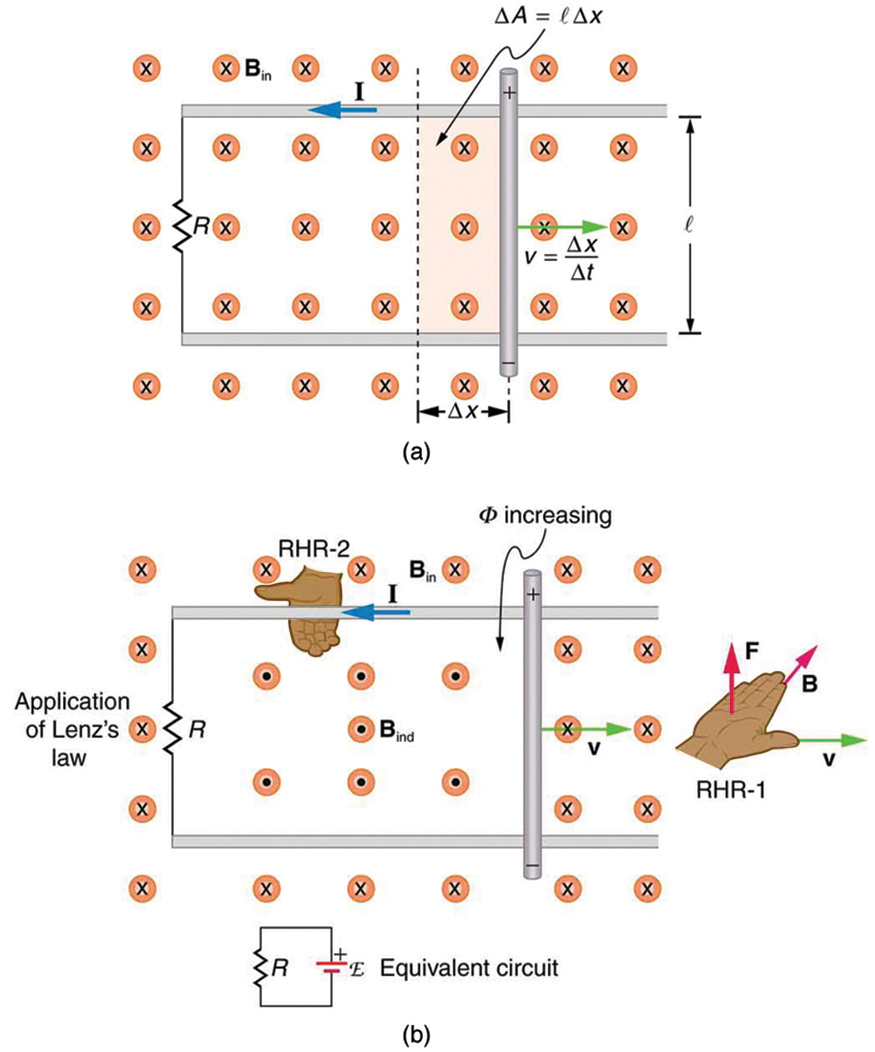
Consider the situation shown in [Figure 1]. A rod is moved at a speed $v$ along a pair of conducting rails separated by a distance $\ell$ in a uniform magnetic field $B$ . The rails are stationary relative to $B$ and are connected to a stationary resistor $R$ . The resistor could be anything from a light bulb to a voltmeter. Consider the area enclosed by the moving rod, rails, and resistor $B$ is perpendicular to this area, and the area is increasing as the rod moves. Thus the magnetic flux enclosed by the rails, rod, and resistor is increasing. When flux changes, an emf is induced according to Faraday’s law of induction.
To find the magnitude of emf induced along the moving rod, we use Faraday’s law of induction without the sign:
Here and below, “emf” implies the magnitude of the emf. In this equation,$N=1$ and the flux $\Phi =BA \cos \theta$ . We have $\theta =0º$ and $\cos \theta =1$ , since $B$ is perpendicular to $A$ . Now $\Delta \Phi =\Delta \left(BA\right)=B\Delta A$ , since $B$ is uniform. Note that the area swept out by the rod is $\Delta A=\ell \Delta x$ . Entering these quantities into the expression for emf yields
Finally, note that $\Delta x/\Delta t=v$ , ** the velocity of the rod. Entering this into the last expression shows that
is the motional emf. This is the same expression given for the Hall effect previously.
There are many connections between the electric force and the magnetic force. The fact that a moving electric field produces a magnetic field and, conversely, a moving magnetic field produces an electric field is part of why electric and magnetic forces are now considered to be different manifestations of the same force. This classic unification of electric and magnetic forces into what is called the electromagnetic force is the inspiration for contemporary efforts to unify other basic forces.
To find the direction of the induced field, the direction of the current, and the polarity of the induced emf, we apply Lenz’s law as explained in Faraday's Law of Induction: Lenz's Law. ( See [Figure 1](b).) Flux is increasing, since the area enclosed is increasing. Thus the induced field must oppose the existing one and be out of the page. And so the RHR-2 requires that I be counterclockwise, which in turn means the top of the rod is positive as shown.
Motional emf also occurs if the magnetic field moves and the rod (or other object) is stationary relative to the Earth (or some observer). We have seen an example of this in the situation where a moving magnet induces an emf in a stationary coil. It is the relative motion that is important. What is emerging in these observations is a connection between magnetic and electric fields. A moving magnetic field produces an electric field through its induced emf. We already have seen that a moving electric field produces a magnetic field—moving charge implies moving electric field and moving charge produces a magnetic field.
Motional emfs in the Earth’s weak magnetic field are not ordinarily very large, or we would notice voltage along metal rods, such as a screwdriver, during ordinary motions. For example, a simple calculation of the motional emf of a 1 m rod moving at 3.0 m/s perpendicular to the Earth’s field gives
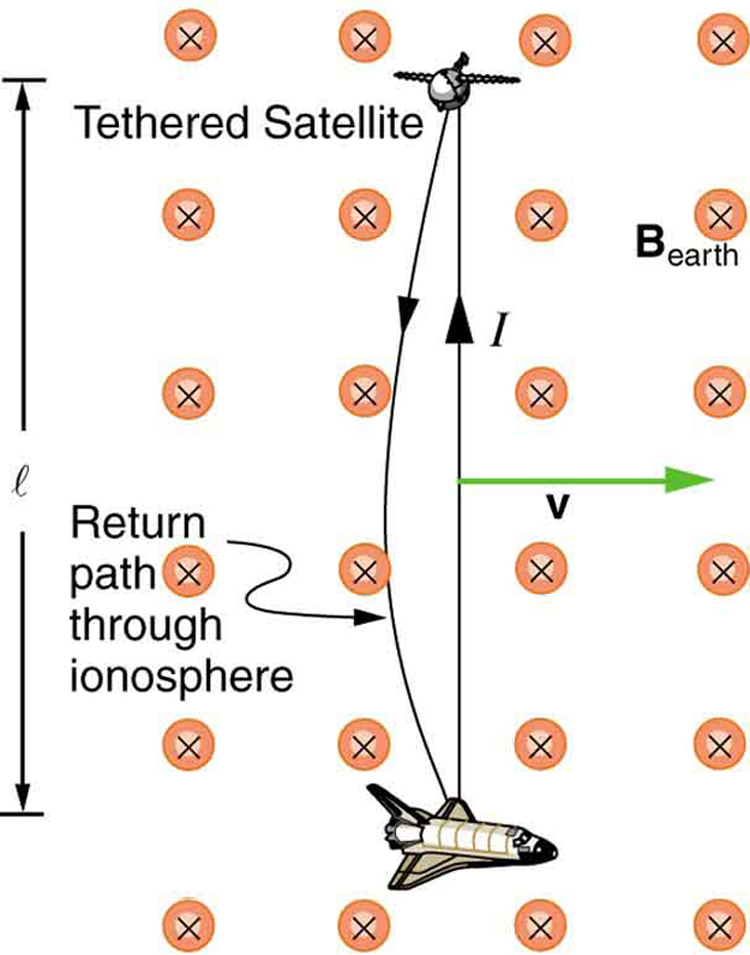
$\text{emf}=B\ell v=\left( 5.0 \times 10^{-5} \text{T}\right)\left( 1.0 m\right)\left( 3.0 m/s\right)=150 \text{μV}$ . This small value is consistent with experience. There is a spectacular exception, however. In 1992 and 1996, attempts were made with the space shuttle to create large motional emfs. The Tethered Satellite was to be let out on a 20 km length of wire as shown in [Figure 2], to create a 5 kV emf by moving at orbital speed through the Earth’s field. This emf could be used to convert some of the shuttle’s kinetic and potential energy into electrical energy if a complete circuit could be made. To complete the circuit, the stationary ionosphere was to supply a return path for the current to flow. (The ionosphere is the rarefied and partially ionized atmosphere at orbital altitudes. It conducts because of the ionization. The ionosphere serves the same function as the stationary rails and connecting resistor in [Figure 1], without which there would not be a complete circuit.) Drag on the current in the cable due to the magnetic force $F=I\ell B \sin \theta$ does the work that reduces the shuttle’s kinetic and potential energy and allows it to be converted to electrical energy. The tests were both unsuccessful. In the first, the cable hung up and could only be extended a couple of hundred meters; in the second, the cable broke when almost fully extended. [Example 1] indicates feasibility in principle.
Calculate the motional emf induced along a 20.0 km long conductor moving at an orbital speed of 7.80 km/s perpendicular to the Earth’s $5.00 \times 10^{-5} \text{T}$ magnetic field.
Strategy
This is a straightforward application of the expression for motional emf— $\text{emf}=B\ell v$.
Solution
Entering the given values into $\text{emf}=B\ell v$ gives
Discussion
The value obtained is greater than the 5 kV measured voltage for the shuttle experiment, since the actual orbital motion of the tether is not perpendicular to the Earth’s field. The 7.80 kV value is the maximum emf obtained when $\theta =90 ^\circ$ and $\sin \theta =1$.
An emf induced by motion relative to a magnetic field $B$ is called a motional emf and is given by
where $\ell$ is the length of the object moving at speed $v$ relative to the field.
Why must part of the circuit be moving relative to other parts, to have usable motional emf? Consider, for example, that the rails in [Figure 1] are stationary relative to the magnetic field, while the rod moves.
A powerful induction cannon can be made by placing a metal cylinder inside a solenoid coil. The cylinder is forcefully expelled when solenoid current is turned on rapidly. Use Faraday’s and Lenz’s laws to explain how this works. Why might the cylinder get live/hot when the cannon is fired?
An induction stove heats a pot with a coil carrying an alternating current located beneath the pot (and without a hot surface). Can the stove surface be a conductor? Why won’t a coil carrying a direct current work?
Explain how you could thaw out a frozen water pipe by wrapping a coil carrying an alternating current around it. Does it matter whether or not the pipe is a conductor? Explain.
Use Faraday’s law, Lenz’s law, and RHR-1 to show that the magnetic force on the current in the moving rod in [Figure 1] is in the opposite direction of its velocity.
Strategy
We’ll apply Faraday’s law to find the induced emf, use Lenz’s law to determine the direction of the induced current, and then apply RHR-1 to find the direction of the magnetic force on that current.
Solution
As the rod moves to the right with velocity $v$, the flux through the circuit increases (the enclosed area increases). By Faraday’s law, this changing flux induces an emf in the circuit.
By Lenz’s law, the induced current must create a magnetic field that opposes the change in flux. Since the flux into the page is increasing, the induced magnetic field must point out of the page. Using RHR-2 (right-hand rule for the magnetic field created by a current loop), the induced current must flow counterclockwise in the circuit—up through the rod.
Now we apply RHR-1 (the right-hand rule for the magnetic force on a current-carrying conductor). Point your fingers in the direction of current (upward in the rod), curl them toward the direction of the magnetic field (into the page), and your thumb points in the direction of the force. This gives a force to the left—opposite to the rod’s velocity (which is to the right).
Discussion
This result makes physical sense from energy conservation. The magnetic force opposes the motion of the rod, so work must be done to keep the rod moving at constant velocity. This mechanical work is converted into electrical energy in the circuit. If the magnetic force were in the same direction as the velocity, we would have perpetual motion, violating energy conservation. The opposing force represents the mechanical “cost” of generating electrical power.
Final Answer
By Faraday’s law, the moving rod induces an emf. By Lenz’s law, the induced current flows upward through the rod (counterclockwise in the circuit). By RHR-1, a current flowing upward in a magnetic field directed into the page experiences a force to the left, opposite to the rod’s rightward velocity.
If a current flows in the Satellite Tether shown in [Figure 2], use Faraday’s law, Lenz’s law, and RHR-1 to show that there is a magnetic force on the tether in the direction opposite to its velocity.
Strategy
We’ll apply the same reasoning as in the previous problem: use Faraday’s law for the induced emf, Lenz’s law for the current direction, and RHR-1 for the force direction.
Solution
As the tethered satellite moves through Earth’s magnetic field at orbital velocity, the tether sweeps through the field lines, creating a changing magnetic flux through the circuit formed by the tether, ionosphere, and shuttle. By Faraday’s law, this induces an emf of $\text{emf}=B\ell v$.
By Lenz’s law, the induced current must flow in a direction that creates a magnetic field opposing the flux change. As the system moves forward through Earth’s magnetic field, the induced current flows in such a direction to oppose this motion.
Using RHR-1 (force on a current-carrying conductor in a magnetic field): Point your fingers in the direction of the current in the tether, curl them toward the direction of Earth’s magnetic field, and your thumb points in the direction of the magnetic force. This force,$F=I\ell B$, is directed opposite to the satellite’s velocity.
Discussion
This magnetic drag force is what enables energy conversion in the Tethered Satellite experiment. The satellite’s kinetic and potential energy is converted to electrical energy through the induced emf and current. The opposing magnetic force does negative work on the satellite, slowing it down and extracting energy from its orbital motion. This is the fundamental principle behind electromagnetic braking and regenerative power generation.
Final Answer
The moving tether induces an emf by Faraday’s law. The resulting current (whose direction is determined by Lenz’s law to oppose the motion) experiences a magnetic force by RHR-1 that is directed opposite to the satellite’s velocity, providing magnetic drag.
(a) A jet airplane with a 75.0 m wingspan is flying at 280 m/s. What emf is induced between wing tips if the vertical component of the Earth’s field is $3.00 \times 10^{-5} \text{T}$ ? (b) Is an emf of this magnitude likely to have any consequences? Explain.
Strategy
(a) Use the motional emf formula $\text{emf}=B\ell v$ where $\ell$ is the wingspan,$v$ is the airplane’s speed, and $B$ is the vertical component of Earth’s magnetic field. (b) Assess whether 0.630 V is significant in the context of an aircraft’s electrical system.
Solution
(a) Given: -$\ell = 75.0 \text{ m}$ -$v = 280 \text{ m/s}$ -$B = 3.00 \times 10^{-5} \text{ T}$
(b) No, this emf is very small and unlikely to have any practical consequences. Modern aircraft electrical systems operate at much higher voltages (typically 28 V DC or 115 V AC). The 0.630 V induced emf is far too small to affect aircraft electronics, cause sparking, or pose any safety hazard. Furthermore, for current to flow and dissipate energy, there would need to be a complete circuit through the aircraft, which is generally not present in a way that would utilize this emf.
Discussion
While the induced emf exists, it’s insignificant compared to the voltages used in aircraft systems. This problem illustrates that motional emf in Earth’s relatively weak magnetic field produces only small voltages unless the conductor is very long (as in the Tethered Satellite experiment) or moving extremely fast. The calculation confirms that pilots and passengers need not worry about electromagnetic effects from flying through Earth’s magnetic field.
Final Answer
(a) 0.630 V
(b) No, this is a very small emf compared to aircraft electrical system voltages and poses no practical consequences.
(a) A nonferrous screwdriver is being used in a 2.00 T magnetic field. What maximum emf can be induced along its 12.0 cm length when it moves at 6.00 m/s? (b) Is it likely that this emf will have any consequences or even be noticed?
Strategy
(a) Use $\text{emf}=B\ell v$ with maximum emf occurring when motion is perpendicular to the field. (b) Assess whether the calculated emf is noticeable.
Solution
(a) Given:$B = 2.00 \text{ T}$,$\ell = 12.0 \text{ cm} = 0.120 \text{ m}$,$v = 6.00 \text{ m/s}$
(b) This emf of 1.44 V is unlikely to be noticed or have practical consequences. It’s too small to cause sparking or electrical shock. While it’s larger than typical static electricity, the screwdriver’s high resistance would limit current flow. A person holding the screwdriver wouldn’t feel anything, and it wouldn’t affect the tool’s operation.
Discussion
The 1.44 V emf calculated in part (a) is significant enough to be measurable with a voltmeter but far too small to pose any safety hazard or practical concern. The strong 2.00 T field used here (typical of MRI machines or research electromagnets) produces this modest voltage even when the screwdriver moves at 6.00 m/s (about 22 km/h). This demonstrates why motional emf effects are negligible in everyday life—even in strong magnetic fields with rapid motion, the induced voltages remain small for hand-held objects.
The screwdriver is specified as “nonferrous” (non-magnetic material like brass, aluminum, or certain stainless steels) to avoid magnetic attraction forces, but the motional emf depends only on conductivity, not magnetic properties. Even if current could flow through the screwdriver, the high resistance of the tool and the person holding it would limit current to microamperes or less—completely imperceptible and harmless.
This problem illustrates the practical safety of working near strong magnetic fields. While safety protocols exist for MRI environments, the motional emf from moving metal tools is not a significant concern compared to projectile hazards from ferromagnetic materials.
Final Answer
(a) 1.44 V; (b) No practical consequences—too small to notice.
At what speed must the sliding rod in [Figure 1] move to produce an emf of 1.00 V in a 1.50 T field, given the rod’s length is 30.0 cm?
Strategy
Rearrange $\text{emf}=B\ell v$ to solve for $v$.
Solution
Given:$\text{emf} = 1.00 \text{ V}$,$B = 1.50 \text{ T}$,$\ell = 30.0 \text{ cm} = 0.300 \text{ m}$
Discussion
This is a moderate speed (about 8 km/h or 5 mph)—roughly walking pace. The relatively strong magnetic field (1.50 T, about 30,000 times Earth’s field) allows a modest velocity to generate 1.00 V, which is sufficient to drive measurable current through a load resistor.
Final Answer
2.22 m/s
The 12.0 cm long rod in [Figure 1] moves at 4.00 m/s. What is the strength of the magnetic field if a 95.0 V emf is induced?
Strategy
Rearrange $\text{emf}=B\ell v$ to solve for $B$.
Solution
Given:$\ell = 12.0 \text{ cm} = 0.120 \text{ m}$,$v = 4.00 \text{ m/s}$,$\text{emf} = 95.0 \text{ V}$
Discussion
This is an extremely strong magnetic field—about 4 million times stronger than Earth’s field and much stronger than typical laboratory electromagnets (usually 1-2 T). Such fields are only achievable with superconducting magnets or pulsed magnetic field facilities. This demonstrates that generating substantial voltage with a small, slow-moving conductor requires an extraordinarily strong field.
Final Answer
198 T
Prove that when $B$ , $\ell$ , and $v$ are not mutually perpendicular, motional emf is given by $\text{emf}=B\ell v \sin \theta$ . If $v$ is perpendicular to $B$ , then $\theta$ is the angle between $\ell$ and $B$ . If $\ell$ is perpendicular to $B$ , then $\theta$ is the angle between $v$ and $B$.
Strategy
Start with Faraday’s law and consider the component of either $\ell$ or $v$ that is perpendicular to $B$.
Solution
From Faraday’s law,$\text{emf}=\frac{\Delta \Phi}{\Delta t}=\frac{B\Delta A}{\Delta t}$, where $\Delta A$ is the change in area.
Case 1: If $v$ is perpendicular to $B$, then $\theta$ is the angle between $\ell$ and $B$. The effective length perpendicular to $B$ is $\ell_{\perp}=\ell \sin \theta$. The area swept out in time $\Delta t$ is:
Therefore:
Case 2: If $\ell$ is perpendicular to $B$, then $\theta$ is the angle between $v$ and $B$. The effective velocity perpendicular to $B$ is $v_{\perp}=v \sin \theta$. The area swept out is:
Again:
Discussion
This proves that motional emf depends on the sine of the angle between the vectors. Maximum emf occurs when $\theta = 90°$ (perpendicular configuration), and zero emf when $\theta = 0°$ (parallel configuration). This is consistent with the requirement that the conductor must cut through field lines to generate emf.
Final Answer
Proven:$\text{emf}=B\ell v \sin \theta$ where $\theta$ is defined as stated depending on which pair of vectors are perpendicular.
In the August 1992 space shuttle flight, only 250 m of the conducting tether considered in [Example 1] could be let out. A 40.0 V motional emf was generated in the Earth’s $5.00 \times 10^{-5} \text{T}$ field, while moving at $7.80 \times 10^{3} \text{m/s}$ . What was the angle between the shuttle’s velocity and the Earth’s field, assuming the conductor was perpendicular to the field?
Strategy
Use $\text{emf}=B\ell v \sin \theta$ and solve for $\theta$, where $\theta$ is the angle between $v$ and $B$.
Solution
Given: -$\text{emf} = 40.0 \text{ V}$ -$B = 5.00 \times 10^{-5} \text{ T}$ -$\ell = 250 \text{ m}$ -$v = 7.80 \times 10^3 \text{ m/s}$
Discussion
The angle of 24.2° means the shuttle’s velocity was not perpendicular to Earth’s magnetic field, which reduced the induced emf from what it would have been at 90°. If the tether had been perpendicular to both $v$ and $B$, the maximum possible emf would have been $97.5 \text{ V}$. The actual value of 40.0 V represents about 41% of this maximum, consistent with $\sin 24.2° = 0.410$.
Final Answer
24.2°
Integrated Concepts
Derive an expression for the current in a system like that in [Figure 1], under the following conditions. The resistance between the rails is $R$ , the rails and the moving rod are identical in cross-section $A$ and have the same resistivity $\rho$ . The distance between the rails is l, and the rod moves at constant speed $v$ perpendicular to the uniform field $B$ . At time zero, the moving rod is next to the resistance $R$.
Strategy
Find the total resistance of the circuit (including the rails and rod) and use Ohm’s law with the motional emf.
Solution
The motional emf is:$\text{emf}=B\ell v$
At time $t$, the rod has moved a distance $x = vt$ from the resistance $R$. The circuit consists of:
Total resistance:
Current from Ohm’s law:
This can be written as:
Discussion
The current decreases with time as the rod moves away from $R$, increasing the total circuit resistance. Initially (at $t=0$), the current is maximum. As $t$ increases, the resistance from the lengthening rail sections causes the current to decrease.
Final Answer
$I=\frac{B\ell v}{R + \frac{2\rho vt + \rho \ell}{A}}$ or equivalently $I=\frac{B\ell vA}{RA + 2\rho vt + \rho \ell}$
Integrated Concepts
The Tethered Satellite in [Figure 2] has a mass of 525 kg and is at the end of a 20.0 km long, 2.50 mm diameter cable with the tensile strength of steel. (a) How much does the cable stretch if a 100 N force is exerted to pull the satellite in? (Assume the satellite and shuttle are at the same altitude above the Earth.) (b) What is the effective force constant of the cable? (c) How much energy is stored in it when stretched by the 100 N force?
Strategy
(a) Use $\Delta L=\frac{FL_0}{YA}$ where $Y$ is Young’s modulus for steel ($2.0 \times 10^{11} \text{ N/m}^2$). (b) Calculate $k=F/\Delta L$. (c) Use $E=\frac{1}{2}k(\Delta L)^2$.
Solution
(a) Given: -$F = 100 \text{ N}$ -$L_0 = 20.0 \text{ km} = 2.00 \times 10^4 \text{ m}$ -$d = 2.50 \text{ mm}$, so $A = \pi r^2 = \pi(1.25 \times 10^{-3})^2 = 4.91 \times 10^{-6} \text{ m}^2$ -$Y = 2.0 \times 10^{11} \text{ N/m}^2$
(b) <div class="equation"> $k=\frac{F}{\Delta L}=\frac{100 \text{ N}}{2.04 \text{ m}}=49.0 \text{ N/m}$
</div>
Integrated Concepts
The Tethered Satellite discussed in this module is producing 5.00 kV, and a current of 10.0 A flows. (a) What magnetic drag force does this produce if the system is moving at 7.80 km/s? (b) How much kinetic energy is removed from the system in 1.00 h, neglecting any change in altitude or velocity during that time? (c) What is the change in velocity if the mass of the system is 100 000 kg? (d) Discuss the long term consequences (say, a week-long mission) on the space shuttle’s orbit, noting what effect a decrease in velocity has and assessing the magnitude of the effect.
Strategy
(a) The magnetic drag force on a current-carrying conductor in a magnetic field is $F=I\ell B$, where we need to determine $\ell$ from the emf and velocity. (b) Power dissipated is $P=\text{emf} \times I$, and energy over time is $E=Pt$. (c) Use the work-energy theorem: the energy removed equals the change in kinetic energy. (d) Extrapolate the velocity change over a week and discuss orbital mechanics implications.
Solution
(a) Given: -$\text{emf} = 5.00 \text{ kV} = 5000 \text{ V}$ -$I = 10.0 \text{ A}$ -$v = 7.80 \text{ km/s} = 7.80 \times 10^3 \text{ m/s}$
First, find the length of the tether from $\text{emf}=B\ell v$:
The magnetic drag force is:
Wait, let me recalculate. The problem states the tether is 20.0 km from Example 1, so:
(b) Power dissipated:
Energy removed in 1.00 hour:
Actually, let me recalculate using the force and distance. The work done by the drag force equals the kinetic energy removed:
(c) Using the work-energy theorem, the energy removed equals the change in kinetic energy:
For small changes where $\Delta v \ll v$:
(d) For a week-long mission (168 hours):
This represents:
Discussion
Part (a): The magnetic drag force of 10.0 N may seem small, but it acts continuously on the satellite system. This force results from the interaction between the 10.0 A current in the 20.0 km tether and Earth’s magnetic field. The force opposes the satellite’s motion, extracting orbital energy.
Part (b): The energy removal of $2.81 \times 10^8$ J (281 megajoules) in just one hour is substantial—equivalent to about 78 kWh of electrical energy. This demonstrates the potential of the tethered satellite as a power source, though the “fuel” being consumed is the orbital kinetic energy of the shuttle itself. The power of 50 kW (from $P = VI$) could run several households.
Part (c): The velocity decrease of 0.36 m/s per hour seems modest, but it’s significant in orbital mechanics. This confirms that the energy accounting is consistent: the mechanical energy lost (from slowing down) equals the electrical energy generated plus any dissipated heat.
Part (d): Over a week-long mission, the cumulative velocity loss of approximately 60 m/s (about 0.8% of orbital velocity) would have measurable effects on the orbit. A decrease in orbital velocity causes the orbit to decay—the satellite drops to a lower altitude where it moves faster, but with less total energy. The shuttle would need to fire thrusters periodically to maintain the desired orbit, effectively using rocket fuel to replace the energy extracted by the tether.
This illustrates a fundamental trade-off: the tethered satellite can generate substantial electrical power, but only by “stealing” kinetic energy from the orbit. For short experiments this is acceptable, but continuous operation would require either accepting orbital decay or using additional propulsion. The concept demonstrates electromagnetic energy harvesting but highlights why perpetual orbital power generation faces practical limitations.
Final Answer
(a) 10.0 N
(b)$2.81 \times 10^{8} \text{ J}$
(c) 0.360 m/s
(d) For a week-long mission,$\Delta v \approx 60$ m/s (about 0.8% of orbital velocity). This velocity decrease would cause orbital decay, requiring the shuttle to use additional fuel to maintain altitude. The long-term consequence is that the electrical energy generated comes at the cost of orbital energy, making sustained operation impractical without continuous propulsion to compensate.