Faraday’s experiments showed that the emf induced by a change in magnetic flux depends on only a few factors. First, emf is directly proportional to the change in flux $\Delta \Phi$ . Second, emf is greatest when the change in time $\Delta t$ is smallest—that is, emf is inversely proportional to $\Delta t$ . Finally, if a coil has $N$ turns, an emf will be produced that is $N$ times greater than for a single coil, so that emf is directly proportional to $N$ . The equation for the emf induced by a change in magnetic flux is
This relationship is known as Faraday’s law of induction. The units for emf are volts, as is usual.
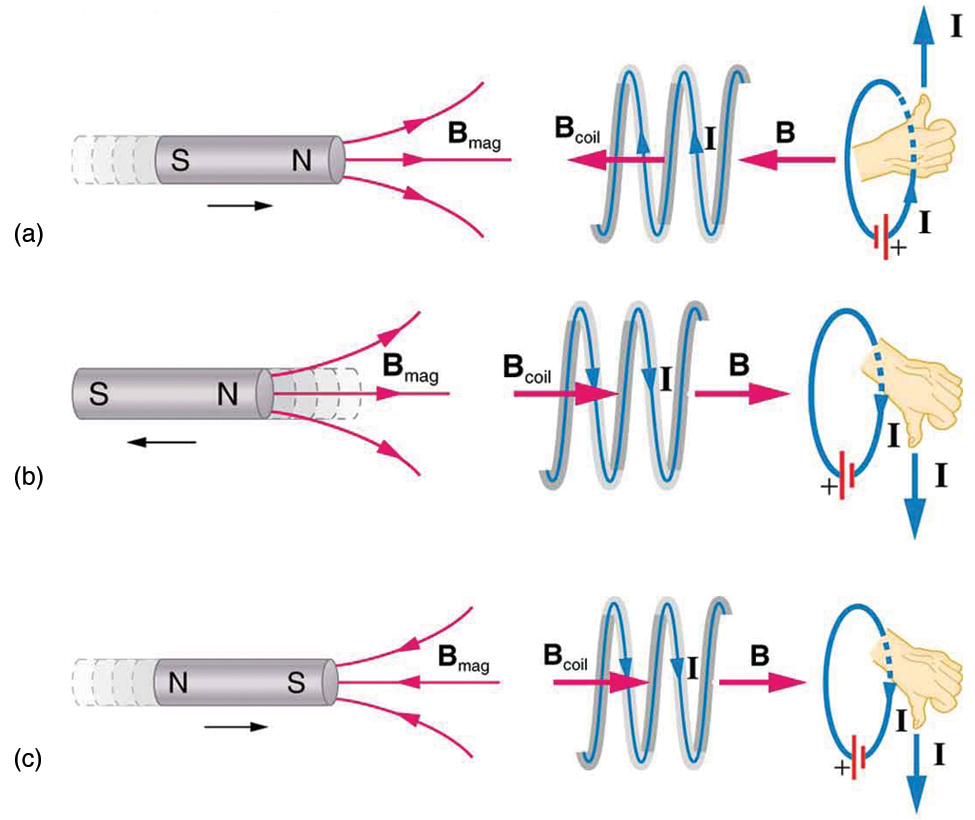
The minus sign in Faraday’s law of induction is very important. The minus means that the emf creates a current I and magnetic field B that oppose the change in flux $\Delta \Phi$ —this is known as Lenz’s law. The direction (given by the minus sign) of the emf is so important that it is called Lenz’s law after the Russian Heinrich Lenz (1804–1865), who, like Faraday and Henry,independently investigated aspects of induction. Faraday was aware of the direction, but Lenz stated it so clearly that he is credited for its discovery. ( See [Figure 1].)
To use Lenz’s law to determine the directions of the induced magnetic fields, currents, and emfs:
For practice, apply these steps to the situations shown in [Figure 1] and to others that are part of the following text material.
There are many applications of Faraday’s Law of induction, as we will explore in this chapter and others. At this juncture, let us mention several that have to do with data storage and magnetic fields. A very important application has to do with audio and video recording tapes. A plastic tape, coated with iron oxide, moves past a recording head. This recording head is basically a round iron ring about which is wrapped a coil of wire—an electromagnet ([Figure 2]). A signal in the form of a varying input current from a microphone or camera goes to the recording head. These signals (which are a function of the signal amplitude and frequency) produce varying magnetic fields at the recording head. As the tape moves past the recording head, the magnetic field orientations of the iron oxide molecules on the tape are changed thus recording the signal. In the playback mode, the magnetized tape is run past another head, similar in structure to the recording head. The different magnetic field orientations of the iron oxide molecules on the tape induces an emf in the coil of wire in the playback head. This signal then is sent to a loudspeaker or video player.
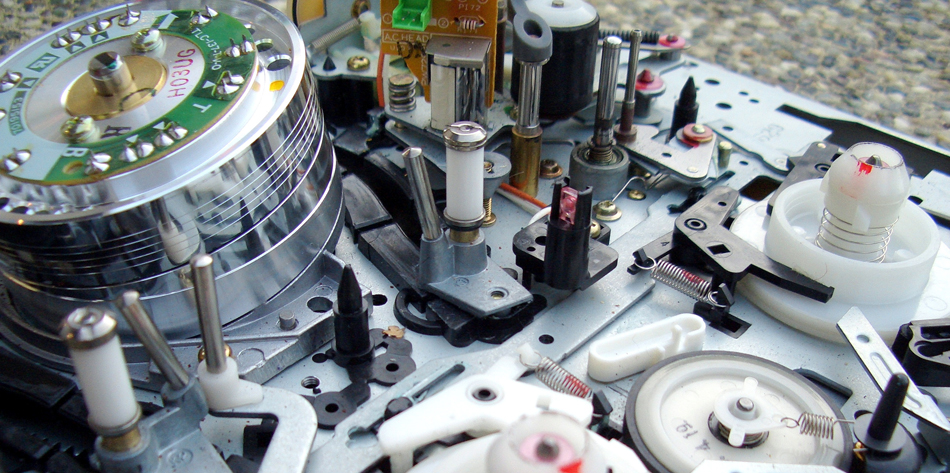
Similar principles apply to computer hard drives, except at a much faster rate. Here recordings are on a coated, spinning disk. Read heads historically were made to work on the principle of induction. However, the input information is carried in digital rather than analog form – a series of 0’s or 1’s are written upon the spinning hard drive. Today, most hard drive readout devices do not work on the principle of induction, but use a technique known as giant magnetoresistance. (The discovery that weak changes in a magnetic field in a thin film of iron and chromium could bring about much larger changes in electrical resistance was one of the first large successes of nanotechnology.) Another application of induction is found on the magnetic stripe on the back of your personal credit card as used at the grocery store or the ATM. This works on the same principle as the audio or videotape mentioned in the last paragraph in which a head reads personal information from your card.
Another application of electromagnetic induction is when electrical signals need to be transmitted across a barrier. Consider the cochlear implant shown below. Sound is picked up by a microphone on the outside of the skull and is used to set up a varying magnetic field. A current is induced in a receiver secured in the bone beneath the skin and transmitted to electrodes in the inner ear. Electromagnetic induction can be used in other instances where electric signals need to be conveyed across various media.

Another contemporary area of research in which electromagnetic induction is being successfully implemented (and with substantial potential) is transcranial magnetic simulation. A host of disorders, including depression and hallucinations can be traced to irregular localized electrical activity in the brain. In transcranial magnetic stimulation, a rapidly varying and very localized magnetic field is placed close to certain sites identified in the brain. Weak electric currents are induced in the identified sites and can result in recovery of electrical functioning in the brain tissue.
Sleep apnea (“the cessation of breath”) affects both adults and infants ( especially premature babies and it may be a cause of sudden infant deaths [SID]). In such individuals, breath can stop repeatedly during their sleep. A cessation of more than 20 seconds can be very dangerous. Stroke, heart failure, and tiredness are just some of the possible consequences for a person having sleep apnea. The concern in infants is the stopping of breath for these longer times. One type of monitor to alert parents when a child is not breathing uses electromagnetic induction. A wire wrapped around the infant’s chest has an alternating current running through it. The expansion and contraction of the infant’s chest as the infant breathes changes the area through the coil. A pickup coil located nearby has an alternating current induced in it due to the changing magnetic field of the initial wire. If the child stops breathing, there will be a change in the induced current, and so a parent can be alerted.
Lenz’s law is a manifestation of the conservation of energy. The induced emf produces a current that opposes the change in flux, because a change in flux means a change in energy. Energy can enter or leave, but not instantaneously. Lenz’s law is a consequence. As the change begins, the law says induction opposes and, thus, slows the change. In fact, if the induced emf were in the same direction as the change in flux, there would be a positive feedback that would give us free energy from no apparent source—conservation of energy would be violated.
Calculate the magnitude of the induced emf when the magnet in [Figure 1](a) is thrust into the coil, given the following information: the single loop coil has a radius of 6.00 cm and the average value of $B \cos \theta$ (this is given, since the bar magnet’s field is complex) increases from 0.0500 T to 0.250 T in 0.100 s.
Strategy
To find the magnitude of emf, we use Faraday’s law of induction as stated by $\text{emf}=-N\frac{\Delta \Phi }{\Delta t}$ , but without the minus sign that indicates direction:
Solution
We are given that $N=1$ and $\Delta t= 0.100 \text{s}$ , but we must determine the change in flux $\Delta \Phi$ before we can find emf. Since the area of the loop is fixed, we see that
Now $\Delta \left(B \cos \theta \right)=0.200 \text{T}$ , since it was given that $B \cos \theta$ changes from 0.0500 to 0.250 T. The area of the loop is $A=\pi r^2=\left( 3.14\text{...}\right){\left(0.060 \text{m}\right)}^{2}= 1.13 \times 10^{-2} {\text{m}}^{2}$ . Thus,
Entering the determined values into the expression for emf gives
Discussion
While this is an easily measured voltage, it is certainly not large enough for most practical applications. More loops in the coil, a stronger magnet, and faster movement make induction the practical source of voltages that it is.
Play with a bar magnet and coils to learn about Faraday's law. Move a bar magnet near one or two coils to make a light bulb glow. View the magnetic field lines. A meter shows the direction and magnitude of the current. View the magnetic field lines or use a meter to show the direction and magnitude of the current. You can also play with electromagnets, generators and transformers!
Faraday’s law of induction states that the emf**induced by a change in magnetic flux is
when flux changes by $\Delta \Phi$ in a time $\Delta t$ .
A person who works with large magnets sometimes places her head inside a strong field. She reports feeling dizzy as she quickly turns her head. How might this be associated with induction?
A particle accelerator sends high-velocity charged particles down an evacuated pipe. Explain how a coil of wire wrapped around the pipe could detect the passage of individual particles. Sketch a graph of the voltage output of the coil as a single particle passes through it.
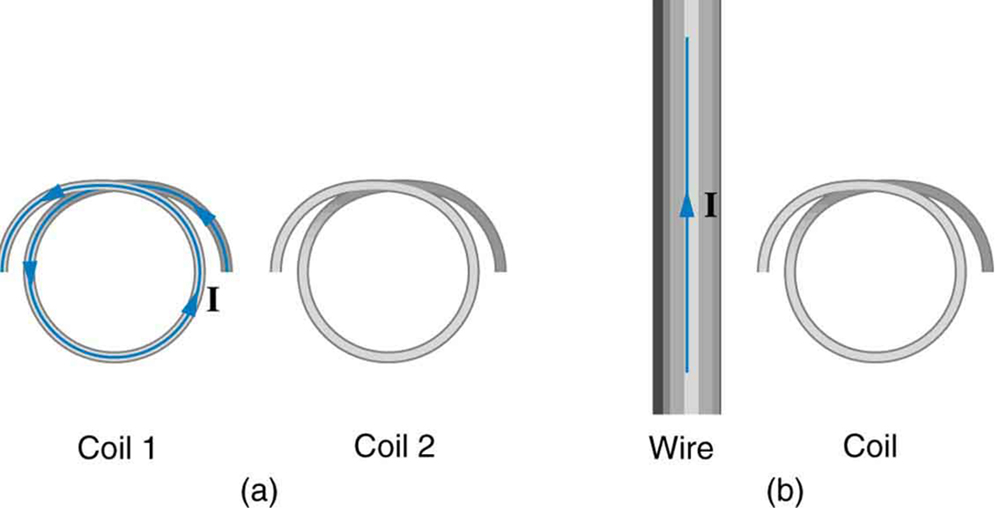
Referring to [Figure 4](a), what is the direction of the current induced in coil 2: (a) If the current in coil 1 increases? (b) If the current in coil 1 decreases? (c) If the current in coil 1 is constant? Explicitly show how you follow the steps in the Problem-Solving Strategy for Lenz’s Law.
Strategy
We follow the problem-solving strategy for Lenz’s Law: First, identify the direction of the magnetic field from coil 1. Then determine whether the flux through coil 2 is increasing or decreasing. Next, find the direction of the induced field in coil 2 that opposes this change. Finally, use RHR-2 to determine the induced current direction.
Solution for (a): Current in coil 1 increases
Following the steps:
Answer for (a): The induced current in coil 2 is clockwise (CW).
Solution for (b): Current in coil 1 decreases
Following the steps:
Answer for (b): The induced current in coil 2 is counterclockwise (CCW).
Solution for (c): Current in coil 1 is constant
Following the steps:
Answer for (c): No current is induced in coil 2.
Discussion
This problem demonstrates the key principle of electromagnetic induction: only a changing magnetic flux induces an emf. A steady magnetic field, no matter how strong, produces no induced current. Lenz’s law ensures that the induced current always opposes the change that produces it, which is a manifestation of energy conservation.
Final Answer
(a) Clockwise (CW); (b) Counterclockwise (CCW); (c) No current induced.
Referring to [Figure 3](b), what is the direction of the current induced in the coil: (a) If the current in the wire increases? (b) If the current in the wire decreases? (c) If the current in the wire suddenly changes direction? Explicitly show how you follow the steps in the Problem-Solving Strategy for Lenz’s Law.
Strategy
We follow the problem-solving strategy for Lenz’s law: identify the direction of the magnetic field from the wire, determine whether flux through the coil is increasing or decreasing, find the direction of the induced field that opposes this change, and use RHR-2 to find the induced current direction.
Solution for (a)
Following the steps:
Answer: The induced current is clockwise when viewed from above.
Solution for (b)
If current decreases:
Answer: The induced current is counterclockwise when viewed from above.
Solution for (c)
If current suddenly reverses:
Answer: The induced current initially flows counterclockwise, then clockwise when viewed from above.
Discussion
In all cases, Lenz’s law ensures the induced current creates a magnetic field opposing the change in flux, consistent with energy conservation.
Final Answer
(a) Clockwise; (b) Counterclockwise; (c) First counterclockwise, then clockwise (when viewed from above).
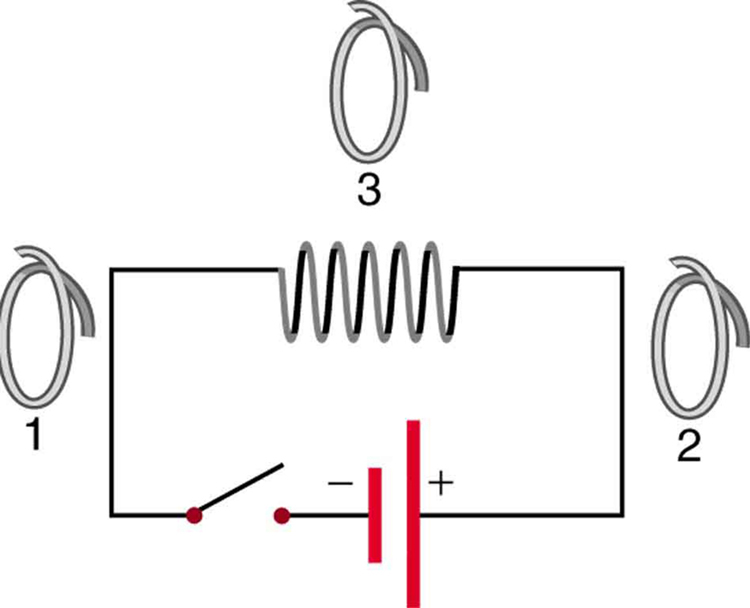
Referring to [Figure 5], what are the directions of the currents in coils 1, 2, and 3 (assume that the coils are lying in the plane of the circuit): (a) When the switch is first closed? (b) When the switch has been closed for a long time? (c) Just after the switch is opened?
Strategy
We apply Lenz’s law to each coil. When the switch closes, current begins flowing in the main coil, creating a magnetic field. When the switch has been closed for a long time, the current and field are constant. When the switch opens, the current and field decrease to zero. Each nearby coil (1, 2, and 3) experiences a change in magnetic flux, inducing currents that oppose these changes.
Solution for (a): When the switch is first closed
When the switch closes, current starts flowing through the main coil (clockwise as viewed from above based on battery polarity). This creates a magnetic field.
For Coil 1 (to the left of main coil):
For Coil 2 (to the right of main coil):
For Coil 3 (above main coil):
Solution for (b): When the switch has been closed for a long time
After a long time, the current in the main coil is constant (steady state).
Solution for (c): Just after the switch is opened
When the switch opens, current in the main coil drops to zero rapidly. The magnetic field decreases.
For Coil 1:
For Coil 2:
For Coil 3:
Discussion
Notice that when the field is increasing (switch closes), the induced currents create fields that oppose the increase. When the field is decreasing (switch opens), the induced currents create fields that oppose the decrease—trying to maintain the original field. This is Lenz’s law in action: induced effects always oppose the change causing them. This is consistent with energy conservation—if induced currents aided the change, we would have a runaway positive feedback system.
Final Answer
(a) Coil 1: CCW, Coil 2: CCW, Coil 3: CW; (b) All coils: no current induced; (c) Coil 1: CW, Coil 2: CW, Coil 3: CCW.
Repeat the previous problem with the battery reversed.
Strategy
With the battery reversed, currents in all three coils from the previous problem will be in opposite directions.
Solution
From the previous problem with normal battery orientation:
With battery reversed, all currents reverse:
(a) When switch is first closed:
(b) When switch has been closed for a long time:
(c) Just after switch is opened:
Discussion
Reversing the battery reverses the magnetic field direction in the main coil, which reverses all induced currents by Lenz’s law.
Final Answer
(a) Coil 1: CW, Coil 2: CW, Coil 3: CCW; (b) All no current; (c) Coil 1: CCW, Coil 2: CCW, Coil 3: CW.
Verify that the units of $\Delta \Phi$ / $\Delta t$ are volts. That is, show that $1 \text{T}\cdot {\text{m}}^{2}/\text{s}=1 \text{V}$.
Strategy
We express tesla in fundamental units and show the equivalence to volts.
Solution
Starting with the magnetic flux units:
The tesla is defined as:
Alternatively, from the magnetic force on a moving charge:
Substituting into the flux rate:
Since work/energy is force times distance:
Therefore: $1 \text{ T} \cdot \text{m}^2/\text{s} = 1 \text{ V}$
Discussion
This confirms that Faraday’s law correctly gives emf in volts when magnetic flux (in T·m²) changes over time (in seconds).
Final Answer
Verified: $1 \text{ T} \cdot \text{m}^2/\text{s} = 1 \text{ V}$.
Suppose a 50-turn coil lies in the plane of the page in a uniform magnetic field that is directed into the page. The coil originally has an area of $0.250 {\text{m}}^{2}$ . It is stretched to have no area in 0.100 s. What is the direction and magnitude of the induced emf if the uniform magnetic field has a strength of 1.50 T?
Strategy
We use Faraday’s law $\text{emf} = -N\frac{\Delta\Phi}{\Delta t}$ where $\Phi = BA\cos\theta$. Since the field is perpendicular to the coil, $\theta = 0°$ and $\cos\theta = 1$. The area changes from 0.250 m² to zero.
Solution
The change in flux is:
The magnitude of induced emf is:
For direction: The flux into the page is decreasing. By Lenz’s law, the induced current must create a field into the page to oppose this decrease. By RHR-2, a clockwise current (viewed from above) creates a field into the page.
Discussion
The relatively large emf results from the rapid change in area combined with the 50-turn coil. This principle is used in various sensors and measuring devices.
Final Answer
The induced emf is 188 V, and the induced current flows clockwise when viewed from the front of the page.
(a) An MRI technician moves his hand from a region of very low magnetic field strength into an MRI scanner’s 2.00 T field with his fingers pointing in the direction of the field. Find the average emf induced in his wedding ring, given its diameter is 2.20 cm and assuming it takes 0.250 s to move it into the field. (b) Discuss whether this current would significantly change the temperature of the ring.
Strategy
The ring moves from near-zero field into a 2.00 T field. The magnetic flux through the ring changes from approximately zero to $\Phi = BA$, where $A$ is the ring’s area. We use Faraday’s law $\text{emf} = \frac{\Delta\Phi}{\Delta t}$ to find the induced emf. For part (b), we estimate the current using Ohm’s law and calculate the heating using $Q = I^2 R t$.
Solution for (a)
The ring’s radius is:
The ring’s area is:
The change in magnetic flux is:
The magnitude of induced emf is:
Solution for (b)
To estimate heating, we need to know the ring’s resistance. For a gold wedding ring, a reasonable lower estimate is $R = 1.00 \text{ m}\Omega = 1.00 \times 10^{-3} \Omega$.
The induced current during the 0.250 s interval is:
The energy dissipated as heat is:
This is a very small amount of energy. To put it in perspective, the specific heat of gold is about 129 J/(kg·°C). For a typical 5-gram ring:
This temperature rise is negligible and would not be noticeable.
Discussion
While the induced emf is measurable (3.04 mV), the actual heating effect is negligible due to the ring’s low resistance and the brief duration. However, MRI technicians are still advised to remove all metal jewelry because:
Final Answer
(a) The average induced emf is 3.04 mV. (b) The heat transferred would be approximately 2.31 mJ, causing a negligible temperature rise of about 0.004 °C. This is not a significant amount of heat and would not be noticed by the wearer.
Integrated Concepts
Referring to the situation in the previous problem: (a) What current is induced in the ring if its resistance is 0.0100 $\Omega$ ? (b) What average power is dissipated? (c) What magnetic field is induced at the center of the ring? (d) What is the direction of the induced magnetic field relative to the MRI’s field?
Strategy
From the previous problem, the induced emf is 3.04 mV. We use Ohm’s law to find current, $P = I^2R$ for power, and the equation for magnetic field at the center of a circular loop: $B = \frac{\mu_0 I}{2r}$.
Solution for (a)
Solution for (b)
Alternatively: $P = \frac{\text{emf}^2}{R} = \frac{(3.04 \times 10^{-3})^2}{0.0100} = 9.24 \times 10^{-4} \text{ W}$
Solution for (c)
The radius is $r = d/2 = 0.0220/2 = 0.0110 \text{ m}$:
Solution for (d)
By Lenz’s law, the induced field opposes the change. Since the MRI field (into which the hand moves) is increasing through the ring, the induced field points opposite to the MRI field.
Discussion
The small power dissipation (less than 1 mW) explains why the ring doesn’t heat significantly. The induced field is much weaker than the 2.00 T MRI field, about 10,000 times smaller.
Final Answer
(a) 0.304 A; (b) 0.924 mW; (c) 17.4 μT; (d) opposite to the MRI field direction.
An emf is induced by rotating a 1000-turn, 20.0 cm diameter coil in the Earth’s $5.00 \times 10^{-5} \text{T}$ magnetic field. What average emf is induced, given the plane of the coil is originally perpendicular to the Earth’s field and is rotated to be parallel to the field in 10.0 ms?
Strategy
When the coil plane is perpendicular to the Earth’s field, maximum flux passes through it: $\Phi_i = BA\cos(0°) = BA$. When rotated to be parallel to the field, no flux passes through: $\Phi_f = BA\cos(90°) = 0$. We use Faraday’s law $\text{emf} = N\frac{\Delta\Phi}{\Delta t}$ to find the average induced emf.
Solution
The coil radius is:
The coil area is:
The initial flux (perpendicular orientation):
The final flux (parallel orientation):
The change in flux:
The magnitude of average induced emf:
Discussion
Despite the Earth’s weak magnetic field (only 50 μT), a measurable emf of 157 mV is produced due to the large number of turns (1000) in the coil. This demonstrates the principle behind generators: even weak magnetic fields can produce useful voltages when combined with multiple coil turns and rapid rotation. The rapid 10 ms rotation time (equivalent to 100 rotations per second) also contributes significantly to the induced emf.
Final Answer
The average induced emf is 0.157 V (or 157 mV).
A 0.250 m radius, 500-turn coil is rotated one-fourth of a revolution in 4.17 ms, originally having its plane perpendicular to a uniform magnetic field. (This is 60 rev/s.) Find the magnetic field strength needed to induce an average emf of 10 000 V.
Strategy
When rotated one-fourth revolution from perpendicular to parallel, $\Delta(BA\cos\theta) = BA$ (changes from BA to 0). We use $\text{emf} = N\frac{\Delta\Phi}{\Delta t} = N\frac{BA}{\Delta t}$ and solve for $B$.
Solution
The area of the coil is:
From Faraday’s law:
Solving for $B$:
Discussion
This field strength is achievable with strong permanent magnets or electromagnets, making this a practical generator design. The high emf results from the combination of many turns and rapid rotation.
Final Answer
The required magnetic field strength is 0.425 T.
Integrated Concepts
Approximately how does the emf induced in the loop in [Figure 3](b) depend on the distance of the center of the loop from the wire?
Strategy
The magnetic field from a long straight wire is $B = \frac{\mu_0 I}{2\pi r}$, where $r$ is the distance from the wire. For a small loop at distance $r$, the flux is approximately $\Phi \approx BA$, where $A$ is the loop area. When the current changes, the induced emf depends on how the flux changes: $\text{emf} = \frac{\Delta\Phi}{\Delta t}$.
Solution
The magnetic field from the wire at distance $r$ is:
For a loop of area $A$ positioned at distance $r$ from the wire (assuming the loop is small compared to $r$):
When the current changes by $\Delta I$ in time $\Delta t$:
The induced emf is:
Since $\mu_0$, $A$, and $\frac{\Delta I}{\Delta t}$ are constants (or specified parameters), we can write:
Discussion
The induced emf is inversely proportional to the distance from the wire. This makes physical sense because:
This means that if you double the distance from the wire, the induced emf is halved. If you move 10 times farther away, the induced emf becomes 1/10 of its original value. This inverse relationship is characteristic of fields produced by long straight wires and is important for understanding electromagnetic induction in practical situations like power lines and electrical circuits.
Final Answer
The induced emf is approximately proportional to $\frac{1}{r}$, where $r$ is the distance from the center of the loop to the wire.
Integrated Concepts
(a) A lightning bolt produces a rapidly varying magnetic field. If the bolt strikes the earth vertically and acts like a current in a long straight wire, it will induce a voltage in a loop aligned like that in [Figure 3](b). What voltage is induced in a 1.00 m diameter loop 50.0 m from a $2.00 \times 10^{6} \text{A}$ lightning strike, if the current falls to zero in $25.0 \mu \text{s}$ ? (b) Discuss circumstances under which such a voltage would produce noticeable consequences.
Strategy
The magnetic field from a long straight wire is $B = \frac{\mu_0 I}{2\pi r}$. The flux through a horizontal loop of area $A$ is approximately $\Phi \approx BA$. The induced emf is $\text{emf} = \frac{\Delta\Phi}{\Delta t}$.
Solution for (a)
The magnetic field at distance $r = 50.0 \text{ m}$ from the lightning bolt:
The loop area is:
The change in flux as current drops to zero:
The induced emf:
Solution for (b)
This 80 V induced emf could produce noticeable consequences in several situations:
Discussion
This demonstrates why lightning strikes can damage electrical systems even at considerable distances. Proper grounding and surge protection are essential.
Final Answer
(a) The induced voltage is 80.0 V. (b) This voltage could damage electronics, trip breakers, cause dangerous shocks, or create arcing in nearby conductors.