Simple machines are devices that can be used to multiply or augment a force that we apply – often at the expense of a distance through which we apply the force. The word for “machine” comes from the Greek word meaning “to help make things easier.” Levers, gears, pulleys, wedges, and screws are some examples of machines. Energy is still conserved for these devices because a machine cannot do more work than the energy put into it. However, machines can reduce the input force that is needed to perform the job. The ratio of output to input force magnitudes for any simple machine is called its mechanical advantage (MA).
One of the simplest machines is the lever, which is a rigid bar pivoted at a fixed place called the fulcrum. Torques are involved in levers, since there is rotation about a pivot point. Distances from the physical pivot of the lever are crucial, and we can obtain a useful expression for the MA in terms of these distances.
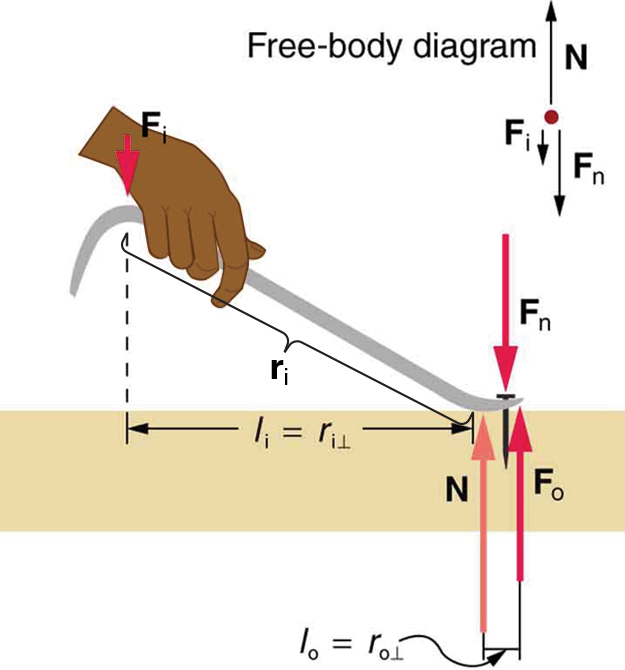
Figure 1 shows a lever type that is used as a nail puller. Crowbars, seesaws, and other such levers are all analogous to this one. $\vb{F}_{\text{i}}$ is the input force and $\vb{F}_{\text{o}}$ is the output force. There are three vertical forces acting on the nail puller ( the system of interest) – these are $\vb{F}_{\text{i}}, \vb{F}_{\N }$, and $\vb{N}$. $\vb{F}_{\N }$ is the reaction force back on the system, equal and opposite to $\vb{F}_{\text{o}}$. (Note that $\vb{F}_{\text{o}}$ is not a force on the system.) $\vb{N}$ is the normal force upon the lever, and its torque is zero since it is exerted at the pivot. The torques due to $\vb{F}_{\text{i}}$ and $\vb{F}_{\N }$ must be equal to each other if the nail is not moving, to satisfy the second condition for equilibrium $\left( \text{net}\tau =0\right)$. (In order for the nail to actually move, the torque due to $\vb{F}_{\text{i}}$ must be ever-so-slightly greater than torque due to $\vb{F}\_{\N }$.) Hence,
where $l_{\text{i}}$ and $l_{\text{o}}$ are the distances from where the input and output forces are applied to the pivot, as shown in the figure. Rearranging the last equation gives
What interests us most here is that the magnitude of the force exerted by the nail puller, $F_{\text{o}}$, is much greater than the magnitude of the input force applied to the puller at the other end, $F\_{\text{i}}$. For the nail puller,
This equation is true for levers in general. For the nail puller, the MA is certainly greater than one. The longer the handle on the nail puller, the greater the force you can exert with it.
Two other types of levers that differ slightly from the nail puller are a wheelbarrow and a shovel, shown in Figure 2. All these lever types are similar in that only three forces are involved – the input force, the output force, and the force on the pivot – and thus their MAs are given by $\text{MA}=\frac{ F_{\text{o}}}{ F_{\text{i}}}$ and $\text{MA}=\frac{ d_{1}}{ d_{2}}$, with distances being measured relative to the physical pivot. The wheelbarrow and shovel differ from the nail puller because both the input and output forces are on the same side of the pivot.
In the case of the wheelbarrow, the output force or load is between the pivot ( the wheel’s axle) and the input or applied force. In the case of the shovel, the input force is between the pivot (at the end of the handle) and the load, but the input lever arm is shorter than the output lever arm. In this case, the MA is less than one.
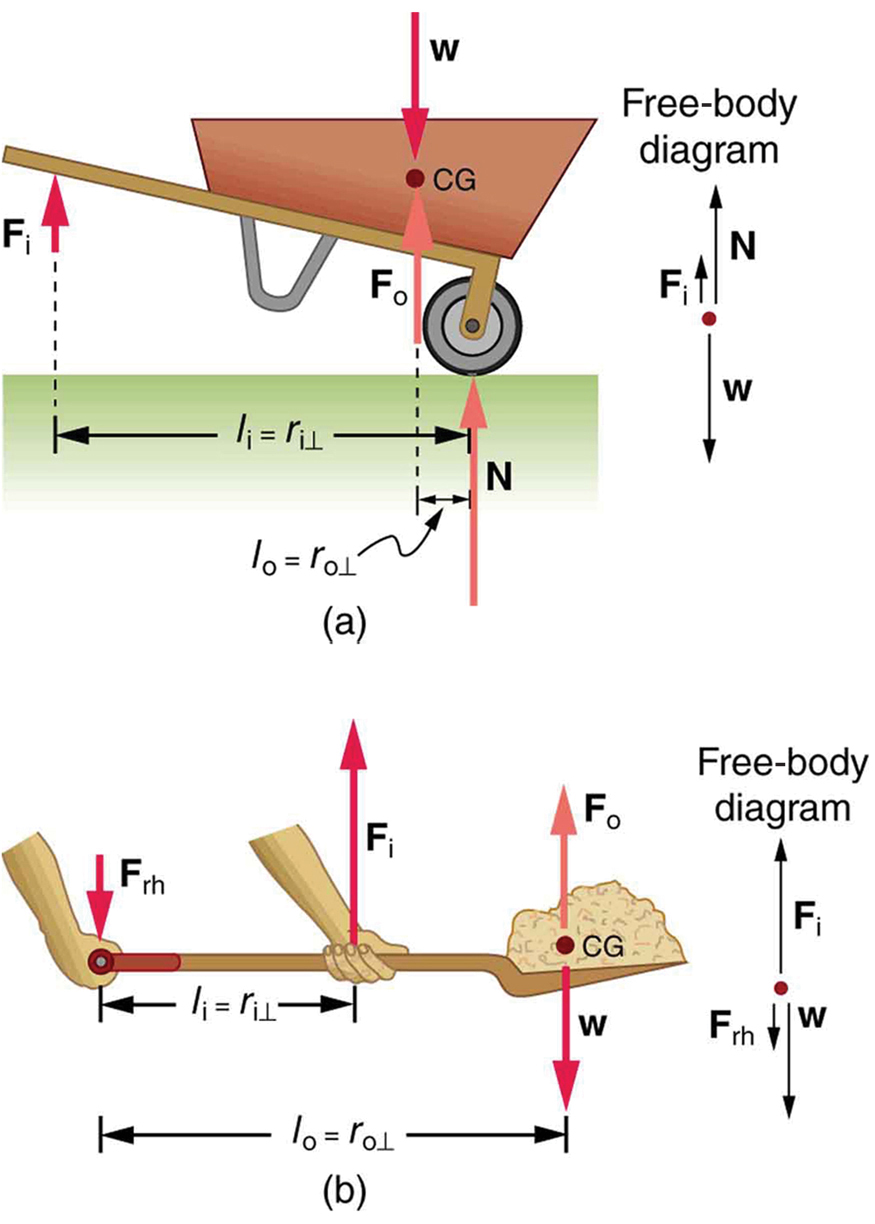
In the wheelbarrow of Figure 2, the load has a perpendicular lever arm of 7.50 cm, while the hands have a perpendicular lever arm of 1.02 m. (a) What upward force must you exert to support the wheelbarrow and its load if their combined mass is 45.0 kg? (b) What force does the wheelbarrow exert on the ground?
Strategy
Here, we use the concept of mechanical advantage.
Solution
(a) In this case, $\frac{ F_{\text{o}}}{ F_{\text{i}}}=\frac{ l_{i}}{ l_{o}}$
becomes
Adding values into this equation yields
The free-body diagram (see Figure 2) gives the following normal force: $F_{i}+N=W$. Therefore, $N=\left(45.0 \kg \right)\left( 9.80\mss \right)-32.4 \N = 409 \N$. $N$ is the normal force acting on the wheel; by Newton’s third law, the force the wheel exerts on the ground is $409 \N$.
Discussion
An even longer handle would reduce the force needed to lift the load. The MA here is $\text{MA}=1.02/0.0750=13.6$.
Another very simple machine is the inclined plane. Pushing a cart up a plane is easier than lifting the same cart straight up to the top using a ladder, because the applied force is less. However, the work done in both cases (assuming the work done by friction is negligible) is the same. Inclined lanes or ramps were probably used during the construction of the Egyptian pyramids to move large blocks of stone to the top.
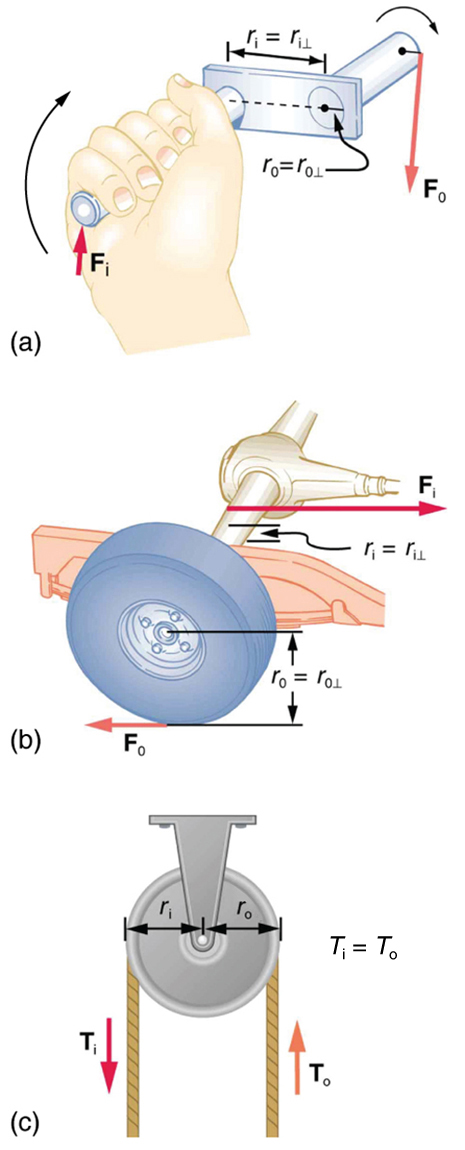
A crank is a lever that can be rotated $360^\circ$ about its pivot, as shown in Figure 3. Such a machine may not look like a lever, but the physics of its actions remain the same. The MA for a crank is simply the ratio of the radii $r_{\text{i}}/r_{0}$. Wheels and gears have this simple expression for their MAs too. The MA can be greater than 1, as it is for the crank, or less than 1, as it is for the simplified car axle driving the wheels, as shown. If the axle’s radius is $2.0 \text{cm}$ and the wheel’s radius is $24.0 \text{cm}$, then $\text{MA}=2.0/24.0=0.083$ and the axle would have to exert a force of $12 000 \N$ on the wheel to enable it to exert a force of $1000 \N$ on the ground.
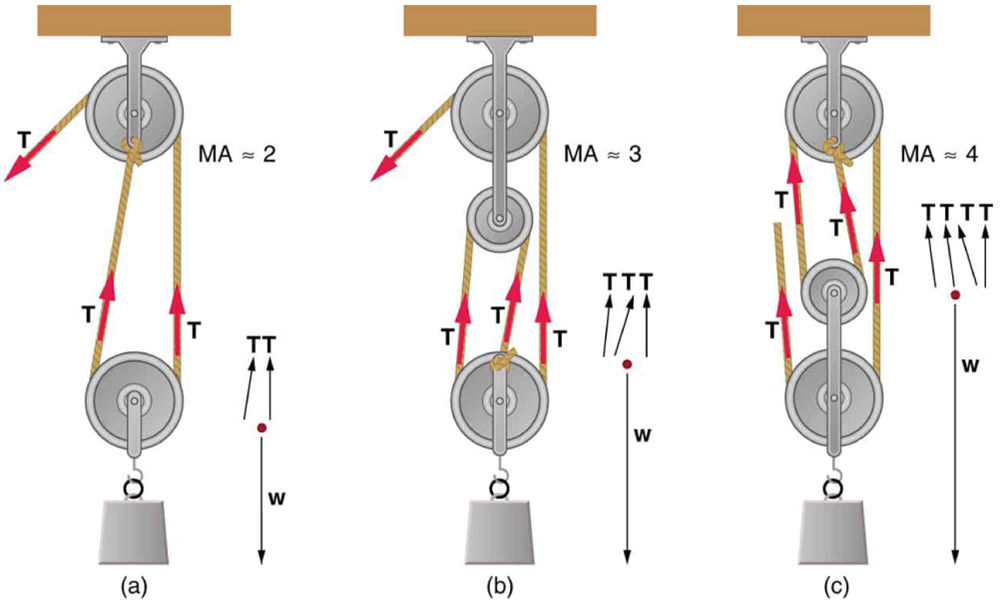
An ordinary pulley has an MA of 1; it only changes the direction of the force and not its magnitude. Combinations of pulleys, such as those illustrated in Figure 4, are used to multiply force. If the pulleys are friction-free, then the force output is approximately an integral multiple of the tension in the cable. The number of cables pulling directly upward on the system of interest, as illustrated in the figures given below, is approximately the MA of the pulley system. Since each attachment applies an external force in approximately the same direction as the others, they add, producing a total force that is nearly an integral multiple of the input force $T$.
Scissors are like a double-lever system. Which of the simple machines in Figure 1 and Figure 2 is most analogous to scissors?
Strategy
We analyze the structure of scissors and compare it to the lever configurations shown in Figures 1 and 2. Scissors have two crossed blades that pivot at a central fulcrum, with the input force applied at the handles and the output force applied at the cutting edges.
Solution
Scissors are most analogous to the nail puller shown in Figure 1.
In scissors:
This is the same configuration as the nail puller, where:
Discussion
This is why scissors have long handles relative to their cutting blades—the longer handles increase the mechanical advantage, allowing us to cut through tough materials with relatively little effort. Different types of scissors vary their MA: fabric scissors have longer blades for smooth cuts, while sheet metal snips have very short blades and very long handles for maximum cutting force. This is a first-class lever system.
Suppose you pull a nail at a constant rate using a nail puller as shown in Figure 1. Is the nail puller in equilibrium? What if you pull the nail with some acceleration – is the nail puller in equilibrium then? In which case is the force applied to the nail puller larger and why?
Strategy
We apply the conditions for equilibrium. A system is in equilibrium when the net force and net torque are zero, which means there is no acceleration.
Solution
Constant rate (constant velocity): Yes, the nail puller is in equilibrium. When moving at constant velocity, acceleration is zero. By Newton’s first law, this means the net force is zero, and the net torque is also zero. All forces and torques are balanced.
With acceleration: No, the nail puller is not in equilibrium. When accelerating, there must be a net force and/or net torque acting on the system.
Which case requires more force? The force applied to the nail puller is larger when pulling with acceleration.
Here’s why:
where $I\alpha$ represents the additional torque needed to produce angular acceleration. The input force must not only overcome the resistance from the nail but also provide the extra force to accelerate the system.
Discussion
This is analogous to pushing a car: maintaining constant velocity requires only enough force to overcome friction, while accelerating requires additional force according to $F = ma$. In practice, a skilled user pulls nails at nearly constant speed, minimizing the required force and reducing fatigue.
Why are the forces exerted on the outside world by the limbs of our bodies usually much smaller than the forces exerted by muscles inside the body?
Strategy
We analyze the lever systems in the body, recognizing that muscles are typically attached very close to joints while the load is applied at the end of limbs far from the joint.
Solution
The forces exerted on the outside world by limbs are smaller than the forces exerted by muscles because most skeletal muscle systems have a mechanical advantage much less than 1.
This occurs because:
Muscles attach close to joints: Tendons typically connect muscles to bones very near the pivot point (joint). This creates a short input lever arm ($l_i$).
Loads are applied far from joints: We interact with the outside world at the ends of our limbs (hands, feet), which are far from the joint. This creates a long output lever arm ($l_o$).
MA relationship: For levers, $\text{MA} = \frac{F_{\text{output}}}{F_{\text{input}}} = \frac{l_i}{l_o}$
Since $l_i < l_o$ in most body systems, $\text{MA} < 1$, which means $F_{\text{muscle}} > F_{\text{output}}$.
Example: In the forearm system, the biceps attaches about 4 cm from the elbow, but the hand is about 35 cm from the elbow. This gives $\text{MA} \approx 4/35 \approx 0.11$, meaning the muscle force must be about 9 times larger than the force exerted by the hand.
Discussion
While this seems inefficient for force production, it provides advantages in speed and range of motion. A small muscle contraction produces a large movement at the hand, allowing fast, sweeping motions that would be impossible if muscles were attached at the ends of limbs.
Explain why the forces in our joints are several times larger than the forces we exert on the outside world with our limbs. Can these forces be even greater than muscle forces (see previous Question)?
Strategy
We apply equilibrium analysis to the lever systems in the body. The joint force must balance both the muscle force and the external load, and since these often act in opposite directions relative to the joint, the forces can add together.
Solution
Joint forces are larger than external forces because joints must support both the large muscle forces and the reaction to those forces.
Consider the forearm example from Figure 1 in the text:
Why this happens:
Can joint forces exceed muscle forces? Yes, they can!
This occurs when:
For example, in the spine when lifting with a bent back (see Figure 4 in section 6), the vertebral force $F_V = 4660 \N$ exceeds the back muscle force $F_B = 4200 \N$ because the forces add vectorially.
Discussion
This explains why joint damage (arthritis, torn cartilage, damaged discs) is so common. Even modest external loads create enormous internal forces that wear down joint surfaces over time, especially with repetitive motions or poor posture.
What is the mechanical advantage of a nail puller—similar to the one shown in Figure 1 —where you exert a force $45 \text{cm}$ from the pivot and the nail is $1.8 \text{cm}$ on the other side? What minimum force must you exert to apply a force of $1250 \N$ to the nail?
Strategy
Use the mechanical advantage formula for a lever: $\text{MA} = \frac{l_i}{l_o} = \frac{F_o}{F_i}$, where $l_i$ is the distance from pivot to input force and $l_o$ is the distance from pivot to output force.
Solution
Given:
Mechanical advantage:
Minimum force required:
Discussion
The mechanical advantage of 25 is quite impressive - you only need to exert 50 N (about 11 pounds) to apply 1250 N (about 280 pounds) to the nail. This is why nail pullers are so effective. The long handle multiplies your force by 25 times. However, you must move your hand 25 times farther than the nail moves - when the nail moves 1 mm, your hand moves 25 mm. Energy is conserved, but the work is made easier.
Answer
The mechanical advantage is 25, and the minimum force required is 50 N.
Suppose you needed to raise a 250-kg mower a distance of 6.0 cm above the ground to change a tire. If you had a 2.0-m long lever, where would you place the fulcrum if your force was limited to 300 N?
Strategy
This is a lever problem where we need to find the position of the fulcrum. We use the mechanical advantage relationship: $\text{MA} = \frac{F_o}{F_i} = \frac{l_i}{l_o}$. The total length of the lever is the sum of the input and output lever arms: $l_i + l_o = 2.0 \m$.
Solution
First, calculate the weight of the mower (the output force needed):
The required mechanical advantage is:
Using the lever relationship:
Since the total lever length is 2.0 m:
The fulcrum should be placed 22 cm (0.22 m) from the mower (or equivalently, 1.78 m from where you apply your force).
Discussion
This result makes sense: to lift a heavy load with a small force, the fulcrum must be placed very close to the load. The input lever arm (1.78 m) is about 8 times longer than the output lever arm (0.22 m), giving the required mechanical advantage of about 8. Note that while the force is reduced, the distance you must push down is proportionally larger than the distance the mower rises—energy is conserved.
(a) What is the mechanical advantage of a wheelbarrow, such as the one in Figure 2, if the center of gravity of the wheelbarrow and its load has a perpendicular lever arm of 5.50 cm, while the hands have a perpendicular lever arm of 1.02 m? (b) What upward force should you exert to support the wheelbarrow and its load if their combined mass is 55.0 kg? (c) What force does the wheel exert on the ground?
Strategy
For a wheelbarrow, the mechanical advantage is the ratio of lever arms. Use $\text{MA} = \frac{l_i}{l_o}$. For parts (b) and (c), apply equilibrium conditions.
Solution
Given:
(a) Mechanical advantage:
(b) Upward force to support the load:
The output force is the weight of the wheelbarrow and load:
The input force is:
(c) Force the wheel exerts on the ground:
Using equilibrium (forces must sum to zero):
By Newton’s third law, the wheel exerts 510 N downward on the ground.
Discussion
The mechanical advantage of 18.5 means you only need to exert about 29 N (about 6.5 pounds) to support a 55-kg load (121 pounds)! The wheelbarrow is an excellent example of how simple machines make work easier. The wheel bears most of the load (510 N), while your hands provide only the small force needed to maintain equilibrium. The long handles and position of the wheel close to the load create this large mechanical advantage.
Answer
(a) The mechanical advantage is 18.5.
(b) The upward force required is 29.1 N.
(c) The wheel exerts 510 N downward on the ground.
A typical car has an axle with $1.10 \text{cm}$ radius driving a tire with a radius of $27.5 \text{cm}$. What is its mechanical advantage assuming the very simplified model in Figure 3(b)?
Strategy
For a wheel and axle system like Figure 3(b), the mechanical advantage is the ratio of the input radius (axle) to the output radius (wheel): $\text{MA} = \frac{r_i}{r_o}$. In this case, the axle applies the input force and the wheel exerts the output force on the ground.
Solution
Given:
The mechanical advantage is 0.0400 (or equivalently, 1/25).
Discussion
A mechanical advantage less than 1 means the system is designed for speed rather than force multiplication. The wheel travels 25 times farther than the axle rotates through, but the force on the ground is only 1/25 of the force applied by the axle. This is desirable for vehicles: a small rotation of the engine/axle produces a large distance traveled by the wheel. The tradeoff is that the axle must exert very large forces—this is why car axles are built so strong. If you want to apply 1000 N to the road, the axle must exert 25,000 N!
What force does the nail puller in Figure 1 exert on the supporting surface? The nail puller has a mass of 2.10 kg.
Strategy
Apply the equilibrium condition: the sum of all forces on the nail puller must equal zero. Use the values from Problem 1, where we found the mechanical advantage is 25 and the output force on the nail is 1250 N.
Solution
Given (from Problem 1 and figure):
For equilibrium, the sum of vertical forces equals zero:
where $N$ is the normal force from the supporting surface (upward).
By Newton’s third law, the nail puller exerts a force of 1.3 × 10³ N downward on the supporting surface.
Discussion
The supporting surface must bear the brunt of the forces - it supports not only the force pulling up on the nail (as a reaction) but also the input force and the weight of the puller. This explains why nail pulling can damage surfaces beneath the fulcrum, and why carpenters often place a piece of scrap wood under the nail puller to protect finished surfaces and distribute this large force.
Answer
The nail puller exerts $1.3 \times 10^3\text{ N}$ on the supporting surface.
If you used an ideal pulley of the type shown in Figure 4(a) to support a car engine of mass $115 \kg$, (a) What would be the tension in the rope? (b) What force must the ceiling supply, assuming you pull straight down on the rope? Neglect the pulley system’s mass.
Strategy
The pulley system in Figure 4(a) has two rope segments pulling up on the load, giving it a mechanical advantage of approximately 2. The tension in the rope is uniform throughout (for an ideal, frictionless pulley). For part (b), we apply force equilibrium to the upper pulley.
Solution for (a)
The weight of the engine is:
In the pulley system shown in Figure 4(a), there are two rope segments supporting the load. Each carries the same tension $T$. For equilibrium of the lower pulley and load:
The tension in the rope is 564 N (or $5.64 \times 10^{2} \N$).
Solution for (b)
The ceiling must support the upper pulley, which has three rope forces acting on it:
All three rope segments pull down on the upper pulley, so the ceiling must supply an upward force:
The ceiling must supply 1690 N (or $1.69 \times 10^{3} \N$) upward.
Discussion
Note that the ceiling force (1690 N) is greater than the engine weight (1127 N)! This makes sense because the ceiling must support not only the engine but also counteract the downward force you apply when pulling on the rope. The extra 564 N represents your pull. The mechanical advantage of 2 means you only need to pull with half the engine’s weight, but the ceiling picks up the slack.
Repeat the previous exercise for the pulley shown in Figure 4(c), assuming you pull straight up on the rope. The pulley system’s mass is $7.00 \kg$.
Strategy
For Figure 4(c), this is a more complex pulley system with a mechanical advantage of 4 (four rope segments support the load). The total weight includes the engine plus the pulley system. Since you pull straight up, your force adds to the ceiling support.
Solution
Given:
(a) Tension in the rope:
Total weight to support:
In Figure 4(c), four rope segments support the load, giving MA = 4:
(b) Force the ceiling must supply:
When you pull straight up on the rope with tension $T$, you exert an upward force that helps support the system. The ceiling only needs to supply the rest:
The ceiling must supply 897 N upward.
Discussion
This pulley arrangement is more efficient than the one in the previous problem. With MA = 4, you only need to pull with 299 N (about 67 pounds) to lift a 122-kg load. Also notice that because you pull upward, the ceiling force is actually less than the total weight - you’re helping to support the load. Compare this to the previous problem where pulling downward meant the ceiling had to support more than the load’s weight. This is why many pulley arrangements are designed so you pull upward, reducing structural requirements on the support.
Answer
(a) The tension in the rope is $T = 299\text{ N}$.
(b) The ceiling must supply 897 N upward.