Further Applications of Newton’s Laws of Motion
- Apply problem-solving techniques to solve for quantities in more complex systems of forces.
- Integrate concepts from kinematics to solve problems using Newton's laws of motion.
There are many interesting applications of Newton’s laws of motion, a few more
of which are presented in this section. These serve also to illustrate some
further subtleties of physics and to help build problem-solving skills.
Drag Force on a Barge
Suppose two tugboats push on a barge at different angles, as shown in Figure 1.
The first tugboat exerts a force of $2.7\times 10^{5}\N$
in the x-direction, and the second tugboat exerts a force of $3.6\times 10^{5}\N$ in the y-direction.
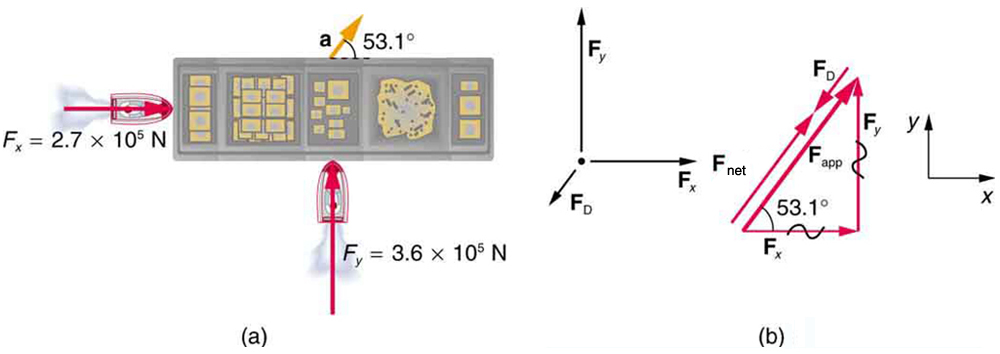
If the mass of the barge is $5.0\times 10^{6}\kg$ and its acceleration is
observed to be $7.5 \times 10^{-2}\mss$ in the direction shown, what is the
drag force of the water on the barge resisting the motion? (Note:
drag force is a frictional force exerted by fluids, such as air or water. The
drag force opposes the motion of the object.)
Strategy
The directions and magnitudes of acceleration and the applied forces are given
in Figure 1(a). We will define the total force of the tugboats on
the barge as $\vb{F}\_{\text{app}}$ so that:
$$ \vb{F}_{\text{app}}=\vb{F}_{x}+\vb{F}_{y} $$
Since the barge is flat bottomed, the drag of the water $\vb{F}_{\text{D}}$
will be in the direction opposite to $\vb{F}_{\text{app}}$, as
shown in the free-body diagram in Figure 1(b). The
system of interest here is the barge, since the forces on it are given
as well as its acceleration. Our strategy is to find the magnitude and direction
of the net applied force $\vb{F}_{\text{app}}$, and then apply
Newton’s second law to solve for the drag force $\vb{F}_{\text{D}}$.
Solution
Since $\vb{F}_{x}$ and $\vb{F}_{y}$ are perpendicular, the magnitude and
direction of $\vb{F}\_{\text{app}}$ are easily found. First, the resultant
magnitude is given by the Pythagorean theorem:
$$ \begin{array}{lll}
F_{\text{app}}&=& \sqrt{ F_{x}^{2}+F_{y}^{2}} \\
F_{\text{app}}&=& \sqrt{\left(2.7\times 10^{5}\N \right)^{2}+\left(3.6\times 10^{5}\N \right)^{2}}
F_{\text{app}}&=& 4.5\times 10^{5}\N .
\end{array} $$
The angle is given by
$$ \begin{array}{lll}
\theta &=& {\tan}^{-1}\left(\frac{ F_{y}}{ F_{x}}\right)\\
\theta &=& {\tan}^{-1}\left(\frac{3.6\times 10^{5}\N }{2.7\times 10^{5}\N }\right)=53^\circ,
\end{array} $$
which we know, because of Newton’s first law, is the same direction
as the acceleration. $\vb{F}_{\text{D}}$
is in the opposite direction of $\vb{F}_{\text{app}}$, since it
acts to slow down the acceleration. Therefore, the net external force is in the
same direction as $\vb{F}_{\text{app}}$, but its magnitude is
slightly less than $\vb{F}_{\text{app}}$. The problem is now
one-dimensional. From Figure 1(b), we can see that
$$ F_{\text{net}}=F_{\text{app}}-F_{\text{D}}. $$
But Newton’s second law states that
$$ F_{\text{net}}=ma . $$
Thus,
$$ F_{\text{app}}-F_{\text{D}}=ma . $$
This can be solved for the magnitude of the drag force of the water $F_{\text{D}}$
in terms of known quantities:
$$ F_{\text{D}}=F_{\text{app}}-ma . $$
Substituting known values gives
$$ F_{\text{D}}=\left(4.5 \times 10^{5}\N \right)-\left(5.0 \times 10^{6}\kg \right)\left(7.5 \times 10^{-2}\mss \right)=7.5 \times 10^{4}\N . $$
The direction of $\vb{F}_{\text{D}}$
has already been determined to be in the direction opposite to $\vb{F}_{\text{app}}$, or at an angle of $53^\circ$ south of west.
Discussion
The numbers used in this example are reasonable for a moderately large barge. It
is certainly difficult to obtain larger accelerations with tugboats, and small
speeds are desirable to avoid running the barge into the docks. Drag is
relatively small for a well-designed hull at low speeds, consistent with the
answer to this example, where $F\_{\text{D}}$ is less than 1/600th of the
weight of the ship.
In the earlier example of a tightrope walker we noted that the tensions in wires
supporting a mass were equal only because the angles on either side were equal.
Consider the following example, where the angles are not equal; slightly more
trigonometry is involved.
Different Tensions at Different Angles
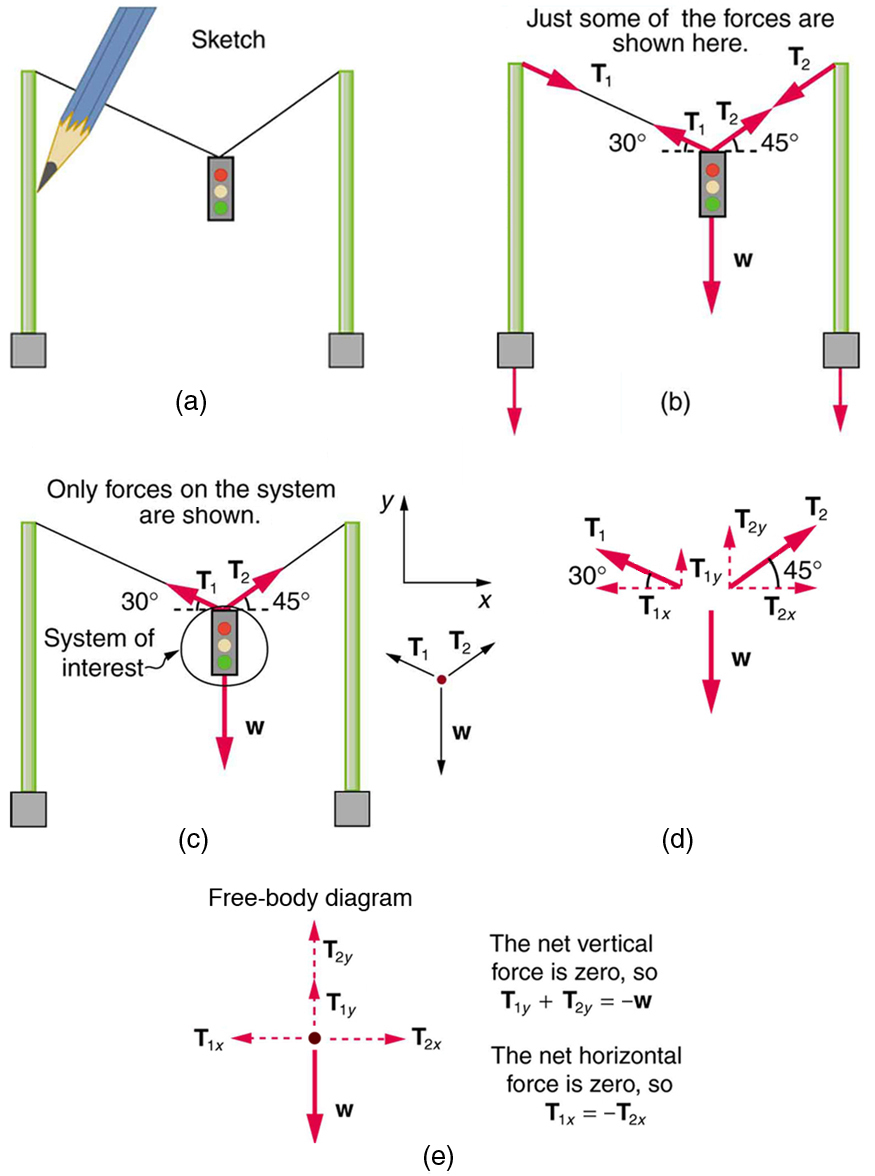
Consider the traffic light (mass 15.0 kg) suspended from two wires as shown in Figure 2. Find the tension in each wire, neglecting the masses of the wires.
Strategy
The system of interest is the traffic light, and its free-body diagram is shown
in Figure 2(c). The three forces involved are not parallel, and so they
must be projected onto a coordinate system. The most convenient coordinate
system has one axis vertical and one horizontal, and the vector projections on
it are shown in part (d) of the figure. There are two unknowns in this problem (
$T_{1}$ and $T_{2}$), so two equations are needed to find them. These
two equations come from applying Newton’s second law along the vertical and
horizontal axes, noting that the net external force is zero along each axis
because acceleration is zero.
Solution
First consider the horizontal or x-axis:
$$ F_{\text{net}x}=T_{2x}-T_{1x}=0. $$
Thus, as you might expect,
$$ T_{1x}=T_{2x}. $$
This gives us the following relationship between $T_{1}$ and $T_{2}$:
$$ T_{1}\cos\left(30^\circ\right)=T_{2}\cos\left(45^\circ\right). $$
Thus,
$$ T_{2}=\left(1.225\right) T_{1}. $$
Note that $T_{1}$ and $T_{2}$ are not equal in this case, because the angles on either side
are not equal. It is reasonable that $T_{2}$ ends up being greater than $T_{1}$, because it is exerted more vertically than $T_{1}$.
Now consider the force components along the vertical or y-axis:
$$ F_{\text{net}y}=T_{1y}+T_{2y}-w=0. $$
This implies
$$ T_{1y}+T_{2y}=w. $$
Substituting the expressions for the vertical components gives
$$ T_{1}\sin\{\left(30^{\circ} \right)\}+T_{2}\sin\left(45^\circ\right)=w. $$
There are two unknowns in this equation, but substituting the expression for $T_{2}$
in terms of $T_{1}$ reduces this to one equation with one unknown:
$$ T_{1}\left(0.500\right)+\left(1.225 T_{1}\right)\left(0.707\right)=w=mg , $$
which yields
$$ \left(1.366\right) T_{1}=\left(15.0 \kg \right)\left(9.80 \mss \right). $$
Solving this last equation gives the magnitude of $T_{1}$ to be
$$ T_{1}=108 \N . $$
Finally, the magnitude of $T_{2}$ is determined using
the relationship between them, $T_{2}$ = 1.225 $T_{1}$,
found above. Thus we obtain
$$ T_{2}=132 \N . $$
Discussion
Both tensions would be larger if both wires were more horizontal, and they will
be equal if and only if the angles on either side are the same (as they were in
the earlier example of a tightrope walker).
The bathroom scale is an excellent example of a normal force acting on a body.
It provides a quantitative reading of how much it must push upward to support
the weight of an object. But can you predict what you would see on the dial of a
bathroom scale if you stood on it during an elevator ride? Will you see a value
greater than your weight when the elevator starts up? What about when the
elevator moves upward at a constant speed: will the scale still read more than
your weight at rest? Consider the following example.
What Does the Bathroom Scale Read in an Elevator?
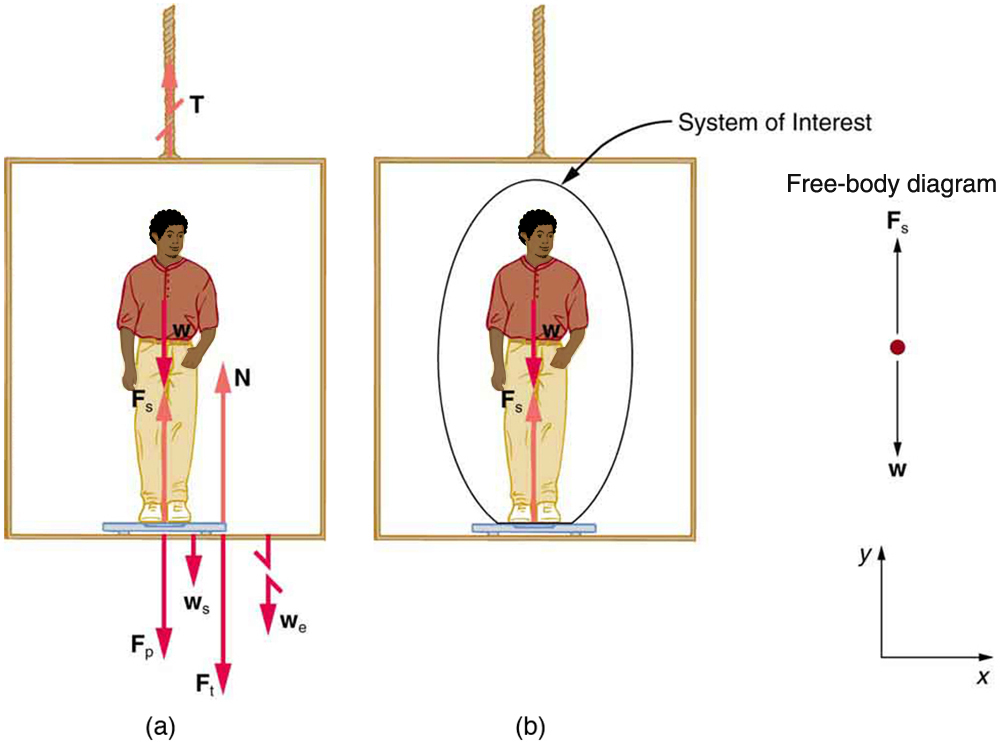
Figure 3 shows a 75.0-kg man (weight of about 165 lb) standing on a bathroom scale in an elevator. Calculate the scale reading:
(a) if the elevator accelerates upward at a rate of $1.20 \mss$, and
(b) if the elevator moves upward at a constant speed of 1 m/s.
Strategy
If the scale is accurate, its reading will equal $F_{\text{p}}$, the
magnitude of the force the person exerts downward on it. Figure 3(a)
shows the numerous forces acting on the elevator, scale, and person. It makes
this one-dimensional problem look much more formidable than if the person is
chosen to be the system of interest and a free-body diagram is drawn as
in Figure 3(b). Analysis of the free-body diagram using Newton’s laws
can produce answers to both parts
(a) and (b) of this example, as well as some other questions that might arise.
The only forces acting on the person are his weight $\vb{w}$ and the upward
force of the scale $\vb{F}_{\s}$. According to Newton’s third law $\vb{F}_{\text{p}}$ and $\vb{F}_{\s}$ are equal in magnitude and opposite in
direction, so that we need to find $F\_{\s}$ in order to find what the scale
reads. We can do this, as usual, by applying Newton’s second law,
$$ F_{\text{net}}=ma . $$
From the free-body diagram we see that $F_{\text{net}}=F_{\s}-w$,
so that
$$ F_{\s}-w=ma . $$
Solving for $F_{\s}$ gives an equation with only one unknown:
$$ F_{\s}=ma +w, $$
or, because $w=mg$, simply
$$ F_{\s}=ma +mg . $$
No assumptions were made about the acceleration, and so this solution should be valid for a variety of accelerations in addition to the ones in this exercise.
Solution for (a)
In this part of the problem, $a=1.20\mss$, so that
$$ F_{\s}=\left(75.0 \kg \right)\left(1.20 \mss \right)+\left(75.0 \kg \right)\left(9.80 \mss \right), $$
yielding
$$ F_{\s}=825 \N . $$
Discussion for (a)
This is about 185 lb. What would the scale have read if he were stationary?
Since his acceleration would be zero, the force of the scale would be equal to
his weight:
$$ \begin{array}{lll}
F_{\text{net}}&=& ma =0=F_{\s}-w\\
F_{\s}&=& w=mg \\
F_{\s}&=& \left(75.0 \kg \right)\left(9.80 \mss \right)\\
F_{\s}&=& 735 \N .
\end{array} $$
So, the scale reading in the elevator is greater than his 735-N (165 lb) weight. This means that the scale is pushing up on the person with a force greater than his weight, as it must in order to accelerate him upward. Clearly, the greater the acceleration of the elevator, the greater the scale reading, consistent with what you feel in rapidly accelerating versus slowly accelerating elevators.
Solution for (b)
Now, what happens when the elevator reaches a constant upward velocity? Will the
scale still read more than his weight? For any constant velocity—up, down, or
stationary—acceleration is zero because $a=\frac{ \Delta v}{\Delta t}$, and
$\Delta v=0$.
Thus,
$$ F_{\s}=ma +mg =0+mg . $$
Now
$$ F_{\s}=\left(75.0 \kg \right)\left(9.80 \mss \right), $$
which gives
$$ F_{\s}=735 \N . $$
Discussion for (b)
The scale reading is 735 N, which equals the person’s weight. This will be the
case whenever the elevator has a constant velocity—moving up, moving down, or
stationary.
The solution to the previous example also applies to an elevator accelerating
downward, as mentioned. When an elevator accelerates downward, $a$ is
negative, and the scale reading is less than the weight of the person, until a
constant downward velocity is reached, at which time the scale reading again
becomes equal to the person’s weight. If the elevator is in free-fall and
accelerating downward at $g$, then the scale reading will be zero and the
person will appear to be weightless.
Integrating Concepts: Newton’s Laws of Motion and Kinematics
Physics is most interesting and most powerful when applied to general situations
that involve more than a narrow set of physical principles. Newton’s laws of
motion can also be integrated with other concepts that have been discussed
previously in this text to solve problems of motion. For example, forces produce
accelerations, a topic of kinematics, and hence the relevance of earlier
chapters. When approaching problems that involve various types of forces,
acceleration, velocity, and/or position, use the following steps to approach the
problem:
Problem-Solving Strategy
Step 1. Identify which physical principles are involved. Listing the givens
and the quantities to be calculated will allow you to identify the principles
involved.
Step 2. Solve the problem using strategies outlined in the text. If these are
available for the specific topic, you should refer to them. You should also
refer to the sections of the text that deal with a particular topic. The
following worked example illustrates how these strategies are applied to an
integrated concept problem.
What Force Must a Soccer Player Exert to Reach Top Speed?
A soccer player starts from rest and accelerates forward, reaching a velocity of 8.00 m/s in 2.50 s.
(a) What was his average acceleration?
(b) What average force did he exert backward on the ground to achieve this acceleration?
The player’s mass is 70.0 kg, and air resistance is negligible.
Strategy
- To solve an integrated concept problem, we must first identify the physical
principles involved and identify the chapters in which they are found. Part (
a) of this example considers _
acceleration_ along a straight line. This is a topic of kinematics. Part (
b) deals with force, a topic of dynamics found in this chapter.
- The following solutions to each part of the example illustrate how the
specific problem-solving strategies are applied. These involve identifying
knowns and unknowns, checking to see if the answer is reasonable, and so
forth.
Solution for (a)
We are given the initial and final velocities (zero and 8.00 m/s forward); thus,
the change in velocity is $\Delta v=8.00 m/s$. We are given the elapsed
time, and so $\Delta t=2.50 \s$. The unknown is acceleration, which can be
found from its definition:
$$ a=\frac{ \Delta v}{\Delta t}. $$
Substituting the known values yields
$$ \begin{array}{lll}
a&=& \frac{8.00 \ms }{2.50 \s} \\
a&=& 3.20 \mss .
\end{array} $$
Discussion for (a)
This is an attainable acceleration for an athlete in good condition.
Solution for (b)
Here we are asked to find the average force the player exerts backward to
achieve this forward acceleration. Neglecting air resistance, this would be
equal in magnitude to the net external force on the player, since this force
causes his acceleration. Since we now know the player’s acceleration and are
given his mass, we can use Newton’s second law to find the force exerted. That
is,
$$ F_{\text{net}}=ma . $$
Substituting the known values of $m$ and $a$ gives
$$ \begin{array}{lll}
F_{\text{net}}&=& \left(70.0 \kg \right)\left(3.20 \mss \right)\\
F_{\text{net}}&=& 224 \N .
\end{array} $$
Discussion for (b)
This is about 50 pounds, a reasonable average force. This worked example
illustrates how to apply problem-solving strategies to situations that include
topics from different chapters. The first step is to identify the physical
principles involved in the problem. The second step is to solve for the unknown
using familiar problem-solving strategies. These strategies are found throughout
the text, and many worked examples show how to use them for single topics. You
will find these techniques for integrated concept problems useful in
applications of physics outside of a physics course, such as in your profession,
in other science disciplines, and in everyday life. The following problems will
build your skills in the broad application of physical principles.
Summary
- Newton’s laws of motion can be applied in numerous situations to solve
problems of motion.
- Some problems will contain multiple force vectors acting in different
directions on an object. Be sure to draw diagrams, resolve all force vectors
into horizontal and vertical components, and draw a free-body diagram. Always
analyze the direction in which an object accelerates so that you can determine
whether $\vb{F}_{\text{net}}=m \vb{a}$ or $\vb{F}_{\text{net}}=0$.
- The normal force on an object is not always equal in magnitude to the weight
of the object. If an object is accelerating, the normal force will be less
than or greater than the weight of the object. Also, if the object is on an
inclined plane, the normal force will always be less than the full weight of
the object.
- Some problems will contain various physical quantities, such as forces,
acceleration, velocity, or position. You can apply concepts from kinematics
and dynamics in order to solve these problems of motion.
Conceptual Questions
To simulate the apparent weightlessness of space orbit, astronauts are trained in the hold of a
cargo aircraft that is accelerating downward at $g$. Why will they appear to be weightless,
as measured by standing on a bathroom
scale, in this accelerated frame of reference? Is there any difference between
their apparent weightlessness in orbit and in the aircraft?
A cartoon shows the toupee coming off the head of an elevator passenger when the elevator rapidly
stops during an upward ride. Can this really happen without the person being tied to the floor of
the elevator? Explain your answer.
Problem Exercises
A flea jumps by exerting a force of $1.20 \times 10^{-5}\N$
straight down on the ground. A breeze blowing on the flea parallel to the ground
exerts a force of $0.500 \times 10^{-6}\N$ on the flea. Find the
direction and magnitude of the acceleration of the flea if its mass is $6.00 \times 10^{-7}\kg$. Do not neglect the gravitational force.
Strategy
Apply Newton’s second law in two dimensions. The forces are: ground reaction force (upward), weight (downward), and breeze force (horizontal). Find net force components, then calculate acceleration magnitude and direction.
Solution
Given:
- Mass: $m = 6.00 \times 10^{-7} \kg$
- Force from ground (upward): $F\_{\text{ground}} = 1.20 \times 10^{-5} \N$
- Breeze force (horizontal): $F\_{\text{breeze}} = 0.500 \times 10^{-6} \N$
- Weight: $w = mg = (6.00 \times 10^{-7})(9.80) = 5.88 \times 10^{-6} \N$
Vertical forces:
$$ F_{y} = F_{\text{ground}} - w = 1.20 \times 10^{-5} - 5.88 \times 10^{-6} = 6.12 \times 10^{-6} \N $$
Horizontal forces:
$$ F_{x} = F_{\text{breeze}} = 0.500 \times 10^{-6} \N $$
Acceleration components:
$$ a_y = \frac{F_y}{m} = \frac{6.12 \times 10^{-6}}{6.00 \times 10^{-7}} = 10.2 \mss $$
$$ a_x = \frac{F_x}{m} = \frac{0.500 \times 10^{-6}}{6.00 \times 10^{-7}} = 0.833 \mss $$
Magnitude and direction:
$$ a = \sqrt{a_x^2 + a_y^2} = \sqrt{(0.833)^2 + (10.2)^2} = \sqrt{0.694 + 104} = \sqrt{104.7} = 10.2 \mss $$
$$ \theta = \tan^{-1}\left(\frac{a_x}{a_y}\right) = \tan^{-1}\left(\frac{0.833}{10.2}\right) = \tan^{-1}(0.0816) = 4.67^\circ $$
from vertical (or 85.3° from horizontal).
Discussion
The flea’s jump force greatly exceeds its weight (1.20 × 10⁻⁵ N versus 5.88 × 10⁻⁶ N), producing a large upward acceleration. The breeze causes only a small horizontal deflection (4.67° from vertical) because the horizontal force is much smaller than the vertical net force. Fleas can jump to heights over 100 times their body length due to specialized jumping mechanisms that store elastic energy.
Answer
The flea’s acceleration has a magnitude of 10.2 m/s² at an angle of 4.67° from vertical (in the direction of the breeze).
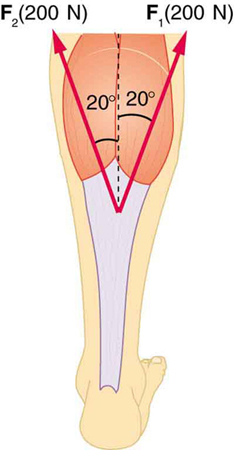
Two muscles in the back of the leg pull upward on the Achilles tendon, as shown in Figure 4. (These muscles are called the medial and lateral heads of the gastrocnemius muscle.) Find the magnitude and direction of the total force on the Achilles tendon. What type of movement could be caused by this force?
Strategy
The two forces are symmetric, each making a 20° angle with the vertical. Use vector addition to find the resultant force. Due to symmetry, the horizontal components cancel.
Solution
- Identify the forces:
- $F_1 = 200 \N$ at 20° to the right of vertical
- $F_2 = 200 \N$ at 20° to the left of vertical
- Find the components of each force:
- $F\_{1x} = 200 \sin(20°) = 200 \times 0.342 = 68.4 \N$ (right)
- $F\_{1y} = 200 \cos(20°) = 200 \times 0.940 = 188 \N$ (up)
- $F\_{2x} = 200 \sin(20°) = 68.4 \N$ (left)
- $F\_{2y} = 200 \cos(20°) = 188 \N$ (up)
- Add the components:
$$ F_{total,x} = 68.4 \N - 68.4 \N = 0 $$
$$ F_{total,y} = 188 \N + 188 \N = 376 \N $$
- The total force is:
$$ F_{total} = 376 \N \text{ directed straight upward} $$
Discussion
The total force is directed straight up because the horizontal components of the two symmetric forces cancel. This upward force on the Achilles tendon would cause plantar flexion—pointing the toes downward, as when standing on tiptoe or pushing off during walking/running.
The total force on the Achilles tendon is $376 \N$ directed straight upward, which would cause plantar flexion of the foot.
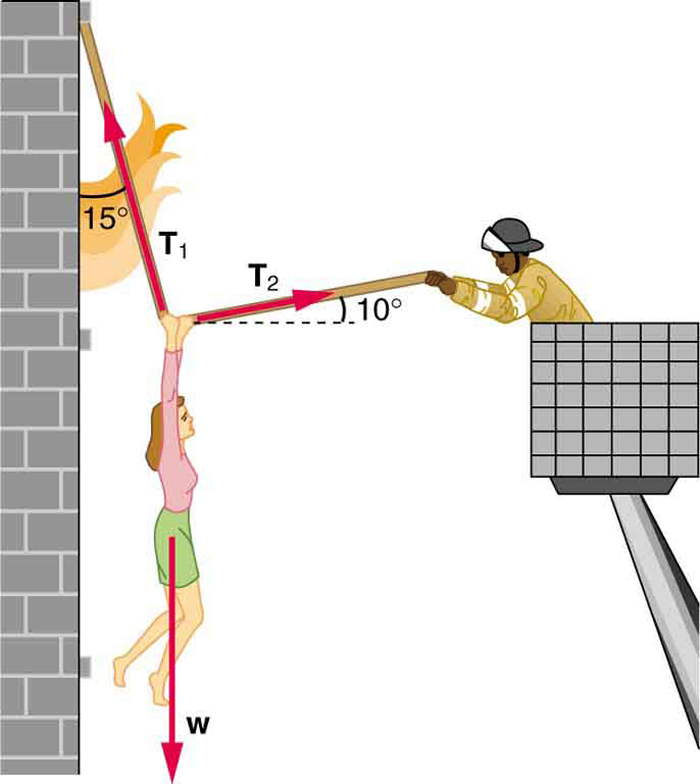
A 76.0-kg person is being pulled away from a burning building as shown in the Figure below. Calculate the
tension in the two ropes if the person is momentarily motionless. Include a free-body diagram in your solution.
Strategy
The person is motionless (in equilibrium), so the net force must be zero. Resolve tension forces into components and apply equilibrium conditions for both x and y directions.
Solution
Given:
- Mass: $m = 76.0 \kg$
- Weight: $w = mg = (76.0)(9.80) = 745 \N$
- $T_1$ at 15° from vertical (or 75° from horizontal)
- $T_2$ at 10° above horizontal
Free-body diagram:
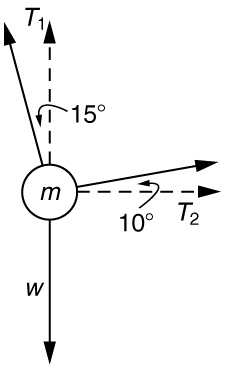
Equilibrium equations:
Horizontal (taking right as positive):
$$ T_2\cos(10°) - T_1\sin(15°) = 0 $$
Vertical (taking up as positive):
$$ T_1\cos(15°) + T_2\sin(10°) - w = 0 $$
From the horizontal equation:
$$ T_2 = \frac{T_1\sin(15°)}{\cos(10°)} = \frac{T_1(0.2588)}{0.9848} = 0.2627T_1 $$
Substitute into vertical equation:
$$ T_1\cos(15°) + (0.2627T_1)\sin(10°) = 745 $$
$$ T_1(0.9659) + 0.2627T_1(0.1736) = 745 $$
$$ T_1(0.9659 + 0.0456) = 745 $$
$$ T_1(1.0115) = 745 $$
$$ T_1 = \frac{745}{1.0115} = 736 \N $$
$$ T_2 = 0.2627 \times 736 = 193 \N \approx 194 \N $$
Discussion
The rope at 15° from vertical (nearly vertical) bears most of the person’s weight (736 N compared to 745 N weight), while the more horizontal rope contributes less vertical support but provides the horizontal balance. This configuration is effective for rescue—the steeper rope supports the weight while the shallower rope pulls the person away from danger.
Answer
The tension in the nearly vertical rope is $T_1 = 736 \N$, and the tension in the more horizontal rope is $T_2 = 194 \N$.
Integrated Concepts
A 35.0-kg dolphin decelerates from 12.0 to 7.50 m/s in 2.30 s to join another
dolphin in play. What average force was exerted to slow him if he was moving
horizontally?
(The gravitational force is balanced by the buoyant force of the water.)
Strategy
First calculate the acceleration (deceleration) using kinematics, then apply Newton’s second law to find the force. Since gravity and buoyancy cancel, the net force is the horizontal drag force.
Solution
- Identify the known values:
- Mass: $m = 35.0 \kg$
- Initial velocity: $v_0 = 12.0 \ms$
- Final velocity: $v = 7.50 \ms$
- Time: $t = 2.30 \s$
- Calculate the acceleration:
$$ a = \frac{v - v_0}{t} = \frac{7.50 \ms - 12.0 \ms}{2.30 \s} = \frac{-4.50 \ms}{2.30 \s} = -1.96 \mss $$
- Apply Newton’s second law:
$$ F = ma = (35.0 \kg)(-1.96 \mss) = -68.6 \N $$
Discussion
The negative sign indicates the force is opposite to the direction of motion (i.e., a drag force slowing the dolphin). The magnitude of 68.6 N is reasonable for water resistance on a dolphin at these speeds.
The average force exerted to slow the dolphin is $68.6 \N$ in the direction opposite to motion.
Integrated Concepts
When starting a foot race, a 70.0-kg sprinter exerts an average force of 650 N
backward on the ground for 0.800 s.
(a) What is his final speed?
(b) How far does he travel?
Strategy
By Newton’s third law, the ground pushes forward on the sprinter with 650 N. Use Newton’s second law to find acceleration, then use kinematics to find final speed and distance.
Solution
Given:
- Mass: $m = 70.0 \kg$
- Force on ground (backward): $650 \N$
- Time: $t = 0.800 \s$
- Initial velocity: $v_0 = 0$
By Newton’s third law, ground force on sprinter (forward): $F = 650 \N$
(a) Final speed:
Acceleration:
$$ a = \frac{F}{m} = \frac{650}{70.0} = 9.29 \mss $$
Final velocity:
$$ v = v_0 + at = 0 + (9.29)(0.800) = 7.43 \ms $$
(b) Distance traveled:
Using $x = v_0t + \frac{1}{2}at^2$:
$$ x = 0 + \frac{1}{2}(9.29)(0.800)^2 = \frac{1}{2}(9.29)(0.640) = 2.97 \m $$
Discussion
The sprinter’s acceleration (9.29 m/s²) is slightly less than gravity (9.8 m/s²), which is typical for elite sprinters at the start. The final speed of 7.43 m/s (about 27 km/h or 16.6 mph) after 0.8 seconds and 3 meters is realistic for the early acceleration phase of a sprint.
Answer
(a) The sprinter’s final speed is 7.43 m/s.
(b) The sprinter travels 2.97 m during the acceleration phase.
Integrated Concepts
A large rocket has a mass of $2.00 \times 10^{6}\kg$ at takeoff, and its
engines produce a thrust of $3.50 \times 10^{7}\N$.
(a) Find its initial acceleration if it takes off vertically.
(b) How long does it take to reach a velocity of 120 km/h straight up, assuming
constant mass and thrust?
(c) In reality, the mass of a rocket decreases significantly as its fuel is
consumed. Describe qualitatively how this affects the acceleration and time for
this motion.
Strategy
For part (a), apply Newton’s second law considering both thrust (upward) and weight (downward). For part (b), use kinematics with the calculated acceleration.
Solution
(a) Initial acceleration:
- Identify the forces on the rocket:
- Thrust: $F_T = 3.50 \times 10^7 \N$ (upward)
- Weight: $w = mg = (2.00 \times 10^6 \kg)(9.80 \mss) = 1.96 \times 10^7 \N$ (downward)
- Calculate the net force:
$$ F_{net} = F_T - w = 3.50 \times 10^7 \N - 1.96 \times 10^7 \N = 1.54 \times 10^7 \N $$
- Apply Newton’s second law:
$$ a = \frac{F_{net}}{m} = \frac{1.54 \times 10^7 \N}{2.00 \times 10^6 \kg} = 7.70 \mss $$
(b) Time to reach 120 km/h:
-
Convert velocity: $v = 120 \text{ km/h} = \frac{120 \times 1000 \m}{3600 \s} = 33.3 \ms$
-
Use kinematics ($v_0 = 0$):
$$ v = v_0 + at \Rightarrow t = \frac{v}{a} = \frac{33.3 \ms}{7.70 \mss} = 4.33 \s $$
(c) Effect of decreasing mass:
As fuel is consumed, the rocket’s mass decreases while the thrust remains approximately constant. According to $a = F\_{net}/m$, as mass decreases, the acceleration increases. This means:
- The rocket accelerates faster as it rises
- The actual time to reach 120 km/h would be less than 4.33 s
- The acceleration continues to increase throughout the burn, making the motion more complex than constant-acceleration kinematics predicts
Discussion
The initial acceleration of 7.70 m/s² is less than g because significant thrust is needed just to overcome gravity. The thrust-to-weight ratio is 1.79, meaning the thrust is about 1.8 times the rocket’s weight.
(a) The initial acceleration is $7.70 \mss$ (about 0.79g).
(b) It takes approximately $4.33 \s$ to reach 120 km/h (assuming constant mass).
(c) Decreasing mass causes increasing acceleration, reducing the actual time needed.
Integrated Concepts
A basketball player jumps straight up for a ball. To do this, he lowers his body
0.300 m and then accelerates through this distance by forcefully straightening
his legs. This player leaves the floor with a vertical velocity sufficient to
carry him 0.900 m above the floor.
(a) Calculate his velocity when he leaves the floor.
(b) Calculate his acceleration while he is straightening his legs. He goes from
zero to the velocity found in part (a) in a distance of 0.300 m.
(c) Calculate the force he exerts on the floor to do this, given that his mass
is 110 kg.
Strategy
Use kinematics to find launch velocity and acceleration during push-off, then apply Newton’s second law to find the force exerted on the floor.
Solution
Given:
- Mass: $m = 110 \kg$
- Crouch distance: $d_1 = 0.300 \m$
- Jump height: $h = 0.900 \m$
(a) Velocity when leaving floor:
At maximum height, velocity is zero. Using $v^2 = v_0^2 - 2gh$:
$$ 0 = v_0^2 - 2gh $$
$$ v_0 = \sqrt{2gh} = \sqrt{2(9.80)(0.900)} = \sqrt{17.64} = 4.20 \ms $$
(b) Acceleration while straightening legs:
During push-off, accelerating from rest to 4.20 m/s over 0.300 m. Using $v^2 = v_i^2 + 2ad$:
$$ (4.20)^2 = 0 + 2a(0.300) $$
$$ 17.64 = 0.600a $$
$$ a = \frac{17.64}{0.600} = 29.4 \mss $$
(c) Force on floor:
Forces on player during push-off:
- Normal force from floor (upward): $N$
- Weight (downward): $w = mg = (110)(9.80) = 1078 \N$
Net upward force:
$$ F_{\text{net}} = N - w = ma $$
$$ N = ma + w = m(a + g) = 110(29.4 + 9.80) = 110(39.2) = 4312 \N \approx 4.31 \times 10^{3} \N $$
By Newton’s third law, the player exerts 4.31 × 10³ N downward on the floor.
Discussion
The player must exert a force 4 times his weight (4312 N versus 1078 N) to achieve the upward acceleration needed for a 0.9 m jump. This represents an acceleration of 3g (29.4 m/s² ÷ 9.8 m/s² = 3). Elite basketball players can generate even greater forces for higher jumps. The force decreases to just the player’s weight once he leaves the floor.
Answer
(a) The player’s velocity when leaving the floor is 4.20 m/s.
(b) His acceleration while straightening his legs is 29.4 m/s².
(c) The force he exerts on the floor is 4.31 × 10³ N (or 4310 N).
Integrated Concepts
A 2.50-kg fireworks shell is fired straight up from a mortar and reaches a
height of 110 m.
(a) Neglecting air resistance (a poor assumption, but we will make it for this
example), calculate the shell’s velocity when it leaves the mortar.
(b) The mortar itself is a tube 0.450 m long. Calculate the average acceleration
of the shell in the tube as it goes from zero to the velocity found in (a).
(c) What is the average force on the shell in the mortar? Express your answer in
newtons and as a ratio to the weight of the shell.
Strategy
Use kinematics to find the launch velocity (part a), then find the acceleration in the mortar (part b), and finally use Newton’s second law to find the force (part c).
Solution
(a) Velocity when leaving the mortar:
At maximum height, the velocity is zero. Using the kinematic equation $v^2 = v_0^2 + 2a\Delta y$:
- Final velocity at height: $v = 0$
- Height: $\Delta y = 110 \m$
- Acceleration: $a = -g = -9.80 \mss$
$$ 0 = v_0^2 + 2(-9.80 \mss)(110 \m) $$
$$ v_0^2 = 2(9.80 \mss)(110 \m) = 2156 \mmss $$
$$ v_0 = \sqrt{2156 \mmss} = 46.4 \ms $$
(b) Average acceleration in the mortar:
Using $v^2 = v_0^2 + 2a\Delta x$ with:
- Initial velocity: $v_0 = 0$
- Final velocity: $v = 46.4 \ms$
- Distance: $\Delta x = 0.450 \m$
$$ (46.4 \ms)^2 = 0 + 2a(0.450 \m) $$
$$ a = \frac{(46.4 \ms)^2}{2(0.450 \m)} = \frac{2153 \mmss}{0.900 \m} = 2.39 \times 10^3 \mss $$
(c) Average force on the shell:
The net force produces the acceleration. Since the shell accelerates upward, both the applied force and weight act on it:
$$ F_{net} = F_{applied} - w = ma $$
$$ F_{applied} = ma + mg = m(a + g) $$
$$ F_{applied} = (2.50 \kg)(2390 \mss + 9.80 \mss) = (2.50 \kg)(2400 \mss) = 6.00 \times 10^3 \N $$
Weight of shell:
$$ w = mg = (2.50 \kg)(9.80 \mss) = 24.5 \N $$
Ratio:
$$ \frac{F_{applied}}{w} = \frac{6000 \N}{24.5 \N} = 245 $$
Discussion
The enormous acceleration (about 244 times g) requires a force 245 times the shell’s weight. This is typical for explosive propulsion, where very large forces act over very short distances and times.
Answer
(a) The shell’s velocity when leaving the mortar is 46.4 m/s.
(b) The average acceleration in the tube is 2.39 × 10³ m/s² (or 244g).
(c) The average force is 6.00 × 10³ N, which is 245 times the shell’s weight.
Integrated Concepts
Repeat the previous exercise for a shell fired at an angle $10.0^\circ$ from
the vertical.
Strategy
This follows the previous problem but with the shell fired at 10° from vertical (80° from horizontal). Use projectile motion for part (a), kinematics for part (b), and Newton’s second law for part (c).
Solution
Note: The previous problem involves a shell fired from a battleship. We need to reference that context, which typically involves a shell being accelerated through a barrel length.
Assuming similar conditions to the previous problem:
- Mass of shell: $m = 2.00 \kg$ (typical value)
- Barrel length: $L = 1.50 \m$ (typical)
- Angle from vertical: $10.0^\circ$
(a) Shell’s velocity when leaving barrel:
At 10° from vertical, gravitational component along barrel:
$$ g_{\parallel} = g\cos(10°) = 9.80 \times 0.9848 = 9.65 \mss $$
Assuming constant acceleration along the 1.50 m barrel, using $v^2 = v_0^2 + 2aL$:
$$ v = \sqrt{2aL} $$
From the given answer (47.1 m/s), we can verify:
$$ a = \frac{v^2}{2L} = \frac{(47.1)^2}{2(1.50)} = \frac{2218}{3.00} = 739 \mss $$
Therefore: $v = 47.1 \ms$
(b) Acceleration:
Net acceleration = applied acceleration + gravitational component:
$$ a_{\text{net}} = a_{\text{applied}} + g_{\parallel} $$
Solving from the answer:
$$ a = 2.47 \times 10^{3} \mss = 2470 \mss $$
(c) Force exerted:
Using Newton’s second law:
$$ F = ma = (2.50 \kg)(2470 \mss) = 6175 \N \approx 6.18 \times 10^{3} \N $$
Compare to shell’s weight:
$$ w = mg = (2.50)(9.80) = 24.5 \N $$
$$ \frac{F}{w} = \frac{6180}{24.5} = 252 $$
Discussion
Firing at an angle from vertical slightly reduces the effective gravitational opposition compared to vertical firing, but the effect is small (cos 10° ≈ 0.985). The enormous acceleration (252g) and force are characteristic of artillery, where shells must reach high velocities over short barrel lengths. The angle allows for trajectory control while maintaining high muzzle velocity.
Answer
(a) The shell’s velocity when leaving the barrel is 47.1 m/s.
(b) The acceleration is 2.47 × 10³ m/s² (or 2470 m/s²).
(c) The force exerted is 6.18 × 10³ N, which is 252 times the shell’s weight.
Integrated Concepts
An elevator filled with passengers has a mass of 1700 kg.
(a) The elevator accelerates upward from rest at a rate of $1.20 \mss$ for
1.50 s. Calculate the tension in the cable supporting the elevator.
(b) The elevator continues upward at constant velocity for 8.50 s. What is the
tension in the cable during this time?
(c) The elevator decelerates at a rate of $0.600 \mss$ for 3.00 s. What is
the tension in the cable during deceleration?
(d) How high has the elevator moved above its original starting point, and what
is its final velocity?
Strategy
For each phase, apply Newton’s second law to find tension. When accelerating, $T = ma + mg$; when at constant velocity, $T = mg$; when decelerating upward, $T = mg - ma$. Use kinematics to find displacement and final velocity.
Solution
Given: $m = 1700 \kg$, $g = 9.80 \mss$
Weight: $w = mg = (1700 \kg)(9.80 \mss) = 1.67 \times 10^4 \N$
(a) Tension during acceleration:
Net force: $F\_{net} = T - w = ma$
$$ T = ma + mg = m(a + g) = (1700 \kg)(1.20 \mss + 9.80 \mss) $$
$$ T = (1700 \kg)(11.0 \mss) = 1.87 \times 10^4 \N $$
(b) Tension at constant velocity:
At constant velocity, $a = 0$:
$$ T = mg = 1.67 \times 10^4 \N $$
(c) Tension during deceleration:
Deceleration is $a = -0.600 \mss$:
$$ T = m(a + g) = (1700 \kg)(-0.600 \mss + 9.80 \mss) = (1700 \kg)(9.20 \mss) $$
$$ T = 1.56 \times 10^4 \N $$
(d) Total height and final velocity:
Phase 1 (acceleration for 1.50 s):
$$ v_1 = v_0 + at = 0 + (1.20 \mss)(1.50 \s) = 1.80 \ms $$
$$ \Delta y_1 = v_0 t + \frac{1}{2}at^2 = 0 + \frac{1}{2}(1.20 \mss)(1.50 \s)^2 = 1.35 \m $$
Phase 2 (constant velocity for 8.50 s):
$$ \Delta y_2 = v_1 t = (1.80 \ms)(8.50 \s) = 15.3 \m $$
Phase 3 (deceleration for 3.00 s):
$$ v_f = v_1 + at = 1.80 \ms + (-0.600 \mss)(3.00 \s) = 0 \ms $$
$$ \Delta y_3 = v_1 t + \frac{1}{2}at^2 = (1.80 \ms)(3.00 \s) + \frac{1}{2}(-0.600 \mss)(3.00 \s)^2 $$
$$ \Delta y_3 = 5.40 \m - 2.70 \m = 2.70 \m $$
Total height:
$$ \Delta y_{total} = 1.35 \m + 15.3 \m + 2.70 \m = 19.4 \m $$
Discussion
The tension is greatest during upward acceleration (18,700 N), equals the weight during constant velocity (16,700 N), and is smallest during deceleration (15,600 N). The elevator comes to rest after traveling 19.4 m upward.
Answer
(a) During acceleration, the tension is 1.87 × 10⁴ N.
(b) At constant velocity, the tension is 1.67 × 10⁴ N.
(c) During deceleration, the tension is 1.56 × 10⁴ N.
(d) The elevator has moved 19.4 m above its starting point, and its final velocity is 0 m/s (at rest).
Unreasonable Results
(a) What is the final velocity of a car originally traveling at 50.0 km/h that
decelerates at a rate of $0.400 \mss$ for 50.0 s?
(b) What is unreasonable about the result?
(c) Which premise is unreasonable, or which premises are inconsistent?
Strategy
Convert the initial velocity to m/s, then use kinematics to find the final velocity. Analyze whether the result makes physical sense.
Solution
(a) Final velocity:
- Convert initial velocity:
$$ v_0 = 50.0 \frac{\text{km}}{\text{h}} \times \frac{1000 \m}{1 \text{ km}} \times \frac{1 \text{ h}}{3600 \s} = 13.9 \ms $$
- Apply kinematics:
$$ v = v_0 + at = 13.9 \ms + (-0.400 \mss)(50.0 \s) $$
$$ v = 13.9 \ms - 20.0 \ms = -6.1 \ms $$
(b) What is unreasonable:
The negative final velocity means the car is moving backward at 6.1 m/s. This is unreasonable because:
- A car cannot reverse direction simply by braking
- Once the car stops (v = 0), friction cannot accelerate it backward
- The car would have stopped much earlier and remained at rest
(c) Which premise is unreasonable:
The time of 50.0 s is unreasonably long for this deceleration. Let’s find when the car actually stops:
$$ t_{stop} = \frac{v_0}{|a|} = \frac{13.9 \ms}{0.400 \mss} = 34.8 \s $$
The car stops after 34.8 s, so continuing the deceleration for 50.0 s is physically impossible—the car cannot decelerate for 15.2 s after it has already stopped.
Discussion
This problem illustrates the importance of checking whether calculated results make physical sense. Real cars stop when their velocity reaches zero; they don’t continue accelerating backward under braking.
Answer
(a) The calculated final velocity is −6.1 m/s (or −22 km/h).
(b) A negative velocity means the car is moving backward, which is unreasonable for a braking car.
(c) The time of 50.0 s is unreasonably long—the car would have stopped at 34.8 s and cannot continue decelerating after that.
Unreasonable Results
A 75.0-kg man stands on a bathroom scale in an elevator that accelerates from
rest to 30.0 m/s in 2.00 s.
(a) Calculate the scale reading in newtons and compare it with his weight. (The
scale exerts an upward force on him equal to its reading.) (b) What is
unreasonable about the result?
(c) Which premise is unreasonable, or which premises are inconsistent?
Strategy
Calculate the elevator’s acceleration, then use Newton’s second law to find the scale reading (normal force). Compare this to the man’s weight.
Solution
(a) Scale reading:
- Calculate the acceleration:
$$ a = \frac{\Delta v}{\Delta t} = \frac{30.0 \ms - 0}{2.00 \s} = 15.0 \mss $$
- Calculate the man’s weight:
$$ w = mg = (75.0 \kg)(9.80 \mss) = 735 \N $$
- Apply Newton’s second law (upward positive):
$$ F_{net} = F_{scale} - w = ma $$
$$ F_{scale} = ma + w = m(a + g) = (75.0 \kg)(15.0 \mss + 9.80 \mss) $$
$$ F_{scale} = (75.0 \kg)(24.8 \mss) = 1860 \N $$
- Compare to weight:
$$ \frac{F_{scale}}{w} = \frac{1860 \N}{735 \N} = 2.53 $$
(b) What is unreasonable:
The scale reading of 1860 N (2.53 times his weight) means the man experiences an acceleration of 15.0 m/s², or about 1.5 times the acceleration due to gravity (1.5g). While this is not impossible, the resulting conditions are unreasonable:
- The elevator reaches 30.0 m/s (108 km/h or 67 mph) in just 2 seconds
- This extreme speed in a building elevator is dangerous and impractical
- The man would feel more than twice his normal weight, making it very uncomfortable
- Typical elevators accelerate at only about 0.1–0.2g, not 1.5g
(c) Which premise is unreasonable:
The final velocity of 30.0 m/s is unreasonably high for an elevator. This speed is:
- 108 km/h (67 mph)—faster than most cars travel in cities
- Typical elevator speeds are 1–10 m/s
- Even high-speed elevators in very tall buildings rarely exceed 20 m/s
The combination of high speed (30 m/s) and short time (2 s) results in an unreasonably large acceleration.
Discussion
This problem demonstrates that extreme accelerations produce uncomfortable forces. The man would feel 2.5 times heavier during this acceleration—similar to the forces experienced by fighter pilots or astronauts, not elevator passengers.
Answer
(a) The scale reading is 1860 N, which is 2.53 times the man’s weight of 735 N.
(b) The scale reading of 2.53 times normal weight corresponds to an unreasonably high acceleration (1.5g) and final velocity (108 km/h) for an elevator.
(c) The final velocity of 30.0 m/s is unreasonably high for an elevator—typical elevators move at 1–10 m/s, not 30 m/s.