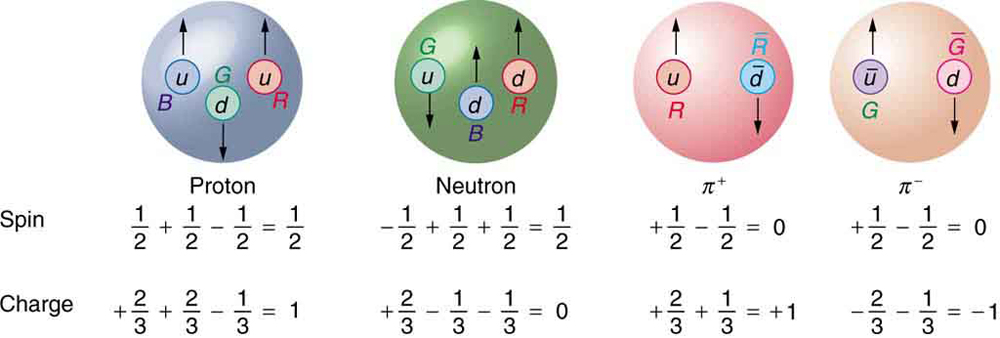
Quarks have been mentioned at various points in this text as fundamental building blocks and members of the exclusive club of truly elementary particles. Note that an elementary or fundamental particle has no substructure (it is not made of other particles) and has no finite size other than its wavelength. This does not mean that fundamental particles are stable—some decay, while others do not. Keep in mind that all leptons seem to be fundamental, whereas no hadrons are fundamental. There is strong evidence that quarks are the fundamental building blocks of hadrons as seen in [Figure 1]. Quarks are the second group of fundamental particles (leptons are the first). The third and perhaps final group of fundamental particles is the carrier particles for the four basic forces. Leptons, quarks, and carrier particles may be all there is. In this module we will discuss the quark substructure of hadrons and its relationship to forces as well as indicate some remaining questions and problems.
Quarks were first proposed independently by American physicists Murray Gell-Mann and George Zweig in 1963. Their quaint name was taken by Gell-Mann from a James Joyce novel—Gell-Mann was also largely responsible for the concept and name of strangeness. (Whimsical names are common in particle physics, reflecting the personalities of modern physicists.) Originally, three quark types—or flavors—were proposed to account for the then-known mesons and baryons. These quark flavors are named up (u), down (d), and strange (s). All quarks have half-integral spin and are thus fermions. All mesons have integral spin while all baryons have half-integral spin. Therefore, mesons should be made up of an even number of quarks while baryons need to be made up of an odd number of quarks. [Figure 1] shows the quark substructure of the proton, neutron, and two pions. The most radical proposal by Gell-Mann and Zweig is the fractional charges of quarks, which are \(±\left(\frac{2}{3}\right){q}_{e}\) and \(\left(\frac{1}{3}\right){q}_{e}\) , whereas all directly observed particles have charges that are integral multiples of \({q}_{e}\) . Note that the fractional value of the quark does not violate the fact that the e is the smallest unit of charge that is observed, because a free quark cannot exist. [Table 1] lists characteristics of the six quark flavors that are now thought to exist. Discoveries made since 1963 have required extra quark flavors, which are divided into three families quite analogous to leptons.
To understand how these quark substructures work, let us specifically examine the proton, neutron, and the two pions pictured in [Figure 1] before moving on to more general considerations. First, the proton p is composed of the three quarks uud, so that its total charge is \(+\left(\frac{2}{3}\right){q}_{e}+\left(\frac{2}{3}\right){q}_{e}-\left(\frac{1}{3}\right){q}_{e}={q}_{e}\), as expected. With the spins aligned as in the figure, the proton’s intrinsic spin is \(+\left(\frac{1}{2}\right)+\left(\frac{1}{2}\right)-\left(\frac{1}{2}\right)=\left(\frac{1}{2}\right)\), also as expected. Note that the spins of the up quarks are aligned, so that they would be in the same state except that they have different colors (another quantum number to be elaborated upon a little later). Quarks obey the Pauli exclusion principle. Similar comments apply to the neutron n, which is composed of the three quarks udd. Note also that the neutron is made of charges that add to zero but move internally, producing its well-known magnetic moment. When the neutron \({\beta }^{-}\) decays, it does so by changing the flavor of one of its quarks. Writing neutron \({\beta }^{-}\) decay in terms of quarks,
We see that this is equivalent to a down quark changing flavor to become an up quark:
| Name | Symbol | Antiparticle | Spin | Charge | $$B $$ 2 | $$S $$ | $$c $$ | $$b $$ | $$t $$ | Mass $$\left(\text{GeV}/{c}^{2}\right) $$3 |
|---|---|---|---|---|---|---|---|---|---|---|
| Up | $$u $$ | $$\stackrel{-}{u} $$ | 1/2 | $$±\frac{2}{3}{q}_{e} $$ | $$±\frac{1}{3} $$ | 0 | 0 | 0 | 0 | 0.005 |
| Down | $$d $$ | $$\stackrel{-}{d} $$ | 1/2 | $$\mp \frac{1}{3}{q}_{e} $$ | $$±\frac{1}{3} $$ | 0 | 0 | 0 | 0 | 0.008 |
| Strange | $$s $$ | $$\stackrel{-}{s} $$ | 1/2 | $$\mp \frac{1}{3}{q}_{e} $$ | $$±\frac{1}{3} $$ | $$\mp 1 $$ | 0 | 0 | 0 | 0.50 |
| Charmed | $$c $$ | $$\stackrel{-}{c} $$ | 1/2 | $$±\frac{2}{3}{q}_{e} $$ | $$±\frac{1}{3} $$ | 0 | $$±1 $$ | 0 | 0 | 1.6 |
| Bottom | $$b $$ | $$\stackrel{-}{b} $$ | 1/2 | $$\mp \frac{1}{3}{q}_{e} $$ | $$±\frac{1}{3} $$ | 0 | 0 | $$\mp 1 $$ | 0 | 5 |
| Top | $$t $$ | $$\stackrel{-}{t} $$ | 1/2 | $$±\frac{2}{3}{q}_{e} $$ | $$±\frac{1}{3} $$ | 0 | 0 | 0 | $$±1 $$ | 173 |
| Particle | Quark Composition | |
|---|---|---|
| Mesons | ||
| $${\pi }^{+} $$ | $$u\stackrel{-}{d} $$ | |
| $${\pi }^{-} $$ | $$\stackrel{-}{u}d $$ | |
| $${\pi }^{0} $$ | $$u\stackrel{-}{u} $$, $$d\stackrel{-}{d} $$ mixture5 | |
| $${\eta }^{0} $$ | $$u\stackrel{-}{u} $$, $$d\stackrel{-}{d} $$ mixture6 | |
| $${K}^{0} $$ | $$d\stackrel{-}{s} $$ | |
| $${\stackrel{-}{K} }^{0} $$ | $$\stackrel{-}{d}s $$ | |
| $${K}^{+} $$ | $$u\stackrel{-}{s} $$ | |
| $${K}^{-} $$ | $$\stackrel{-}{u}s $$ | |
| $$J/\psi $$ | $$c\stackrel{-}{c} $$ | |
| $$\Upsilon $$ | $$b\stackrel{-}{b} $$ | |
| Baryons7,8 | ||
| $$p $$ | $$\text{uud} $$ | |
| $$n $$ | $$\text{udd} $$ | |
| $${\Delta }^{0} $$ | $$\text{udd} $$ | |
| $${\Delta }^{+} $$ | $$\text{uud} $$ | |
| $${\Delta }^{-} $$ | $$\text{ddd} $$ | |
| $${\Delta }^{++} $$ | $$\text{uuu} $$ | |
| $${\text{Λ} }^{0} $$ | $$\text{uds} $$ | |
| $${\text{Σ} }^{0} $$ | $$\text{uds} $$ | |
| $${\text{Σ} }^{+} $$ | $$\text{uus} $$ | |
| $${\text{Σ} }^{-} $$ | $$\text{dds} $$ | |
| $${\text{Ξ} }^{0} $$ | $$\text{uss} $$ | |
| $${\text{Ξ} }^{-} $$ | $$\text{dss} $$ | |
| $${\Omega }^{-} $$ | $$\text{sss} $$ | |
This is an example of the general fact that the weak nuclear force can change the flavor of a quark. By general, we mean that any quark can be converted to any other (change flavor) by the weak nuclear force. Not only can we get \(d\to u\) , we can also get \(u\to d\) . Furthermore, the strange quark can be changed by the weak force, too, making \(s\to u\) and \(s\to d\) possible. This explains the violation of the conservation of strangeness by the weak force noted in the preceding section. Another general fact is that the strong nuclear force cannot change the flavor of a quark.
Again, from [Figure 1], we see that the \({\pi }^{+}\) meson (one of the three pions) is composed of an up quark plus an antidown quark, or \(u\stackrel{-}{d}\) . Its total charge is thus \(+\left(\frac{2}{3}\right){q}_{e}+\left(\frac{1}{3}\right){q}_{e}={q}_{e}\) , as expected. Its baryon number is 0, since it has a quark and an antiquark with baryon numbers \(+\left( \frac{1}{3}\right)-\left(\frac{1}{3}\right)=0\) . The \({\pi }^{+}\) half-life is relatively long since, although it is composed of matter and antimatter, the quarks are different flavors and the weak force should cause the decay by changing the flavor of one into that of the other. The spins of the \(u\) and \(\stackrel{-}{d}\) quarks are antiparallel, enabling the pion to have spin zero, as observed experimentally. Finally, the \({\pi }^{-}\) meson shown in [Figure 1] is the antiparticle of the \({\pi }^{+}\) meson, and it is composed of the corresponding quark antiparticles. That is, the \({\pi }^{+}\) meson is \(u\stackrel{-}{d}\) , while the \({\pi }^{-}\) meson is \(\stackrel{-}{u}d\) . These two pions annihilate each other quickly, because their constituent quarks are each other’s antiparticles.
Two general rules for combining quarks to form hadrons are:
One of the clever things about this scheme is that only integral charges result, even though the quarks have fractional charge.
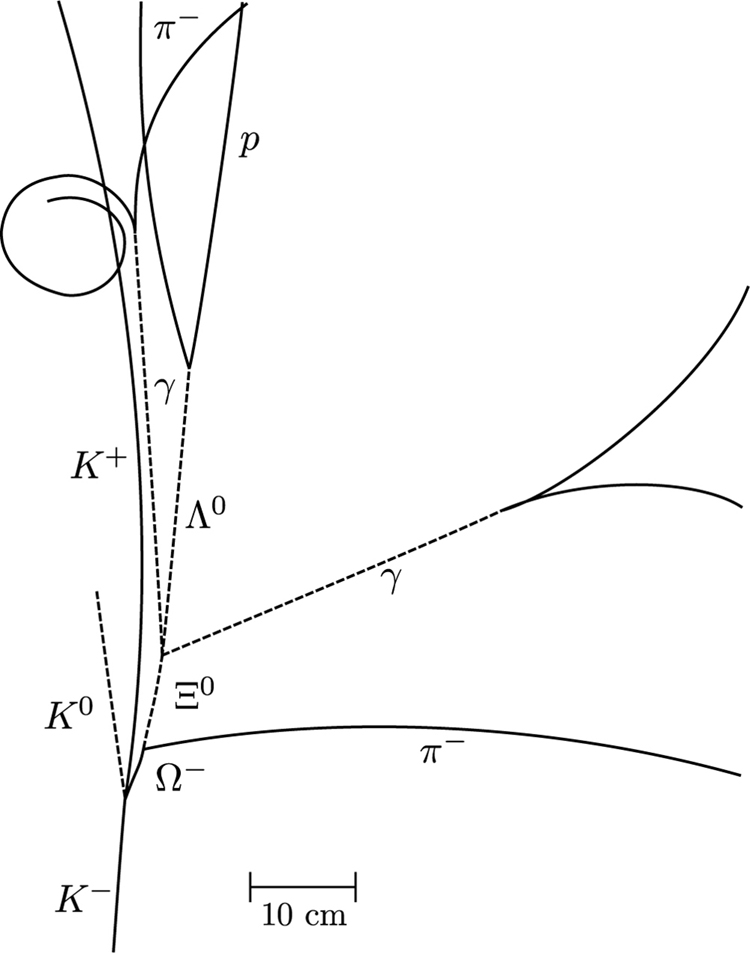
All quark combinations are possible. [Table 2] lists some of these combinations. When Gell-Mann and Zweig proposed the original three quark flavors, particles corresponding to all combinations of those three had not been observed. The pattern was there, but it was incomplete—much as had been the case in the periodic table of the elements and the chart of nuclides. The \({\Omega }^{-}\) particle, in particular, had not been discovered but was predicted by quark theory. Its combination of three strange quarks, \(\text{sss}\) , gives it a strangeness of \(-3\) (see [Table 2]) and other predictable characteristics, such as spin, charge, approximate mass, and lifetime. If the quark picture is complete, the \({\Omega }^{-}\) should exist. It was first observed in 1964 at Brookhaven National Laboratory and had the predicted characteristics as seen in [Figure 2]. The discovery of the \({\Omega }^{-}\) was convincing indirect evidence for the existence of the three original quark flavors and boosted theoretical and experimental efforts to further explore particle physics in terms of quarks.
Patterns in the properties of atoms allowed the periodic table to be developed. From it, previously unknown elements were predicted and observed. Similarly, patterns were observed in the properties of nuclei, leading to the chart of nuclides and successful predictions of previously unknown nuclides. Now with particle physics, patterns imply a quark substructure that, if taken literally, predicts previously unknown particles. These have now been observed in another triumph of underlying unity.
Verify the quantum numbers given for the \({\text{Ξ} }^{0}\) particle in [Table 2] by adding the quantum numbers for its quark composition as given in [Table 2].
Strategy
The composition of the \({\text{Ξ} }^{0}\) is given as \(\text{uss}\) in [Table 2]. The quantum numbers for the constituent quarks are given in [Table 1]. We will not consider spin, because that is not given for the \({\text{Ξ} }^{0}\) . But we can check on charge and the other quantum numbers given for the quarks.
Solution
The total charge of uss is \(+\left(\frac{2}{3}\right){q}_{e}-\left( \frac{1}{3}\right){q}_{e}-\left(\frac{1}{3}\right){q}_{e}=0\) , which is correct for the \({\text{Ξ} }^{0}\) . The baryon number is \(+\left( \frac{1}{3}\right)+\left(\frac{1}{3}\right)+\left(\frac{1}{3}\right)=1\) , also correct since the \({\text{Ξ}}^{0}\) is a matter baryon and has \(B=1\) , as listed in [Table 2]. Its strangeness is \(S=0-1-1=-2\) , also as expected from [Table 2]. Its charm, bottomness, and topness are 0, as are its lepton family numbers (it is not a lepton).
Discussion
This procedure is similar to what the inventors of the quark hypothesis did when checking to see if their solution to the puzzle of particle patterns was correct. They also checked to see if all combinations were known, thereby predicting the previously unobserved \({\Omega }^{-}\) as the completion of a pattern.
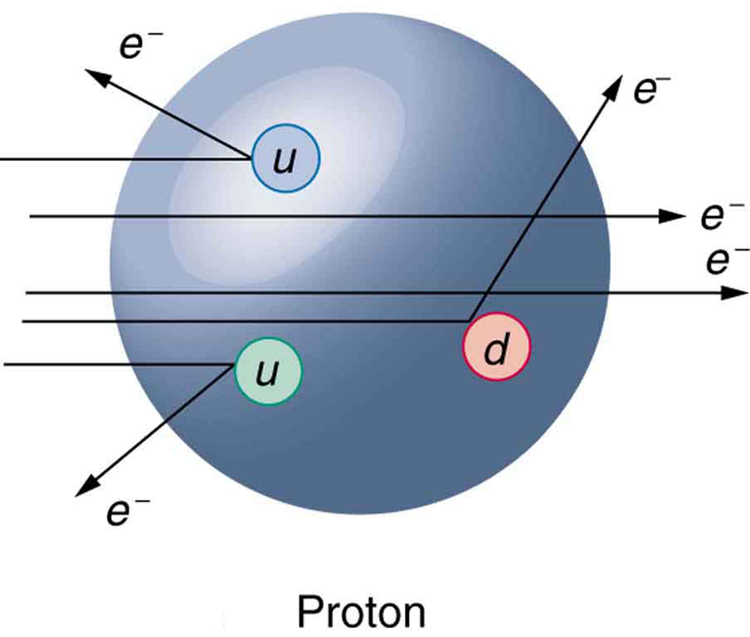
At first, physicists expected that, with sufficient energy, we should be able to free quarks and observe them directly. This has not proved possible. There is still no direct observation of a fractional charge or any isolated quark. When large energies are put into collisions, other particles are created—but no quarks emerge. There is nearly direct evidence for quarks that is quite compelling. By 1967, experiments at SLAC scattering 20-GeV electrons from protons had produced results like Rutherford had obtained for the nucleus nearly 60 years earlier. The SLAC scattering experiments showed unambiguously that there were three pointlike (meaning they had sizes considerably smaller than the probe’s wavelength) charges inside the proton as seen in [Figure 3]. This evidence made all but the most skeptical admit that there was validity to the quark substructure of hadrons.
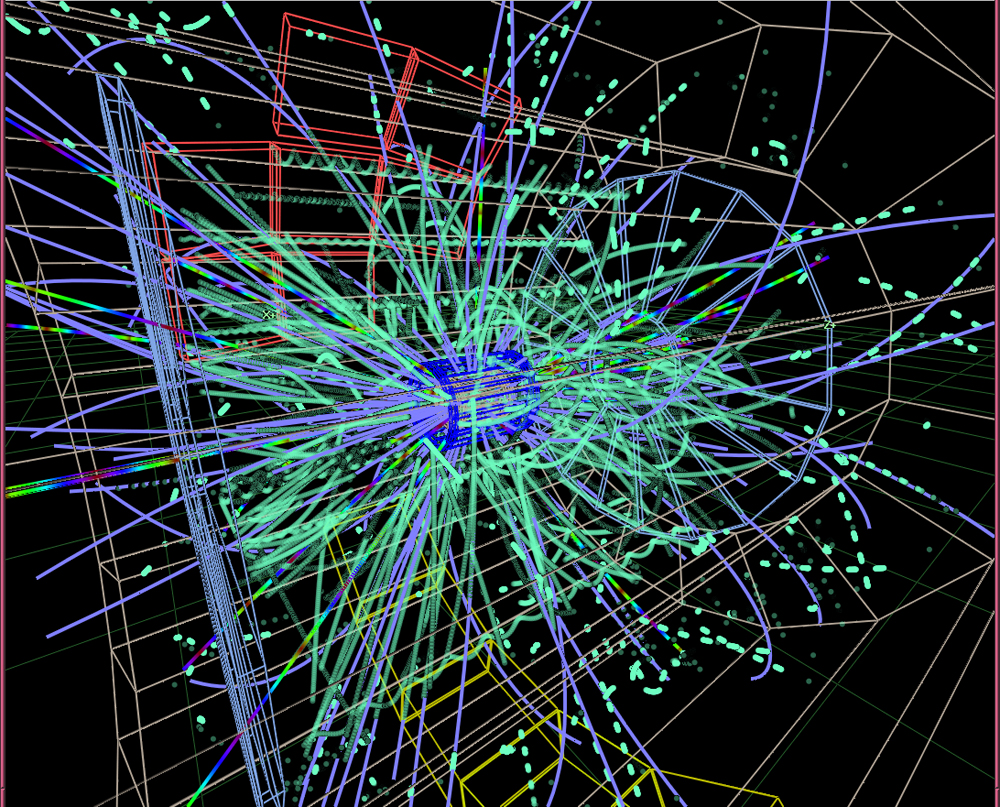
More recent and higher-energy experiments have produced jets of particles in collisions, highly suggestive of three quarks in a nucleon. Since the quarks are very tightly bound, energy put into separating them pulls them only so far apart before it starts being converted into other particles. More energy produces more particles, not a separation of quarks. Conservation of momentum requires that the particles come out in jets along the three paths in which the quarks were being pulled. Note that there are only three jets, and that other characteristics of the particles are consistent with the three-quark substructure.
The quark model actually lost some of its early popularity because the original model with three quarks had to be modified. The up and down quarks seemed to compose normal matter as seen in [Table 2], while the single strange quark explained strangeness. Why didn’t it have a counterpart? A fourth quark flavor called charm (c) was proposed as the counterpart of the strange quark to make things symmetric—there would be two normal quarks (u and d) and two exotic quarks (s and c). Furthermore, at that time only four leptons were known, two normal and two exotic. It was attractive that there would be four quarks and four leptons. The problem was that no known particles contained a charmed quark. Suddenly, in November of 1974, two groups (one headed by C. C. Ting at Brookhaven National Laboratory and the other by Burton Richter at SLAC) independently and nearly simultaneously discovered a new meson with characteristics that made it clear that its substructure is \(c\stackrel{-}{c}\) . It was called J by one group and psi ( \(\psi\) ) by the other and now is known as the \(J/\psi\) meson. Since then, numerous particles have been discovered containing the charmed quark, consistent in every way with the quark model. The discovery of the \(J/\psi\) meson had such a rejuvenating effect on quark theory that it is now called the November Revolution. Ting and Richter shared the 1976 Nobel Prize.
History quickly repeated itself. In 1975, the tau ( \(\tau\) ) was discovered, and a third family of leptons emerged as seen in [Table 2]). Theorists quickly proposed two more quark flavors called top (t) or truth and bottom (b) or beauty to keep the number of quarks the same as the number of leptons. And in 1976, the upsilon ( \(\Upsilon\) ) meson was discovered and shown to be composed of a bottom and an antibottom quark or \(b\stackrel{-}{b}\) , quite analogous to the \(J/\psi\) being \(c\stackrel{-}{c}\) as seen in [Table 2]. Being a single flavor, these mesons are sometimes called bare charm and bare bottom and reveal the characteristics of their quarks most clearly. Other mesons containing bottom quarks have since been observed. In 1995, two groups at Fermilab confirmed the top quark’s existence, completing the picture of six quarks listed in [Table 1]. Each successive quark discovery—first \(c\) , then \(b\) , and finally \(t\) —has required higher energy because each has higher mass. Quark masses in [Table 1] are only approximately known, because they are not directly observed. They must be inferred from the masses of the particles they combine to form.
As mentioned and shown in [Figure 1], quarks carry another quantum number, which we call color. Of course, it is not the color we sense with visible light, but its properties are analogous to those of three primary and three secondary colors. Specifically, a quark can have one of three color values we call red ( \(R\) ), green ( \(G\) ), and blue ( \(B\) ) in analogy to those primary visible colors. Antiquarks have three values we call antired or cyan \(\left(\stackrel{-}{R}\right)\) , antigreen or magenta \(\left(\stackrel{-}{G}\right)\) , and antiblue or yellow \(\left(\stackrel{-}{B}\right)\) in analogy to those secondary visible colors. The reason for these names is that when certain visual colors are combined, the eye sees white. The analogy of the colors combining to white is used to explain why baryons are made of three quarks, why mesons are a quark and an antiquark, and why we cannot isolate a single quark. The force between the quarks is such that their combined colors produce white. This is illustrated in [Figure 5]. A baryon must have one of each primary color or RGB, which produces white. A meson must have a primary color and its anticolor, also producing white.
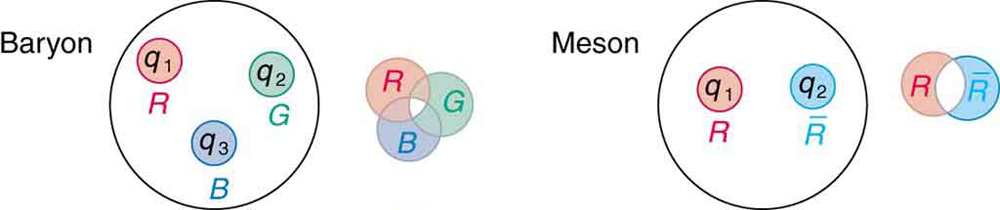
Why must hadrons be white? The color scheme is intentionally devised to explain why baryons have three quarks and mesons have a quark and an antiquark. Quark color is thought to be similar to charge, but with more values. An ion, by analogy, exerts much stronger forces than a neutral molecule. When the color of a combination of quarks is white, it is like a neutral atom. The forces a white particle exerts are like the polarization forces in molecules, but in hadrons these leftovers are the strong nuclear force. When a combination of quarks has color other than white, it exerts extremely large forces—even larger than the strong force—and perhaps cannot be stable or permanently separated. This is part of the theory of quark confinement, which explains how quarks can exist and yet never be isolated or directly observed. Finally, an extra quantum number with three values (like those we assign to color) is necessary for quarks to obey the Pauli exclusion principle. Particles such as the \({\Omega }^{-}\) , which is composed of three strange quarks, \(\text{sss}\) , and the \({\Delta }^{++}\) , which is three up quarks, uuu, can exist because the quarks have different colors and do not have the same quantum numbers. Color is consistent with all observations and is now widely accepted. Quark theory including color is called quantum chromodynamics (QCD), also named by Gell-Mann.
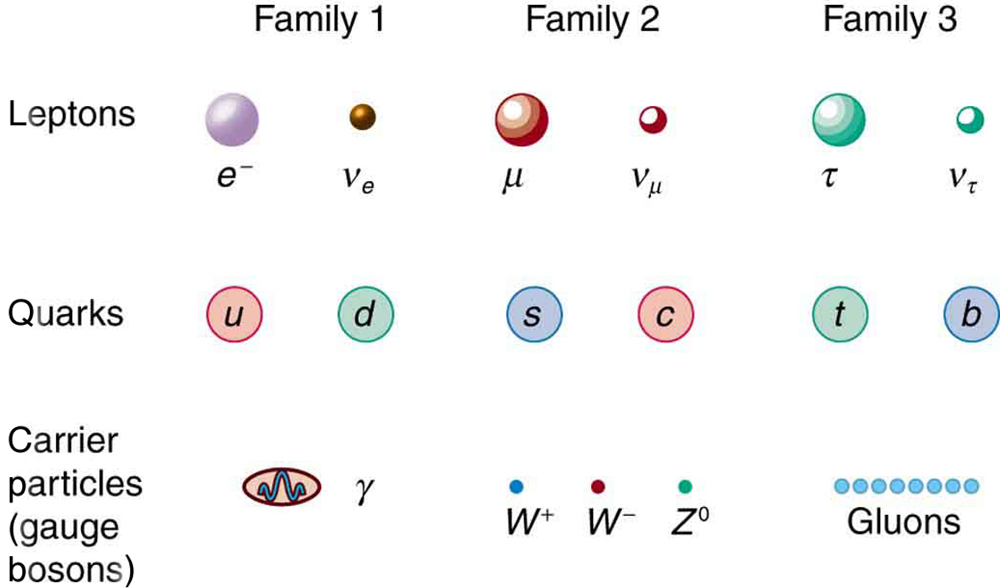
Fundamental particles are thought to be one of three types—leptons, quarks, or carrier particles. Each of those three types is further divided into three analogous families as illustrated in [Figure 5]. We have examined leptons and quarks in some detail. Each has six members (and their six antiparticles) divided into three analogous families. The first family is normal matter, of which most things are composed. The second is exotic, and the third more exotic and more massive than the second. The only stable particles are in the first family, which also has unstable members.
Always searching for symmetry and similarity, physicists have also divided the carrier particles into three families, omitting the graviton. Gravity is special among the four forces in that it affects the space and time in which the other forces exist and is proving most difficult to include in a Theory of Everything or TOE (to stub the pretension of such a theory). Gravity is thus often set apart. It is not certain that there is meaning in the groupings shown in [Figure 6], but the analogies are tempting. In the past, we have been able to make significant advances by looking for analogies and patterns, and this is an example of one under current scrutiny. There are connections between the families of leptons, in that the \(\tau\) decays into the \(\mu\) and the \(\mu\) into the e. Similarly for quarks, the higher families eventually decay into the lowest, leaving only u and d quarks. We have long sought connections between the forces in nature. Since these are carried by particles, we will explore connections between gluons, \({W}^{±}\) and \({Z}^{0}\) , and photons as part of the search for unification of forces discussed in GUTs: The Unification of Forces.
The quark flavor change \(d\to u\) takes place in \({\beta }^{-}\) decay. Does this mean that the reverse quark flavor change \(u\to d\) takes place in \({\beta }^{+}\) decay? Justify your response by writing the decay in terms of the quark constituents, noting that it looks as if a proton is converted into a neutron in \({\beta }^{+}\) decay.
Explain how the weak force can change strangeness by changing quark flavor.
Beta decay is caused by the weak force, as are all reactions in which strangeness changes. Does this imply that the weak force can change quark flavor? Explain.
Why is it easier to see the properties of the c, b, and t quarks in mesons having composition \({W}^{-}\) or \(t\stackrel{-}{t}\) rather than in baryons having a mixture of quarks, such as udb?
How can quarks, which are fermions, combine to form bosons? Why must an even number combine to form a boson? Give one example by stating the quark substructure of a boson.
What evidence is cited to support the contention that the gluon force between quarks is greater than the strong nuclear force between hadrons? How is this related to color? Is it also related to quark confinement?
Discuss how we know that \(\pi \text{-mesons}\) ( \({\pi }^{+},\pi ,{\pi }^{0}\) ) are not fundamental particles and are not the basic carriers of the strong force.
An antibaryon has three antiquarks with colors \(\stackrel{-}{R}\stackrel{-}{G}\stackrel{-}{B}\) . What is its color?
Suppose leptons are created in a reaction. Does this imply the weak force is acting? (for example, consider \(\beta\) decay.)
How can the lifetime of a particle indicate that its decay is caused by the strong nuclear force? How can a change in strangeness imply which force is responsible for a reaction? What does a change in quark flavor imply about the force that is responsible?
(a) Do all particles having strangeness also have at least one strange quark in them?
(b) Do all hadrons with a strange quark also have nonzero strangeness?
The sigma-zero particle decays mostly via the reaction \({\text{Σ}}^{0}\to {\text{Λ}}^{0}+\gamma\) . Explain how this decay and the respective quark compositions imply that the \({\text{Σ}}^{0}\) is an excited state of the \({\text{Λ}}^{0}\).
What do the quark compositions and other quantum numbers imply about the relationships between the \({\Delta }^{+}\) and the proton? The \({\Delta }^{0}\) and the neutron?
Discuss the similarities and differences between the photon and the \({Z}^{0}\) in terms of particle properties, including forces felt.
Identify evidence for electroweak unification.
The quarks in a particle are confined, meaning individual quarks cannot be directly observed. Are gluons confined as well? Explain
(a) Verify from its quark composition that the \({\Delta }^{+}\) particle could be an excited state of the proton.
(b) There is a spread of about 100 MeV in the decay energy of the \({\Delta }^{+}\) , interpreted as uncertainty due to its short lifetime. What is its approximate lifetime?
(c) Does its decay proceed via the strong or weak force?
(a) The \(\text{uud}\) composition is the same as for a proton.
(b) \(3.3 \times 10^{-24} \text{s}\) (c) Strong (short lifetime)
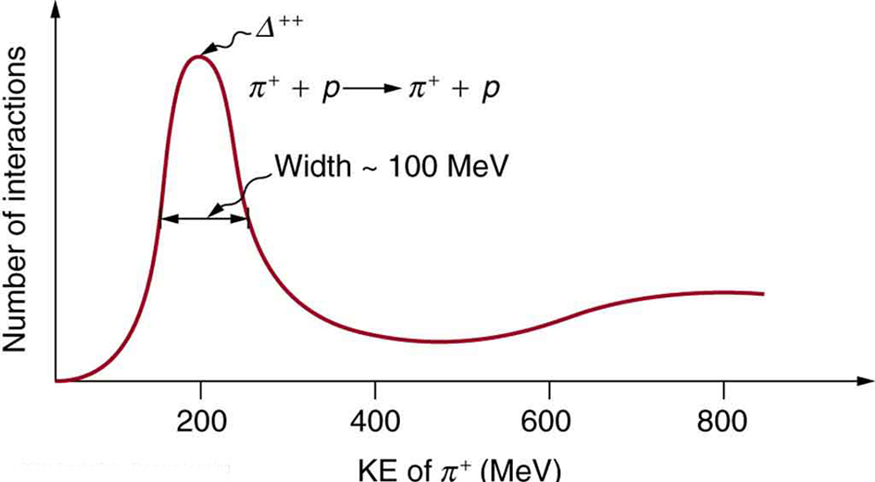
Accelerators such as the Triangle Universities Meson Facility (TRIUMF) in British Columbia produce secondary beams of pions by having an intense primary proton beam strike a target. Such “meson factories” have been used for many years to study the interaction of pions with nuclei and, hence, the strong nuclear force. One reaction that occurs is \({\pi }^{+}+p\to {\Delta }^{++}\to {\pi }^{+}+p\) , where the \({\Delta }^{++}\) is a very short-lived particle. The graph in [Figure 6] shows the probability of this reaction as a function of energy. The width of the bump is the uncertainty in energy due to the short lifetime of the \({\Delta }^{++}\).
(a) Find this lifetime.
(b) Verify from the quark composition of the particles that this reaction annihilates and then re-creates a d quark and a \(\stackrel{-}{d}\) antiquark by writing the reaction and decay in terms of quarks.
(c) Draw a Feynman diagram of the production and decay of the \({\Delta }^{++}\) showing the individual quarks involved.
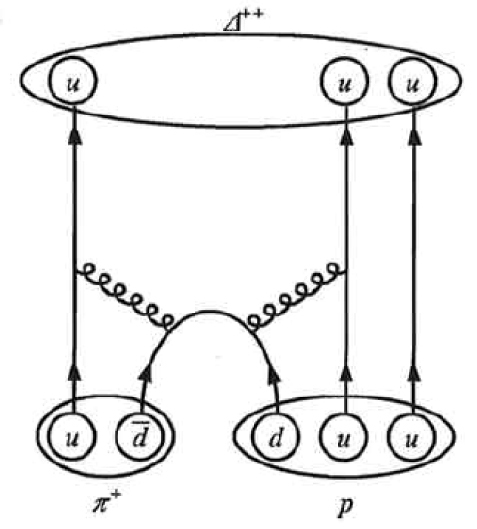
The reaction \({\pi }^{+}+p\to {\Delta }^{++}\) (described in the preceding problem) takes place via the strong force. (a) What is the baryon number of the \({\Delta }^{++}\) particle?
(b) Draw a Feynman diagram of the reaction showing the individual quarks involved.
a) \({\Delta }^{++}\left(\text{uuu}\right); B=\frac{1}{3}+\frac{1}{3}+\frac{1}{3}=1\) b)
One of the decay modes of the omega minus is \({\Omega }^{-}\to {\text{Ξ}}^{0}+{\pi }^{-}\).
(a) What is the change in strangeness?
(b) Verify that baryon number and charge are conserved, while lepton numbers are unaffected.
(c) Write the equation in terms of the constituent quarks, indicating that the weak force is responsible.
Strategy
We’ll use the quantum numbers from the particle tables and quark compositions. From [Table 2], \({\Omega}^{-}\) has \(S = -3\), \({\Xi}^{0}\) has \(S = -2\), and \({\pi}^{-}\) has \(S = 0\). The quark compositions are: \({\Omega}^{-}\) is sss, \({\Xi}^{0}\) is uss, and \({\pi}^{-}\) is \(\overline{u}d\).
Solution
(a) The change in strangeness is:
(b) Baryon number:
Charge:
Lepton numbers:
(c) In terms of quark constituents:
This can be rewritten to show the quark flavor change:
The weak force is responsible because strangeness changes by 1, indicating a quark flavor change from strange to up and down quarks.
Discussion
This decay clearly demonstrates the weak force at work. The change in strangeness (\(\Delta S = +1\)) is a signature of the weak interaction—neither the strong nor electromagnetic forces can change strangeness. At the quark level, one of the three strange quarks in the \({\Omega}^{-}\) transforms into an up quark (creating the \({\Xi}^{0}\)), while simultaneously creating an up-antiup quark-antiquark pair along with a down quark (forming the \({\pi}^{-}\)). The relatively long lifetime of the \({\Omega}^{-}\) (\(0.82 \times 10^{-10}\) s) is also consistent with weak decay, being many orders of magnitude longer than strong force decays (typically \(10^{-23}\) to \(10^{-16}\) s). This decay mode occurs about 68% of the time, making it one of the dominant decay channels for the omega minus.
Repeat the previous problem for the decay mode \({\Omega }^{-}\to {\text{Λ}}^{0}+{K}^{-}.\)
(a) \(+1\) (b) \(B=1=1+0, Z=0+\left(-1\right)\) , all lepton numbers are 0 before and after
(c) \(\left(\text{sss}\right)\to \left(\text{uds}\right)+\left(\stackrel{-}{u}s\right)\)
One decay mode for the eta-zero meson is \({\eta }^{0}\to \gamma +\mathrm{\gamma .}\) (a) Find the energy released.
(b) What is the uncertainty in the energy due to the short lifetime?
(c) Write the decay in terms of the constituent quarks.
(d) Verify that baryon number, lepton numbers, and charge are conserved.
Strategy
From [Table 1], the \({\eta}^{0}\) has mass 547.9 MeV/\(c^2\) and lifetime \(2.53 \times 10^{-19}\) s. The photons are massless. For part (b), we’ll use the Heisenberg uncertainty principle.
Solution
(a) Since the \({\eta}^{0}\) decays completely into two photons, all its rest mass energy is released:
Each photon carries half the energy (by momentum conservation, since the \({\eta}^{0}\) is at rest):
(b) Using the Heisenberg uncertainty principle:
Converting to eV:
(c) From [Table 2], the \({\eta}^{0}\) is a mixture of \(u\overline{u}\) and \(d\overline{d}\). The decay in terms of quarks is:
The quark-antiquark pairs annihilate to produce the two photons.
(d) Conservation checks:
Discussion
This two-photon decay is characteristic of the \({\eta}^{0}\) being its own antiparticle. The particle-antiparticle pair (quark and antiquark) annihilate completely, converting all the rest mass into electromagnetic energy. The energy uncertainty of 1.31 keV is tiny compared to the total energy of 547.9 MeV (about 0.0002%), showing that the short lifetime introduces only a small uncertainty in the energy. This decay proceeds via the electromagnetic force, as evidenced by the photon production and the relatively short (but not extremely short) lifetime of \(2.53 \times 10^{-19}\) s. Compare this to \({\pi}^{0} \to \gamma + \gamma\) with an even shorter lifetime of \(8.4 \times 10^{-17}\) s—both are electromagnetic decays of neutral mesons that are their own antiparticles.
One decay mode for the eta-zero meson is \({\eta }^{0}\to {\pi }^{0}+{\pi }^{0}\).
(a) Write the decay in terms of the quark constituents.
(b) How much energy is released?
(c) What is the ultimate release of energy, given the decay mode for the pi zero is \({\pi }^{0}\to \gamma +\gamma\) ?
(a) \(\left(u\stackrel{-}{u}+d\overline{d}\right)\to \left(u\stackrel{-}{u}+d\overline{d}\right)+\left(u\stackrel{-}{u}+d\overline{d}\right)\) (b) 277.9 MeV
(c) 547.9 MeV
Is the decay \(n\to {e}^{+}+{e}^{-}\) possible considering the appropriate conservation laws? State why or why not.
Strategy
We need to check all relevant conservation laws: charge, baryon number, lepton family numbers, and energy.
Solution
No, this decay is not possible. It violates multiple conservation laws:
Charge conservation:
Baryon number conservation:
Electron family number (\(L_e\)):
Discussion
This decay violates baryon number conservation, which is one of the most fundamental conservation laws in particle physics. Baryon number has never been observed to be violated in any experiment. The neutron is a baryon (\(B = +1\)), and this quantum number must be preserved in any decay. Electrons and positrons are leptons (\(B = 0\)), so the final state has zero baryon number. This means a baryon would simply disappear, which is forbidden.
The actual decay mode of a free neutron is \(n \to p + e^{-} + \overline{\nu}_e\), which conserves baryon number (both neutron and proton have \(B = +1\)). Grand Unified Theories (GUTs) do predict extremely rare baryon number violation in processes like proton decay (\(p \to \pi^{0} + e^{+}\)), but with lifetimes exceeding \(10^{31}\) years—far longer than the age of the universe. No such violation has ever been observed experimentally. The conservation of baryon number is why the total number of nucleons (protons plus neutrons) remains constant in nuclear reactions, a fact that was discovered long before the concept of baryon number was formulated.
Is the decay \({\mu }^{-}\to {e}^{-}+{\nu }_{e}+{\nu }_{\mu }\) possible considering the appropriate conservation laws? State why or why not.
No. \(\text{Charge}=-1\) is conserved. \({L}_{ {e}_{\text{i}}}=0\ne {L}_{ {e}_{\text{f}}}=2\) is not conserved. \({L}_{\mu }=1\) is conserved.
(a) Is the decay \({\text{Λ}}^{0}\to n+{\pi }^{0}\) possible considering the appropriate conservation laws? State why or why not.
(b) Write the decay in terms of the quark constituents of the particles.
Strategy
We’ll check all relevant conservation laws and examine the quark compositions. From the tables: \({\Lambda}^{0}\) is uds, neutron n is udd, and \({\pi}^{0}\) is \(u\overline{u} + d\overline{d}\).
Solution
(a) Yes, this decay is possible. Let’s verify all conservation laws:
Charge:
Baryon number:
Strangeness:
Lepton numbers:
Energy:
(b) In terms of quark constituents:
This shows that the strange quark changes to a down quark, consistent with the weak force: \(s \to d\).
Discussion
This decay is allowed and does occur in nature, proceeding via the weak force. The key signature is the change in strangeness (\(\Delta S = +1\)), which can only occur through weak interactions. The quark-level process involves the strange quark transforming into a down quark via emission of a \(W^{+}\) boson (the carrier of the weak force), which then creates quark-antiquark pairs that form the \({\pi}^{0}\). The relatively long lifetime of the \({\Lambda}^{0}\) (\(2.63 \times 10^{-10}\) s) is characteristic of weak decay—much longer than strong force decays but shorter than typical beta decay. This is actually one of the dominant decay modes of the \({\Lambda}^{0}\), occurring about 36% of the time. The energy release of 41.1 MeV is shared between the kinetic energies of the neutron and pion.
(a) Is the decay \({\text{Σ}}^{-}\to n+{\pi }^{-}\) possible considering the appropriate conservation laws? State why or why not. (b) Write the decay in terms of the quark constituents of the particles.
(a)Yes. \(Z=-1=0+\left(-1\right)\) , \(B=1=1+0\) , all lepton family numbers are 0 before and after, spontaneous since mass greater before reaction.
(b) \(\text{dds}\to \text{udd}+\stackrel{-}{u}d\)
The only combination of quark colors that produces a white baryon is RGB. Identify all the color combinations that can produce a white meson.
Strategy
Mesons consist of a quark-antiquark pair. For a meson to be “white” (color neutral), the antiquark must carry the anticolor of the quark’s color. This is analogous to how a color and its complement make white in the RGB color model.
Solution
The color combinations that produce a white meson are:
Discussion
In quantum chromodynamics (QCD), color charge works differently than regular electric charge. While baryons require all three colors (RGB) to be colorless (white), mesons achieve color neutrality through color-anticolor pairs. This is similar to how a particle and its antiparticle have opposite charges that cancel. The three combinations listed above are the only ways to make a colorless meson.
It’s important to note that “color” in QCD is just a label for a type of charge—quarks don’t actually have visible color. The terminology comes from the mathematical similarity to how red, green, and blue light combine to make white light. Just as RGB combine to white, the three color charges in a baryon combine to be colorless. And just as red light plus “anti-red” (cyan) makes white, a red quark plus an antired antiquark makes a colorless meson.
This color neutrality requirement is fundamental to quark confinement—all observable hadrons must be color neutral (“white”). Individual colored quarks or gluons cannot exist in isolation, which is why we never observe free quarks despite their being the fundamental constituents of matter. Any meson in nature will be in one of these three color states (though quantum mechanically, it’s actually a superposition of all three), ensuring it remains colorless and observable.
(a) Three quarks form a baryon. How many combinations of the six known quarks are there if all combinations are possible?
(b) This number is less than the number of known baryons. Explain why.
(a) 216
(b) There are more baryons observed because we have the 6 antiquarks and various mixtures of quarks (as for the π-meson) as well.
(a) Show that the conjectured decay of the proton, \(p\to {\pi }^{0}+{e}^{+}\) , violates conservation of baryon number and conservation of lepton number.
(b) What is the analogous decay process for the antiproton?
Strategy
We’ll check baryon number and lepton family number conservation for this conjectured decay predicted by Grand Unified Theories (GUTs).
Solution
(a) Baryon number violation:
Electron family number violation:
Note that charge IS conserved: \(Q = +1\) before and \(Q = 0 + 1 = +1\) after.
(b) For the antiproton, the analogous decay would be:
In this case:
Discussion
This hypothetical proton decay is forbidden by the conservation laws that have been observed to hold in all experiments to date. However, Grand Unified Theories predict that baryon and lepton number conservation are not absolute at extremely high energies where the forces unify. GUTs predict proton lifetimes of about \(10^{31}\) years or longer—far exceeding the age of the universe (\(\sim 10^{10}\) years).
Extensive experiments have searched for proton decay using huge tanks of water instrumented with detectors. Despite monitoring trillions of protons for years, no confirmed proton decay has been observed, placing the experimental lower limit on the proton lifetime at greater than \(5 \times 10^{32}\) years. This doesn’t disprove GUTs but does constrain their parameters.
If protons could decay rapidly, all matter would be unstable—atoms would disintegrate, and the universe as we know it couldn’t exist. The extraordinary stability of the proton (and hence all atomic nuclei) is one of the most important facts about our universe. The search for proton decay continues, as observing it would be revolutionary evidence for grand unification and would fundamentally change our understanding of matter’s ultimate fate.
Verify the quantum numbers given for the \({\Omega }^{+}\) in [Table 2] by adding the quantum numbers for its quark constituents as inferred from [Table 2].
\(\begin{array}{l}{\Omega }^{+}\left(\stackrel{-}{s}\stackrel{-}{s}\stackrel{-}{s}\right)\\ B=-\frac{1}{3}-\frac{1}{3}-\frac{1}{3}=-1,\\ {L}_{e}, \mu , \tau =0+0+0=0,\\ Q=\frac{1}{3}+\frac{1}{3}+\frac{1}{3}=1,\\ S=1+1+1=3 \text{.}\end{array}\)
Verify the quantum numbers given for the proton and neutron in [Table 2] by adding the quantum numbers for their quark constituents as given in [Table 2].
Strategy
We’ll add the quantum numbers (charge \(Q\), baryon number \(B\), and strangeness \(S\)) for the constituent quarks of the proton (uud) and neutron (udd), using values from [Table 1] in this section.
Solution
Proton (p = uud):
From [Table 1], for each quark:
For the proton (two up quarks, one down quark):
Lepton numbers: \(L_e = L_{\mu} = L_{\tau} = 0\) (quarks are not leptons)
These match the values in the particle tables: \(Q = +1\), \(B = +1\), \(S = 0\) ✓
Neutron (n = udd):
For the neutron (one up quark, two down quarks):
Lepton numbers: \(L_e = L_{\mu} = L_{\tau} = 0\)
These match the values in the particle tables: \(Q = 0\), \(B = +1\), \(S = 0\) ✓
Discussion
This verification demonstrates the power of the quark model. The quantum numbers of composite particles (hadrons) are simply the sums of their constituent quark quantum numbers. The fractional charges of quarks (\(\pm\frac{2}{3}q_e\) and \(\mp\frac{1}{3}q_e\)) combine to give integral charges for all observable particles—this was initially a radical proposal by Gell-Mann and Zweig, but it has been completely vindicated by experiment.
The difference between a proton and neutron is simply one quark: swapping one up quark for a down quark changes the charge from +1 to 0, converting a proton into a neutron. This is exactly what happens in beta-minus decay at the quark level: \(d \to u + e^{-} + \overline{\nu}_e\). The fact that both have \(B = +1\) explains why baryon number is conserved in nuclear reactions—at the quark level, the number of quarks minus antiquarks remains constant. This beautifully explains the empirical observation that the total number of nucleons is conserved in nuclear reactions and decays.
(a) How much energy would be released if the proton did decay via the conjectured reaction \(p\to {\pi }^{0}+{e}^{+}\) ?
(b) Given that the \({\pi }^{0}\) decays to two \(\gamma\) s and that the \({e}^{+}\) will find an electron to annihilate, what total energy is ultimately produced in proton decay?
(c) Why is this energy greater than the proton’s total mass (converted to energy)?
(a)803 MeV
(b) 938.8 MeV
(c) The annihilation energy of an extra electron is included in the total energy.
(a) Find the charge, baryon number, strangeness, charm, and bottomness of the \(J/\Psi\) particle from its quark composition.
(b) Do the same for the \(\Upsilon\) particle.
Strategy
From [Table 2], the \(J/\Psi\) has quark composition \(c\overline{c}\) (charm-anticharm) and the \(\Upsilon\) has composition \(b\overline{b}\) (bottom-antibottom). We’ll add the quantum numbers from [Table 1].
Solution
(a) \(J/\Psi\) particle (\(c\overline{c}\)):
From [Table 1]:
For \(J/\Psi\):
(b) \(\Upsilon\) particle (\(b\overline{b}\)):
From [Table 1]:
For \(\Upsilon\):
Discussion
Both the \(J/\Psi\) and \(\Upsilon\) are examples of hidden flavor mesons—they contain a heavy quark and its own antiquark, so the net flavor quantum number is zero. Despite being made of charmed quarks, the \(J/\Psi\) has zero net charm; similarly, the \(\Upsilon\) has zero net bottomness.
These particles are particularly important in particle physics history. The \(J/\Psi\) (discovered independently by two teams in 1974, hence the double name) was the first particle containing charm quarks to be discovered, providing crucial evidence for the quark model and specifically for the existence of the charm quark. Its discovery is known as the “November Revolution” in particle physics and led to Nobel Prizes for Burton Richter and Samuel Ting in 1976.
The \(\Upsilon\) (discovered in 1977) similarly provided the first evidence for the existence of the bottom quark. Both particles are relatively long-lived for their masses because their decay requires the annihilation of the heavy quark-antiquark pair or a flavor-changing weak interaction. These particles and their excited states have been extensively studied and provide a testing ground for quantum chromodynamics (QCD), analogous to how hydrogen atom spectroscopy tested quantum electrodynamics (QED).
There are particles called D-mesons. One of them is the \({D}^{+}\) meson, which has a single positive charge and a baryon number of zero, also the value of its strangeness, topness, and bottomness. It has a charm of \(+1.\) What is its quark configuration?
\(c\overline{d}\)
There are particles called bottom mesons or B-mesons. One of them is the \({B}^{-}\) meson, which has a single negative charge; its baryon number is zero, as are its strangeness, charm, and topness. It has a bottomness of \(-1\) . What is its quark configuration?
Strategy
We need to find a quark-antiquark combination (since it’s a meson with \(B = 0\)) that gives \(Q = -1\), \(S = 0\), \(c = 0\), \(t = 0\), and \(b = -1\). From [Table 1], the bottom quark has \(b = -1\).
Solution
Since the \({B}^{-}\) has bottomness \(b = -1\), it must contain one bottom quark. From [Table 1], the bottom quark has:
To make a meson with total charge \(Q = -1\), we need an antiquark with charge \(-\frac{2}{3}q_e\). The only antiquark with this charge is the anti-up quark (\(\overline{u}\)), which has:
The quark configuration is:
Verification:
Discussion
The \({B}^{-}\) meson consists of a bottom quark and an anti-up antiquark. This is an example of an “open flavor” meson, where the heavy quark (bottom) is paired with a light antiquark rather than with its own antiparticle. Unlike the \(\Upsilon\) particle (\(b\overline{b}\)) which has hidden bottom, the \({B}^{-}\) has explicit bottomness of -1.
B-mesons are particularly important in modern particle physics research. They are produced copiously in particle colliders and are extensively studied in dedicated “B-factory” experiments like BaBar and Belle. These experiments have made precise measurements of CP violation (matter-antimatter asymmetry) in B-meson decays, helping to explain why our universe contains more matter than antimatter. The 2008 Nobel Prize in Physics was awarded to Kobayashi and Maskawa for their work predicting CP violation in systems with three or more generations of quarks, which was confirmed through B-meson studies.
The \({B}^{-}\) meson has a relatively long lifetime for a particle containing a heavy quark (about \(1.6 \times 10^{-12}\) s) because its decay requires a flavor-changing weak interaction where the bottom quark transforms into a charm or up quark. This long lifetime allows B-mesons to travel measurable distances before decaying, enabling detailed study of their decay properties.
(a) What particle has the quark composition \(\stackrel{-}{u}\stackrel{-}{u}\stackrel{-}{d}\) ?
(b) What should its decay mode be?
a)The antiproton
b) \(\stackrel{-}{p}\to {\pi }^{0}+{e}^{-}\)
(a) Show that all combinations of three quarks produce integral charges. Thus baryons must have integral charge.
(b) Show that all combinations of a quark and an antiquark produce only integral charges. Thus mesons must have integral charge.
Strategy
Quarks have charges of \(+\frac{2}{3}q_e\) (up-type: u, c, t) or \(-\frac{1}{3}q_e\) (down-type: d, s, b). Antiquarks have opposite charges. We’ll show that all possible combinations yield integral multiples of \(q_e\).
Solution
(a) Baryons (three quarks):
For three quarks, we can have different combinations of up-type (\(Q = +\frac{2}{3}\)) and down-type (\(Q = -\frac{1}{3}\)) quarks:
Case 1: Three up-type quarks
Example: \(\Delta^{++}\) = uuu has charge +2 ✓
Case 2: Two up-type, one down-type
Example: proton = uud has charge +1 ✓
Case 3: One up-type, two down-type
Example: neutron = udd has charge 0 ✓
Case 4: Three down-type quarks
Example: \(\Omega^{-}\) = sss has charge -1 ✓
All combinations give integral charges: +2, +1, 0, or -1.
(b) Mesons (quark-antiquark pair):
Antiquarks have charges \(-\frac{2}{3}q_e\) (anti-up-type) or \(+\frac{1}{3}q_e\) (anti-down-type).
Case 1: Up-type quark + anti-up-type antiquark
Example: \(J/\Psi = c\overline{c}\) has charge 0 ✓
Case 2: Up-type quark + anti-down-type antiquark
Example: \(\pi^{+} = u\overline{d}\) has charge +1 ✓
Case 3: Down-type quark + anti-up-type antiquark
Example: \(\pi^{-} = \overline{u}d\) has charge -1 ✓
Case 4: Down-type quark + anti-down-type antiquark
Example: \(\pi^{0} = d\overline{d}\) (partial composition) has charge 0 ✓
All combinations give integral charges: +1, 0, or -1.
Discussion
This elegant result shows that despite quarks having fractional electric charges (\(\pm\frac{1}{3}q_e\) and \(\pm\frac{2}{3}q_e\)), all observable composite particles—baryons and mesons—must have integral charges. This is a consequence of:
The fact that we only observe integral charges in nature was originally one of the objections to the quark model when it was first proposed. How could particles with fractional charges combine to make only integral charges? The answer is that fractional charges are confined—free quarks cannot exist in isolation. The combinations that CAN exist (three quarks or quark-antiquark) automatically produce integral charges.
This also explains why we’ve never observed a particle with charge \(+\frac{1}{3}q_e\) or \(+\frac{2}{3}q_e\)—such charges would require an isolated quark, which is forbidden by confinement. The elementary charge \(q_e\) remains the smallest observed unit of charge, even though quarks have smaller fractional charges. This beautiful consistency of the quark model with observed phenomena is one of many pieces of evidence supporting it.