
There is more to motion than distance and displacement. Questions such as, “How long does a foot race take?” and “What was the runner’s speed?” cannot be answered without an understanding of other concepts. In this section we add definitions of time, velocity, and speed to expand our description of motion.
As discussed in Physical Quantities and Units , the most fundamental physical quantities are defined by how they are measured. This is the case with time. Every measurement of time involves measuring a change in some physical quantity. It may be a number on a digital clock, a heartbeat, or the position of the Sun in the sky. In physics, the definition of time is simple—time is change, or the interval over which change occurs. It is impossible to know that time has passed unless something changes.
The amount of time or change is calibrated by comparison with a standard. The SI unit for time is the second, abbreviated s. We might, for example, observe that a certain pendulum makes one full swing every 0.75 s. We could then use the pendulum to measure time by counting its swings or, of course, by connecting the pendulum to a clock mechanism that registers time on a dial. This allows us to not only measure the amount of time, but also to determine a sequence of events.
How does time relate to motion? We are usually interested in elapsed time for a particular motion, such as how long it takes an airplane passenger to get from his seat to the back of the plane. To find elapsed time, we note the time at the beginning and end of the motion and subtract the two. For example, a lecture may start at 11:00 A.M. and end at 11:50 A.M., so that the elapsed time would be 50 min. Elapsed time $\Delta t$ is the difference between the ending time and beginning time,
where $\Delta t$ is the change in time or elapsed time, $t_{f}$ is the time at the end of the motion, and $t_{0}$ is the time at the beginning of the motion. (As usual, the delta symbol, $\Delta$, means the change in the quantity that follows it.)
Life is simpler if the beginning time $t_{0}$ is taken to be zero, as when we use a stopwatch. If we were using a stopwatch, it would simply read zero at the start of the lecture and 50 min at the end. If $t_{0}=0$, then $\Delta t=t_{f}\equiv t$.
In this text, for simplicity’s sake,
Your notion of velocity is probably the same as its scientific definition. You know that if you have a large displacement in a small amount of time you have a large velocity, and that velocity has units of distance divided by time, such as miles per hour or kilometers per hour.
Average velocity is displacement (change in position) divided by the time of travel,
where $\overline{v}$ is the average (indicated by the bar over the $v$) velocity, $\Delta x$ is the change in position (or displacement), and $x_{f}$ and $x_{0}$ are the final and beginning positions at times $t_{f}$ and $t_{0}$, respectively. If the starting time $t_{0}$ is taken to be zero, then the average velocity is simply
Notice that this definition indicates that velocity is a vector because displacement is a vector. It has both magnitude and direction. The SI unit for velocity is meters per second or m/s, but many other units, such as km/h, mi/h ( also written as mph), and cm/s, are in common use. Suppose, for example, an airplane passenger took 5 seconds to move −4 m (the negative sign indicates that displacement is toward the back of the plane). His average velocity would be
The minus sign indicates the average velocity is also toward the rear of the plane.
The average velocity of an object does not tell us anything about what happens to it between the starting point and ending point, however. For example, we cannot tell from average velocity whether the airplane passenger stops momentarily or backs up before he goes to the back of the plane. To get more details, we must consider smaller segments of the trip over smaller time intervals.
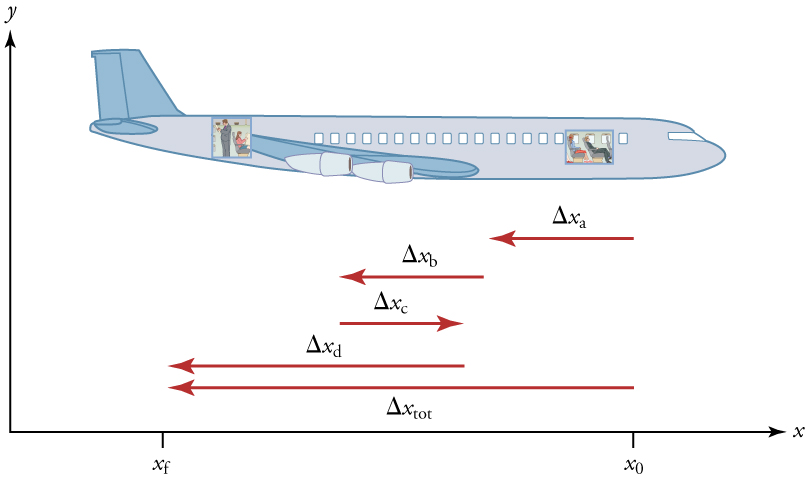
The smaller the time intervals considered in a motion, the more detailed the information. When we carry this process to its logical conclusion, we are left with an infinitesimally small interval. Over such an interval, the average velocity becomes the instantaneous velocity or the velocity at a specific instant. A car’s speedometer, for example, shows the magnitude (but not the direction) of the instantaneous velocity of the car. (Police give tickets based on instantaneous velocity, but when calculating how long it will take to get from one place to another on a road trip, you need to use average velocity.) Instantaneous velocity $v$ is the average velocity at a specific instant in time (or over an infinitesimally small time interval).
Mathematically, finding instantaneous velocity, $v$, at a precise instant $t$ can involve taking a limit, a calculus operation beyond the scope of this text. However, under many circumstances, we can find precise values for instantaneous velocity without calculus.
In everyday language, most people use the terms “speed” and “velocity” interchangeably. In physics, however, they do not have the same meaning and they are distinct concepts. One major difference is that speed has no direction. Thus speed is a scalar. Just as we need to distinguish between instantaneous velocity and average velocity, we also need to distinguish between instantaneous speed and average speed.
Instantaneous speed is the magnitude of instantaneous velocity. For example, suppose the airplane passenger at one instant had an instantaneous velocity of −3.0 m/s (the minus meaning toward the rear of the plane). At that same time his instantaneous speed was 3.0 m/s. Or suppose that at one time during a shopping trip your instantaneous velocity is 40 km/h due north. Your instantaneous speed at that instant would be 40 km/h—the same magnitude but without a direction. Average speed, however, is very different from average velocity. Average speed is the distance traveled divided by elapsed time.
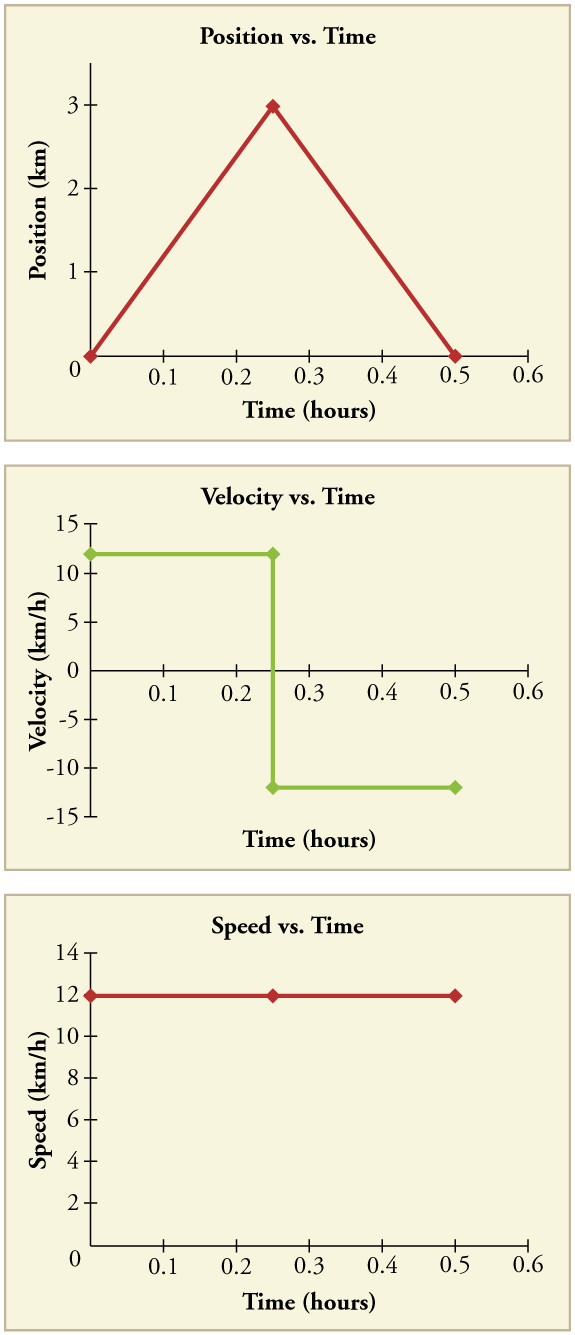
We have noted that distance traveled can be greater than displacement. So average speed can be greater than average velocity, which is displacement divided by time. For example, if you drive to a store and return home in half an hour, and your car’s odometer shows the total distance traveled was 6 km, then your average speed was 12 km/h. Your average velocity, however, was zero, because your displacement for the round trip is zero. (Displacement is change in position and, thus, is zero for a round trip.) Thus average speed is not simply the magnitude of average velocity.
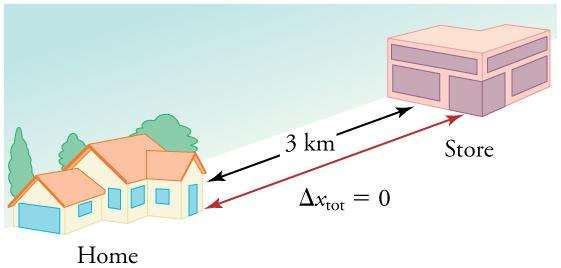
Another way of visualizing the motion of an object is to use a graph. A plot of position or of velocity as a function of time can be very useful. For example, for this trip to the store, the position, velocity, and speed-vs.-time graphs are displayed in Figure 4. (Note that these graphs depict a very simplified model of the trip. We are assuming that speed is constant during the trip, which is unrealistic given that we’ll probably stop at the store. But for simplicity’s sake, we will model it with no stops or changes in speed. We are also assuming that the route between the store and the house is a perfectly straight line.)
If you have spent much time driving, you probably have a good sense of speeds between about 10 and 70 miles per hour. But what are these in meters per second? What do we mean when we say that something is moving at 10 m/s? To get a better sense of what these values really mean, do some observations and calculations on your own:
A commuter train travels from Baltimore to Washington, DC, and back in 1 hour and 45 minutes. The distance between the two stations is approximately 40 miles. What is (a) the average velocity of the train, and (b) the average speed of the train in m/s?
(a) The average velocity of the train is zero because $x_{f}=x_{0}$; the train ends up at the same place it starts.
(b) The average speed of the train is calculated below. Note that the train travels 40 miles one way and 40 miles back, for a total distance of 80 miles.
where $t_{f}$ is the final time and $t_{0}$ is the initial time. The initial time is often taken to be zero, as if measured with a stopwatch; the elapsed time is then just $t$.
Give an example (but not one from the text) of a device used to measure time and identify what change in that device indicates a change in time.
There is a distinction between average speed and the magnitude of average velocity. Give an example that illustrates the difference between these two quantities.
Does a car’s odometer measure distance or displacement? Does its speedometer measure speed or velocity?
If you divide the total distance traveled on a car trip (as determined by the odometer) by the time for the trip, are you calculating the average speed or the magnitude of the average velocity? Under what circumstances are these two quantities the same?
How are instantaneous velocity and instantaneous speed related to one another? How do they differ?
(a) Calculate Earth’s average speed relative to the Sun. (b) What is its average velocity over a period of one year?
Strategy
For average speed, use distance traveled divided by time. For average velocity, use displacement divided by time.
Solution
(a) Earth’s average speed:
Earth’s orbital radius is approximately $1.5 \times 10^{11} \m$ (distance from Earth to Sun).
Calculate the circumference of Earth’s orbit:
(b) Average velocity over one year:
After one complete orbit, Earth returns to its starting position, so the displacement is zero:
Discussion
This problem illustrates the fundamental difference between speed and velocity. Earth travels an enormous distance (9.42 × 10¹¹ m) in one year, moving at approximately 30 km/s relative to the Sun—faster than any human-made vehicle. Yet its average velocity over a complete orbit is zero because it returns to its starting position, making the displacement zero.
This distinction is crucial in physics: speed depends only on the distance traveled (a scalar quantity), while velocity depends on displacement (a vector quantity with both magnitude and direction). For any complete orbit or round trip, average velocity is always zero regardless of how fast the object moves, while average speed depends on the total distance covered.
The calculated speed of 30,000 m/s (about 67,000 mph or 108,000 km/h) is consistent with astronomical observations and is typical for planets in our solar system. This high orbital speed is necessary to maintain Earth’s orbit—it represents the balance between Earth’s inertia (which would cause it to move in a straight line) and the Sun’s gravitational pull (which curves its path into an ellipse, very close to circular).
Answer
(a) Earth’s average speed is $3.0\times 10^{4} \ms$ (or 30 km/s).
(b) Earth’s average velocity over one year is 0 m/s.
A helicopter blade spins at exactly 100 revolutions per minute. Its tip is 5.00 m from the center of rotation. (a) Calculate the average speed of the blade tip in the helicopter’s frame of reference. (b) What is its average velocity over one revolution?
Strategy
To find average speed, we need to calculate the total distance traveled by the blade tip and divide by the time taken. For one revolution, the blade tip traces out a circle. Average velocity requires finding displacement, which is zero for a complete revolution.
Solution
Given:
(a) Average speed:
First, convert the rotation rate to revolutions per second:
The distance traveled in one revolution is the circumference of the circle:
The time for one revolution:
Average speed:
(b) Average velocity over one revolution:
After one complete revolution, the blade tip returns to its starting position. Therefore, the displacement is zero:
Average velocity:
Discussion
This problem illustrates the important distinction between speed and velocity. The blade tip is moving at a considerable speed (52.4 m/s), but because it returns to its starting point after each revolution, its average velocity is zero. This makes physical sense: velocity is a vector quantity that depends on displacement, while speed is a scalar that depends only on distance traveled. Circular motion always results in zero average velocity over complete cycles.
Answer
(a) The average speed of the blade tip is 52.4 m/s.
(b) The average velocity over one revolution is 0 m/s.
The North American and European continents are moving apart at a rate of about 3 cm/y. At this rate how long will it take them to drift 500 km farther apart than they are at present?
Strategy
We need to find the time required for a given displacement at constant velocity (rate). Use $t = \frac{\Delta x}{v}$, converting units appropriately.
Solution
Given:
First, convert the displacement to centimeters:
Now calculate the time:
Discussion
This result of approximately 17 million years (or 20 million years when rounded to one significant figure) represents a very long time on human scales, but it’s a reasonable timescale for plate tectonics. The continents are drifting apart due to seafloor spreading at the Mid-Atlantic Ridge, where new oceanic crust is continuously created. This process is part of continental drift, first proposed by Alfred Wegener in 1912 and now explained by the theory of plate tectonics.
For context, the Atlantic Ocean has been widening for about 180 million years, and the continents have drifted thousands of kilometers apart during that time. The rate of 3 cm/year is typical for mid-ocean ridge spreading rates.
Answer
It will take approximately 2 × 10⁷ years (20 million years, or more precisely 17 million years) for the continents to drift 500 km farther apart.
Land west of the San Andreas fault in southern California is moving at an average velocity of about 6 cm/y northwest relative to land east of the fault. Los Angeles is west of the fault and may thus someday be at the same latitude as San Francisco, which is east of the fault. How far in the future will this occur if the displacement to be made is 590 km northwest, assuming the motion remains constant?
Strategy
We need to find the time required for a given displacement at constant velocity. Use the relationship $t = \frac{\Delta x}{v}$, being careful to convert units consistently.
Solution
Given:
First, convert the displacement to centimeters:
Now calculate the time:
Discussion
This result means it will take approximately 9.8 million years for Los Angeles to reach the same latitude as San Francisco, assuming constant motion. This is a reasonable timescale for geological processes. The calculation assumes the velocity remains constant, which is a simplification – actual tectonic motion can vary over such long periods. This problem illustrates how we can apply kinematics principles to very slow geological processes using the same equations we use for everyday motion.
Answer
Los Angeles will be at the same latitude as San Francisco in approximately $9.8 \times 10^{6}$ years (9.8 million years).
On May 26, 1934, a streamlined, stainless steel diesel train called the Zephyr set the world’s nonstop long-distance speed record for trains. Its run from Denver to Chicago took 13 hours, 4 minutes, 58 seconds, and was witnessed by more than a million people along the route. The total distance traveled was 1633.8 km. What was its average speed in km/h and m/s?
Strategy
Average speed is total distance divided by total time. Calculate the time in hours first, then find the average speed in km/h and convert to m/s.
Solution
Given:
Step 1: Convert time to hours
Step 2: Calculate average speed in km/h
Step 3: Convert to m/s
Discussion
The Zephyr’s average speed of nearly 125 km/h (about 78 mph) was remarkable for 1934, especially for a nonstop journey of over 1600 km. This was significantly faster than conventional trains of that era. The streamlined design reduced air resistance, allowing higher speeds and better fuel efficiency.
Answer
The Zephyr’s average speed was 124.9 km/h (or 34.69 m/s).
Tidal friction is slowing the rotation of the Earth. As a result, the orbit of the Moon is increasing in radius at a rate of approximately 4 cm/year. Assuming this to be a constant rate, how many years will pass before the radius of the Moon’s orbit increases by $3.84 \times 10^{6} \m$ (1%)?
Strategy
We need to find the time required for the Moon’s orbital radius to increase by a given amount at a constant rate. Use $t = \frac{\Delta r}{v}$ where $v$ is the rate of change and $\Delta r$ is the change in radius.
Solution
Given:
First, convert the change in radius to centimeters:
Now calculate the time:
Discussion
This result of 96 million years is a very long time on human scales but not unreasonable for astronomical processes. The 1% increase in the Moon’s orbital radius represents a significant change – the current Earth-Moon distance is approximately 384,000 km, so a 1% increase is 3,840 km. This gradual recession of the Moon is a real phenomenon caused by tidal interactions between Earth and the Moon. The energy for this comes from Earth’s rotation, which is gradually slowing down as the Moon moves farther away, conserving angular momentum in the Earth-Moon system.
Answer
It will take $9.6 \times 10^{7}$ years (96 million years) for the Moon’s orbital radius to increase by 1%.
A student drove to the university from her home and noted that the odometer reading of her car increased by 12.0 km. The trip took 18.0 min. (a) What was her average speed? (b) If the straight-line distance from her home to the university is 10.3 km in a direction $25.0^\circ$ south of east, what was her average velocity? (c) If she returned home by the same path 7 h 30 min after she left, what were her average speed and velocity for the entire trip?
Strategy
Average speed uses total distance traveled divided by time. Average velocity uses displacement (straight-line distance with direction) divided by time. For the round trip, the displacement is zero since she returns to her starting point.
Solution
(a) Average speed to university:
Given:
(b) Average velocity to university:
Given:
(c) Average speed and velocity for entire round trip:
For the round trip:
Average speed:
Average velocity:
Discussion
Notice the important distinction between average speed and average velocity. The odometer reading increased by 12.0 km even though the straight-line displacement was only 10.3 km, indicating the route was not a perfectly straight line. For the round trip, the average velocity is zero because the displacement is zero (she ends where she started), but the average speed is 3.20 km/h because she did travel a total distance of 24.0 km.
Answer
(a) Her average speed to the university was 40.0 km/h.
(b) Her average velocity to the university was 34.3 km/h at 25.0° south of east.
(c) For the entire round trip, her average speed was 3.20 km/h and her average velocity was 0 km/h (or zero).
The speed of propagation of the action potential (an electrical signal) in a nerve cell depends (inversely) on the diameter of the axon (nerve fiber). If the nerve cell connecting the spinal cord to your feet is 1.1 m long, and the nerve impulse speed is 18 m/s, how long does it take for the nerve signal to travel this distance?
Strategy
Use the relationship between distance, speed, and time: $t = \frac{d}{v}$.
Solution
Given:
Calculate the time:
Discussion
The result of 61 milliseconds (0.061 seconds) is the time it takes for a nerve signal to travel from your spinal cord to your feet. This seems quite fast, but it’s actually relatively slow compared to electrical signals in wires, which travel near the speed of light. This delay is why your reaction time to step on something sharp isn’t instantaneous – the signal must travel up to your brain and then back down to your muscles.
For comparison, if the signal were traveling at the speed of light ($3 \times 10^8 \ms$), it would take only about 3.7 nanoseconds to cover this distance – over 16 million times faster! The relatively slow speed of nerve impulses is due to the biological mechanism of signal propagation, which involves ion channels opening and closing sequentially along the axon rather than simple electron flow.
Answer
It takes 0.061 s (or 61 ms) for the nerve signal to travel from the spinal cord to the feet.
Conversations with astronauts on the lunar surface were characterized by a kind of echo in which the earthbound person’s voice was so loud in the astronaut’s space helmet that it was picked up by the astronaut’s microphone and transmitted back to Earth. It is reasonable to assume that the echo time equals the time necessary for the radio wave to travel from the Earth to the Moon and back (that is, neglecting any time delays in the electronic equipment). Calculate the distance from Earth to the Moon given that the echo time was 2.56 s and that radio waves travel at the speed of light $\left(3.00 \times 10^{8} \ms \right)$.
Strategy
The echo time is the time for the radio wave to travel from Earth to Moon and back. Use the relationship $d = vt$, where the total distance traveled is twice the Earth-Moon distance.
Solution
Given:
The radio wave travels to the Moon and back, so:
The Earth-Moon distance is half of this:
Convert to kilometers:
Discussion
This result of 384,000 km matches the well-known average Earth-Moon distance quite well. The echo delay of 2.56 seconds was a characteristic feature of lunar communications during the Apollo missions. This delay was noticeable in conversations and required astronauts and mission control to adapt their communication style – they couldn’t have natural back-and-forth conversations but had to wait for responses.
The calculation assumes the radio waves travel at the speed of light in vacuum, which is a good approximation since most of the path is through the vacuum of space. This method of using signal travel time to measure distances is fundamental in astronomy and is how we measure distances to planets, spacecraft, and even nearby stars (using radar or laser ranging).
Answer
The distance from Earth to the Moon is 384,000 km (or 3.84 × 10⁵ km or 3.84 × 10⁸ m).
A football quarterback runs 15.0 m straight down the playing field in 2.50 s. He is then hit and pushed 3.00 m straight backward in 1.75 s. He breaks the tackle and runs straight forward another 21.0 m in 5.20 s. Calculate his average velocity (a) for each of the three intervals and (b) for the entire motion.
Strategy
Average velocity is displacement divided by time. For each interval, we identify the displacement (with sign indicating direction) and time, then calculate the average velocity. For the entire motion, we sum the displacements and times.
Solution
Let’s define forward (down the field) as the positive direction.
(a) Average velocity for each interval:
Interval 1: Initial run
Interval 2: Pushed backward
Interval 3: Breaking tackle and running forward
(b) Average velocity for entire motion:
Total displacement:
Total time:
Average velocity for entire motion:
Discussion
The negative velocity in interval 2 indicates backward motion. The average velocity for the entire motion (3.49 m/s) is less than the average of the three interval velocities because the quarterback spent more time in the slower interval 3. The net displacement is 33.0 m forward, which makes sense: he moved forward 15.0 m, then backward 3.00 m (net 12.0 m forward so far), then forward another 21.0 m, giving a total of 33.0 m forward. This speed of 3.49 m/s is reasonable for a quarterback navigating through defenders – it’s much slower than his sprint speed but accounts for the backward motion and the time spent breaking tackles.
Answer
(a) Interval 1: 6.00 m/s forward; Interval 2: 1.71 m/s backward; Interval 3: 4.04 m/s forward.
(b) The average velocity for the entire motion is 3.49 m/s forward.
The planetary model of the atom pictures electrons orbiting the atomic nucleus much as planets orbit the Sun. In this model you can view hydrogen, the simplest atom,as having a single electron in a circular orbit $1.06 \times 10^{-10} \m$ in diameter. (a) If the average speed of the electron in this orbit is known to be $2.20 \times 10^{6} \ms$, calculate the number of revolutions per second it makes about the nucleus. (b) What is the electron’s average velocity during one revolution?
Strategy
The electron orbits the nucleus in a circular path. To find the number of revolutions per second, we need to find how far the electron travels in one second and divide by the circumference of one orbit. The average velocity over one complete revolution is zero because the electron returns to its starting position.
Solution
Given:
(a) Number of revolutions per second:
(b) Average velocity during one revolution:
After completing one full revolution, the electron returns to its starting position. Therefore:
Discussion
The electron completes an astounding $6.61 \times 10^{15}$ revolutions every second - that’s over 6 quadrillion orbits per second! Despite this incredibly high speed (about 0.7% of the speed of light), the average velocity over one complete orbit is zero because velocity is a vector quantity that depends on displacement, not distance. The electron travels a great distance but ends up back where it started, so its net displacement is zero. This distinction between speed (a scalar based on distance) and velocity (a vector based on displacement) is fundamental to understanding motion.
Note: The planetary model of the atom, while useful for visualization, has been superseded by quantum mechanics. In reality, electrons don’t orbit in fixed circular paths but exist in probability clouds called orbitals. Nevertheless, this calculation gives reasonable estimates for the characteristic speeds and frequencies involved in atomic-scale motion.
Answer
(a) The electron makes $6.61 \times 10^{15}$ revolutions per second about the nucleus.
(b) The electron’s average velocity during one complete revolution is 0 m/s.