Early thinkers had a wide array of theories regarding vision. Euclid and Ptolemy believed that the eyes emitted rays of light; others promoted the idea that objects gave off some particle or substance that was discerned by the eye. Ibn al-Haytham (sometimes called Alhazen), who was mentioned earlier as an originator of the scientific method, conducted a number of experiments to illustrate how the anatomical construction of the eye led to its ability to form images. He recognized that light reflected from objects entered the eye through the lens and was passed to the optic nerve. Al-Haytham did not fully understand the mechanisms involved, but many subsequent discoveries in vision, reflection, and magnification built on his discoveries and methods.
The eye is perhaps the most interesting of all optical instruments. The eye is remarkable in how it forms images and in the richness of detail and color it can detect. However, our eyes commonly need some correction, to reach what is called “normal” vision, but should be called ideal rather than normal. Image formation by our eyes and common vision correction are easy to analyze with the optics discussed in Geometric Optics.
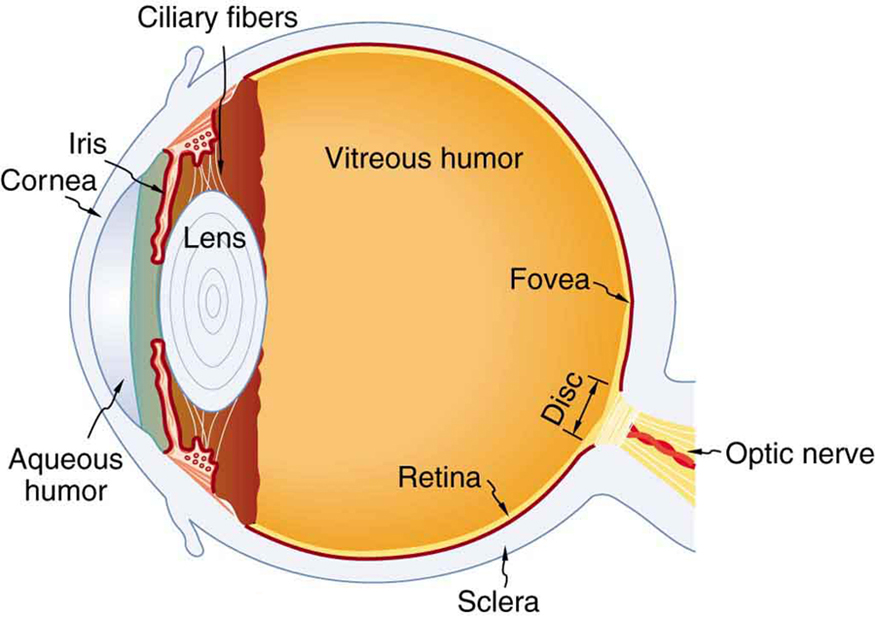
[Figure 1] shows the basic anatomy of the eye. The cornea and lens form a system that, to a good approximation, acts as a single thin lens. For clear vision, a real image must be projected onto the light-sensitive retina, which lies at a fixed distance from the lens. The lens of the eye adjusts its power to produce an image on the retina for objects at different distances. The center of the image falls on the fovea, which has the greatest density of light receptors and the greatest acuity (sharpness) in the visual field. The variable opening (or pupil) of the eye along with chemical adaptation allows the eye to detect light intensities from the lowest observable to $10^{10}$ times greater (without damage). This is an incredible range of detection. Our eyes perform a vast number of functions, such as sense direction, movement, sophisticated colors, and distance. Processing of visual nerve impulses begins with interconnections in the retina and continues in the brain. The optic nerve conveys signals received by the eye to the brain.
Refractive indices are crucial to image formation using lenses. [Table 1] shows refractive indices relevant to the eye. The biggest change in the refractive index, and bending of rays, occurs at the cornea rather than the lens. The ray diagram in [Figure 2] shows image formation by the cornea and lens of the eye. The rays bend according to the refractive indices provided in [Table 1]. The cornea provides about two-thirds of the power of the eye, owing to the fact that speed of light changes considerably while traveling from air into cornea. The lens provides the remaining power needed to produce an image on the retina. The cornea and lens can be treated as a single thin lens, even though the light rays pass through several layers of material (such as cornea, aqueous humor, several layers in the lens, and vitreous humor), changing direction at each interface. The image formed is much like the one produced by a single convex lens. This is a case 1 image. Images formed in the eye are inverted but the brain inverts them once more to make them seem upright.
| Material | Index of Refraction |
|---|---|
| Water | 1.33 |
| Air | 1.0 |
| Cornea | 1.38 |
| Aqueous humor | 1.34 |
| Lens | 1.41 average (varies throughout the lens, greatest in center) |
| Vitreous humor | 1.34 |
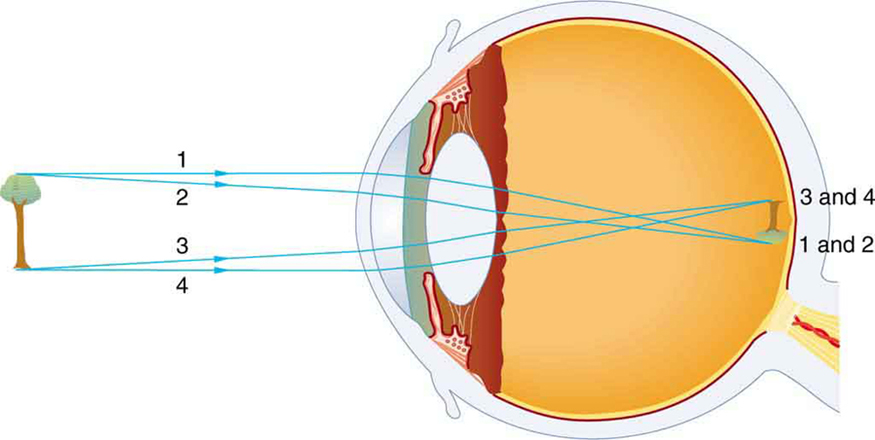
As noted, the image must fall precisely on the retina to produce clear vision — that is, the image distance ${d}_{\text{i}}$ must equal the lens-to-retina distance. Because the lens-to-retina distance does not change, the image distance ${d}_{\text{i}}$ must be the same for objects at all distances. The eye manages this by varying the power (and focal length) of the lens to accommodate for objects at various distances. The process of adjusting the eye’s focal length is called accommodation. A person with normal (ideal) vision can see objects clearly at distances ranging from 25 cm to essentially infinity. However, although the near point (the shortest distance at which a sharp focus can be obtained) increases with age (becoming meters for some older people), we will consider it to be 25 cm in our treatment here.
[Figure 3] shows the accommodation of the eye for distant and near vision. Since light rays from a nearby object can diverge and still enter the eye, the lens must be more converging (more powerful) for close vision than for distant vision. To be more converging, the lens is made thicker by the action of the ciliary muscle surrounding it. The eye is most relaxed when viewing distant objects, one reason that microscopes and telescopes are designed to produce distant images. Vision of very distant objects is called totally relaxed, while close vision is termed accommodated, with the closest vision being _ fully accommodated_.
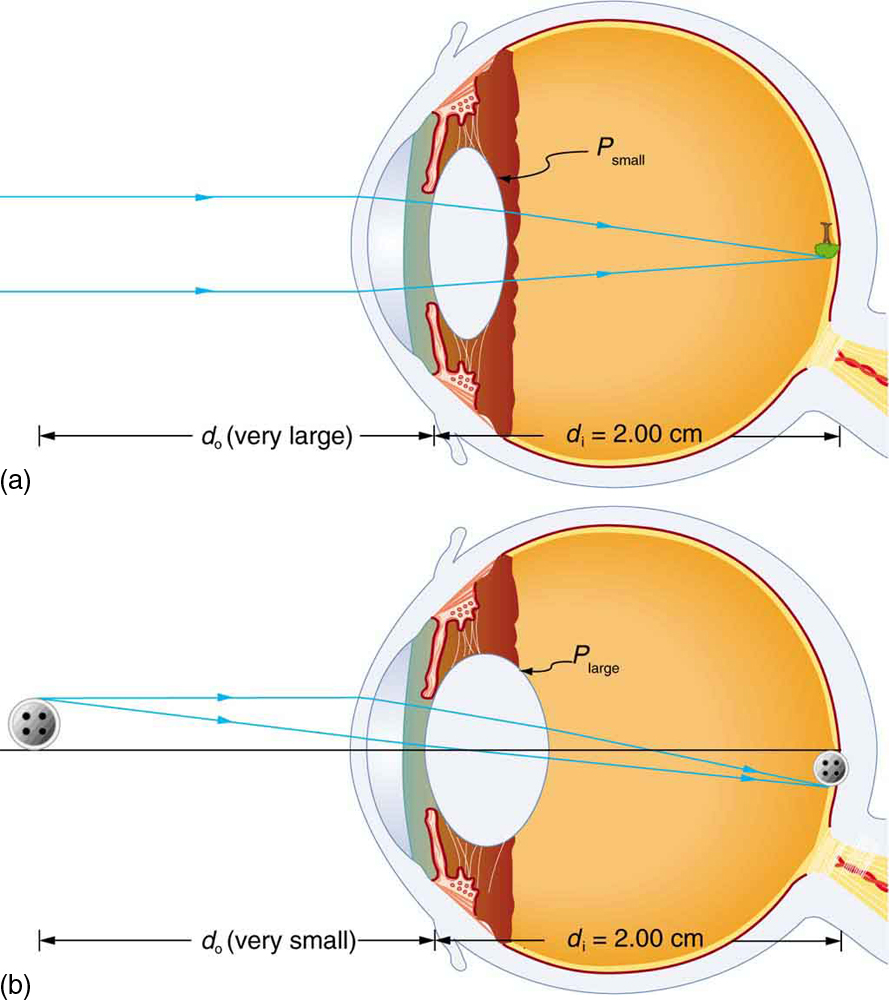
We will use the thin lens equations to examine image formation by the eye quantitatively. First, note the power of a lens is given as $P=1/f$ , so we rewrite the thin lens equations as
and
We understand that ${d}_{\text{i}}$ must equal the lens-to-retina distance to obtain clear vision, and that normal vision is possible for objects at distances ${d}\_{o}=25 \text{cm}$ to infinity.
Look at the central transparent area of someone’s eye, the pupil, in normal room light. Estimate the diameter of the pupil. Now turn off the lights and darken the room. After a few minutes turn on the lights and promptly estimate the diameter of the pupil. What happens to the pupil as the eye adjusts to the room light? Explain your observations.
The eye can detect an impressive amount of detail, considering how small the image is on the retina. To get some idea of how small the image can be, consider the following example.
What is the size of the image on the retina of a $1.20 \times 10^{-2}$ cm diameter human hair, held at arm’s length (60.0 cm) away? Take the lens-to-retina distance to be 2.00 cm.
Strategy
We want to find the height of the image ${h}_{i}$ , given the height of the object is ${h}_{o}= 1.20 \times 10^{-2}$ cm. We also know that the object is 60.0 cm away, so that ${d}_{o}=60.0 \text{cm}$ . For clear vision, the image distance must equal the lens-to-retina distance, and so ${d}_{\text{i}}=2.00 \text{cm}$ . The equation $\frac{ {h}_{\text{i}}}{ {h}_{\text{o}}}=-\frac{ {d}_{\text{i}}}{ {d}_{\text{o}}}=m$ can be used to find ${h}_{i}$ with the known information.
Solution
The only unknown variable in the equation $\frac{ {h}_{\text{i}}}{ {h}_{\text{o}}}=-\frac{ {d}_{\text{i}}}{ {d}_{\text{o}}}=m$ is ${h}_{\text{i}}$ :
Rearranging to isolate ${h}_{\text{i}}$ yields
Substituting the known values gives
Discussion
This truly small image is not the smallest discernible—that is, the limit to visual acuity is even smaller than this. Limitations on visual acuity have to do with the wave properties of light and will be discussed in the next chapter. Some limitation is also due to the inherent anatomy of the eye and processing that occurs in our brain.
Calculate the power of the eye when viewing objects at the greatest and smallest distances possible with normal vision, assuming a lens-to-retina distance of 2.00 cm (a typical value).
Strategy
For clear vision, the image must be on the retina, and so ${d}_{\text{i}}=2.00 \text{cm}$ here. For distant vision, ${d}_{o}\approx \infty$ , and for close vision, ${d}_{o}=25.0 \text{cm}$ , as discussed earlier. The equation $P=\frac{1}{ {d}_{\text{o}}}+\frac{1}{ {d}_{\text{i}}}$ as written just above, can be used directly to solve for $P$ in both cases, since we know ${d}_{\text{i}}$ and ${d}_{o}$ . Power has units of diopters, where $1 \text{D}=1 \text{/m}$ , and so we should express all distances in meters.
Solution
For distant vision,
Since $1/\infty =0$ , this gives
Now, for close vision,
Discussion
For an eye with this typical 2.00 cm lens-to-retina distance, the power of the eye ranges from 50.0 D (for distant totally relaxed vision) to 54.0 D (for close fully accommodated vision), which is an 8% increase. This increase in power for close vision is consistent with the preceding discussion and the ray tracing in [Figure 3]. An 8% ability to accommodate is considered normal but is typical for people who are about 40 years old. Younger people have greater accommodation ability, whereas older people gradually lose the ability to accommodate. When an optometrist identifies accommodation as a problem in elder people, it is most likely due to stiffening of the lens. The lens of the eye changes with age in ways that tend to preserve the ability to see distant objects clearly but do not allow the eye to accommodate for close vision, a condition called presbyopia (literally, elder eye). To correct this vision defect, we place a converging, positive power lens in front of the eye, such as found in reading glasses. Commonly available reading glasses are rated by their power in diopters, typically ranging from 1.0 to 3.5 D.
Image formation by the eye is adequately described by the thin lens equations:
If the lens of a person’s eye is removed because of cataracts (as has been done since ancient times), why would you expect a spectacle lens of about 16 D to be prescribed?
Strategy
The eye’s total optical power comes from two sources: the cornea and the lens. To understand why a spectacle lens of approximately 16 D would be needed after lens removal, we need to determine how much power the natural lens contributes to the eye’s total focusing ability. We can analyze this by examining the power contributions of the cornea and lens separately, using the information provided in the chapter about the eye’s optical properties and refractive indices.
Solution
The normal relaxed eye has a total power of approximately 50 D when viewing distant objects. From the chapter text, we learned that the cornea provides about two-thirds of the eye’s total power because the largest change in refractive index occurs at the air-cornea interface (from $n = 1.0$ to $n = 1.38$).
Calculating the cornea’s contribution:
The remaining power comes from the lens:
When the natural lens is removed (aphakia), the eye loses approximately 17 D of focusing power. To restore the ability to focus on distant objects, a spectacle lens must replace this lost power. Therefore, a lens of approximately 16-17 D would be prescribed.
More precisely, when the natural lens is removed, light entering through the cornea alone is insufficient to converge rays onto the retina. The spectacle lens must provide the additional converging power that was previously supplied by the crystalline lens.
Discussion
This question highlights the crucial optical role of the crystalline lens in the eye’s focusing system. Although the cornea provides the majority of the eye’s refractive power (about 33 D out of 50 D), the lens contributes an essential 17 D that is necessary to bring light to focus on the retina.
Historically, cataract surgery dates back to ancient times, with evidence of the procedure being performed as early as the 5th century BCE. In traditional “couching” procedures, the clouded lens was displaced rather than removed, but by the 18th century, extraction became more common. Patients who underwent lens removal became extremely hyperopic (farsighted) and required strong converging lenses to see clearly at any distance.
The prescription of a 16 D spectacle lens restores distance vision, but it’s important to note that such patients lose all accommodation ability since the natural lens is responsible for changing the eye’s focal length. Without the lens, the eye cannot adjust its power for near vision. This means that patients with aphakia typically need different spectacle corrections for different viewing distances—strong additional plus power for reading and intermediate tasks.
Modern cataract surgery involves replacing the clouded natural lens with an artificial intraocular lens (IOL) of appropriate power, which provides both distance correction and, in some advanced designs, some degree of accommodation or multifocal capability. This represents a significant improvement over simple spectacle correction for aphakia.
The physical principle demonstrated here is that the total power of a compound optical system (cornea plus lens) equals the sum of the individual powers when the optical elements are close together. Removing one element requires external compensation to maintain proper image formation.
A cataract is cloudiness in the lens of the eye. Is light dispersed or diffused by it?
Strategy
To answer this question, we must distinguish between two different optical phenomena: dispersion and diffusion. Dispersion refers to the separation of light into its component wavelengths (colors) due to wavelength-dependent refraction, such as occurs in a prism. Diffusion, also called scattering, refers to the random redirection of light rays when they encounter irregularities or particles in a medium. We need to consider the physical nature of a cataract and determine which phenomenon better describes its effect on light.
Solution
Light is diffused (scattered) by a cataract, not dispersed.
A cataract consists of cloudy or opaque regions in the normally transparent crystalline lens. These cloudy regions result from protein aggregation and structural changes in the lens fibers. The cloudiness creates numerous small irregularities and inhomogeneities in the refractive index throughout the lens tissue.
When light encounters these irregularities:
Dispersion, by contrast, would require a wavelength-dependent deviation of light, which would cause colored fringes and chromatic effects. While the eye’s lens does have some inherent dispersive properties (as all transparent materials do), a cataract does not enhance dispersion. Instead, the dominant effect is diffuse scattering.
Discussion
The distinction between diffusion and dispersion is crucial for understanding how cataracts affect vision. Patients with cataracts typically report:
They generally do not report rainbow-colored fringes or chromatic aberrations, which would be characteristic of dispersion.
The diffuse scattering mechanism explains why cataracts progressively reduce visual acuity. As more light is scattered away from its intended path to the retina, the image becomes increasingly degraded. Light that should form a sharp point on the retina is instead spread over a larger area, with some light scattered to incorrect locations. This is similar to trying to see through frosted glass—the image becomes blurred and washed out, but colors remain relatively normal.
Understanding this scattering mechanism has practical implications for cataract patients. For example:
This question also illustrates an important principle in optics: not all interactions between light and matter involve dispersion. While refraction at interfaces causes dispersion to some degree, the dominant effect of irregular, inhomogeneous media is diffuse scattering. This same principle applies to fog, clouds, frosted glass, and other translucent materials where structural irregularities scatter light.
When laser light is shone into a relaxed normal-vision eye to repair a tear by spot-welding the retina to the back of the eye, the rays entering the eye must be parallel. Why?
Strategy
This question relates to the eye’s accommodation and how it focuses light from objects at different distances. We need to consider what “relaxed normal-vision eye” means in terms of focal length and power, and then determine what type of incoming light rays will naturally focus on the retina without requiring accommodation. The key is understanding the relationship between object distance and ray convergence/divergence.
Solution
Parallel rays entering the eye must be used because a relaxed normal-vision eye is focused at infinity, and only parallel rays focus precisely on the retina when the eye is in its relaxed state.
From the thin lens equation and the chapter discussion:
For laser retinal repair:
Discussion
This question highlights a fundamental principle of geometric optics applied to medical procedures. The relaxed eye represents the eye’s natural, most stable optical configuration. When viewing distant objects (effectively at infinity), the incoming light rays are parallel, and the relaxed eye brings them to focus on the retina without any muscular effort from the ciliary muscles.
In laser photocoagulation (retinal welding), precision is paramount. The laser must deliver energy to an extremely small, specific spot on the retina—often just tens of micrometers in diameter. Using parallel incident rays provides several crucial advantages:
Predictability: The optical path through a relaxed eye is consistent and calculable. There’s no variation due to accommodation.
Patient comfort: Maintaining accommodation (lens contraction) for the duration of the procedure would cause eye strain and fatigue, leading to involuntary eye movements.
Repeatability: Each laser pulse can be delivered with the same optical configuration, ensuring consistent spot size and energy density.
Minimized aberrations: The relaxed lens has its most natural shape with minimal optical aberrations.
Practically, the laser system is designed to emit a collimated (parallel) beam that enters the patient’s eye. The surgeon uses additional optics (such as a contact lens placed on the cornea) to view the retina and aim the laser, but the fundamental requirement remains that the beam entering the eye is parallel.
This same principle applies to other ophthalmic procedures and diagnostic techniques. For example, autorefractors (devices that measure refractive error) typically project parallel or near-parallel light into the eye to assess the eye’s optical power in its relaxed state.
The question also reinforces the concept that object distance and ray geometry are intimately connected: distant objects produce parallel rays, nearby objects produce diverging rays. By controlling the ray geometry entering the eye, physicians can control where light focuses without requiring the patient to actively accommodate, resulting in safer, more precise medical procedures.
How does the power of a dry contact lens compare with its power when resting on the tear layer of the eye? Explain.
Strategy
The power of a lens depends on the refractive index difference between the lens material and the surrounding medium. We need to apply the lensmaker’s equation concept to understand how changing the medium on one side of the contact lens affects its optical power. A dry contact lens has air ($n = 1.0$) on both surfaces, while a contact lens on the eye has tear fluid ($n \approx 1.34$) on the back surface and air on the front surface.
Solution
A dry contact lens has greater power than the same lens when resting on the tear layer of the eye.
The power of a lens is determined by the refractive index differences at its surfaces. For a thin lens, the lensmaker’s equation shows that power is proportional to:
For a dry contact lens (in air):
For a contact lens on the eye:
Since the refractive index of tears ($n = 1.34$) is much closer to that of the contact lens material ($n \approx 1.4-1.5$) than air is, the back surface of the contact lens contributes much less optical power when the lens is on the eye. The front surface contribution remains the same, but the reduced back surface contribution means the total power decreases.
Quantitatively, if a contact lens has power $P_{\text{dry}}$ when measured in air, its effective power $P_{\text{on eye}}$ when placed on the tear film is less: $P_{\text{on eye}} < P_{\text{dry}}$.
Discussion
This question illustrates an important practical consideration in contact lens prescription. The phenomenon explains why contact lens powers cannot be directly converted from spectacle lens prescriptions, and why contact lenses must be measured and specified based on their performance when placed on the eye, not in air.
The physical principle at work is that refraction occurs due to changes in the speed of light at interfaces between materials with different refractive indices. The greater the difference in refractive indices, the greater the refraction (and hence the optical power). When a contact lens is in air:
When the same lens is placed on the tear film:
This reduction in power is actually advantageous because it allows the tear layer-cornea-lens system to work together more naturally. The tear film fills any small gaps between the contact lens and the cornea, creating better optical quality and comfort.
Practically, this means:
This principle also applies to intraocular lenses (IOLs) used in cataract surgery. An IOL implanted inside the eye is surrounded by aqueous humor ($n = 1.34$) rather than air, so its effective power is significantly less than it would be if measured in air. IOL power calculations must account for this to achieve the desired postoperative refraction.
Understanding this concept reinforces the general principle that the optical power of any lens system depends not just on the lens geometry and material, but critically on the refractive indices of the surrounding media. This is why the same physical lens can have different effective powers in different environments.
Why is your vision so blurry when you open your eyes while swimming under water? How does a face mask enable clear vision?
Strategy
The eye’s focusing power depends critically on the refractive index difference at the cornea-medium interface. We need to compare the optical situation when the eye is in air versus in water, using the refractive indices from Table 1 in the chapter: air ($n = 1.0$), water ($n = 1.33$), and cornea ($n = 1.38$). By analyzing how the cornea’s refractive power changes in different media, we can understand why underwater vision is blurred and how a face mask solves this problem.
Solution
Vision is blurry underwater because the cornea loses most of its refractive power when surrounded by water instead of air.
In air (normal vision):
Underwater (blurry vision):
With a face mask (clear vision restored):
The flat glass or plastic window of the mask does cause some refraction, but since it has parallel surfaces and the light enters and exits at approximately the same angle, the net effect on image position is minimal. The critical factor is maintaining the air-cornea interface.
Discussion
This question beautifully illustrates how the eye’s optical design is specifically adapted for vision in air. The cornea is the eye’s primary refractive element, but its power depends entirely on being surrounded by a medium with a significantly different refractive index. Water’s refractive index (1.33) is so close to that of the cornea (1.38) and aqueous humor (1.34) that the cornea essentially becomes “invisible” optically—light passes through with minimal bending.
The magnitude of the vision impairment underwater is substantial. With only about 40% of the normal optical power (20-22 D instead of 50 D), the eye is massively hyperopic. This is equivalent to someone with normal vision suddenly needing reading glasses with power of about +28 to +30 D—an enormous refractive error that renders everything hopelessly blurred.
Interestingly, some aquatic mammals have evolved different solutions to this problem:
The face mask solution exploits the simple principle that the eye evolved for air-based vision. By maintaining an air pocket in front of the eyes, the mask preserves the normal optical conditions. The mask window does introduce some additional effects:
This question also explains why prescription swim goggles exist for people with refractive errors. While the mask or goggles restore the corneal refractive power, they don’t correct pre-existing myopia or hyperopia. People who wear glasses on land still have the same refractive error underwater once the corneal power is restored by a mask.
From a physics perspective, this demonstrates that optical power arises from refractive index discontinuities, not from the absolute value of the refractive index. A lens or curved surface has power only insofar as it creates an index difference. This principle applies universally to all optical systems and explains why glasses work (glass-air interface), why oil immersion microscopy improves resolution (reducing the index step), and why anti-reflection coatings are designed with intermediate refractive indices (to minimize index discontinuities).
Unless otherwise stated, the lens-to-retina distance is 2.00 cm.
What is the power of the eye when viewing an object 50.0 cm away?
Strategy
To find the power of the eye when viewing an object at 50.0 cm, we use the thin lens equation in power form: $P = \frac{1}{d_o} + \frac{1}{d_i}$. The object distance is given as $d_o = 50.0$ cm, and the image distance (lens-to-retina distance) is $d_i = 2.00$ cm. We must convert both distances to meters since power is measured in diopters (D), where $1 \text{ D} = 1 \text{ m}^{-1}$.
Solution
Given values:
Using the power equation:
Substituting the known values:
Discussion
The power of the eye when viewing an object 50.0 cm away is 52.0 D. This represents a 2.0 D increase over the relaxed eye power of 50.0 D (for distant vision at infinity). This 2.0 D of accommodation is well within the normal range—a typical young adult can accommodate up to 4.0 D. The calculation shows that reading at arm’s length (approximately 50 cm) requires moderate accommodation. This distance is comfortable for extended reading, which is why many people naturally hold books and devices at about this distance. As people age and lose accommodation ability (presbyopia), this 50 cm distance may become the closest they can see clearly without reading glasses.
Calculate the power of the eye when viewing an object 3.00 m away.
Strategy
The power of the eye can be calculated using the thin lens equation $P = \frac{1}{d_o} + \frac{1}{d_i}$, where $d_o$ is the object distance and $d_i$ is the image distance (lens-to-retina distance). For clear vision, the image must form on the retina, so $d_i = 2.00$ cm. We need to convert all distances to meters since power is measured in diopters ($1 \text{ D} = 1 \text{ m}^{-1}$).
Solution
Given values:
Using the power equation:
Substituting the known values:
Discussion
The power of the eye when viewing an object 3.00 m away is 50.3 D, which is only slightly greater than the 50.0 D required for distant vision (at infinity). This makes sense because 3.00 m is relatively far from the eye, so the eye is nearly completely relaxed. The small additional 0.3 D of power represents minimal accommodation compared to the 4.0 D increase needed for close vision at 25 cm. This demonstrates that objects beyond a few meters require essentially the same eye power as viewing objects at infinity, which is why distant objects from 3 m to infinity are all in clear focus for a relaxed eye.
(a) The print in many books averages 3.50 mm in height. How high is the image of the print on the retina when the book is held 30.0 cm from the eye?
(b) Compare the size of the print to the sizes of rods and cones in the fovea and discuss the possible details observable in the letters. (The eye-brain system can perform better because of interconnections and higher order image processing.)
Strategy
For part (a), we use the magnification formula $\frac{h_i}{h_o} = -\frac{d_i}{d_o}$ to find the image height $h_i$ on the retina, where $h_o = 3.50$ mm is the object height, $d_o = 30.0$ cm is the object distance, and $d_i = 2.00$ cm is the lens-to-retina distance. For part (b), we compare the calculated image size to the typical dimensions of photoreceptors in the fovea (rods: ~2 μm diameter, cones: ~1.5-3 μm diameter in the fovea).
Solution
Given values:
(a) Using the magnification equation:
Solving for the image height:
The negative sign indicates an inverted image, which is expected for the eye.
(b) Comparison with photoreceptors:
The image height (233 μm) is approximately 78-155 times larger than the diameter of individual cones in the fovea. This means the image of a 3.50 mm letter spans about 78-155 cones, allowing excellent resolution of fine details within letters.
Discussion
Part (a): The retinal image of 3.50 mm print is 0.233 mm (233 μm) tall. Despite being a ~15-fold reduction in size, this is still quite large relative to the photoreceptors on the retina.
Part (b): Since each 3.50 mm letter produces an image spanning approximately 78-155 photoreceptors, the eye can easily distinguish individual letters and even fine details within letters such as serifs, the crossbar in an “A”, or the dot on an “i”. Each feature of a letter might span 10-20 or more cones, providing excellent resolution.
The fovea contains approximately 200,000 cones packed into a ~1.5 mm diameter area, giving exceptional acuity for central vision. The fact that the image of a single letter spans dozens of cones explains why we can read small print clearly. The eye-brain system performs even better than this simple calculation suggests due to lateral inhibition, edge detection, pattern recognition, and higher-order visual processing in the visual cortex. This is why we can sometimes read print even smaller than 3.50 mm under good lighting conditions.
Suppose a certain person’s visual acuity is such that he can see objects clearly that form an image $4.00 \mu m$ high on his retina. What is the maximum distance at which he can read the 75.0 cm high letters on the side of an airplane?
Strategy
This problem involves finding the object distance $d_o$ at which a letter of height $h_o = 75.0$ cm produces an image of height $h_i = 4.00 \mu\text{m}$ on the retina. We use the magnification equation $\frac{h_i}{h_o} = -\frac{d_i}{d_o}$, where $d_i = 2.00$ cm is the lens-to-retina distance. Solving for $d_o$ will give us the maximum distance at which the person can read the letters.
Solution
Given values:
Using the magnification equation:
Rearranging to solve for $d_o$:
Substituting the known values:
Taking the magnitude (the negative sign indicates an inverted image, which is expected):
Discussion
This person can read the 75.0 cm high letters from a maximum distance of 3.75 km (about 2.3 miles). This is a remarkably long distance and demonstrates the impressive resolution of the human visual system. The visual acuity of 4.00 μm corresponds to the ability to distinguish fine details approaching the size of individual photoreceptors on the retina. For reference, the diameter of a cone cell in the fovea is approximately 2-3 μm, so a 4.00 μm image is only slightly larger than a single cone.
This calculation assumes ideal viewing conditions (clear air, good contrast, proper lighting). In practice, atmospheric effects, contrast limitations, and other factors would likely reduce the actual reading distance. Nevertheless, this problem illustrates why large letters are used on aircraft and why they remain legible from considerable distances. The linear relationship between object size and viewing distance means that doubling the letter size would double the maximum readable distance.
People who do very detailed work close up, such as jewellers, often can see objects clearly at much closer distance than the normal 25 cm.
(a) What is the power of the eyes of a woman who can see an object clearly at a distance of only 8.00 cm?
(b) What is the size of an image of a 1.00 mm object, such as lettering inside a ring, held at this distance?
(c) What would the size of the image be if the object were held at the normal 25.0 cm distance?
Strategy
For part (a), we use $P = \frac{1}{d_o} + \frac{1}{d_i}$ with $d_o = 8.00$ cm and $d_i = 2.00$ cm to find the accommodated power. For parts (b) and (c), we use the magnification equation $\frac{h_i}{h_o} = -\frac{d_i}{d_o}$ to calculate the retinal image size for a 1.00 mm object at different viewing distances.
Solution
Given values:
(a) Calculate the accommodated power:
(b) Calculate the image size at 8.00 cm:
(c) Calculate the image size at 25.0 cm:
Discussion
Part (a): The jeweller’s accommodated power of 62.5 D represents a remarkable 12.5 D of accommodation (compared to 50.0 D for distant vision). This is more than three times the typical 4.0 D accommodation of a young adult. Such exceptional near vision is developed through years of close-up work and may also involve some degree of natural myopia that, while problematic for distant vision, is advantageous for detailed close work.
Part (b): At 8.00 cm, the 1.00 mm object produces a retinal image of 0.250 mm (250 μm). This is larger than typical print images and allows the jeweller to see extremely fine details like hallmarks, engravings, or imperfections in gemstones.
Part (c): At the normal 25.0 cm distance, the same object would produce only a 0.0800 mm (80 μm) image—less than one-third the size. The ratio of image sizes (250 μm / 80 μm = 3.125) equals the ratio of distances (25.0 cm / 8.00 cm = 3.125), as expected from the linear magnification relationship.
This problem illustrates why jewellers and others doing fine detail work benefit from exceptional near vision. The ability to work at 8.00 cm instead of 25.0 cm provides more than 3× magnification “for free” without requiring magnifying glasses. However, this extreme accommodation cannot be maintained for long periods without eye strain, which is why professional jewellers often supplement their natural vision with magnifying loupes or microscopes for extended detailed work.