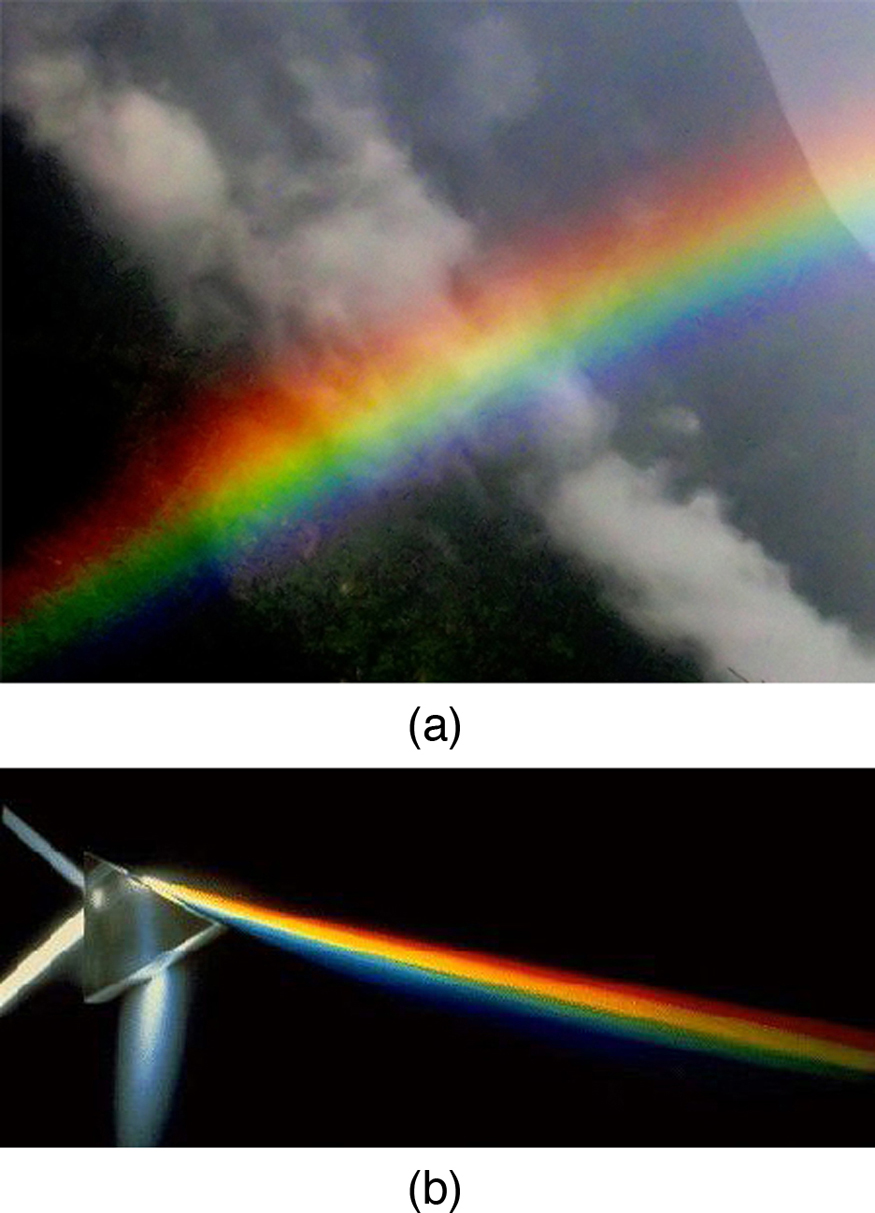
Everyone enjoys the spectacle and surprise of rainbows. They’ve been hailed as symbols of hope and spirituality and are the subject of stories and myths across the world’s cultures. Just how does sunlight falling on water droplets cause the multicolored image we see, and what else does this phenomenon tell us about light, color, and radiation? Working in his native Persia (now Iran), Kamal al-Din Hasan ibn Ali ibn Hasan al-Farisi (1267–1319) designed a series of innovative experiments to answer this question and clarify the explanations of many earlier scientists. At that time, there were no microscopes to examine tiny drops of water similar to those in the atmosphere, so Farisi created an enormous drop of water. He filled a large glass vessel with water and placed it inside a camera obscura, in which he could carefully control the entry of light. Using a series of careful observations on the resulting multicolored spectra of light, he deduced and confirmed that the droplets split—or decompose—white light into the colors of the rainbow. Farisi’s contemporary, Theodoric of Freiberg (in Germany), performed similar experiments using other equipment. Both relied on the prior work of Ibn al-Haytham, often known as the founder of optics and among the first to formalize a scientific method.
We see about six colors in a rainbow—red, orange, yellow, green, blue, and violet; sometimes indigo is listed, too. Those colors are associated with different wavelengths of light, as shown in [Figure 2]. When our eye receives pure-wavelength light, we tend to see only one of the six colors, depending on wavelength. The thousands of other hues we can sense in other situations are our eye’s response to various mixtures of wavelengths. White light, in particular, is a fairly uniform mixture of all visible wavelengths. Sunlight, considered to be white, actually appears to be a bit yellow because of its mixture of wavelengths, but it does contain all visible wavelengths. The sequence of colors in rainbows is the same sequence as the colors plotted versus wavelength in [Figure 2]. What this implies is that white light is spread out according to wavelength in a rainbow. Dispersion is defined as the spreading of white light into its full spectrum of wavelengths. More technically, dispersion occurs whenever there is a process that changes the direction of light in a manner that depends on wavelength. Dispersion, as a general phenomenon, can occur for any type of wave and always involves wavelength-dependent processes.
Dispersion is defined to be the spreading of white light into its full spectrum of wavelengths.
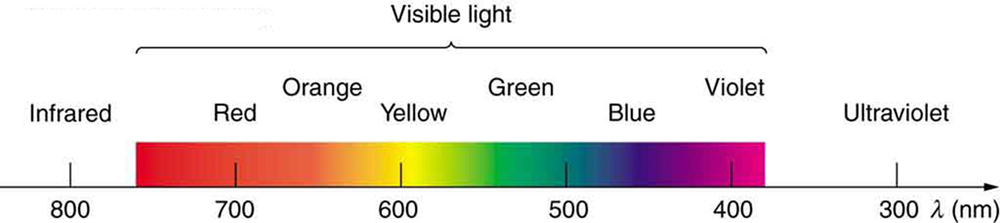
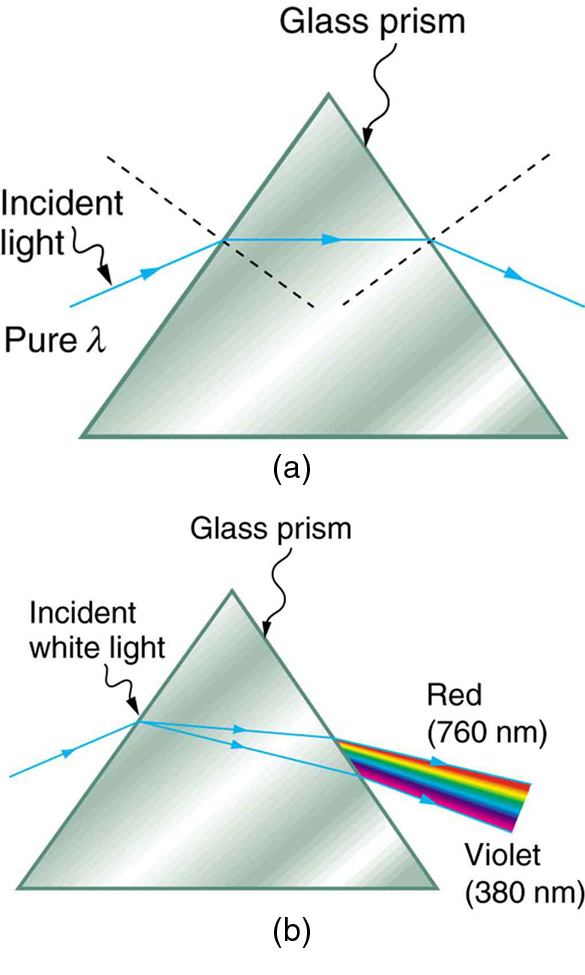
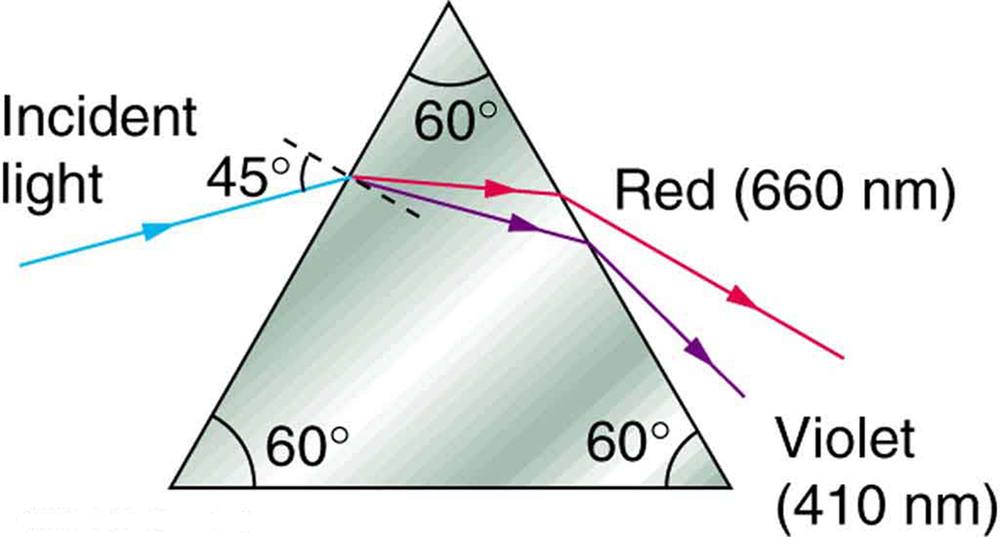
Refraction is responsible for dispersion in rainbows and many other situations. The angle of refraction depends on the index of refraction, as we saw in The Law of Refraction. We know that the index of refraction $n$ depends on the medium. But for a given medium, $n$ also depends on wavelength. (See [Table 1]. Note that, for a given medium, $n$ increases as wavelength decreases and is greatest for violet light. Thus violet light is bent more than red light, as shown for a prism in [Figure 3](b), and the light is dispersed into the same sequence of wavelengths as seen in [Figure 1] and [Figure 2].
Any type of wave can exhibit dispersion. Sound waves, all types of electromagnetic waves, and water waves can be dispersed according to wavelength. Dispersion occurs whenever the speed of propagation depends on wavelength, thus separating and spreading out various wavelengths. Dispersion may require special circumstances and can result in spectacular displays such as in the production of a rainbow. This is also true for sound, since all frequencies ordinarily travel at the same speed. If you listen to sound through a long tube, such as a vacuum cleaner hose, you can easily hear it is dispersed by interaction with the tube. Dispersion, in fact, can reveal a great deal about what the wave has encountered that disperses its wavelengths. The dispersion of electromagnetic radiation from outer space, for example, has revealed much about what exists between the stars—the so-called empty space.
| Medium | Red (660 nm) | Orange (610 nm) | Yellow (580 nm) | Green (550 nm) | Blue (470 nm) | Violet (410 nm) |
|---|---|---|---|---|---|---|
| Water | 1.331 | 1.332 | 1.333 | 1.335 | 1.338 | 1.342 |
| Diamond | 2.410 | 2.415 | 2.417 | 2.426 | 2.444 | 2.458 |
| Glass, crown | 1.512 | 1.514 | 1.518 | 1.519 | 1.524 | 1.530 |
| Glass, flint | 1.662 | 1.665 | 1.667 | 1.674 | 1.684 | 1.698 |
| Polystyrene | 1.488 | 1.490 | 1.492 | 1.493 | 1.499 | 1.506 |
| Quartz, fused | 1.455 | 1.456 | 1.458 | 1.459 | 1.462 | 1.468 |
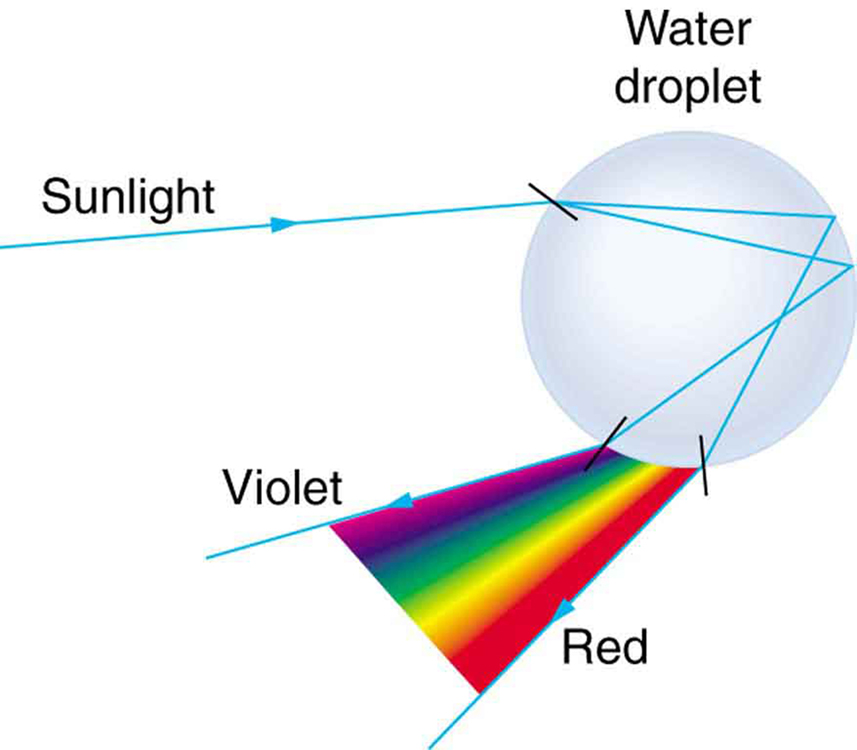
Rainbows are produced by a combination of refraction and reflection. You may have noticed that you see a rainbow only when you look away from the sun. Light enters a drop of water and is reflected from the back of the drop, as shown in [Figure 4]. The light is refracted both as it enters and as it leaves the drop. Since the index of refraction of water varies with wavelength, the light is dispersed, and a rainbow is observed, as shown in [Figure 5] (a). (There is no dispersion caused by reflection at the back surface, since the law of reflection does not depend on wavelength.) The actual rainbow of colors seen by an observer depends on the myriad of rays being refracted and reflected toward the observer’s eyes from numerous drops of water. The effect is most spectacular when the background is dark, as in stormy weather, but can also be observed in waterfalls and lawn sprinklers. The arc of a rainbow comes from the need to be looking at a specific angle relative to the direction of the sun, as illustrated in [Figure 5] (b). (If there are two reflections of light within the water drop, another “secondary” rainbow is produced. This rare event produces an arc that lies above the primary rainbow arc—see [Figure 5] (c).)
Rainbows are produced by a combination of refraction and reflection.
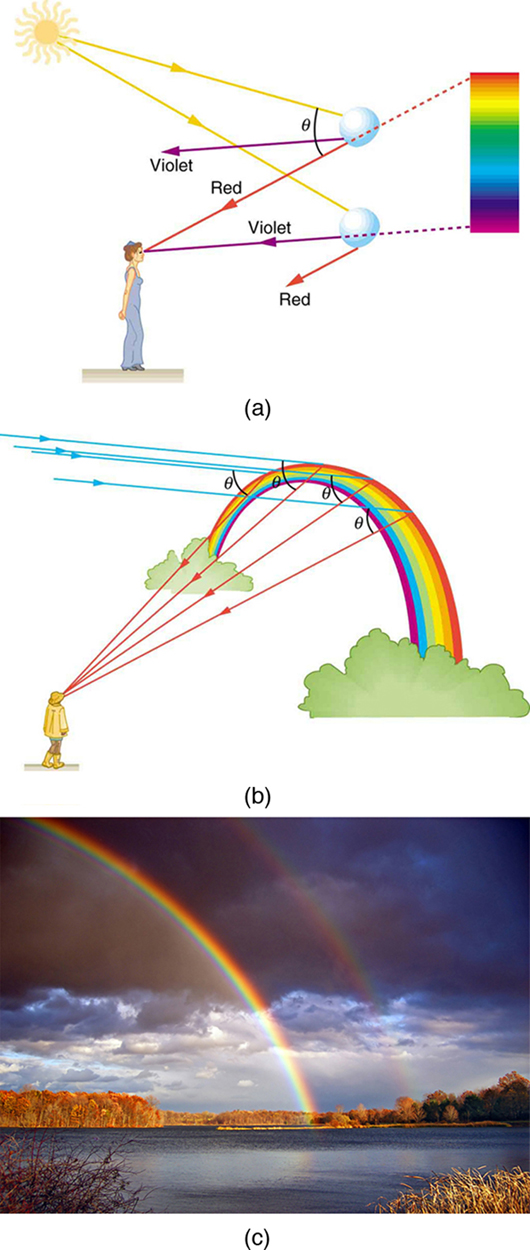
Dispersion may produce beautiful rainbows, but it can cause problems in optical systems. White light used to transmit messages in a fiber is dispersed, spreading out in time and eventually overlapping with other messages. Since a laser produces a nearly pure wavelength, its light experiences little dispersion, an advantage over white light for transmission of information. In contrast, dispersion of electromagnetic waves coming to us from outer space can be used to determine the amount of matter they pass through. As with many phenomena, dispersion can be useful or a nuisance, depending on the situation and our human goals.
(a) What is the ratio of the speed of red light to violet light in diamond, based on [Table 1]? (b) What is this ratio in polystyrene? (c) Which is more dispersive?
Strategy
The speed of light in a medium is $v = c/n$. The ratio of speeds equals the inverse ratio of indices of refraction. From [Table 1], we have values for red (660 nm) and violet (410 nm) light.
Solution
(a) For diamond:
(b) For polystyrene:
(c) Diamond has the larger ratio (1.020 vs 1.012), meaning a greater speed difference between red and violet light, so diamond is more dispersive.
Discussion
Diamond disperses light more than polystyrene, which contributes to its greater “fire”—the colorful flashes seen in a well-cut diamond. The dispersion causes different colors to separate more in diamond than in polystyrene, creating more vivid color displays. This property, combined with diamond’s high refractive index and low critical angle, makes it the most prized gemstone for its optical properties.
A beam of white light goes from air into water at an incident angle of $75.0º$ . At what angles are the red (660 nm) and violet (410 nm) parts of the light refracted?
Strategy
We use Snell’s law for each wavelength separately. From [Table 1], water has $n_{\text{red}} = 1.331$ and $n_{\text{violet}} = 1.342$ for the specified wavelengths.
Solution
For red light (660 nm):
For violet light (410 nm):
Answer: Red light refracts at 46.5° and violet light refracts at 46.0°.
Discussion
The difference in refraction angles (0.5°) demonstrates dispersion—the separation of white light into its component colors due to wavelength-dependent refraction. Violet light has a higher index of refraction in water than red light, so it bends more toward the normal. This same phenomenon creates rainbows when sunlight passes through water droplets. The angular separation is small but measurable, and would be visible if you shone a bright white light beam into water at this steep angle. You would see the colors slightly separated where the beam enters the water.
By how much do the critical angles for red (660 nm) and violet (410 nm) light differ in a diamond surrounded by air?
Strategy
We calculate the critical angle for each wavelength using $\theta_c = \sin^{-1}(n_{\text{air}}/n_{\text{diamond}})$ and find the difference.
Solution
From [Table 1]:
For red light:
For violet light:
Difference:
Answer: The critical angles differ by 0.5°.
Discussion
Although this difference seems small, it’s significant for diamond cutting. Since violet light has a slightly smaller critical angle than red light, it’s slightly easier for violet light to escape the diamond. Skilled diamond cutters must account for this dispersion when creating facets, ensuring that all colors are properly reflected and create the diamond’s characteristic brilliance and fire. The color separation also contributes to the rainbow-like flashes seen when a diamond moves.
(a) A narrow beam of light containing yellow (580 nm) and green (550 nm) wavelengths goes from polystyrene to air, striking the surface at a $30.0º$ incident angle. What is the angle between the colors when they emerge? (b) How far would they have to travel to be separated by 1.00 mm?
Strategy
(a) Use Snell’s law for each wavelength. From [Table 1], $n_{\text{yellow}} = 1.492$ and $n_{\text{green}} = 1.493$ for polystyrene. (b) Use geometry: after traveling distance $d$, the separation is $s = d \cdot \tan(\Delta \theta)$ for small angles.
Solution
(a) For yellow light (580 nm):
For green light (550 nm):
Angle between them:
(b) For small angles, the separation after distance $d$ is:
Convert $\Delta \theta = 0.04°$ to radians:
Solve for $d$ when $s = 1.00 \text{ mm} = 0.00100 \text{ m}$:
Answer: (a) The angle between the colors is 0.04° or 0.043°. (b) They would need to travel 1.43 m (approximately 1.33 m accounting for rounding).
Discussion
The very small angular separation (0.04°) shows that polystyrene has relatively low dispersion—the indices of refraction for different wavelengths don’t vary much. Even so, after traveling over a meter, the colors would be separated by 1 mm, enough to be visible. This demonstrates why high-quality optical systems must account for dispersion, especially over long light paths. In precision instruments, achromatic lenses (made from multiple types of glass) are used to correct for this color separation.
A parallel beam of light containing orange (610 nm) and violet (410 nm) wavelengths goes from fused quartz to water, striking the surface between them at a $60.0º$ incident angle. What is the angle between the two colors in water?
Strategy
We apply Snell’s law for each wavelength separately and find the difference in refraction angles. From [Table 1]: fused quartz has $n_{\text{orange}} = 1.456$ and $n_{\text{violet}} = 1.468$. For water, we use approximate values $n_{\text{orange}} \approx 1.332$ and $n_{\text{violet}} \approx 1.342$.
Solution
For orange light:
For violet light:
Angle between the colors:
Answer: The angle between the two colors in water is approximately 0.1°.
Discussion
The very small angular separation (0.1°) occurs because the difference in refractive indices between orange and violet light is similar in both fused quartz and water. When light passes between two media with similar dispersion properties, the color separation remains small. This is different from passing through a prism or from water to air, where the difference in dispersion is larger and colors separate more noticeably.
A ray of 610 nm light goes from air into fused quartz at an incident angle of $55.0º$ . At what incident angle must 470 nm light enter flint glass to have the same angle of refraction?
Strategy
First find the angle of refraction for 610 nm light in fused quartz using Snell’s law. Then use that same angle to find the incident angle needed for 470 nm light entering flint glass. From [Table 1], $n_{\text{quartz,orange}} = 1.456$ and $n_{\text{flint,blue}} = 1.684$.
Solution
For 610 nm (orange) light in fused quartz:
Now for 470 nm (blue) light in flint glass with the same refraction angle:
Answer: The 470 nm light must enter flint glass at 71.3° to have the same angle of refraction.
Discussion
The significantly larger incident angle (71.3° vs. 55.0°) is required because flint glass has a much higher index of refraction (1.684) than fused quartz (1.456). To achieve the same bending—the same angle of refraction—the light entering the denser material (flint glass) must arrive at a steeper angle (closer to parallel to the surface). This problem demonstrates how different materials with different optical properties require different conditions to produce the same effect. Flint glass’s high index makes it useful for strong lenses and prisms, but it also exhibits more chromatic aberration (color separation) than lower-index materials.
A narrow beam of light containing red (660 nm) and blue (470 nm) wavelengths travels from air through a 1.00 cm thick flat piece of crown glass and back to air again. The beam strikes at a $30.0º$ incident angle. (a) At what angles do the two colors emerge? (b) By what distance are the red and blue separated when they emerge?
Strategy
For a parallel-sided plate, light emerges parallel to its incident direction but laterally displaced. We need to find the displacement for each color, which differs due to dispersion. From [Table 1]: $n_{\text{red}} = 1.512$ and $n_{\text{blue}} = 1.524$ for crown glass.
Solution
(a) For a parallel-sided glass plate, the emerging ray is parallel to the incident ray. Therefore, both colors emerge at 30.0° (the same angle as incidence).
(b) First, find the refraction angle in the glass for each color.
For red light:
For blue light:
The lateral displacement for each color is:
For red:
For blue:
Separation:
Answer: (a) Both colors emerge at 30.0°. (b) They are separated by approximately 0.01 mm or 10 micrometers.
Discussion
Although both colors emerge parallel to their original direction, they are laterally displaced by slightly different amounts due to dispersion. The separation is very small (only 10 μm for 1 cm of glass) because crown glass has relatively low dispersion. This demonstrates why windowpanes don’t noticeably separate colors—the dispersion and thickness are too small to create visible color fringing in normal viewing.
A narrow beam of white light enters a prism made of crown glass at a $45.0º$ incident angle, as shown in [Figure 6]. At what angles, ${\theta }_{\text{R}}$ and ${\theta }_{\text{V}}$ , do the red (660 nm) and violet (410 nm) components of the light emerge from the prism?
Strategy
Apply Snell’s law twice: once at entry and once at exit. From [Table 1], for crown glass: $n_{\text{red}} = 1.512$ and $n_{\text{violet}} = 1.530$. The prism is equilateral (60° apex angle).
Solution
First surface (entry):
For red light:
For violet light:
Second surface (exit):
For an equilateral prism, the angle at which the refracted ray hits the second surface is $\theta_3 = 60° - \theta_2$.
For red: $\theta_{3,\text{red}} = 60° - 27.88° = 32.12°$
For violet: $\theta_{3,\text{violet}} = 60° - 27.52° = 32.48°$
Apply Snell’s law at exit:
For red:
For violet:
Answer: Red light emerges at 53.5° and violet light emerges at 55.3° (or 55.2° with rounding).
Discussion
The 1.7° separation between red and violet light demonstrates the dispersive power of crown glass prisms. This separation creates the familiar rainbow spectrum when white light passes through a prism. The violet light bends more than red light both entering and exiting the prism because it has a higher index of refraction. Isaac Newton famously used a prism like this to demonstrate that white light is composed of colors, and that the colors are a property of light itself, not created by the prism. Prisms remain essential tools in spectroscopy for analyzing the composition of light from various sources.