Many circuits also contain capacitors and inductors, in addition to resistors and an AC voltage source. We have seen how capacitors and inductors respond to DC voltage when it is switched on and off. We will now explore how inductors and capacitors react to sinusoidal AC voltage.
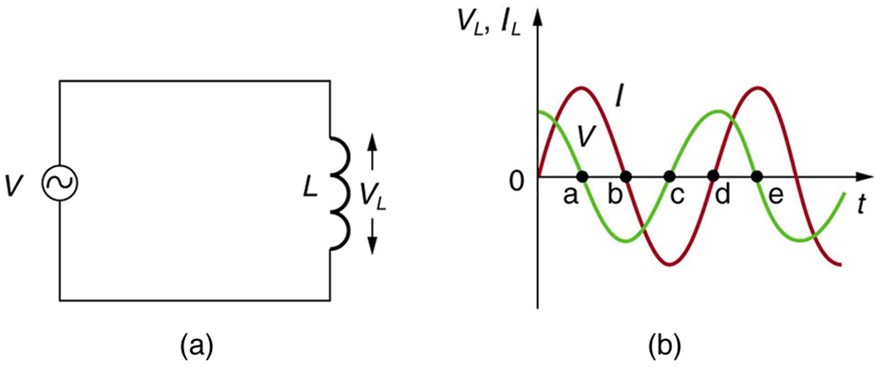
Suppose an inductor is connected directly to an AC voltage source, as shown in [Figure 1]. It is reasonable to assume negligible resistance, since in practice we can make the resistance of an inductor so small that it has a negligible effect on the circuit. Also shown is a graph of voltage and current as functions of time.
The graph in [Figure 1](b) starts with voltage at a maximum. Note that the current starts at zero and rises to its peak after the voltage that drives it, just as was the case when DC voltage was switched on in the preceding section. When the voltage becomes negative at point a, the current begins to decrease; it becomes zero at point b, where voltage is its most negative. The current then becomes negative, again following the voltage. The voltage becomes positive at point c and begins to make the current less negative. At point d, the current goes through zero just as the voltage reaches its positive peak to start another cycle. This behavior is summarized as follows:
When a sinusoidal voltage is applied to an inductor, the voltage leads the current by one-fourth of a cycle, or by a $90 ^\circ$ phase angle.
Current lags behind voltage, since inductors oppose change in current. Changing current induces a back emf $V=-L\left(\Delta I/\Delta t\right)$ . This is considered to be an effective resistance of the inductor to AC. The rms current $I$ through an inductor $L$ is given by a version of Ohm’s law:
where $V$ is the rms voltage across the inductor and ${X}_{L}$ is defined to be
with $f$ the frequency of the AC voltage source in hertz (An analysis of the circuit using Kirchhoff’s loop rule and calculus actually produces this expression). ${X}_{L}$ is called the inductive reactance, because the inductor reacts to impede the current. ${X}_{L}$ has units of ohms ( $1 H=1 \Omega \cdot \text{s}$ , so that frequency times inductance has units of $\left(\text{cycles/s}\right)\left(\Omega \cdot \text{s}\right)=\Omega$ ), consistent with its role as an effective resistance. It makes sense that ${X}_{L}$ is proportional to $L$ , since the greater the induction the greater its resistance to change. It is also reasonable that ${X}_{L}$ is proportional to frequency $f$ , since greater frequency means greater change in current. That is, $\Delta I/\Delta t$ is large for large frequencies ( large $f$ , small $\Delta t$ ). The greater the change, the greater the opposition of an inductor.
(a) Calculate the inductive reactance of a 3.00 mH inductor when 60.0 Hz and 10.0 kHz AC voltages are applied. (b) What is the rms current at each frequency if the applied rms voltage is 120 V?
Strategy
The inductive reactance is found directly from the expression ${X}_{L}=2\pi fL$ . Once ${X}_{L}$ has been found at each frequency, Ohm’s law as stated in the Equation $I=V/{X}_{L}$ can be used to find the current at each frequency.
Solution for (a)
Entering the frequency and inductance into Equation ${X}_{L}=2\pi fL$ gives
Similarly, at 10 kHz,
Solution for (b)
The rms current is now found using the version of Ohm’s law in Equation $I=V/{X}_{L}$ , given the applied rms voltage is 120 V. For the first frequency, this yields
Similarly, at 10 kHz,
Discussion
The inductor reacts very differently at the two different frequencies. At the higher frequency, its reactance is large and the current is small, consistent with how an inductor impedes rapid change. Thus high frequencies are impeded the most. Inductors can be used to filter out high frequencies; for example, a large inductor can be put in series with a sound reproduction system or in series with your home computer to reduce high-frequency sound output from your speakers or high-frequency power spikes into your computer.
Note that although the resistance in the circuit considered is negligible, the AC current is not extremely large because inductive reactance impedes its flow. With AC, there is no time for the current to become extremely large.
Consider the capacitor connected directly to an AC voltage source as shown in [Figure 2]. The resistance of a circuit like this can be made so small that it has a negligible effect compared with the capacitor, and so we can assume negligible resistance. Voltage across the capacitor and current are graphed as functions of time in the figure.
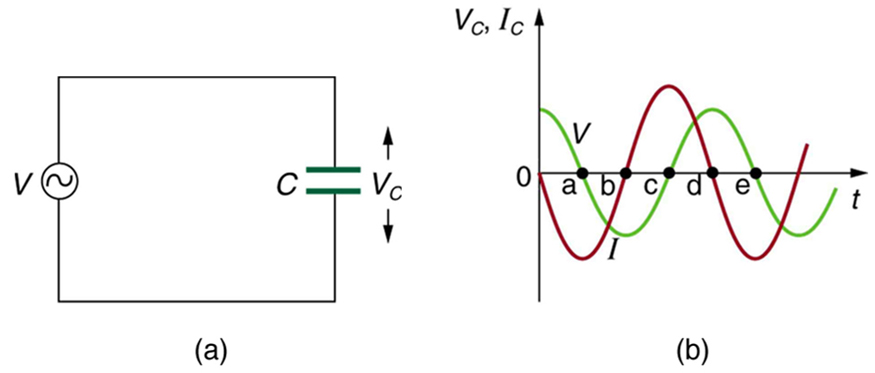
The graph in [Figure 2] starts with voltage across the capacitor at a maximum. The current is zero at this point, because the capacitor is fully charged and halts the flow. Then voltage drops and the current becomes negative as the capacitor discharges. At point a, the capacitor has fully discharged ( $Q=0$ on it) and the voltage across it is zero. The current remains negative between points a and b, causing the voltage on the capacitor to reverse. This is complete at point b, where the current is zero and the voltage has its most negative value. The current becomes positive after point b, neutralizing the charge on the capacitor and bringing the voltage to zero at point c, which allows the current to reach its maximum. Between points c and d, the current drops to zero as the voltage rises to its peak, and the process starts to repeat. Throughout the cycle, the voltage follows what the current is doing by one-fourth of a cycle:
When a sinusoidal voltage is applied to a capacitor, the voltage follows the current by one-fourth of a cycle, or by a $90 ^\circ$ phase angle.
The capacitor is affecting the current, having the ability to stop it altogether when fully charged. Since an AC voltage is applied, there is an rms current, but it is limited by the capacitor. This is considered to be an effective resistance of the capacitor to AC, and so the rms current $I$ in the circuit containing only a capacitor $C$ is given by another version of Ohm’s law to be
where $V$ is the rms voltage and ${X}_{C}$ is defined (As with ${X}_{L}$ , this expression for ${X}_{C}$ results from an analysis of the circuit using Kirchhoff’s rules and calculus) to be
where ${X}_{C}$ is called the capacitive reactance, because the capacitor reacts to impede the current. ${X}_{C}$ has units of ohms (verification left as an exercise for the reader). ${X}_{C}$ is inversely proportional to the capacitance $C$ ; the larger the capacitor, the greater the charge it can store and the greater the current that can flow. It is also inversely proportional to the frequency $f$ ; the greater the frequency, the less time there is to fully charge the capacitor, and so it impedes current less.
(a) Calculate the capacitive reactance of a 5.00 $\mu$F capacitor when 60.0 Hz and 10.0 kHz AC voltages are applied. (b) What is the rms current if the applied rms voltage is 120 V?
Strategy
The capacitive reactance is found directly from the expression in ${X}_{C}=\frac{1}{2\pi \text{fC}}$ . Once ${X}_{C}$ has been found at each frequency, Ohm’s law stated as $I=V/{X}_{C}$ can be used to find the current at each frequency.
Solution for (a)
Entering the frequency and capacitance into ${X}\_{C}=\frac{1}{2\pi \text{fC}}$
gives
Similarly, at 10 kHz,
Solution for (b)
The rms current is now found using the version of Ohm’s law in $I=V/{X}_{C}$ , given the applied rms voltage is 120 V. For the first frequency, this yields
Similarly, at 10 kHz,
Discussion
The capacitor reacts very differently at the two different frequencies, and in exactly the opposite way an inductor reacts. At the higher frequency, its reactance is small and the current is large. Capacitors favor change, whereas inductors oppose change. Capacitors impede low frequencies the most, since low frequency allows them time to become charged and stop the current. Capacitors can be used to filter out low frequencies. For example, a capacitor in series with a sound reproduction system rids it of the 60 Hz hum.
Although a capacitor is basically an open circuit, there is an rms current in a circuit with an AC voltage applied to a capacitor. This is because the voltage is continually reversing, charging and discharging the capacitor. If the frequency goes to zero (DC), ${X}_{C}$ tends to infinity, and the current is zero once the capacitor is charged. At very high frequencies, the capacitor’s reactance tends to zero—it has a negligible reactance and does not impede the current (it acts like a simple wire). Capacitors have the opposite effect on AC circuits that inductors have.
Just as a reminder, consider [Figure 3], which shows an AC voltage applied to a resistor and a graph of voltage and current versus time. The voltage and current are exactly in phase in a resistor. There is no frequency dependence to the behavior of plain resistance in a circuit:
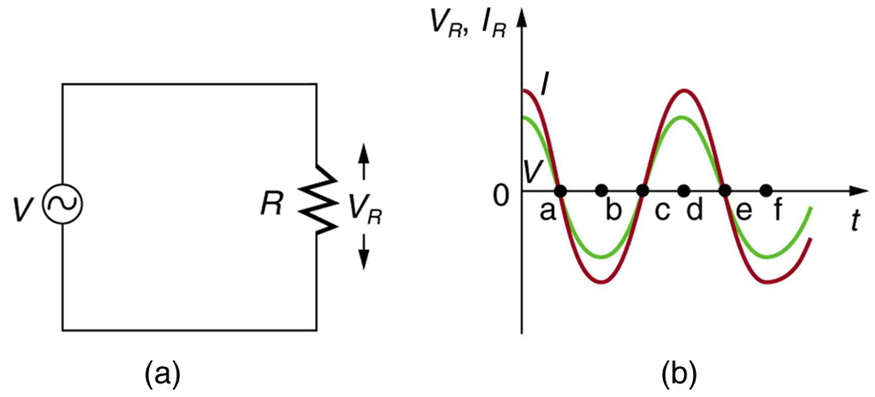
When a sinusoidal voltage is applied to a resistor, the voltage is exactly in phase with the current—they have a $0 ^\circ$ phase angle.
Ohm’s law for an inductor is
where $V$ is the rms voltage across the inductor.
with $f$ the frequency of the AC voltage source in hertz.
where $V$ is the rms voltage across the capacitor.
Presbycusis is a hearing loss due to age that progressively affects higher frequencies. A hearing aid amplifier is designed to amplify all frequencies equally. To adjust its output for presbycusis, would you put a capacitor in series or parallel with the hearing aid’s speaker? Explain.
Would you use a large inductance or a large capacitance in series with a system to filter out low frequencies, such as the 100 Hz hum in a sound system? Explain.
High-frequency noise in AC power can damage computers. Does the plug-in unit designed to prevent this damage use a large inductance or a large capacitance (in series with the computer) to filter out such high frequencies? Explain.
Does inductance depend on current, frequency, or both? What about inductive reactance?
Explain why the capacitor in [Figure 4](a) acts as a low-frequency filter between the two circuits, whereas that in [Figure 4](b) acts as a high-frequency filter.
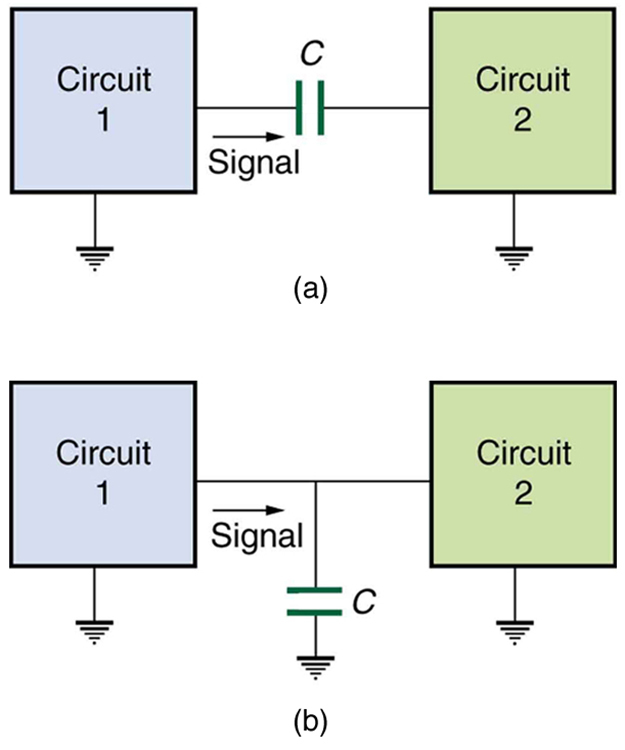
If the capacitors in [Figure 4] are replaced by inductors, which acts as a low-frequency filter and which as a high-frequency filter?
At what frequency will a 30.0 mH inductor have a reactance of $100 \text{Ω}$ ?
Strategy
We use the inductive reactance formula ${X}_{L}=2\pi fL$ and solve for the frequency $f$. We know the reactance and inductance.
Solution
Given:
Rearranging the inductive reactance equation:
Substituting the values:
Discussion
This frequency of 531 Hz is in the audible range, near the frequency of the musical note C5. At this frequency, the 30.0 mH inductor presents a reactance of 100 Ω, which is significant enough to substantially limit AC current. At lower frequencies, the reactance would be smaller, allowing more current to flow. At higher frequencies, the reactance would be larger, further impeding current flow.
Final Answer
531 Hz
What value of inductance should be used if a $20.0 \text{kΩ}$ reactance is needed at a frequency of 500 Hz?
Strategy
We use the inductive reactance formula ${X}_{L}=2\pi fL$ and solve for the inductance $L$. We know the desired reactance and the frequency.
Solution
Given:
Rearranging for $L$:
Substituting the values:
Discussion
This is a very large inductance (6.37 H), which would typically require a large coil with many turns and possibly an iron core. Such a large inductor would be bulky and heavy. The high reactance of 20.0 kΩ at the relatively low frequency of 500 Hz makes this inductor an excellent filter for blocking signals at and above this frequency while allowing DC and very low-frequency signals to pass relatively unimpeded.
Final Answer
6.37 H
What capacitance should be used to produce a $2.00 \text{MΩ}$ reactance at 60.0 Hz?
Strategy
We use the capacitive reactance formula ${X}_{C}=\frac{1}{2\pi fC}$ and solve for the capacitance $C$. We know the desired reactance and the frequency.
Solution
Given:
Rearranging for $C$:
Substituting the values:
Discussion
This is a very small capacitance—only 1.33 nanofarads. The extremely high reactance of 2.00 MΩ at the low frequency of 60.0 Hz means this capacitor would effectively block low-frequency signals, including 60 Hz power line noise. Small capacitors like this are commonly used in high-impedance circuits and for filtering applications where blocking low frequencies is desired.
Final Answer
1.33 nF
At what frequency will an 80.0 mF capacitor have a reactance of $0.250 \text{Ω}$ ?
Strategy
We use the capacitive reactance formula ${X}_{C}=\frac{1}{2\pi fC}$ and solve for the frequency $f$. We know the reactance and capacitance.
Solution
Given:
Rearranging for $f$:
Substituting the values:
Discussion
This is a very low frequency (about 8 Hz), well below the range of common AC power systems. The combination of a very large capacitor (80.0 mF, which is unusually large for most applications) and a very small reactance (0.250 Ω) results in this low frequency. At higher frequencies, this capacitor would have even lower reactance, effectively acting as a short circuit. Large capacitors like this are sometimes used in power supply smoothing circuits and low-frequency filter applications.
Final Answer
7.96 Hz
(a) Find the current through a 0.500 H inductor connected to a 60.0 Hz, 480 V AC source. (b) What would the current be at 100 kHz?
Strategy
(a) First calculate the inductive reactance using ${X}_{L}=2\pi fL$, then find the current using $I=\frac{V}{{X}_{L}}$. (b) Repeat the calculation with the new frequency.
Solution
(a) Given:
First, calculate the inductive reactance:
Now find the current:
(b) At $f = 100 \text{ kHz} = 1.00 \times 10^5 \text{ Hz}$:
Discussion
The inductor exhibits dramatically different behavior at the two frequencies. At 60.0 Hz, the reactance is modest (188 Ω) and allows 2.55 A of current to flow. At 100 kHz, the reactance increases by a factor of about 1670 to 314 kΩ, reducing the current to only 1.53 mA—a reduction by the same factor. This demonstrates how inductors effectively block high-frequency signals while allowing low-frequency signals to pass, making them excellent high-frequency filters.
Final Answer
(a) 2.55 A
(b) 1.53 mA
(a) What current flows when a 60.0 Hz, 480 V AC source is connected to a $0.250 \text{μF}$ capacitor? (b) What would the current be at 25.0 kHz?
Strategy
(a) Calculate the capacitive reactance using ${X}_{C}=\frac{1}{2\pi fC}$, then find the current using $I=\frac{V}{{X}_{C}}$. (b) Repeat the calculation with the new frequency.
Solution
(a) Given:
First, calculate the capacitive reactance:
Now find the current:
(b) At $f = 25.0 \text{ kHz} = 2.50 \times 10^4 \text{ Hz}$:
Discussion
The capacitor behaves opposite to an inductor. At the low frequency of 60.0 Hz, the capacitive reactance is very high (10.6 kΩ), limiting the current to only 45.3 mA. At the much higher frequency of 25.0 kHz, the reactance drops dramatically to 25.5 Ω, allowing a much larger current of 18.8 A to flow. This demonstrates how capacitors block low-frequency signals while allowing high-frequency signals to pass, making them excellent low-frequency filters—exactly the opposite behavior of inductors.
Final Answer
(a) 45.3 mA
(b) 18.8 A
A 20.0 kHz, 16.0 V source connected to an inductor produces a 2.00 A current. What is the inductance?
Strategy
First find the inductive reactance using $I=\frac{V}{{X}_{L}}$, then use ${X}_{L}=2\pi fL$ to find the inductance.
Solution
Given:
First, find the inductive reactance:
Now solve for inductance:
Discussion
This is a small inductance, typical of inductors used in high-frequency circuits such as radio receivers and transmitters. At the high frequency of 20.0 kHz, even this small inductance produces a significant reactance of 8.00 Ω. At lower frequencies, this same inductor would have much less reactance and would allow more current to flow for the same applied voltage.
Final Answer
63.7 µH
A 20.0 Hz, 16.0 V source produces a 2.00 mA current when connected to a capacitor. What is the capacitance?
Strategy
First find the capacitive reactance using $I=\frac{V}{{X}_{C}}$, then use ${X}_{C}=\frac{1}{2\pi fC}$ to find the capacitance.
Solution
Given:
First, find the capacitive reactance:
Now solve for capacitance:
Discussion
This is a reasonable capacitance value, just under 1 microfarad. At the low frequency of 20.0 Hz, this capacitor presents a substantial reactance of 8.00 kΩ, which significantly limits current flow. If the frequency were increased, the capacitive reactance would decrease, allowing more current to flow. This demonstrates why capacitors are effective at blocking low-frequency signals while passing high-frequency signals.
Final Answer
0.995 µF
(a) An inductor designed to filter high-frequency noise from power supplied to a personal computer is placed in series with the computer. What minimum inductance should it have to produce a $2.00 \text{kΩ}$ reactance for 15.0 kHz noise? (b) What is its reactance at 60.0 Hz?
Strategy
(a) Use ${X}_{L}=2\pi fL$ to find the required inductance at 15.0 kHz. (b) Calculate the reactance at 60.0 Hz using the inductance found in part (a).
Solution
(a) Given:
Solving for inductance:
(b) At $f = 60.0 \text{ Hz}$:
Discussion
This inductor is very effective as a noise filter. At the high frequency of 15.0 kHz (typical of electrical noise), it presents a large reactance of 2.00 kΩ, strongly impeding the noise current. However, at the power line frequency of 60.0 Hz, the reactance is only 8.00 Ω—a factor of 250 times smaller. This small reactance has minimal effect on the 60 Hz power delivery to the computer while effectively blocking high-frequency noise. This is exactly the desired characteristic for a power line filter.
Final Answer
(a) 21.2 mH
(b) 8.00 Ω
The capacitor in [Figure 4](a) is designed to filter low-frequency signals, impeding their transmission between circuits. (a) What capacitance is needed to produce a $100 \text{kΩ}$ reactance at a frequency of 120 Hz? (b) What would its reactance be at 1.00 MHz? (c) Discuss the implications of your answers to (a) and (b).
Strategy
(a) Use ${X}_{C}=\frac{1}{2\pi fC}$ to find the required capacitance at 120 Hz. (b) Calculate the reactance at 1.00 MHz using the capacitance from part (a). (c) Compare the two reactances to understand the filtering behavior.
Solution
(a) Given:
Solving for capacitance:
(b) At $f = 1.00 \text{ MHz} = 1.00 \times 10^6 \text{ Hz}$:
(c) At the low frequency of 120 Hz, the capacitor has a very high reactance of 100 kΩ, effectively blocking the signal from passing between circuits (acting as an open circuit). However, at the high frequency of 1.00 MHz, the reactance drops to only 12.0 Ω—over 8000 times smaller. This low reactance allows high-frequency signals to pass through easily (nearly like a short circuit). This capacitor therefore functions as a high-pass filter, blocking low frequencies while allowing high frequencies to pass.
Discussion
This is a practical example of capacitive filtering in series configuration. The capacitor in Figure 4(a) is in series with the signal path, so high reactance blocks signals while low reactance passes them. This type of filter is commonly used to remove DC and low-frequency components from signals while preserving high-frequency information, such as in audio coupling capacitors that block DC bias while passing audio signals.
Final Answer
(a) 13.3 nF
(b) 12.0 Ω
(c) The capacitor blocks low-frequency signals (high reactance at 120 Hz) but passes high-frequency signals (low reactance at 1.00 MHz), functioning as a high-pass filter.
The capacitor in [Figure 4](b) will filter high-frequency signals by shorting them to earth/ground. (a) What capacitance is needed to produce a reactance of $10.0 \text{mΩ}$ for a 5.00 kHz signal? (b) What would its reactance be at 3.00 Hz? (c) Discuss the implications of your answers to (a) and (b).
Strategy
(a) Use ${X}_{C}=\frac{1}{2\pi fC}$ to find the required capacitance at 5.00 kHz. (b) Calculate the reactance at 3.00 Hz using the capacitance from part (a). (c) Analyze how this configuration filters signals.
Solution
(a) Given:
Solving for capacitance:
(b) At $f = 3.00 \text{ Hz}$:
(c) At the high frequency of 5.00 kHz, the capacitor has an extremely low reactance of only 10.0 mΩ (essentially a short circuit to ground), effectively shunting high-frequency signals to ground and preventing them from passing through the circuit. At the low frequency of 3.00 Hz, the reactance increases to 16.7 Ω—over 1600 times higher. While still relatively low, this higher reactance is much less effective at shunting low-frequency signals to ground, allowing them to pass through the circuit with less attenuation. This capacitor therefore functions as a low-pass filter in the shunt configuration, removing high-frequency noise while preserving low-frequency signals.
Discussion
This is the complement to the previous problem. In Figure 4(b), the capacitor is connected to ground (shunt configuration), so low reactance diverts signals to ground while high reactance leaves them in the circuit. This configuration is commonly used to bypass high-frequency noise to ground in power supply circuits and to remove RF interference, while allowing lower frequency signals and DC to pass through unaffected.
Final Answer
(a) 3.18 mF
(b) 16.7 Ω
(c) The capacitor shorts high-frequency signals to ground (low reactance at 5.00 kHz) while having minimal effect on low-frequency signals (higher reactance at 3.00 Hz), functioning as a low-pass filter.
Unreasonable Results
In a recording of voltages due to brain activity (an EEG), a 10.0 mV signal with a 0.500 Hz frequency is applied to a capacitor, producing a current of 100 mA. Resistance is negligible. (a) What is the capacitance? (b) What is unreasonable about this result? (c) Which assumption or premise is responsible?
Strategy
(a) Find the capacitive reactance from $I=\frac{V}{{X}_{C}}$, then calculate the capacitance from ${X}_{C}=\frac{1}{2\pi fC}$. (b) Evaluate whether the calculated capacitance is physically reasonable for an EEG application. (c) Identify which parameter is unreasonable.
Solution
(a) Given:
First, find the capacitive reactance:
Now find the capacitance:
(b) A capacitance of 3.18 farads is unreasonably large for an EEG measurement circuit. Typical EEG equipment uses capacitances in the picofarad to microfarad range—millions of times smaller than this value. A 3.18 F capacitor would be physically enormous (like a supercapacitor used in power applications) and completely impractical for medical instrumentation. Furthermore, such a large capacitor would store a huge amount of charge and energy, which would be dangerous in a medical setting.
(c) The unreasonable assumption is the current of 100 mA. EEG signals are extremely weak—typically only a few microvolts to millivolts in amplitude—and produce correspondingly tiny currents, typically in the nanoampere to microampere range, not milliamperes. A 10.0 mV signal at 0.500 Hz would produce a current many orders of magnitude smaller than 100 mA in a realistic EEG circuit. The stated current is about a million times too large for this application.
Discussion
This problem illustrates the importance of checking results against physical reality. EEG measurements require extremely sensitive, high-impedance amplifiers precisely because the signals are so weak. A current of 100 mA flowing through the brain would cause severe tissue damage or death—it’s far above the threshold for dangerous electrical shock. Realistic EEG currents are in the nanoampere range, which would yield a much more reasonable capacitance value.
Final Answer
(a) 3.18 F
(b) This capacitance is unreasonably large—about a million times larger than typical values used in EEG equipment.
(c) The current of 100 mA is unreasonably large for an EEG signal. Realistic EEG currents are in the nanoampere to microampere range.
Construct Your Own Problem
Consider the use of an inductor in series with a computer operating on 60 Hz electricity. Construct a problem in which you calculate the relative reduction in voltage of incoming high frequency noise compared to 60 Hz voltage. Among the things to consider are the acceptable series reactance of the inductor for 60 Hz power and the likely frequencies of noise coming through the power lines.