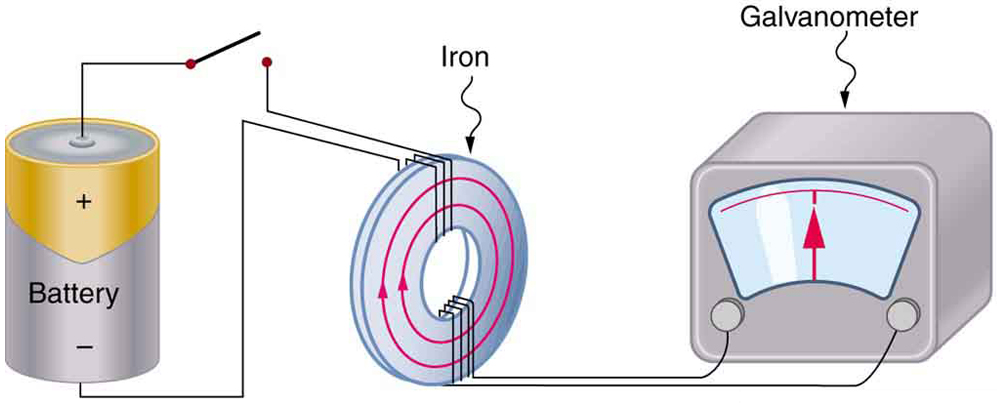
The apparatus used by Faraday to demonstrate that magnetic fields can create currents is illustrated in [Figure 1]. When the switch is closed, a magnetic field is produced in the coil on the top part of the iron ring and transmitted to the coil on the bottom part of the ring. The galvanometer is used to detect any current induced in the coil on the bottom. It was found that each time the switch is closed, the galvanometer detects a current in one direction in the coil on the bottom. (You can also observe this in a physics lab.) Each time the switch is opened, the galvanometer detects a current in the opposite direction. Interestingly, if the switch remains closed or open for any length of time, there is no current through the galvanometer. Closing and opening the switch induces the current. It is the change in magnetic field that creates the current. More basic than the current that flows is the emf that causes it. The current is a result of an emf induced by a changing magnetic field, whether or not there is a path for current to flow.
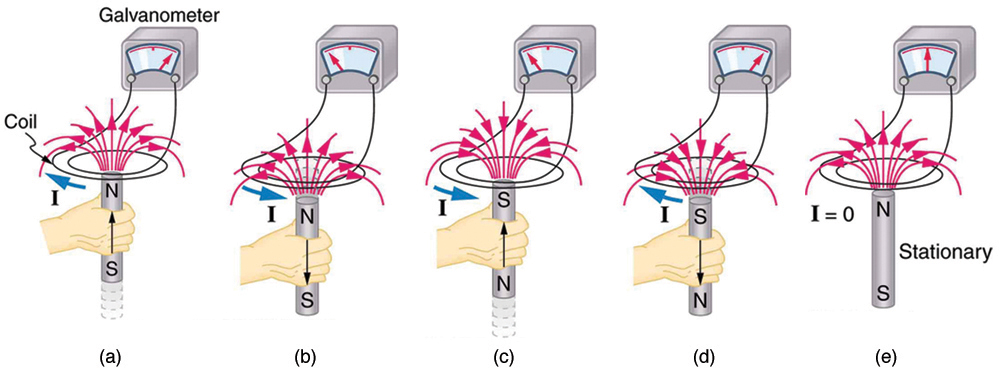
An experiment easily performed and often done in physics labs is illustrated in [Figure 2]. An emf is induced in the coil when a bar magnet is pushed in and out of it. Emfs of opposite signs are produced by motion in opposite directions, and the emfs are also reversed by reversing poles. The same results are produced if the coil is moved rather than the magnet—it is the relative motion that is important. The faster the motion, the greater the emf, and there is no emf when the magnet is stationary relative to the coil.
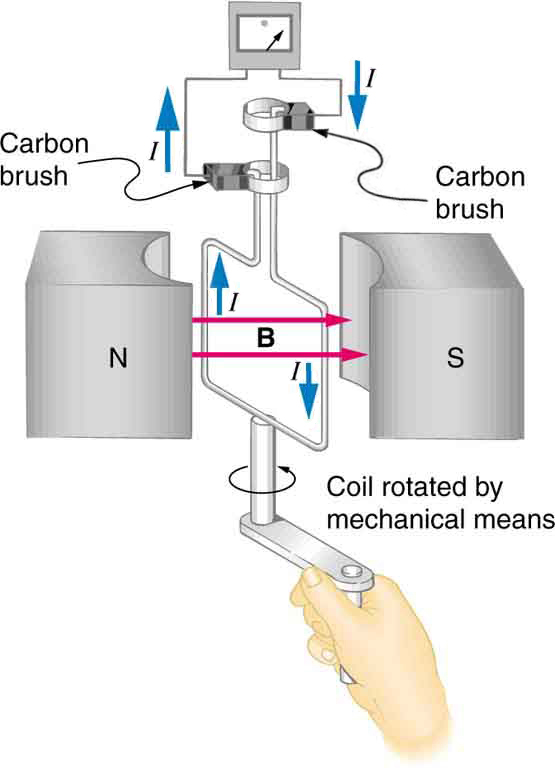
The method of inducing an emf used in most electric generators is shown in [Figure 3]. A coil is rotated in a magnetic field, producing an alternating current emf, which depends on rotation rate and other factors that will be explored in later sections. Note that the generator is remarkably similar in construction to a motor (another symmetry).
So we see that changing the magnitude or direction of a magnetic field produces an emf. Experiments revealed that there is a crucial quantity called the magnetic flux, $\Phi$, given by
where $B$ is the magnetic field strength over an area $A$ , at an angle $\theta$ with the perpendicular to the area as shown in [Figure 4]. Any change in magnetic flux $\Phi$ induces an emf. This process is defined to be electromagnetic induction. Units of magnetic flux $\Phi$ are $\text{T}\cdot {\text{m}}^{2}$ . As seen in [Figure 4], $B \cos \theta = B_\perp$ , which is the component of $B$ perpendicular to the area $A$ . Thus magnetic flux is $\Phi ={B}_{\perp}A$ , the product of the area and the component of the magnetic field perpendicular to it.
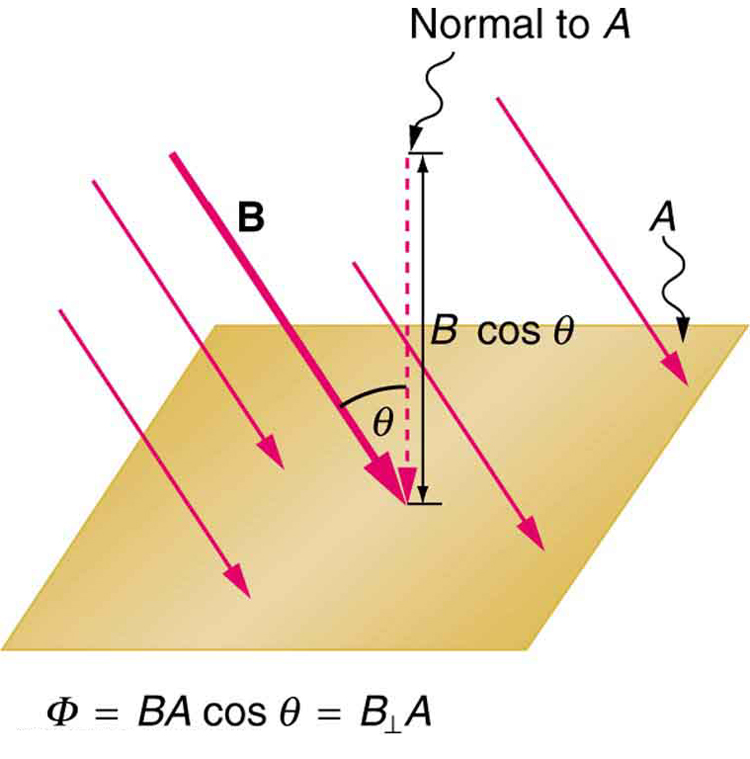
All induction, including the examples given so far, arises from some change in magnetic flux $\Phi$ . For example, Faraday changed $B$ and hence $\Phi$ when opening and closing the switch in his apparatus (shown in [Figure 1]). This is also true for the bar magnet and coil shown in [Figure 2]. When rotating the coil of a generator, the angle $\theta$ and, hence, $\Phi$ is changed. Just how great an emf and what direction it takes depend on the change in $\Phi$ and how rapidly the change is made, as examined in the next section.
Units of magnetic flux $\Phi$ are $\text{T}\cdot {\text{m}}^{2}$ .
How do the multiple-loop coils and iron ring in the version of Faraday’s apparatus shown in [Figure 1] enhance the observation of induced emf?
When a magnet is thrust into a coil as in [Figure 2](a), what is the direction of the force exerted by the coil on the magnet? Draw a diagram showing the direction of the current induced in the coil and the magnetic field it produces, to justify your response. How does the magnitude of the force depend on the resistance of the galvanometer?
Explain how magnetic flux can be zero when the magnetic field is not zero.
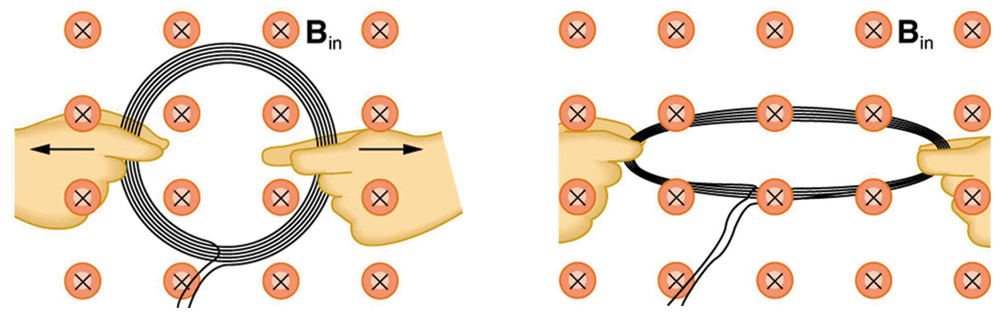
Is an emf induced in the coil in [Figure 5] when it is stretched? If so, state why and give the direction of the induced current.
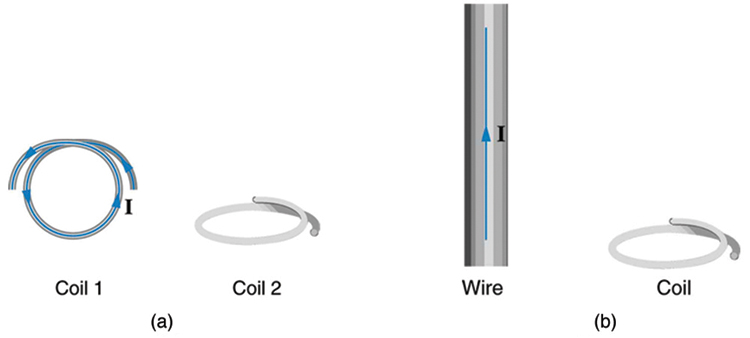
What is the value of the magnetic flux at coil 2 in [Figure 6] due to coil 1?
Strategy
The two coils are perpendicular to each other. When coil 1 carries current, it produces a magnetic field perpendicular to its own plane. We need to determine the angle between this field and the normal to coil 2’s area.
Solution
When current flows through coil 1, it creates a magnetic field along an axis perpendicular to coil 1’s plane. Since coil 2 is positioned perpendicular to coil 1, the plane of coil 2 is parallel to the magnetic field lines from coil 1.
For the magnetic flux through coil 2, we use:
where $\theta$ is the angle between the magnetic field and the normal to coil 2’s area.
Since the magnetic field from coil 1 is perpendicular to coil 1’s plane, and coil 2’s plane is perpendicular to coil 1’s plane, the magnetic field from coil 1 lies in the plane of coil 2. This means the field is perpendicular to the normal of coil 2, so $\theta = 90°$.
Discussion
The perpendicular orientation of the coils is crucial. The magnetic field lines from coil 1 run parallel to the plane of coil 2, so none of them pass through coil 2’s area. This is why the flux is zero despite the presence of a magnetic field.
Final Answer
The magnetic flux at coil 2 due to coil 1 is zero.
What is the value of the magnetic flux through the coil in [Figure 6](b) due to the wire?
Strategy
The wire is perpendicular to the plane of the coil. The magnetic field from the wire forms circles around it, and these field lines lie in the plane of the coil, not perpendicular to it.
Solution
The magnetic field from a long straight wire circles the wire. At any point on the coil, the magnetic field is tangent to a circle centered on the wire. Since the coil lies in a plane that contains the wire, the magnetic field lines are parallel to the plane of the coil.
The magnetic flux is $\Phi = BA\cos\theta$ where $\theta$ is the angle between the field and the normal to the coil’s area. Here, the field is parallel to the coil’s plane, making it perpendicular to the normal ($\theta = 90°$).
Discussion
No magnetic field lines pass through the area of the coil because they all lie in the plane of the coil. This is analogous to how wind blowing parallel to a window doesn’t pass through the window.
Final Answer
The magnetic flux through the coil is zero.