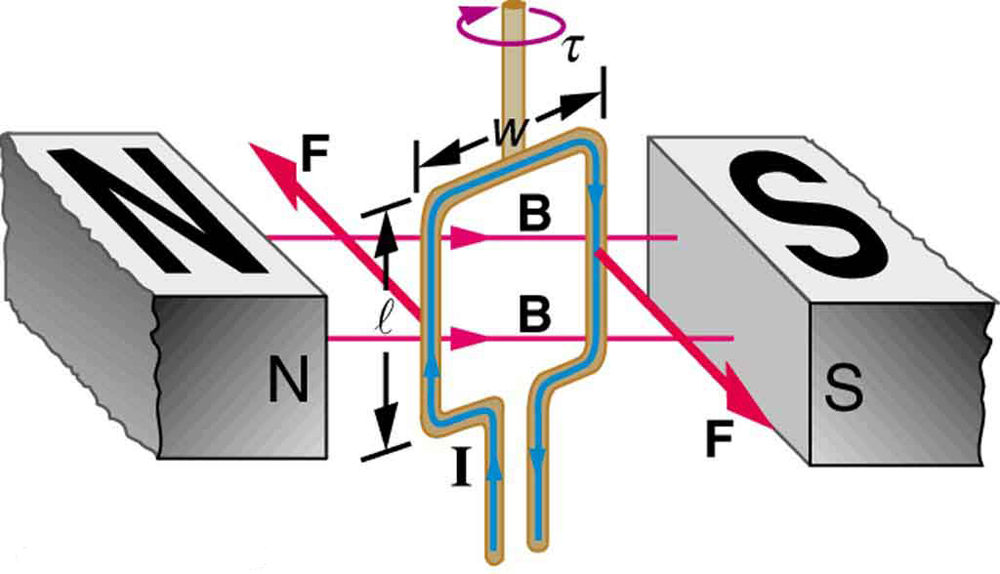
Motors are the most common application of magnetic force on current-carrying wires. Motors have loops of wire in a magnetic field. When current is passed through the loops, the magnetic field exerts torque on the loops, which rotates a shaft. Electrical energy is converted to mechanical work in the process. ( See [Figure 1].)
Let us examine the force on each segment of the loop in [Figure 1] to find the torques produced about the axis of the vertical shaft. (This will lead to a useful equation for the torque on the loop.) We take the magnetic field to be uniform over the rectangular loop, which has width $w$ and height $l$. First, we note that the forces on the top and bottom segments are vertical and, therefore, parallel to the shaft, producing no torque. Those vertical forces are equal in magnitude and opposite in direction, so that they also produce no net force on the loop. [Figure 2] shows views of the loop from above. Torque is defined as $\tau = rF \sin \theta$, where $F$ is the force, $r$ is the distance from the pivot that the force is applied, and $\theta$ is the angle between $r$ and $F$. As seen in [Figure 2](a), right hand rule 1 gives the forces on the sides to be equal in magnitude and opposite in direction, so that the net force is again zero. However, each force produces a clockwise torque. Since $r=w/2$, the torque on each vertical segment is $\left(w/2\right)F \sin \theta$, and the two add to give a total torque.
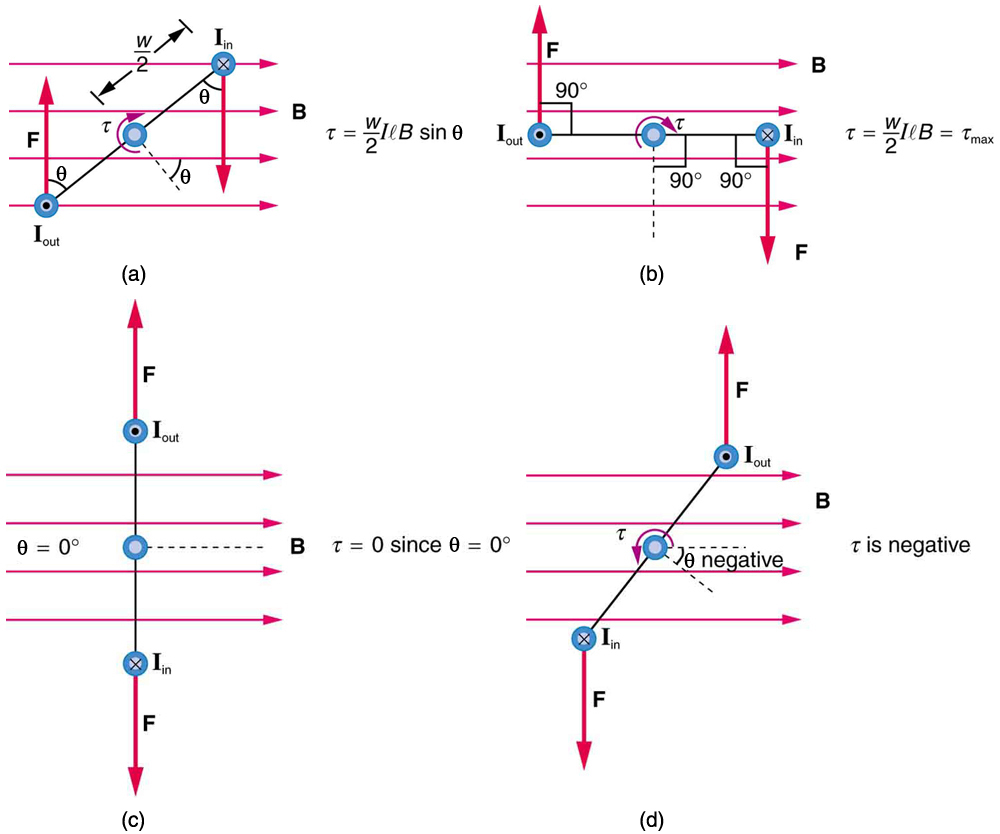
Now, each vertical segment has a length $l$ that is perpendicular to $B$, so that the force on each is $F=IlB$. Entering $F$ into the expression for torque yields
If we have a multiple loop of $N$ turns, we get $N$ times the torque of one loop. Finally, note that the area of the loop is $A= wl$; the expression for the torque becomes
This is the torque on a current-carrying loop in a uniform magnetic field. This equation can be shown to be valid for a loop of any shape. The loop carries a current$I$ , has$N$ turns, each of area$A$ , and the perpendicular to the loop makes an angle$\theta$ with the field$B$. The net force on the loop is zero.
Find the maximum torque on a 100-turn square loop of a wire of 10.0 cm on a side that carries 15.0 A of current in a 2.00-T field.
Strategy
Torque on the loop can be found using$\tau =NIAB \sin \theta$ . Maximum torque occurs when$\theta =90 ^\circ$ and$\sin \theta =1$.
Solution
For$\sin \theta =1$, the maximum torque is
Entering known values yields
Discussion
This torque is large enough to be useful in a motor.
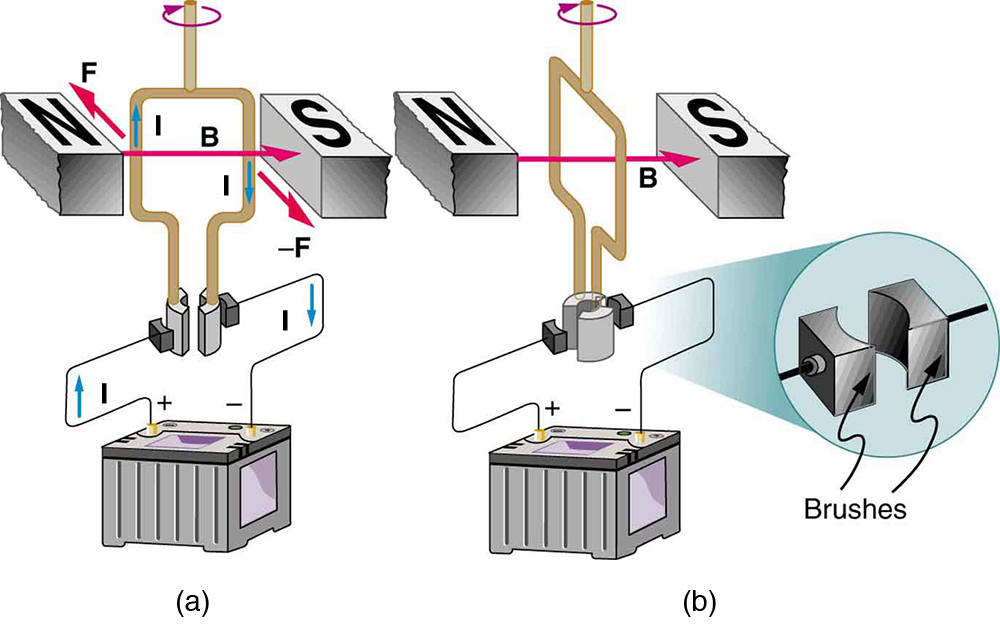
The torque found in the preceding example is the maximum. As the coil rotates, the torque decreases to zero at$\theta =0$ . The torque then reverses its direction once the coil rotates past$\theta =0$ . (See [Figure 2](d).) This means that, unless we do something, the coil will oscillate back and forth about equilibrium at$\theta =0$ . To get the coil to continue rotating in the same direction, we can reverse the current as it passes through$\theta =0$ with automatic switches called brushes. ( See [Figure 3].)
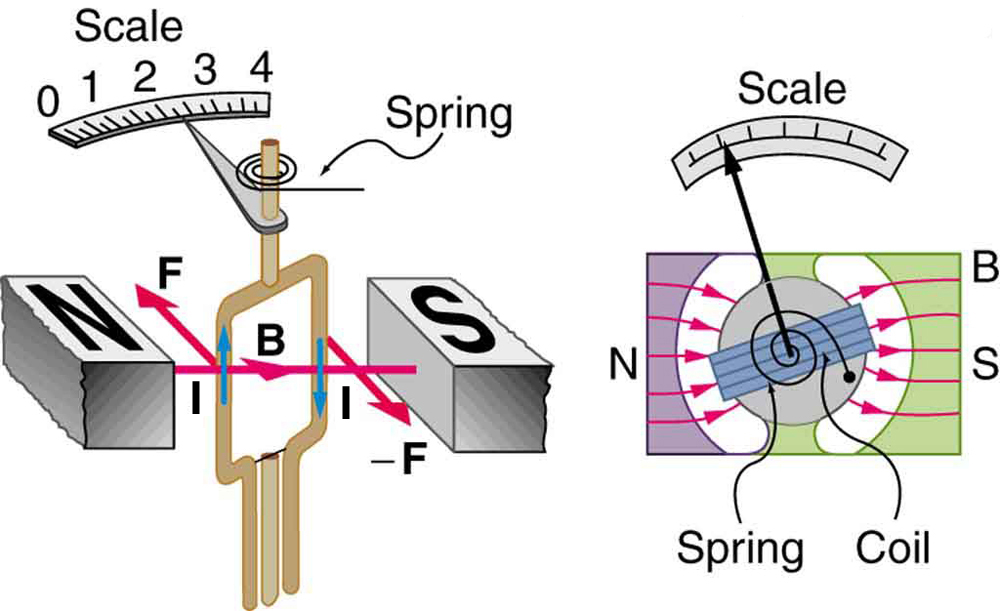
Meters, such as those in analog fuel gauges on a car, are another common application of magnetic torque on a current-carrying loop. [Figure 4] shows that a meter is very similar in construction to a motor. The meter in the figure has its magnets shaped to limit the effect of$\theta$ by making$B$ perpendicular to the loop over a large angular range. Thus the torque is proportional to$I$ and not$\theta$ . A linear spring exerts a counter-torque that balances the current-produced torque. This makes the needle deflection proportional to$I$ . If an exact proportionality cannot be achieved, the gauge reading can be calibrated. To produce a galvanometer for use in analog voltmeters and ammeters that have a low resistance and respond to small currents, we use a large loop area$A$ , high magnetic field$B$ , and low-resistance coils.
where$N$ is the number of turns, $I$ is the current,$A$ is the area of the loop, $B$ is the magnetic field strength, and $\theta$ is the angle between the perpendicular to the loop and the magnetic field.
Draw a diagram and use RHR-1 to show that the forces on the top and bottom segments of the motor’s current loop in [Figure 1] are vertical and produce no torque about the axis of rotation.
(a) By how many percent is the torque of a motor decreased if its permanent magnets lose 5.0% of their strength? (b) How many percent would the current need to be increased to return the torque to original values?
Strategy
Since torque is$\tau = NIAB\sin\theta$, it is directly proportional to the magnetic field strength$B$. If$B$ decreases by some percentage,$\tau$ decreases by the same percentage. To restore the original torque with reduced$B$, we must increase$I$ proportionally.
Solution
(a) Percent decrease in torque:
Since$\tau \propto B$:
If$B$ decreases by 5.00%, then$\tau$ also decreases by 5.00%.
(b) Required current increase:
Let$B' = 0.950 B_0$ (5% reduction). For the torque to return to$\tau_0$:
Since originally$\tau_0 = NI_0AB_0\sin\theta$:
The current must increase by$\frac{1.0526 - 1}{1} \times 100\% = 5.26\%$.
Discussion
This is an inverse proportionality: a 5% decrease in$B$ requires slightly more than a 5% increase in$I$ to compensate (specifically,$1/0.95 = 1.0526$). This relationship is important for motor performance as permanent magnets age and lose strength.
(a) The torque decreases by 5.00%.
(b) The current must increase by 5.26% to restore the original torque.
(a) What is the maximum torque on a 150-turn square loop of wire 18.0 cm on a side that carries a 50.0-A current in a 1.60-T field? (b) What is the torque when$\theta$ is$10.9º$ ?
Strategy
We use$\tau = NIAB\sin\theta$. Maximum torque occurs when$\sin\theta = 1$ (i.e.,$\theta = 90\text{ °}$). The area of the square loop is$A = s^2$ where$s$ is the side length.
Solution
Known quantities:
Area of the loop: $A = s^2 = (0.180 \text{ m})^2 = 0.0324 \text{ m}^2$
(a) Maximum torque ($\theta = 90°$):
(b) Torque at$\theta = 10.9°$:
Discussion
The torque of 389 N·m at maximum is quite large—comparable to the torque output of a small car engine. At$\theta = 10.9°$, the torque drops to about 19% of maximum because$\sin(10.9°) \approx 0.19$. Motors are designed to operate near$\theta = 90°$ for maximum efficiency.
(a) The maximum torque is 389 N·m.
(b) The torque at$\theta = 10.9°$ is 73.5 N·m.
Find the current through a loop needed to create a maximum torque of$9.00 \text{N}\cdot \text{m} \text{.}$ The loop has 50 square turns that are 15.0 cm on a side and is in a uniform 0.800-T magnetic field.
Strategy
We use$\tau_{\max} = NIAB$ and solve for$I$. The area of the square loop is$A = s^2$.
Solution
Known quantities:
Area: $A = s^2 = (0.150 \text{ m})^2 = 0.0225 \text{ m}^2$
Solving for current:
Discussion
This is a moderate current for a practical motor or demonstration device. The loop would need to handle 10 A without overheating, which requires appropriately sized wire.
The required current is 10.0 A.
Calculate the magnetic field strength needed on a 200-turn square loop 20.0 cm on a side to create a maximum torque of$300 \text{N}\cdot \text{m}$ if the loop is carrying 25.0 A.
Strategy
We use$\tau_{\max} = NIAB$ and solve for$B$.
Solution
Known quantities:
Area: $A = s^2 = (0.200 \text{ m})^2 = 0.0400 \text{ m}^2$
Discussion
A 1.50 T field is achievable with strong permanent magnets or electromagnets. This torque of 300 N·m is substantial—comparable to a car engine.
The required magnetic field strength is 1.50 T.
Since the equation for torque on a current-carrying loop is$\tau =NIAB \sin \theta$ , the units of$\text{N} \cdot \text{m}$ must equal units of$\text{A}\cdot {m}^{2} \text{T}$. Verify this.
Strategy
We use the definition of the tesla in terms of base SI units:$1 \text{ T} = 1 \text{ N/(A·m)}$, and show that the units work out correctly.
Solution
Starting with the units on the right side:
Substituting the definition of tesla:
The amperes cancel:
One meter cancels:
This confirms that$[\text{A} \cdot \text{m}^2 \cdot \text{T}] = [\text{N·m}]$ ✓
Discussion
This dimensional analysis verifies the consistency of the torque equation. The tesla was defined precisely so that electromagnetic equations like this one have consistent units. The fact that$N$ (number of turns) and$\sin\theta$ are dimensionless doesn’t affect this analysis.
Verified:$\text{A} \cdot \text{m}^{2} \cdot \text{T} = \text{A} \cdot \text{m}^{2} \cdot \frac{\text{N}}{\text{A} \cdot \text{m}} = \text{N·m}$.
(a) At what angle$\theta$ is the torque on a current loop 90.0% of maximum? (b) 50.0% of maximum? (c) 10.0% of maximum?
Strategy
Since$\tau = \tau_{\max}\sin\theta$, we have$\tau/\tau_{\max} = \sin\theta$. We solve for$\theta = \arcsin(\tau/\tau_{\max})$.
Solution
(a) 90.0% of maximum:
(b) 50.0% of maximum:
(c) 10.0% of maximum:
Discussion
These results show that torque drops off slowly at first but then rapidly as$\theta$ decreases. At 64°, we still have 90% of max torque, but we need to be at only 5.7° to get down to 10%. This is because the sine function has its steepest slope near$\theta = 0°$. Motors use commutators to keep the coil near$\theta = 90°$ where torque is maximum.
(a)$\theta = 64.2°$
(b)$\theta = 30.0°$
(c)$\theta = 5.74°$
A proton has a magnetic field due to its spin on its axis. The field is similar to that created by a circular current loop$0.650 \times 10^{-15} m$ in radius with a current of$1.05 \times 10^{4} A$ (no kidding). Find the maximum torque on a proton in a 2.50-T field. (This is a significant torque on a small particle.)
Strategy
We model the proton’s magnetic moment as a circular current loop and use the torque formula$\tau_{\max} = NIAB$. The area is$A = \pi r^2$ where$r$ is the “radius” of the effective current loop.
Solution
Known quantities:
Area of the loop: $A = \pi r^2 = \pi (0.650 \times 10^{-15} \text{ m})^2 = 1.33 \times 10^{-30} \text{ m}^2$
Maximum torque: $\tau_{\max} = NIAB = (1)(1.05 \times 10^{4} \text{ A})(1.33 \times 10^{-30} \text{ m}^2)(2.50 \text{ T})$
Discussion
This tiny torque on a single proton is indeed significant at the atomic scale. It’s responsible for nuclear magnetic resonance (NMR) and MRI imaging. The torque causes protons to precess in the magnetic field at a characteristic frequency (the Larmor frequency), which is detected to create medical images. The enormous “equivalent current” comes from the extremely rapid quantum mechanical spin of the proton.
The maximum torque on the proton is$3.48 \times 10^{-26}$ N·m.
(a) A 200-turn circular loop of radius 50.0 cm is vertical, with its axis on an east-west line. A current of 100 A circulates clockwise in the loop when viewed from the east. The Earth’s field here is due north, parallel to the ground, with a strength of$3.00 \times 10^{-5} \text{T}$ . What are the direction and magnitude of the torque on the loop? (b) Does this device have any practical applications as a motor?
Strategy
The loop is vertical with its axis east-west, and the field points north. The magnetic moment of the loop points along its axis. We need to find the angle between the magnetic moment and the field to calculate torque. The direction comes from the right-hand rule for magnetic moment (fingers curl with current, thumb points along moment).
Solution
Known quantities:
Area of the loop: $A = \pi r^2 = \pi (0.500)^2 = 0.785 \text{ m}^2$
(a) Magnitude and direction:
The loop is vertical with axis east-west. Current flows clockwise when viewed from the east, so by the right-hand rule, the magnetic moment points west.
The field points north. The angle between the moment (west) and the field (north) is$\theta = 90°$.
Direction: The torque is$\boldsymbol{\tau} = \boldsymbol{\mu} \times \boldsymbol{B}$ (west × north = upward, but torque tends to align moment with field). The torque acts to rotate the loop so that its moment aligns with the field—this means the torque is directed downward (or the loop tries to tip so the west-pointing moment rotates toward north).
(b) Practical application as a motor:
This would be an impractical motor:
Discussion
Motors require strong magnetic fields (typically 0.1–2 T from permanent magnets or electromagnets), not Earth’s field ($\sim 3 \times 10^{-5}$ T). The field is about 10,000 times too weak for practical use.
(a) The torque magnitude is 0.471 N·m. The direction is such that the loop tends to rotate about a vertical axis, bringing the magnetic moment from west toward north.
(b) This device would not be practical as a motor due to the extremely weak torque from Earth’s field, which is about 10,000 times weaker than fields used in actual motors.
Repeat [Exercise 1], but with the loop lying flat on the ground with its current circulating counterclockwise (when viewed from above) in a location where the Earth’s field is north, but at an angle$45.0º$ below the horizontal and with a strength of$6.00\times 10^{-5} \text{T}$.
Strategy
With the loop flat on the ground and current counterclockwise (viewed from above), the magnetic moment points upward (by right-hand rule). The field points north but 45° below horizontal, so it has both a horizontal (north) and vertical (downward) component. Only the horizontal component creates torque.
Solution
Known quantities (same as Exercise 1): -$N = 200$,$r = 0.500$ m,$I = 100$ A -$A = 0.785 \text{ m}^2$
(a) Magnitude and direction:
The magnetic moment$\boldsymbol{\mu}$ points upward (out of the ground).
The field has components:
The angle between the upward moment and the field (pointing north and downward at 45°) is$90° + 45° = 135°$ from the horizontal field component’s perspective. However, since the moment is vertical, we find the torque as:
The angle$\theta$ between the magnetic moment (vertical, upward) and the field (north, 45° below horizontal) is:
$\theta = 90° + 45° = 135°$ from moment to field…
Actually, more simply: the moment is perpendicular to the horizontal, so the torque comes from the horizontal component of$B$:
Direction:$\boldsymbol{\tau} = \boldsymbol{\mu} \times \boldsymbol{B}$. With moment up and horizontal field component north, the torque points west.
(b) Practical considerations:
Same as before—this is not practical as a motor due to the weak field of Earth.
Discussion
The vertical component of the field doesn’t contribute to torque because it’s parallel to the magnetic moment. Only the horizontal component ($B\cos 45°$) creates torque.
(a) The torque is 0.666 N·m directed west.
(b) This would not be practical as a motor. The torque is weak, and the current would need to alternate to produce continuous rotation (otherwise the loop would just oscillate about its equilibrium position).