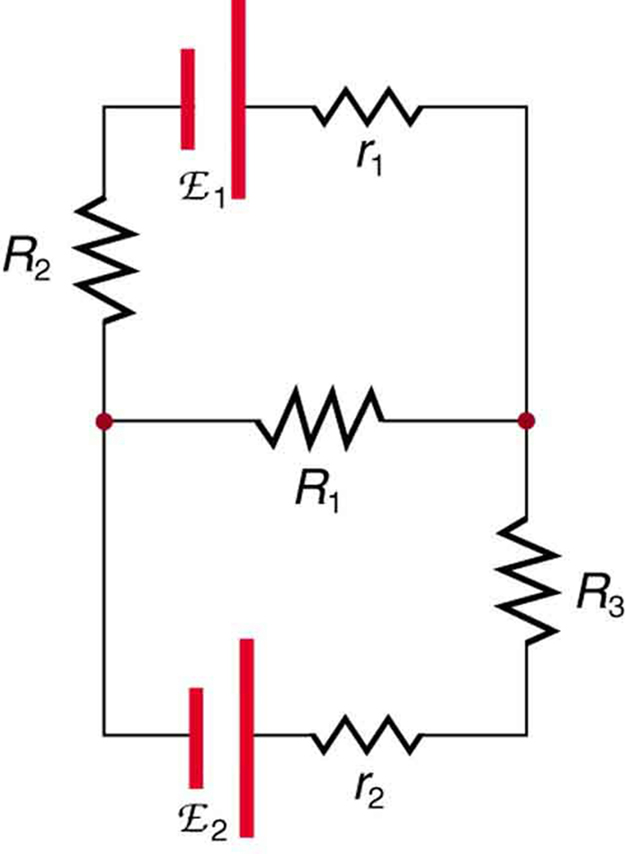
Many complex circuits, such as the one in [Figure 1], cannot be analyzed with the series-parallel techniques developed in Resistors in Series and Parallel and Electromotive Force: Terminal Voltage. There are, however, two circuit analysis rules that can be used to analyze any circuit, simple or complex. These rules are special cases of the laws of conservation of charge and conservation of energy. The rules are known as Kirchhoff’s rules, after their inventor Gustav Kirchhoff (1824–1887).
Explanations of the two rules will now be given, followed by problem-solving hints for applying Kirchhoff’s rules, and a worked example that uses them.
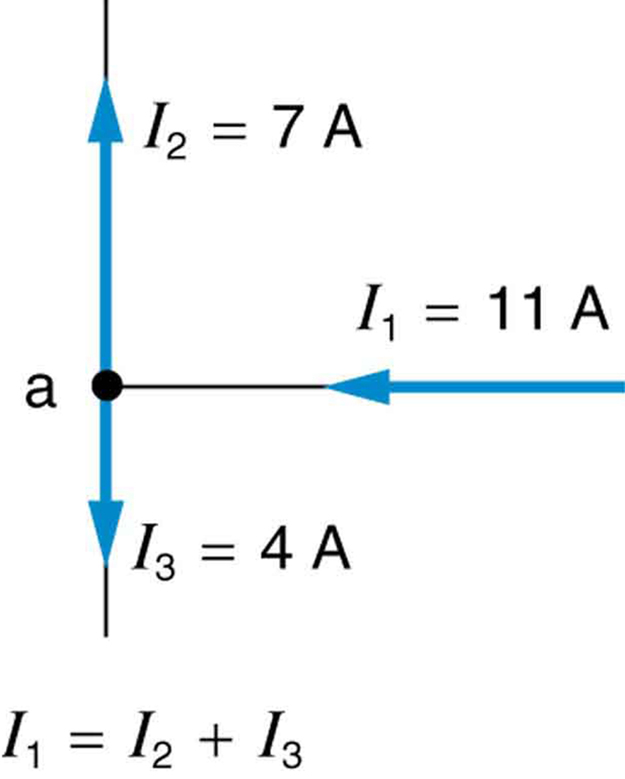
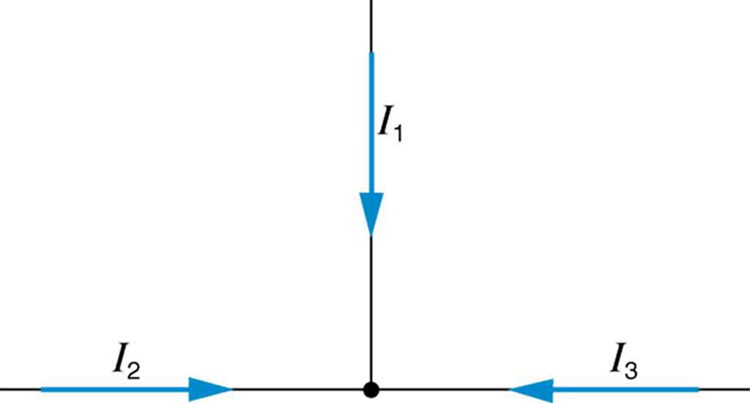
Kirchhoff’s first rule (the junction rule) is an application of the conservation of charge to a junction; it is illustrated in [Figure 2]. Current is the flow of charge, and charge is conserved; thus, whatever charge flows into the junction must flow out. Kirchhoff’s first rule requires that ${I}_{1}={I}_{2}+{I}_{3}$ (see figure). Equations like this can and will be used to analyze circuits and to solve circuit problems.
Kirchhoff’s rules for circuit analysis are applications of conservation laws to circuits. The first rule is the application of conservation of charge, while the second rule is the application of conservation of energy. Conservation laws, even used in a specific application, such as circuit analysis, are so basic as to form the foundation of that application.
Kirchhoff’s second rule (the loop rule) is an application of conservation of energy. The loop rule is stated in terms of potential, $V$ , rather than potential energy, but the two are related since ${\text{PE}}\_{\text{elec}}=qV$
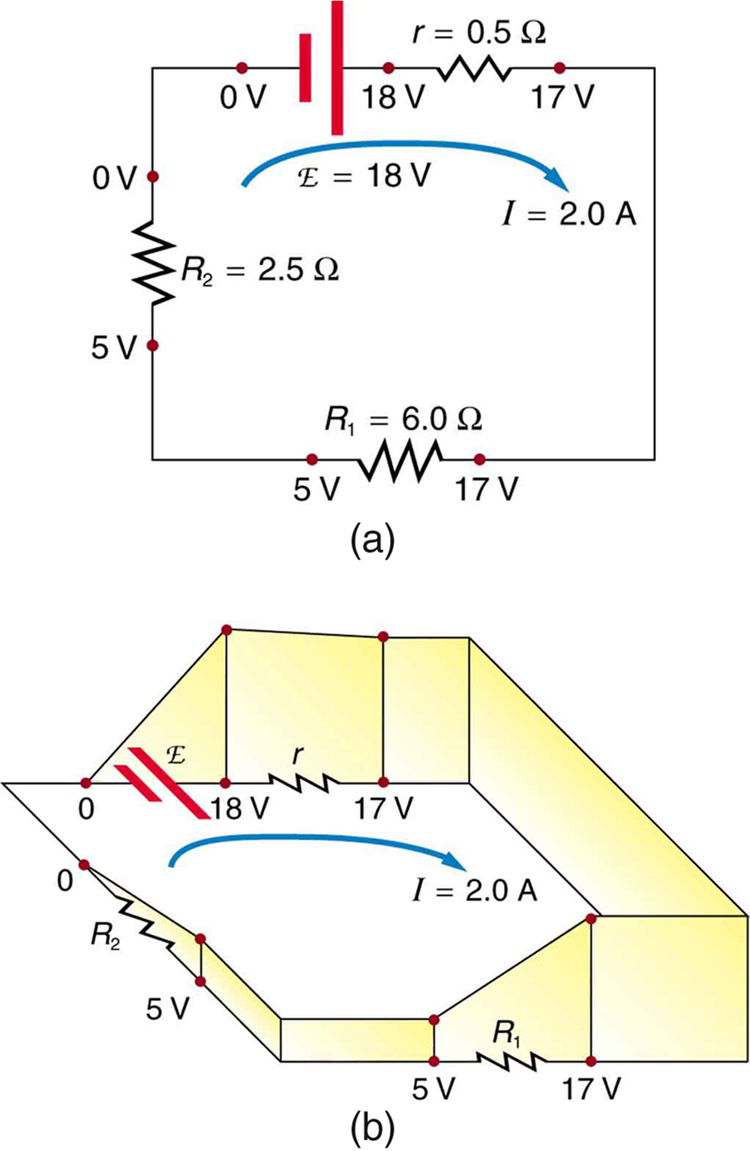
. Recall that emf is the potential difference of a source when no current is flowing. In a closed loop, whatever energy is supplied by emf must be transferred into other forms by devices in the loop, since there are no other ways in which energy can be transferred into or out of the circuit. [Figure 3] illustrates the changes in potential in a simple series circuit loop.
Kirchhoff’s second rule requires $\text{emf}-Ir-IR_{1}-IR_{2}=0$ . Rearranged, this is $\text{emf}=Ir+IR_{1}+IR_{2}$ , which means the emf equals the sum of the $IR$ (voltage) drops in the loop.
By applying Kirchhoff’s rules, we generate equations that allow us to find the unknowns in circuits. The unknowns may be currents, emfs, or resistances. Each time a rule is applied, an equation is produced. If there are as many independent equations as unknowns, then the problem can be solved. There are two decisions you must make when applying Kirchhoff’s rules. These decisions determine the signs of various quantities in the equations you obtain from applying the rules.
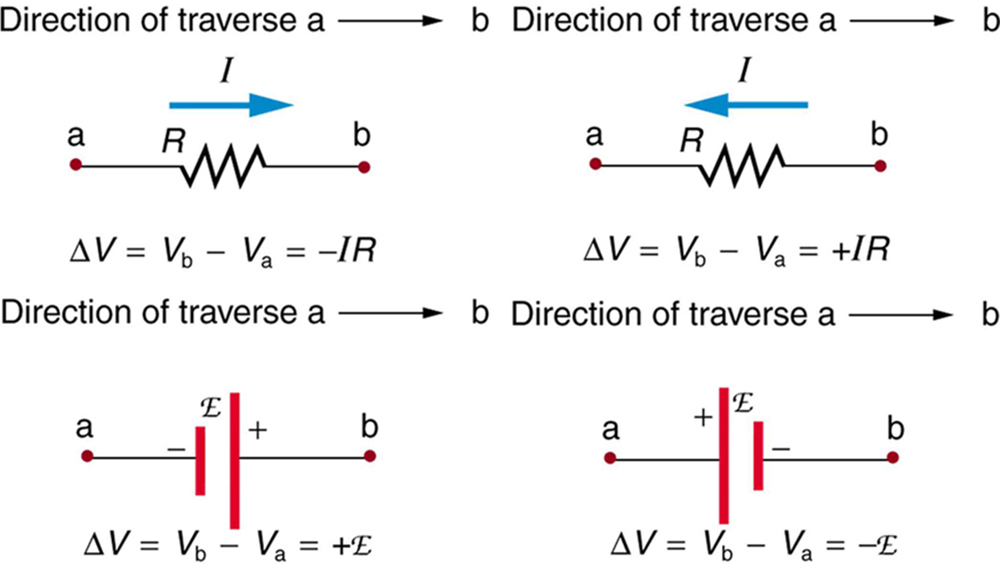
[Figure 4] and the following points will help you get the plus or minus signs right when applying the loop rule. Note that the resistors and emfs are traversed by going from a to b. In many circuits, it will be necessary to construct more than one loop. In traversing each loop, one needs to be consistent for the sign of the change in potential. (See [Example 1] .)
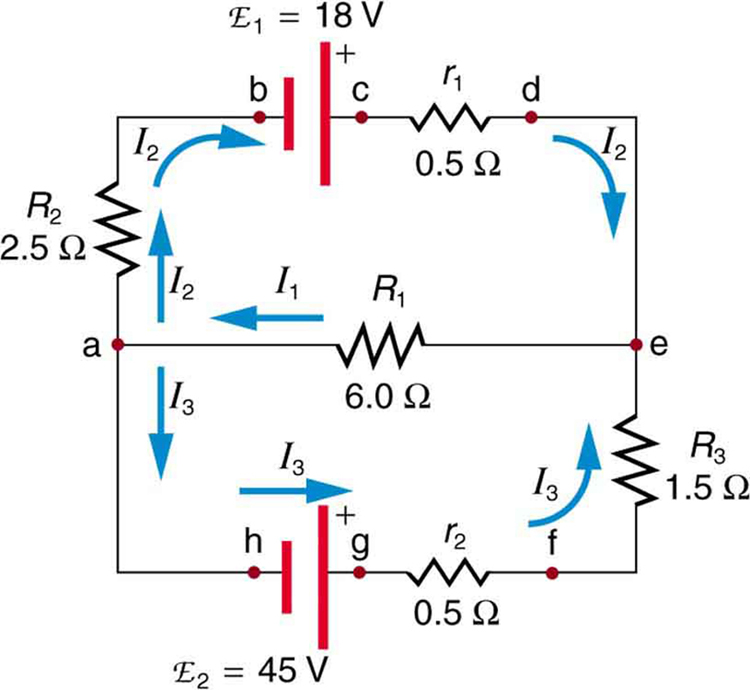
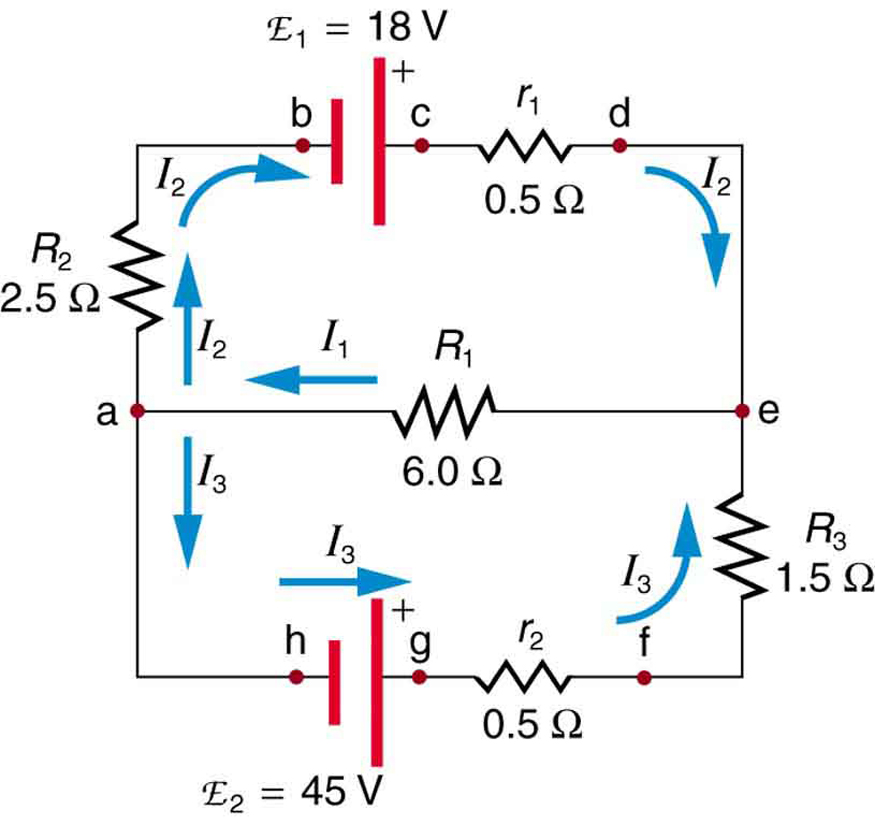
Find the currents flowing in the circuit in [Figure 5].
Strategy
This circuit is sufficiently complex that the currents cannot be found using Ohm’s law and the series-parallel techniques—it is necessary to use Kirchhoff’s rules. Currents have been labeled ${I}_{1}$ , ${I}_{2}$ , and ${I}_{3}$ in the figure and assumptions have been made about their directions. Locations on the diagram have been labeled with letters a through h. In the solution we will apply the junction and loop rules, seeking three independent equations to allow us to solve for the three unknown currents.
Solution
We begin by applying Kirchhoff’s first or junction rule at point a. This gives
since ${I}_{1}$ flows into the junction, while ${I}_{2}$ and ${I}_{3}$ flow out. Applying the junction rule at e produces exactly the same equation, so that no new information is obtained. This is a single equation with three unknowns—three independent equations are needed, and so the loop rule must be applied.
Now we consider the loop abcdea. Going from a to b, we traverse ${R}_{2}$ in the same (assumed) direction of the current ${I}_{2}$ , and so the change in potential is $-{I}_{2}{R}_{2}$ . Then going from b to c, we go from $-$ to +, so that the change in potential is $+{\text{emf}}_{1}$ . Traversing the internal resistance ${r}_{1}$ from c to d gives $-{I}_{2}{r}_{1}$ . Completing the loop by going from d to a again traverses a resistor in the same direction as its current, giving a change in potential of $-{I}_{1}{R}_{1}$.
The loop rule states that the changes in potential sum to zero. Thus,
Substituting values from the circuit diagram for the resistances and emf, and canceling the ampere unit gives
Now applying the loop rule to aefgha (we could have chosen abcdefgha as well) similarly gives
Note that the signs are reversed compared with the other loop, because elements are traversed in the opposite direction. With values entered, this becomes
These three equations are sufficient to solve for the three unknown currents. First, solve the second equation for ${I}_{2}$ :
Now solve the third equation for ${I}_{3}$ :
Substituting these two new equations into the first one allows us to find a value for ${I}_{1}$ :
Combining terms gives
Substituting this value for ${I}_{1}$ back into the fourth equation gives
The minus sign means ${I}_{2}$ flows in the direction opposite to that assumed in [Figure 5].
Finally, substituting the value for ${I}_{1}$ into the fifth equation gives
Discussion
Just as a check, we note that indeed ${I}_{1}={I}_{2}+{I}_{3}$ . The results could also have been checked by entering all of the values into the equation for the abcdefgha loop.
The material in this section is correct in theory. We should be able to verify it by making measurements of current and voltage. In fact, some of the devices used to make such measurements are straightforward applications of the principles covered so far and are explored in the next modules. As we shall see, a very basic, even profound, fact results—making a measurement alters the quantity being measured.
Can Kirchhoff’s rules be applied to simple series and parallel circuits or are they restricted for use in more complicated circuits that are not combinations of series and parallel?
Kirchhoff’s rules can be applied to any circuit since they are applications to circuits of two conservation laws. Conservation laws are the most broadly applicable principles in physics. It is usually mathematically simpler to use the rules for series and parallel in simpler circuits so we emphasize Kirchhoff’s rules for use in more complicated situations. But the rules for series and parallel can be derived from Kirchhoff’s rules. Moreover, Kirchhoff’s rules can be expanded to devices other than resistors and emfs, such as capacitors, and are one of the basic analysis devices in circuit analysis.
Can all of the currents going into the junction in [Figure 6] be positive? Explain.
Apply the junction rule to junction b in [Figure 7]. Is any new information gained by applying the junction rule at e? (In the figure, each emf is represented by script E.)
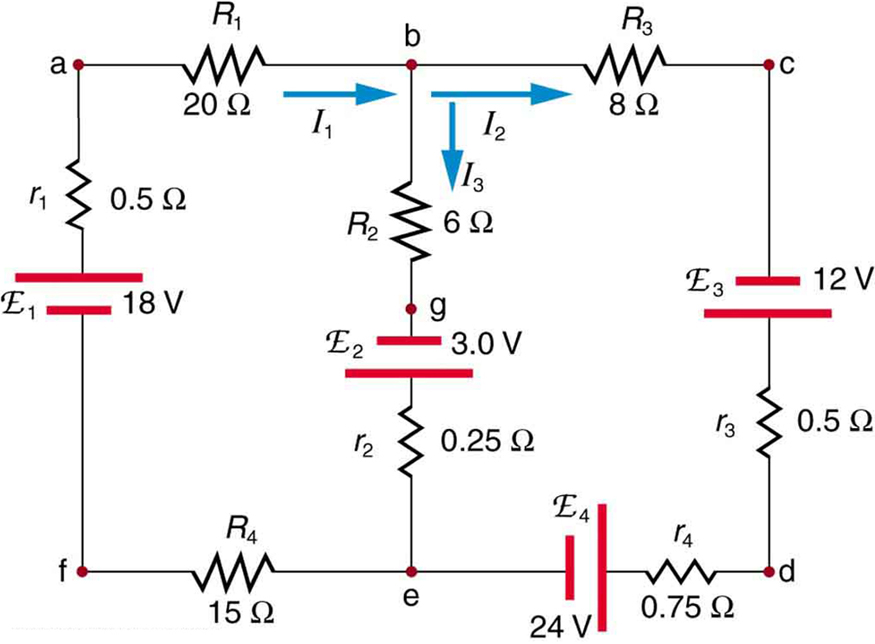
(a) What is the potential difference going from point a to point b in [Figure 7]? (b) What is the potential difference going from c to b? (c) From e to g? (d) From e to d?
Apply the loop rule to loop afedcba in [Figure 7].
Apply the loop rule to loops abgefa and cbgedc in [Figure 7].
Apply the loop rule to loop abcdefgha in [Figure 5].
Apply the loop rule to loop aedcba in [Figure 5].
Strategy
Traverse loop aedcba, summing potential changes. Use sign conventions: $-IR$ when traversing a resistor in the current direction, $+IR$ opposite to current, $+\text{emf}$ from - to +, $-\text{emf}$ from + to -.
Solution
Loop aedcba (clockwise):
Sum equals zero:
Rearranged:
Discussion
This is the same equation that would be obtained by combining the loop abcdea equation with the junction rule, demonstrating that not all loop equations are independent.
The loop equation is: $I_1 R_1 + I_3 r_2 - \text{emf}_2 - I_2 r_1 - I_2 R_2 = 0$.
Verify the second equation in [Example 1] by substituting the values found for the currents ${I}_{1}$ and ${I}_{2}$.
Strategy
From Example 1, the second equation is $-3I_2 + 18 - 6I_1 = 0$. The found values are $I_1 = 4.75 \text{ A}$ and $I_2 = -3.50 \text{ A}$. Substitute and verify the equation holds.
Solution
Substitute values into $-3I_2 + 18 - 6I_1 = 0$:
Discussion
The equation is satisfied exactly, confirming the solution is correct. This verification step is important in Kirchhoff’s Rules problems to catch algebraic errors.
Verified: $-3(-3.50) + 18 - 6(4.75) = 0$.
Verify the third equation in [Example 1] by substituting the values found for the currents ${I}_{1}$ and ${I}_{3}$.
Strategy
The third equation from Example 1 is $+6I_1 + 2I_3 - 45 = 0$. Substitute $I_1 = 4.75 \text{ A}$ and $I_3 = 8.25 \text{ A}$ to verify.
Solution
Discussion
The equation is satisfied, confirming our currents are correct. All three verification checks (junction rule and two loop equations) pass, giving confidence in the solution.
Verified: $+6(4.75) + 2(8.25) - 45 = 0$.
Apply the junction rule at point a in [Figure 8].
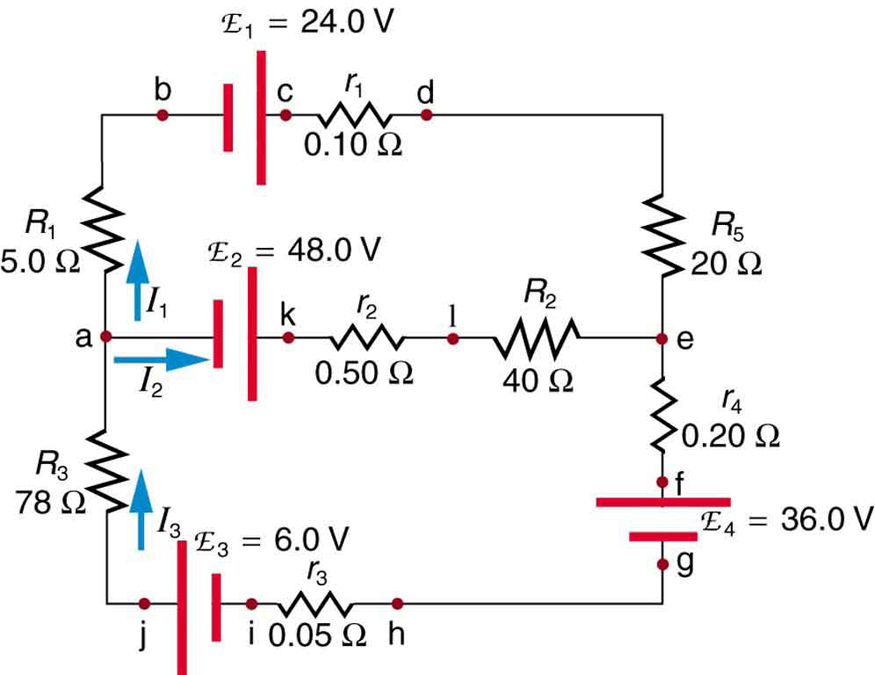
Apply the loop rule to loop abcdefghija in [Figure 8].
Strategy
Traverse the loop abcdefghija, applying the sign conventions for potential changes across resistors and emfs.
Solution
Traversing clockwise:
Sum equals zero:
Discussion
This equation relates $I_1$ and $I_3$ using the loop that connects both branches of the circuit.
The loop equation is: $-I_1(R_1 + r_1 + R_5) - I_3(R_3 + r_3 + R_4 + r_4) + \text{emf}_1 + \text{emf}_4 - \text{emf}_3 = 0$.
Apply the loop rule to loop akledcba in [Figure 8].
Find the currents flowing in the circuit in [Figure 8]. Explicitly show how you follow the steps in the Problem-Solving Strategies for Series and Parallel Resistors.
Strategy
Follow the systematic approach: (1) draw the circuit and label currents, (2) apply junction rule, (3) apply loop rule to get enough independent equations, (4) solve the system, (5) check reasonableness.
Solution
Step 1: Circuit is given in Figure 8. Label currents $I_1$, $I_2$, $I_3$ as shown.
Step 2: Apply junction rule at point a:
Step 3: Apply loop rules (assuming typical values from the figure):
Loop akledcba (already given in previous problem):
Loop abcdefghija:
Step 4: Solve the system of three equations for $I_1$, $I_2$, $I_3$. (Without specific values from Figure 8, we cannot provide numerical results, but the method is established.)
Step 5: Check that:
Discussion
The problem-solving strategy ensures systematic analysis of complex circuits. The three equations (one junction, two loops) allow solving for the three unknown currents. Without specific numerical values from the figure, we’ve established the framework for solution.
The solution requires the specific emf and resistance values from Figure 8 to obtain numerical current values.
Solve [Example 1], but use loop abcdefgha instead of loop akledcba. Explicitly show how you follow the steps in the Problem-Solving Strategies for Series and Parallel Resistors.
(a) $I_{1}=4.75 \text{A}$ (b) $I_{2}=-3.5 \text{A}$ (c) $I_{3}=8.25 \text{A}$
Find the currents flowing in the circuit in [Figure 7].
Strategy
Apply Kirchhoff’s rules systematically: identify junctions, apply junction rule, set up loop equations, and solve for all currents.
Solution
Without specific numerical values from Figure 7, we establish the method:
Junction rule at junction b (or e):
Loop rule for loop containing emf₁ and emf₂: Apply loop rule traversing through the various resistors and emf sources, summing potential changes to zero.
Loop rule for another independent loop: Choose a second loop to provide a third independent equation.
Solve the system of three equations for $I_1$, $I_2$, $I_3$.
Check that junction and loop rules are satisfied.
Discussion
Figure 7 shows a circuit with four emf sources, requiring careful application of Kirchhoff’s rules. The specific current values depend on the given emf and resistance values in the figure. The systematic method ensures all currents are found consistently.
Solution requires specific values from Figure 7 for numerical results.
Unreasonable Results
Consider the circuit in [Figure 9], and suppose that the emfs are unknown and the currents are given to be ${I}_{1}=5.00 \text{A}$ , ${I}_{2}=3.0\text{ A}$ , and ${I}_{3}= -2.00 \text{A}$ . (a) Could you find the emfs? (b) What is wrong with the assumptions?
(a) No, you would get inconsistent equations to solve.
(b) ${I}_{1}\ne {I}_{2}+{I}_{3}$ . The assumed currents violate the junction rule.