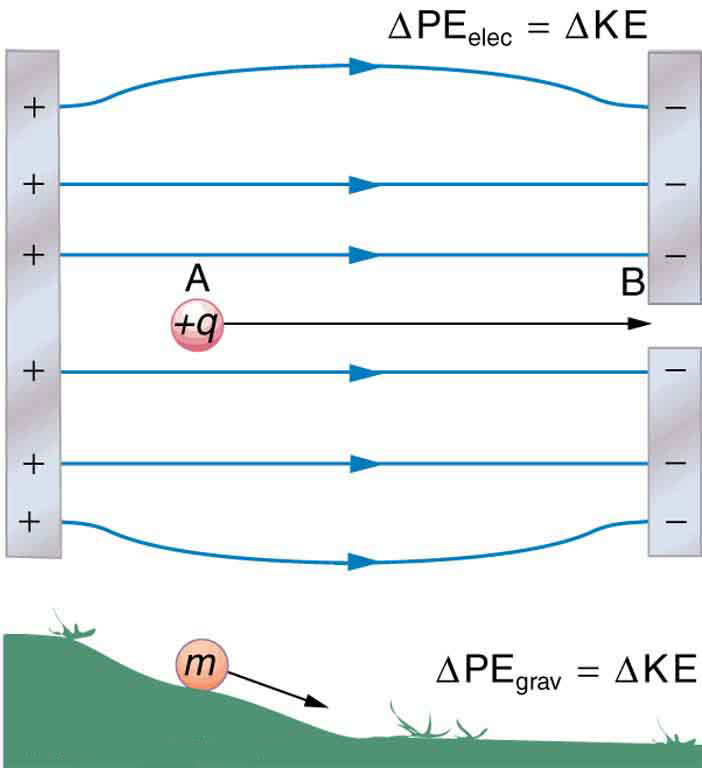
When a free positive charge \(q\) is accelerated by an electric field, such as shown in [Figure 1], it is given kinetic energy. The process is analogous to an object being accelerated by a gravitational field. It is as if the charge is going down an electrical hill where its electric potential energy is converted to kinetic energy. Let us explore the work done on a charge \(q\) by the electric field in this process, so that we may develop a definition of electric potential energy.
The electrostatic or Coulomb force is conservative, which means that the work done on \(q\) is independent of the path taken. This is exactly analogous to the gravitational force in the absence of dissipative forces such as friction. When a force is conservative, it is possible to define a potential energy associated with the force, and it is usually easier to deal with the potential energy (because it depends only on position) than to calculate the work directly.
We use the letters PE to denote electric potential energy, which has units of joules (J). The change in potential energy, \(\Delta \text{PE}\) , is crucial, since the work done by a conservative force is the negative of the change in potential energy; that is, \(W=-\Delta\text{PE}\) . For example, work \(W\) done to accelerate a positive charge from rest is positive and results from a loss in PE, or a negative \(\Delta \text{PE}\) . There must be a minus sign in front of \(\Delta \text{PE}\) to make \(W\) positive. PE can be found at any point by taking one point as a reference and calculating the work needed to move a charge to the other point.
\(W=-\Delta \text{PE}\) . For example, work \(W\) done to accelerate a positive charge from rest is positive and results from a loss in PE, or a negative \(\Delta \text{PE}.\) There must be a minus sign in front of \(\Delta \text{PE}\) to make \(W\) positive. PE can be found at any point by taking one point as a reference and calculating the work needed to move a charge to the other point.
Gravitational potential energy and electric potential energy are quite analogous. Potential energy accounts for work done by a conservative force and gives added insight regarding energy and energy transformation without the necessity of dealing with the force directly. It is much more common, for example, to use the concept of voltage (related to electric potential energy) than to deal with the Coulomb force directly.
Calculating the work directly is generally difficult, since \(W=Fd \cos \theta\) and the direction and magnitude of \(F\) can be complex for multiple charges, for odd-shaped objects, and along arbitrary paths. But we do know that, since \(F=qE\) , the work, and hence \(\Delta \text{PE}\) , is proportional to the test charge \(q.\) To have a physical quantity that is independent of test charge, we define electric potential \(V\) (or simply potential, since electric is understood) to be the potential energy per unit charge:
This is the electric potential energy per unit charge.
Since PE is proportional to \(q\) , the dependence on \(q\) cancels. Thus \(V\) does not depend on \(q\) . The change in potential energy \(\Delta \text{PE}\) is crucial, and so we are concerned with the difference in potential or potential difference \(\Delta V\) between two points, where
The potential difference between points A and B, \({V}_{\text{B}} - {V}_{\text{A}}\) , is thus defined to be the change in potential energy of a charge \(q\) moved from A to B, divided by the charge. Units of potential difference are joules per coulomb, given the name volt (V) after Alessandro Volta.
The potential difference between points A and B, \({V}_{B}-{V}_{A}\) , is defined to be the change in potential energy of a charge \(q\) moved from A to B, divided by the charge. Units of potential difference are joules per coulomb, given the name volt (V) after Alessandro Volta.
The familiar term voltage is the common name for potential difference. Keep in mind that whenever a voltage is quoted, it is understood to be the potential difference between two points. For example, every battery has two terminals, and its voltage is the potential difference between them. More fundamentally, the point you choose to be zero volts is arbitrary. This is analogous to the fact that gravitational potential energy has an arbitrary zero, such as sea level or perhaps a lecture hall floor.
In summary, the relationship between potential difference (or voltage) and electrical potential energy is given by
The relationship between potential difference (or voltage) and electrical potential energy is given by
The second equation is equivalent to the first.
Voltage is not the same as energy. Voltage is the energy per unit charge. Thus a motorcycle battery and a car battery can both have the same voltage (more precisely, the same potential difference between battery terminals), yet one stores much more energy than the other since \(\Delta \text{PE} = q\Delta V\) . The car battery can move more charge than the motorcycle battery, although both are 12 V batteries.
Suppose you have a 12.0 V motorcycle battery that can move 5000 C of charge, and a 12.0 V car battery that can move 60 000 C of charge. How much energy does each deliver? (Assume that the numerical value of each charge is accurate to three significant figures.)
Strategy
To say we have a 12.0 V battery means that its terminals have a 12.0 V potential difference. When such a battery moves charge, it puts the charge through a potential difference of 12.0 V, and the charge is given a change in potential energy equal to \(\Delta \text{PE} = q\Delta V\).
So to find the energy output, we multiply the charge moved by the potential difference.
Solution
For the motorcycle battery, \(q=5000 \text{C}\) and \(\Delta V=12.0 \text{V}\) . The total energy delivered by the motorcycle battery is
Similarly, for the car battery, \(q=60 000 \text{C}\) and
Discussion
While voltage and energy are related, they are not the same thing. The voltages of the batteries are identical, but the energy supplied by each is quite different. Note also that as a battery is discharged, some of its energy is used internally and its terminal voltage drops, such as when headlights dim because of a low car battery. The energy supplied by the battery is still calculated as in this example, but not all of the energy is available for external use.
Note that the energies calculated in the previous example are absolute values. The change in potential energy for the battery is negative, since it loses energy. These batteries, like many electrical systems, actually move negative charge—electrons in particular. The batteries repel electrons from their negative terminals (A) through whatever circuitry is involved and attract them to their positive terminals (B) as shown in [Figure 2]. The change in potential is \(\Delta V={V}_{\text{B}}-V_{\text{A}}=+12 \text{V}\) and the charge \(q\) is negative, so that \(\Delta \text{PE}=q\Delta V\) is negative, meaning the potential energy of the battery has decreased when \(q\) has moved from A to B.
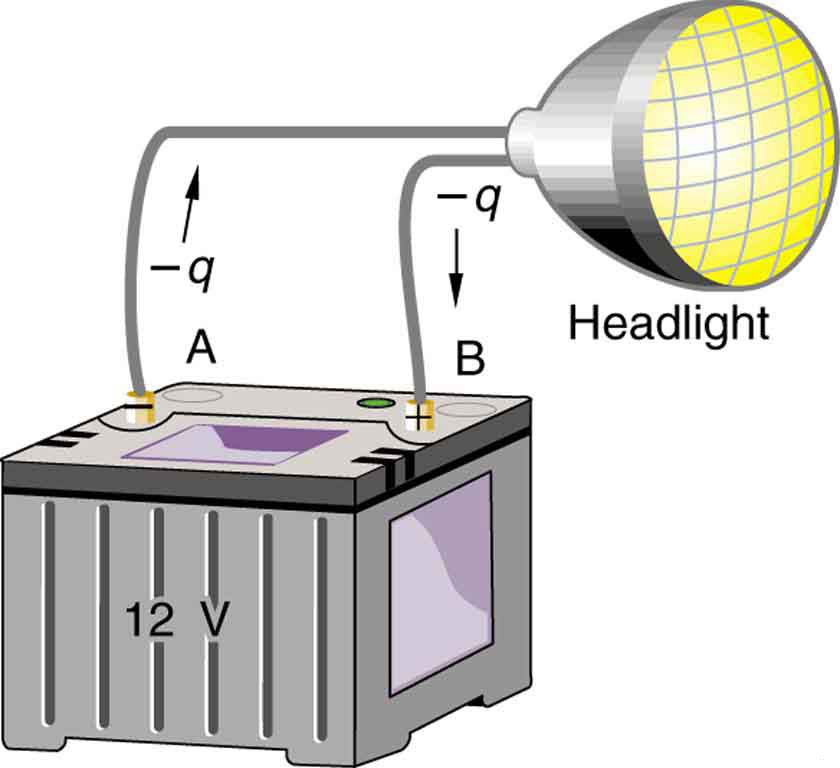
When a 12.0 V car battery runs a single 30.0 W headlight, how many electrons pass through it each second?
Strategy
To find the number of electrons, we must first find the charge that moved in 1.00 s. The charge moved is related to voltage and energy through the equation \(\Delta \text{PE}=q\Delta V\) . A 30.0 W lamp uses 30.0 joules per second. Since the battery loses energy, we have \(\Delta \text{PE}=-30.0 \text{J}\) and, since the electrons are going from the negative terminal to the positive, we see that \(\Delta V=+12.0 \text{V}\).
Solution
To find the charge \(q\) moved, we solve the equation \(\Delta \text{PE}=q\Delta V\) :
Entering the values for \(\Delta \text{PE}\) and \(\Delta V\) , we get
The number of electrons \({\text{n}}_{\text{e}}\) is the total charge divided by the charge per electron. That is,
Discussion
This is a very large number. It is no wonder that we do not ordinarily observe individual electrons with so many being present in ordinary systems. In fact, electricity had been in use for many decades before it was determined that the moving charges in many circumstances were negative. Positive charge moving in the opposite direction of negative charge often produces identical effects; this makes it difficult to determine which is moving or whether both are moving.
The energy per electron is very small in macroscopic situations like that in the previous example—a tiny fraction of a joule. But on a submicroscopic scale, such energy per particle (electron, proton, or ion) can be of great importance. For example, even a tiny fraction of a joule can be great enough for these particles to destroy organic molecules and harm living tissue. The particle may do its damage by direct collision, or it may create harmful X-rays, which can also inflict damage. It is useful to have an energy unit related to submicroscopic effects. [Figure 3] shows a situation related to the definition of such an energy unit. An electron is accelerated between two charged metal plates as it might be in an old-model television tube or oscilloscope. The electron is given kinetic energy that is later converted to another form—light in the television tube, for example. (Note that downhill for the electron is uphill for a positive charge.) Since energy is related to voltage by \(\Delta \text{PE}=q\Delta V,\) we can think of the joule as a coulomb-volt.
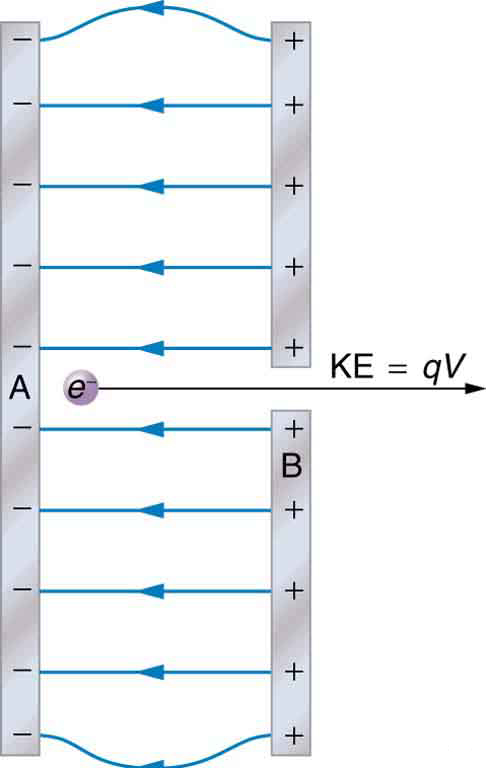
On the submicroscopic scale, it is more convenient to define an energy unit called the electron volt (eV), which is the energy given to a fundamental charge accelerated through a potential difference of 1 V. In equation form,
On the submicroscopic scale, it is more convenient to define an energy unit called the electron volt (eV), which is the energy given to a fundamental charge accelerated through a potential difference of 1 V. In equation form,
An electron accelerated through a potential difference of 1 V is given an energy of 1 eV. It follows that an electron accelerated through 50 V is given 50 eV. A potential difference of 100 000 V (100 kV) will give an electron an energy of 100 000 eV (100 keV), and so on. Similarly, an ion with a double positive charge accelerated through 100 V will be given 200 eV of energy. These simple relationships between accelerating voltage and particle charges make the electron volt a simple and convenient energy unit in such circumstances.
The electron volt (eV) is the most common energy unit for submicroscopic processes. This will be particularly noticeable in the chapters on modern physics. Energy is so important to so many subjects that there is a tendency to define a special energy unit for each major topic. There are, for example, calories for food energy, kilowatt-hours for electrical energy, and therms for natural gas energy.
The electron volt is commonly employed in submicroscopic processes—chemical valence energies and molecular and nuclear binding energies are among the quantities often expressed in electron volts. For example, about 5 eV of energy is required to break up certain organic molecules. If a proton is accelerated from rest through a potential difference of 30 kV, it is given an energy of 30 keV (30 000 eV) and it can break up as many as 6000 of these molecules ( \(30 000 \text{eV}÷5 \text{eV per molecule}=6000 \text{molecules}\) ). Nuclear decay energies are on the order of 1 MeV (1 000 eV) per event and can, thus, produce significant biological damage.
The total energy of a system is conserved if there is no net addition (or subtraction) of work or heat transfer. For conservative forces, such as the electrostatic force, conservation of energy states that mechanical energy is a constant.
Mechanical energy is the sum of the kinetic energy and potential energy of a system; that is, \(\text{KE}+\text{PE = constant}\) . A loss of PE of a charged particle becomes an increase in its KE. Here PE is the electric potential energy. Conservation of energy is stated in equation form as
or
where i and f stand for initial and final conditions. As we have found many times before, considering energy can give us insights and facilitate problem-solving.
Calculate the final speed of a free electron accelerated from rest through a potential difference of 100 V. (Assume that this numerical value is accurate to three significant figures.)
Strategy
We have a system with only conservative forces. Assuming the electron is accelerated in a vacuum, and neglecting the gravitational force (we will check on this assumption later), all of the electrical potential energy is converted into kinetic energy. We can identify the initial and final forms of energy to be \({\text{KE}}_{i}=0, {\text{KE}}_{f}=½mv^{2}, {\text{PE}}_{i}=qV{\text{, and }}\) \text{PE}_{f}=0.
Solution
Conservation of energy states that
Entering the forms identified above, we obtain
We solve this for \(v\) :
Entering values for \(q, V\text{, and } m\) gives
Discussion
Note that both the charge and the initial voltage are negative, as in [Figure 3]. From the discussions in Electric Charge and Electric Field, we know that electrostatic forces on small particles are generally very large compared with the gravitational force. The large final speed confirms that the gravitational force is indeed negligible here. The large speed also indicates how easy it is to accelerate electrons with small voltages because of their very small mass. Voltages much higher than the 100 V in this problem are typically used in electron guns. Those higher voltages produce electron speeds so great that relativistic effects must be taken into account. That is why a low voltage is considered (accurately) in this example.
Electric potential is potential energy per unit charge.
The potential difference between points A and B, \({V}_{B}-{V}_{A}\) , defined to be the change in potential energy of a charge \(q\) moved from A to B, is equal to the change in potential energy divided by the charge, Potential difference is commonly called voltage, represented by the symbol \(\Delta V\) .
An electron volt is the energy given to a fundamental charge accelerated through a potential difference of 1 V. In equation form,
Mechanical energy is the sum of the kinetic energy and potential energy of a system, that is, \(\text{KE}+\text{PE}.\) This sum is a constant.
Voltage is the common word for potential difference. Which term is more descriptive, voltage or potential difference?
If the voltage between two points is zero, can a test charge be moved between them with zero net work being done? Can this necessarily be done without exerting a force? Explain.
What is the relationship between voltage and energy? More precisely, what is the relationship between potential difference and electric potential energy?
Voltages are always measured between two points. Why?
How are units of volts and electron volts related? How do they differ?
Find the ratio of speeds of an electron and a negative hydrogen ion (one having an extra electron) accelerated through the same voltage, assuming non-relativistic final speeds. Take the mass of the hydrogen ion to be \(1.67 \times 10^{-27} \text{kg}\text{.}\)
Strategy
Both particles start at rest and are accelerated through the same potential difference. Since they have the same magnitude of charge (both are singly charged), they gain the same kinetic energy. We can use conservation of energy to relate the final speed to the mass, then form a ratio to compare the two speeds.
Solution
For a charged particle accelerated from rest through a potential difference \(V\), the kinetic energy gained equals the work done by the electric field:
\[ \text{KE} = qV \]For a particle starting from rest:
\[ \frac{1}{2}mv^{2} = qV \]Solving for velocity:
\[ v = \sqrt{\frac{2qV}{m}} \]Since both particles have the same charge magnitude \(q\) and are accelerated through the same voltage \(V\), the ratio of their speeds is:
\[ \frac{v_e}{v_{\text{H}^-}} = \frac{\sqrt{\frac{2qV}{m_e}}}{\sqrt{\frac{2qV}{m_{\text{H}^-}}}} = \sqrt{\frac{m_{\text{H}^-}}{m_e}} \]Substituting the known masses:
Discussion
The electron moves about 43 times faster than the hydrogen ion because it has nearly 2000 times less mass. This result demonstrates why electrons are preferred in devices like cathode ray tubes and electron microscopes—they are much easier to accelerate to high speeds. The ratio depends only on the square root of the mass ratio, which is why the speed ratio (42.8) is much smaller than the mass ratio (1834). This is a direct consequence of kinetic energy depending on \(v^2\).
The ratio of speeds is 42.8, with the electron traveling faster than the hydrogen ion.
An evacuated tube uses an accelerating voltage of 40 kV to accelerate electrons to hit a copper plate and produce X-rays. Non-relativistically, what would be the maximum speed of these electrons?
Strategy
The electrons start at rest and are accelerated through a potential difference of 40 kV. Using conservation of energy, the electrical potential energy lost by the electron is converted entirely to kinetic energy (assuming no energy losses in the evacuated tube). We’ll apply the energy conservation equation to find the final speed.
Solution
Known quantities:
Unknown: Maximum speed \(v\)
The kinetic energy gained equals the work done by the electric field:
\[ \frac{1}{2}m_e v^2 = eV \]Solving for velocity:
\[ v = \sqrt{\frac{2eV}{m_e}} \]Substituting values:
\[ v = \sqrt{\frac{2(1.60 \times 10^{-19} \text{ C})(40,000 \text{ V})}{9.11 \times 10^{-31} \text{ kg}}} \] \[ v = \sqrt{\frac{1.28 \times 10^{-14} \text{ J}}{9.11 \times 10^{-31} \text{ kg}}} \] \[ v = \sqrt{1.405 \times 10^{16} \text{ m}^2/\text{s}^2} \] \[ v = 1.19 \times 10^{8} \text{ m/s} \]Discussion
This calculated speed is about 40% of the speed of light (\(c = 3.0 \times 10^8\) m/s). At this speed, relativistic effects become significant (typically when \(v > 0.1c\)), so our non-relativistic answer is an approximation. The actual speed would be somewhat lower due to relativistic mass increase. This is why the problem specifically asks for the non-relativistic result. X-ray tubes indeed operate at these high voltages, and the high-speed electrons produce X-rays when they rapidly decelerate upon hitting the copper target (bremsstrahlung radiation) or when they knock inner-shell electrons out of copper atoms (characteristic X-rays).
The maximum speed of the electrons is \(1.19 \times 10^{8}\) m/s (non-relativistically).
A bare helium nucleus has two positive charges and a mass of \(6.64 \times 10^{-27} \text{kg}\text{.}\) (a) Calculate its kinetic energy in joules at 2.00% of the speed of light. (b) What is this in electron volts? (c) What voltage would be needed to obtain this energy?
Strategy
A bare helium nucleus (alpha particle) has two protons and two neutrons, with a charge of \(+2e\). We’ll use the classical kinetic energy formula for part (a), convert to electron volts for part (b), and then use the relationship between kinetic energy and voltage for part (c). Since 2% of the speed of light is well below the relativistic regime, the classical formula is appropriate.
Solution
Known quantities:
(a) Kinetic energy in joules:
\[ \text{KE} = \frac{1}{2}mv^{2} \] \[ \text{KE} = \frac{1}{2}(6.64 \times 10^{-27} \text{ kg})(6.00 \times 10^{6} \text{ m/s})^2 \] \[ \text{KE} = \frac{1}{2}(6.64 \times 10^{-27} \text{ kg})(3.60 \times 10^{13} \text{ m}^2/\text{s}^2) \] \[ \text{KE} = 1.20 \times 10^{-13} \text{ J} \](b) Kinetic energy in electron volts:
Using the conversion \(1 \text{ eV} = 1.60 \times 10^{-19} \text{ J}\):
\[ \text{KE} = \frac{1.20 \times 10^{-13} \text{ J}}{1.60 \times 10^{-19} \text{ J/eV}} \] \[ \text{KE} = 7.48 \times 10^{5} \text{ eV} = 748 \text{ keV} \](c) Voltage needed:
The kinetic energy gained by a charge accelerated through a potential difference is \(\text{KE} = qV\). Solving for voltage:
\[ V = \frac{\text{KE}}{q} = \frac{1.20 \times 10^{-13} \text{ J}}{3.20 \times 10^{-19} \text{ C}} \] \[ V = 3.74 \times 10^{5} \text{ V} = 374 \text{ kV} \]Discussion
The helium nucleus needs about 374 kV to reach 2% of the speed of light, which is a substantial but achievable voltage in particle accelerators. Notice that the voltage (374 kV) is exactly half the energy in keV (748 keV) because the helium nucleus has a charge of \(+2e\). This relationship (\(V = \text{KE}_{(\text{eV})}/q_{(\text{in } e)}\)) is very useful for quick calculations. The electron volt is a convenient unit here because energies in the keV to MeV range are typical for nuclear and particle physics experiments.
(a) The kinetic energy is \(1.20 \times 10^{-13}\) J.
(b) The kinetic energy is \(7.48 \times 10^{5}\) eV or 748 keV.
(c) The required voltage is \(3.74 \times 10^{5}\) V or 374 kV.
Integrated Concepts
Singly charged gas ions are accelerated from rest through a voltage of 13.0 V. At what temperature will the average kinetic energy of gas molecules be the same as that given these ions?
Strategy
This problem connects electrostatics with thermodynamics. When a singly charged ion is accelerated through a voltage, it gains kinetic energy \(\text{KE} = eV\). For gas molecules in thermal equilibrium, the average kinetic energy is given by the equipartition theorem: \(\overline{\text{KE}} = \frac{3}{2}k_B T\). We’ll set these equal and solve for temperature.
Solution
Known quantities:
Unknown: Temperature \(T\)
The kinetic energy gained by the ion:
\[ \text{KE}_{\text{ion}} = eV = (1.60 \times 10^{-19} \text{ C})(13.0 \text{ V}) = 2.08 \times 10^{-18} \text{ J} \]The average kinetic energy of gas molecules at temperature \(T\):
\[ \overline{\text{KE}}_{\text{gas}} = \frac{3}{2}k_B T \]Setting these equal:
\[ \frac{3}{2}k_B T = eV \]Solving for temperature:
\[ T = \frac{2eV}{3k_B} \] \[ T = \frac{2(1.60 \times 10^{-19} \text{ C})(13.0 \text{ V})}{3(1.38 \times 10^{-23} \text{ J/K})} \] \[ T = \frac{4.16 \times 10^{-18} \text{ J}}{4.14 \times 10^{-23} \text{ J/K}} \] \[ T = 1.00 \times 10^{5} \text{ K} \]Discussion
A temperature of 100,000 K is extremely hot—much hotter than the surface of the Sun (about 5,800 K). This illustrates how even modest voltages can impart significant kinetic energy to charged particles. At this temperature, all matter would exist as plasma (ionized gas). This connection between temperature and voltage is important in plasma physics and helps explain why particle accelerators are sometimes called “atom smashers”—they can impart energies equivalent to billions of degrees Kelvin to particles.
The temperature at which gas molecules have the same average kinetic energy is \(1.00 \times 10^{5}\) K or 100,000 K.
Integrated Concepts
The temperature near the center of the Sun is thought to be 15 million degrees Celsius \(\left( 1.5 \times 10^{7} ºC\right)\) . Through what voltage must a singly charged ion be accelerated to have the same energy as the average kinetic energy of ions at this temperature?
Strategy
This is the inverse of the previous problem. We know the temperature and need to find the equivalent voltage. We’ll calculate the average kinetic energy at the Sun’s core temperature using \(\overline{\text{KE}} = \frac{3}{2}k_B T\), then find the voltage that would give a singly charged ion the same energy using \(\text{KE} = eV\).
Solution
Known quantities:
Unknown: Voltage \(V\)
The average kinetic energy at temperature \(T\):
\[ \overline{\text{KE}} = \frac{3}{2}k_B T \] \[ \overline{\text{KE}} = \frac{3}{2}(1.38 \times 10^{-23} \text{ J/K})(1.5 \times 10^{7} \text{ K}) \] \[ \overline{\text{KE}} = 3.11 \times 10^{-16} \text{ J} \]For a singly charged ion to gain this energy:
\[ eV = \overline{\text{KE}} \] \[ V = \frac{\overline{\text{KE}}}{e} = \frac{3.11 \times 10^{-16} \text{ J}}{1.60 \times 10^{-19} \text{ C}} \] \[ V = 1.94 \times 10^{3} \text{ V} \approx 1.9 \text{ kV} \]Discussion
Surprisingly, only about 2 kV is needed to accelerate ions to energies equivalent to the Sun’s core temperature. This relatively modest voltage (easily achieved in laboratory settings) corresponds to 15 million degrees because the Boltzmann constant is so small. The Sun’s core temperature is sufficient for hydrogen nuclei to overcome their mutual Coulomb repulsion and undergo nuclear fusion. The energy per particle (about 2 keV) is significant on the atomic scale but small compared to macroscopic energies. This explains why fusion requires such extreme conditions—you need many particles at these energies confined long enough for fusion reactions to occur.
The required voltage is approximately 1.9 kV or \(1.94 \times 10^{3}\) V.
Integrated Concepts
(a) What is the average power output of a heart defibrillator that dissipates 400 J of energy in 10.0 ms? (b) Considering the high-power output, why doesn’t the defibrillator produce serious burns?
Strategy
Power is the rate of energy transfer, defined as \(P = E/t\). For part (a), we’ll calculate the average power from the given energy and time. Part (b) requires understanding how electrical energy interacts with body tissue.
Solution
(a) Average power output:
Known quantities:
(b) Why no serious burns:
Despite the high power output (40 kW—comparable to about 400 household light bulbs), the defibrillator does not cause serious burns for several reasons:
Short duration: The energy is delivered in only 10 ms, limiting the total heat deposited in any one location.
Conductive pathway: At the high voltages used in defibrillators (typically 1,000–5,000 V), the skin’s electrical resistance drops significantly. The current passes through the body to the heart rather than being absorbed primarily by the skin.
Conductive gel: Electrode gel reduces contact resistance and spreads the current over a larger area, preventing “hot spots” that could cause burns.
Energy distribution: The 400 J is distributed throughout the chest cavity, not concentrated at the skin surface.
Impedance matching: Modern defibrillators measure chest impedance and adjust the waveform to deliver energy efficiently to the heart.
Discussion
The 40 kW power output is enormous but brief. By comparison, a lightning strike can deliver billions of watts, but it lasts only microseconds. The key factor for thermal burns is total energy deposited in a specific tissue, not instantaneous power. The defibrillator is designed to deliver most of its energy to the heart muscle (which needs the electrical stimulus to restore rhythm) rather than to the skin.
(a) The average power output is \(4.00 \times 10^{4}\) W or 40.0 kW.
(b) Burns are minimized because the pulse is very brief, conductive gel distributes current over a wide area, and high voltage reduces skin resistance so energy passes through to the heart rather than being absorbed at the surface.
Integrated Concepts
A lightning bolt strikes a tree, moving 20.0 C of charge through a potential difference of \(1.00 \times 10^{2} \text{MV}\) . (a) What energy was dissipated? (b) What mass of water could be raised from \(15 \text{ºC}\) to the boiling point and then boiled by this energy? (c) Discuss the damage that could be caused to the tree by the expansion of the boiling steam.
Strategy
This problem connects electrical energy to thermal energy and phase changes. For part (a), we use \(E = qV\) to find the electrical energy. For part (b), we need to calculate both the energy to heat water from 15 °C to 100 °C and the energy to vaporize it, then find what mass can be processed with the available energy. Part (c) is conceptual.
Solution
(a) Energy dissipated:
Known quantities:
(b) Mass of water heated and boiled:
Known quantities:
The total energy required per kilogram of water:
\[ E_{\text{per kg}} = c \Delta T + L_v \] \[ E_{\text{per kg}} = (4186 \text{ J/(kg·°C)})(85°\text{C}) + 2.26 \times 10^{6} \text{ J/kg} \] \[ E_{\text{per kg}} = 3.56 \times 10^{5} \text{ J/kg} + 2.26 \times 10^{6} \text{ J/kg} = 2.62 \times 10^{6} \text{ J/kg} \]The mass of water that can be heated and boiled:
\[ m = \frac{E}{E_{\text{per kg}}} = \frac{2.00 \times 10^{9} \text{ J}}{2.62 \times 10^{6} \text{ J/kg}} = 764 \text{ kg} \](c) Damage from steam expansion:
When water vaporizes, it expands by a factor of approximately 1,700 at atmospheric pressure. The sudden vaporization of water inside a tree (in the sap, moisture in the wood, etc.) creates an explosive expansion of steam. This causes:
Explosive fragmentation: The rapid steam expansion can literally blow the tree apart from the inside out. Trees are often found splintered or with large sections of bark blown off after lightning strikes.
Structural damage: The pressure wave from the steam expansion creates fractures throughout the wood, weakening the tree’s structural integrity.
Stripping of bark: The steam expanding under the bark can completely strip it from large sections of the trunk.
Fire initiation: The superheated steam and electrical heating can ignite the dried-out wood, causing fires.
Discussion
The 2 GJ of energy is equivalent to about 500 kg of TNT. This enormous energy, delivered in microseconds, causes catastrophic damage. The calculation shows that nearly 800 kg of water could be boiled—far more than the moisture content of a typical tree. This explains why lightning strikes are so devastating: the energy is more than sufficient to explosively vaporize all the water in the strike path, and the rapid expansion of this steam (by a factor of 1,700) acts like an explosion.
(a) The energy dissipated is \(2.00 \times 10^{9}\) J or 2.00 GJ.
(b) The mass of water that could be heated and boiled is 764 kg.
(c) The rapid conversion of water to steam causes explosive expansion (volume increases ~1,700 times), which can blow the tree apart, strip bark, splinter wood, and initiate fires.
Integrated Concepts
A 12.0 V battery-operated bottle warmer heats 50.0 g of glass, \(2.50 \times 10^{2} \text{g}\) of baby formula, and \(2.00 \times 10^{2} \text{g}\) of aluminum from \(20.0ºC\) to \(90.0ºC\) . (a) How much charge is moved by the battery? (b) How many electrons per second flow if it takes 5.00 min to warm the formula? (Hint: Assume that the specific heat of baby formula is about the same as the specific heat of water.)
Strategy
This problem integrates thermodynamics with electrostatics. First, we calculate the total thermal energy needed to heat all three materials using \(Q_{\text{thermal}} = mc\Delta T\) for each. Then, we use the relationship \(E = qV\) to find the charge moved. For part (b), we find the current and convert to electrons per second.
Solution
(a) Charge moved by the battery:
Known quantities:
Calculate the heat required for each material:
\[ Q_g = m_g c_g \Delta T = (0.0500 \text{ kg})(840 \text{ J/(kg·°C)})(70.0°\text{C}) = 2940 \text{ J} \] \[ Q_f = m_f c_f \Delta T = (0.250 \text{ kg})(4186 \text{ J/(kg·°C)})(70.0°\text{C}) = 73,255 \text{ J} \] \[ Q_a = m_a c_a \Delta T = (0.200 \text{ kg})(900 \text{ J/(kg·°C)})(70.0°\text{C}) = 12,600 \text{ J} \]Total thermal energy:
\[ Q_{\text{total}} = Q_g + Q_f + Q_a = 2940 + 73,255 + 12,600 = 88,795 \text{ J} \]Using the energy-voltage relationship \(E = qV\):
\[ q = \frac{E}{V} = \frac{88,795 \text{ J}}{12.0 \text{ V}} = 7.40 \times 10^{3} \text{ C} \](b) Electrons per second:
Time: \(t = 5.00 \text{ min} = 300 \text{ s}\)
Current (charge per unit time):
\[ I = \frac{q}{t} = \frac{7.40 \times 10^{3} \text{ C}}{300 \text{ s}} = 24.7 \text{ A} \]Number of electrons per second:
\[ n = \frac{I}{e} = \frac{24.7 \text{ C/s}}{1.60 \times 10^{-19} \text{ C/electron}} = 1.54 \times 10^{20} \text{ electrons/s} \]Discussion
The baby formula requires by far the most energy (about 82% of the total) because of water’s high specific heat. The current of about 25 A is quite high for a 12 V battery—this would require a fairly large battery and would drain it relatively quickly. The enormous number of electrons flowing (about 154 quintillion per second) illustrates why we don’t normally observe individual electrons in everyday electrical devices. This problem shows how electrical energy from a battery is efficiently converted to thermal energy for practical applications.
(a) The charge moved by the battery is \(7.40 \times 10^{3}\) C.
(b) The electron flow rate is \(1.54 \times 10^{20}\) electrons per second.
Integrated Concepts
A battery-operated car utilizes a 12.0 V system. Find the charge the batteries must be able to move in order to accelerate the 750 kg car from rest to 25.0 m/s, make it climb a \(2.00 \times 10^{2} \text{m}\) high hill, and then cause it to travel at a constant 25.0 m/s by exerting a \(5.00 \times 10^{2} \text{N}\)
force for an hour.
Strategy
This problem requires calculating the total energy needed for three phases of the car’s journey: (1) acceleration from rest, (2) climbing a hill, and (3) overcoming resistance forces while traveling at constant speed. We’ll sum these energies and then use \(E = qV\) to find the required charge.
Solution
Known quantities:
Phase 1: Acceleration from rest to 25.0 m/s
Energy needed equals the kinetic energy gained:
\[ E_1 = \frac{1}{2}mv^{2} = \frac{1}{2}(750 \text{ kg})(25.0 \text{ m/s})^2 = 234,375 \text{ J} \]Phase 2: Climbing 200 m hill
Energy needed equals the gravitational potential energy gained:
\[ E_2 = mgh = (750 \text{ kg})(9.80 \text{ m/s}^2)(200 \text{ m}) = 1,470,000 \text{ J} \]Phase 3: Constant velocity travel
Distance traveled at constant speed:
\[ d = vt = (25.0 \text{ m/s})(3600 \text{ s}) = 90,000 \text{ m} \]Energy needed to overcome resistance force:
\[ E_3 = Fd = (500 \text{ N})(90,000 \text{ m}) = 45,000,000 \text{ J} \]Total energy:
\[ E_{\text{total}} = E_1 + E_2 + E_3 = 234,375 + 1,470,000 + 45,000,000 \] \[ E_{\text{total}} = 46,704,375 \text{ J} \approx 4.67 \times 10^{7} \text{ J} \]Charge required:
\[ q = \frac{E_{\text{total}}}{V} = \frac{4.67 \times 10^{7} \text{ J}}{12.0 \text{ V}} = 3.89 \times 10^{6} \text{ C} \]Discussion
The vast majority of energy (about 96%) is used for Phase 3—overcoming resistance while traveling at constant speed for an hour. This makes sense because the car travels 90 km during this phase. The charge of nearly 4 million coulombs is enormous, representing a battery capacity of about 1,080 amp-hours (since \(q = It\)). Modern electric vehicles use higher voltage systems (300-800 V) specifically to reduce the current and charge requirements for a given energy. At 12 V, the average current would be about 1,080 A, which would require impractically large cables and batteries.
The charge the batteries must be able to move is \(3.89 \times 10^{6}\) C.
Integrated Concepts
Fusion probability is greatly enhanced when appropriate nuclei are brought close together, but mutual Coulomb repulsion must be overcome. This can be done using the kinetic energy of high-temperature gas ions or by accelerating the nuclei toward one another. (a) Calculate the potential energy of two singly charged nuclei separated by \(1.00 \times 10^{-12} \text{m}\) by finding the voltage of one at that distance and multiplying by the charge of the other. (b) At what temperature will atoms of a gas have an average kinetic energy equal to this needed electrical potential energy?
Strategy
This problem connects nuclear physics with thermodynamics. For part (a), we’ll use the point charge potential formula \(V = kq/r\) to find the voltage due to one nucleus, then multiply by the charge of the other to get potential energy. For part (b), we’ll equate this to the thermal kinetic energy \(\frac{3}{2}k_BT\) and solve for temperature.
Solution
(a) Potential energy of two nuclei:
Known quantities:
First, find the electric potential at distance \(r\) from one nucleus:
\[ V = \frac{kq}{r} = \frac{(8.99 \times 10^{9} \text{ N·m}^2/\text{C}^2)(1.60 \times 10^{-19} \text{ C})}{1.00 \times 10^{-12} \text{ m}} \] \[ V = \frac{1.44 \times 10^{-9} \text{ J/C}}{1.00 \times 10^{-12}} = 1.44 \times 10^{3} \text{ V} = 1.44 \text{ kV} \]The potential energy is the voltage times the charge of the second nucleus:
\[ \text{PE} = qV = (1.60 \times 10^{-19} \text{ C})(1.44 \times 10^{3} \text{ V}) \] \[ \text{PE} = 2.30 \times 10^{-16} \text{ J} \]This can also be written as:
\[ \text{PE} = \frac{kq^{2}}{r} = \frac{(8.99 \times 10^{9})(1.60 \times 10^{-19})^2}{1.00 \times 10^{-12}} = 2.30 \times 10^{-16} \text{ J} \]Or in electron volts: \(\text{PE} = 1.44 \text{ keV}\)
(b) Temperature for equivalent kinetic energy:
Setting average thermal kinetic energy equal to the electrical potential energy:
\[ \frac{3}{2}k_B T = \text{PE} \] \[ T = \frac{2 \cdot \text{PE}}{3k_B} = \frac{2(2.30 \times 10^{-16} \text{ J})}{3(1.38 \times 10^{-23} \text{ J/K})} \] \[ T = \frac{4.60 \times 10^{-16} \text{ J}}{4.14 \times 10^{-23} \text{ J/K}} = 1.11 \times 10^{7} \text{ K} \]Discussion
The calculated temperature of about 11 million K is similar to the temperature at the Sun’s core (15 million K). This is not a coincidence—nuclear fusion in the Sun requires bringing hydrogen nuclei close enough together to fuse, which requires overcoming their Coulomb repulsion. The separation distance of 1 picometer (\(10^{-12}\) m) is roughly the distance at which nuclear forces can take over from the repulsive Coulomb force. Note that quantum tunneling allows fusion to occur at temperatures somewhat lower than this classical estimate would suggest, which is why fusion occurs in the Sun despite these enormous energy barriers.
(a) The potential energy is \(2.30 \times 10^{-16}\) J or 1.44 keV.
(b) The temperature required is \(1.11 \times 10^{7}\) K (about 11 million Kelvin).
Unreasonable Results
(a) Find the voltage near a 10.0 cm diameter metal sphere that has 8.00 C of excess positive charge on it. (b) What is unreasonable about this result? (c) Which assumptions are responsible?
Strategy
This is an “Unreasonable Results” problem, where we perform the calculation and then analyze why the result is physically impossible. We’ll use the point charge potential formula (valid for the surface of a spherical conductor) to find the voltage, then evaluate its reasonableness.
Solution
(a) Voltage calculation:
Known quantities:
The potential at the surface of a charged sphere (treating it as a point charge at the center):
\[ V = \frac{kQ}{r} = \frac{(8.99 \times 10^{9} \text{ N·m}^2/\text{C}^2)(8.00 \text{ C})}{0.0500 \text{ m}} \] \[ V = \frac{7.19 \times 10^{10} \text{ V·m}}{0.0500 \text{ m}} = 1.44 \times 10^{12} \text{ V} \](b) What is unreasonable:
This voltage of 1.44 trillion volts (1.44 TV) is absurdly high and physically impossible for several reasons:
Air breakdown: Air breaks down and becomes conductive at about \(3 \times 10^{6}\) V/m. The electric field at the surface of this sphere would be \(E = V/r = 2.88 \times 10^{13}\) V/m, which is about 10 million times the breakdown strength of air. The sphere would discharge immediately through spark discharge.
Comparison to real systems: The highest voltages achieved in laboratory settings are around 10–25 MV (megavolts), using specialized Van de Graaff generators. This calculated voltage is about 100,000 times higher.
Energy considerations: The energy stored would be \(E = \frac{1}{2}QV = 5.8 \times 10^{12}\) J, equivalent to about 1.4 kilotons of TNT—a small nuclear weapon.
(c) Which assumptions are responsible:
The unreasonable assumption is the charge value of 8.00 C. One coulomb is an enormous amount of charge. Consider:
The maximum charge that can be placed on a sphere is limited by the breakdown field of the surrounding medium. For a 10 cm diameter sphere in air:
\[ Q_{\text{max}} = \frac{E_{\text{breakdown}} \cdot r^2}{k} = \frac{(3 \times 10^6)(0.05)^2}{8.99 \times 10^9} \approx 8 \times 10^{-7} \text{ C} \]This is about 10 million times less than the assumed 8.00 C.
Discussion
This problem illustrates the importance of checking whether calculated results are physically reasonable. The enormous value should immediately signal that something is wrong with the given parameters. “Unreasonable Results” problems help develop critical thinking skills—real-world physics must satisfy physical constraints like breakdown limits and energy considerations.
(a) The voltage is \(1.44 \times 10^{12}\) V (1.44 trillion volts).
(b) This voltage is unreasonably high—it would cause immediate discharge through the air, exceeding air’s breakdown strength by a factor of 10 million.
(c) The assumption that 8.00 C of charge can be placed on a small sphere is responsible. This is far more charge than can realistically be accumulated; the maximum would be about \(10^{-6}\) C.
Construct Your Own Problem
Consider a battery used to supply energy to a cellular phone. Construct a problem in which you determine the energy that must be supplied by the battery, and then calculate the amount of charge it must be able to move in order to supply this energy. Among the things to be considered are the energy needs and battery voltage. You may need to look ahead to interpret manufacturer’s battery ratings in ampere-hours as energy in joules.
Guidance for Constructing Your Problem
This is an open-ended problem designed to help you practice applying the concepts of electric potential energy and voltage to a real-world situation. Here’s a framework to guide your approach:
Step 1: Research Typical Values
Step 2: Formulate Your Problem
Example problem: A smartphone has a 3.7 V lithium-ion battery rated at 3000 mAh. (a) How much energy can this battery deliver? (b) How much charge does this represent? (c) If the phone consumes an average of 2.0 W, how long will the battery last?
Step 3: Apply Relevant Equations
Key relationships to use:
Step 4: Sample Solution
For the example problem above:
(a) Energy: Convert 3000 mAh to coulombs: \(q = 3000 \text{ mAh} = 3.0 \text{ Ah} = 3.0 \times 3600 \text{ C} = 10,800 \text{ C}\)
\[ E = qV = (10,800 \text{ C})(3.7 \text{ V}) = 39,960 \text{ J} \approx 40 \text{ kJ} \]Alternatively: \(E = (3.7 \text{ V})(3.0 \text{ Ah}) = 11.1 \text{ Wh} = 11.1 \times 3600 \text{ J} = 40 \text{ kJ}\)
(b) Charge: 10,800 C (as calculated above)
(c) Battery life: \(t = E/P = 39,960 \text{ J} / 2.0 \text{ W} = 20,000 \text{ s} = 5.5 \text{ hours}\)
Discussion Points to Consider: