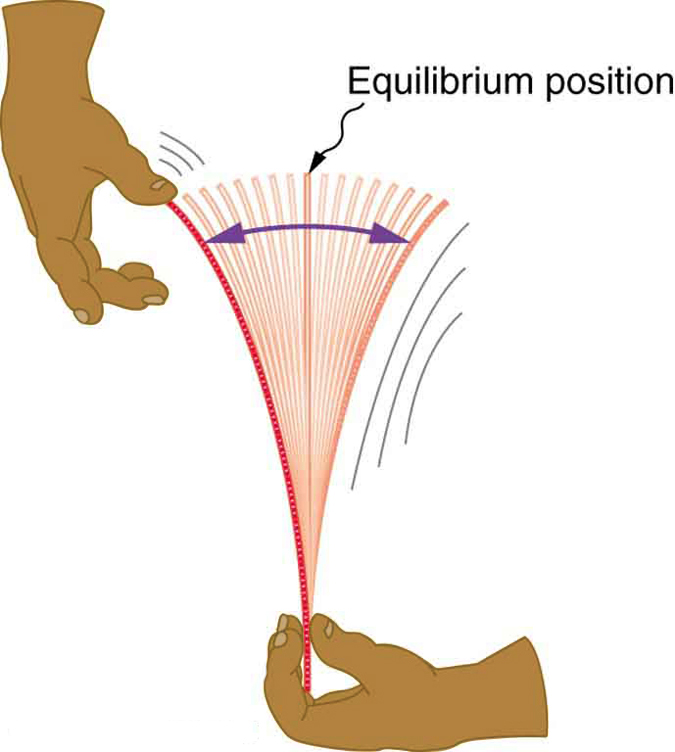
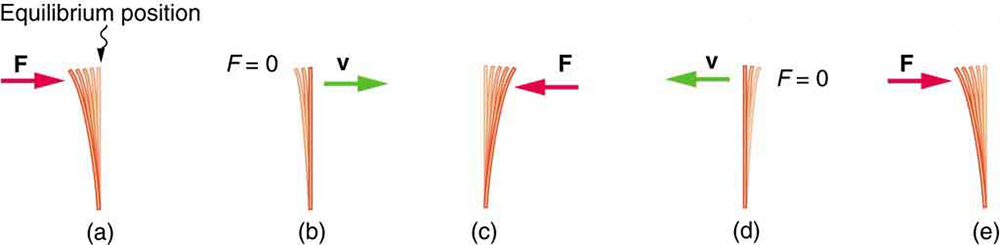
Newton’s first law implies that an object oscillating back and forth is experiencing forces. Without force, the object would move in a straight line at a constant speed rather than oscillate. Consider, for example, plucking a plastic ruler to the left as shown in [Figure 1]. The deformation of the ruler creates a force in the opposite direction, known as a restoring force. Once released, the restoring force causes the ruler to move back toward its stable equilibrium position, where the net force on it is zero. However, by the time the ruler gets there, it gains momentum and continues to move to the right, producing the opposite deformation. It is then forced to the left, back through equilibrium, and the process is repeated until dissipative forces dampen the motion. These forces remove mechanical energy from the system, gradually reducing the motion until the ruler comes to rest.
The simplest oscillations occur when the restoring force is directly proportional to displacement. When stress and strain were covered in Newton’s Third Law of Motion, the name was given to this relationship between force and displacement was Hooke’s law:
Here, $F$ is the restoring force, $x$ is the displacement from equilibrium or deformation, and $k$ is a constant related to the difficulty in deforming the system. The minus sign indicates the restoring force is in the direction opposite to the displacement.
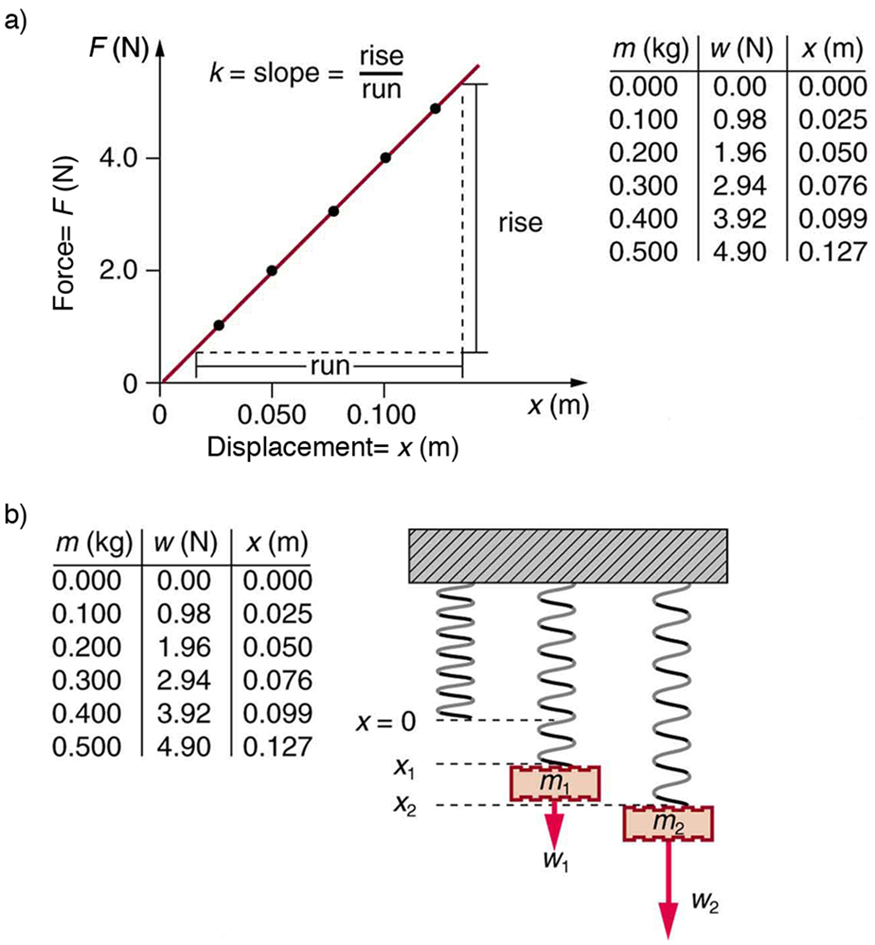
The force constant $k$ is related to the rigidity (or stiffness) of a system—the larger the force constant, the greater the restoring force, and the stiffer the system. The units of $k$ are newtons per meter (N/m). For example, $k$ is directly related to Young’s modulus when we stretch a string. [Figure 3] shows a graph of the absolute value of the restoring force versus the displacement for a system that can be described by Hooke’s law—a simple spring in this case. The slope of the graph equals the force constant $k$ in newtons per meter. A common physics laboratory exercise is to measure restoring forces created by springs, determine if they follow Hooke’s law, and calculate their force constants if they do.
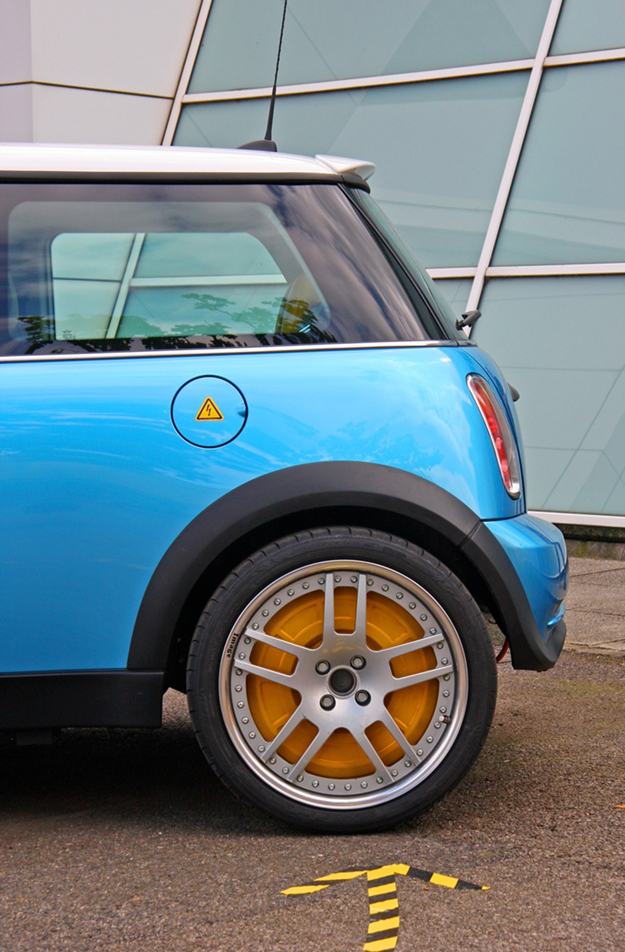
What is the force constant for the suspension system of a car that settles 1.20 cm when an 80.0-kg person gets in?
Strategy
Consider the car to be in its equilibrium position $x=0$ before the person gets in. The car then settles down 1.20 cm, which means it is displaced to a position $x= -1.20 \times 10^{-2} \text{m}$ . At that point, the springs supply a restoring force $F$ equal to the person’s weight $w=mg=\left( 80.0 \text{kg}\right)\left( 9.80 {\text{m/s}}^{2}\right)=784 \text{N}$ . We take this force to be $F$ in Hooke’s law. Knowing $F$ and $x$ , we can then solve the force constant $k$ .
Solution
Substitute known values and solve $k$ :
Discussion
Note that $F$ and $x$ have opposite signs because they are in opposite directions—the restoring force is up, and the displacement is down. Also, note that the car would oscillate up and down when the person got in if it were not for damping (due to frictional forces) provided by shock absorbers. Bouncing cars are a sure sign of bad shock absorbers.
In order to produce a deformation, work must be done. That is, a force must be exerted through a distance, whether you pluck a guitar string or compress a car spring. If the only result is deformation, and no work goes into thermal, sound, or kinetic energy, then all the work is initially stored in the deformed object as some form of potential energy. The potential energy stored in a spring is ${\text{PE}}_{\text{el}}=\frac{1}{2}kx^{2}$ . Here, we generalize the idea to elastic potential energy for a deformation of any system that can be described by Hooke’s law. Hence,
where ${\text{PE}}_{\text{el}}$ is the elastic potential energy stored in any deformed system that obeys Hooke’s law and has a displacement $x$ from equilibrium and a force constant $k$.
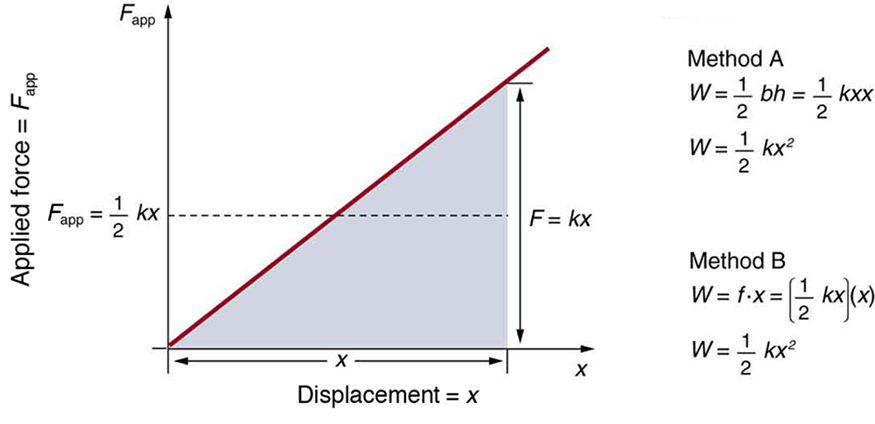
It is possible to find the work done in deforming a system in order to find the energy stored. This work is performed by an applied force ${F}_{\text{app}}$ . The applied force is exactly opposite to the restoring force (action-reaction) , and so ${F}_{\text{app}}=kx$ . [Figure 4] shows a graph of the applied force versus deformation $x$
for a system that can be described by Hooke’s law. Work done on the system is force multiplied by distance, which equals the area under the curve or $\left( 1/2\right)kx^{2}$ (Method A in the figure). Another way to determine the work is to note that the force increases linearly from 0 to $kx$ , so that the average force is $\left(1/2\right) kx$ , the distance moved is $x$ , and thus $W={F}_{\text{app}}d=\left[ \left(1/2\right) k x \right] \left(x\right) =\left(1/2\right)kx^{2}$
(Method B in the figure).
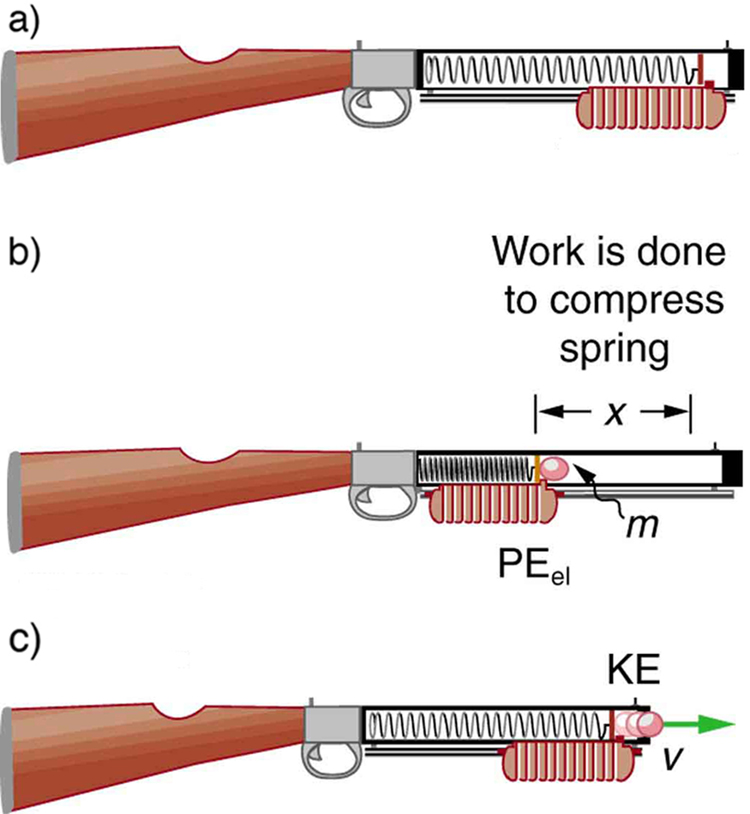
We can use a toy gun’s spring mechanism to ask and answer two simple questions: (a) How much energy is stored in the spring of a tranquilizer gun that has a force constant of 50.0 N/m and is compressed 0.150 m? (b) If you neglect friction and the mass of the spring, at what speed will a 2.00-g projectile be ejected from the gun?
Strategy for a
(a): **The energy stored in the spring can be found directly from elastic potential energy equation, because $k$ and $x$ are given.
Solution for a
Entering the given values for $k$ and $x$ yields
Strategy for b
Because there is no friction, the potential energy is converted entirely into kinetic energy. The expression for kinetic energy can be solved for the projectile’s speed.
Solution for b
Discussion
(a) and (b): This projectile speed is impressive for a tranquilizer gun (more than 80 km/h). The numbers in this problem seem reasonable. The force needed to compress the spring is small enough for an adult to manage, and the energy imparted to the dart is small enough to limit the damage it might do. Yet, the speed of the dart is great enough for it to travel an acceptable distance.
Envision holding the end of a ruler with one hand and deforming it with the other. When you let go, you can see the oscillations of the ruler. In what way could you modify this simple experiment to increase the rigidity of the system?
You could hold the ruler at its midpoint so that the part of the ruler that oscillates is half as long as in the original experiment.
If you apply a deforming force on an object and let it come to equilibrium, what happened to the work you did on the system?
It was stored in the object as potential energy.
where $F$ is the restoring force, $x$ is the displacement from equilibrium or deformation, and $k$ is the force constant of the system.
Describe a system in which elastic potential energy is stored.
Fish are hung on a spring scale to determine their mass (most fishermen feel no obligation to truthfully report the mass).
(a) What is the force constant of the spring in such a scale if the spring stretches 8.00 cm for a 10.0 kg load?
(b) What is the mass of a fish that stretches the spring 5.50 cm?
(c) How far apart are the half-kilogram marks on the scale?
Strategy
For part (a), we use Hooke’s law, recognizing that the restoring force equals the weight of the load. For part (b), we use the spring constant from part (a) with the new displacement to find the force, then calculate mass. For part (c), we find how much the spring stretches for a 0.5 kg mass using the spring constant.
Solution
(a) The weight of the load creates the restoring force:
The displacement is $x = 8.00 \text{ cm} = 0.0800 \text{ m}$. Using Hooke’s law $F = kx$:
(b) For a displacement of $x = 5.50 \text{ cm} = 0.0550 \text{ m}$:
The mass of the fish is:
Rounding to three significant figures: $6.88 \text{ kg}$
(c) For a 0.500 kg mass, the weight is:
The displacement is:
Discussion
Part (a): The spring constant of 1,230 N/m is reasonable for a fish scale. It’s stiff enough that a 10 kg fish stretches the spring only 8 cm, making the scale compact and practical.
Part (b): A fish that stretches the spring 5.50 cm has mass 6.88 kg, which is 68.8% of the reference mass (10.0 kg). This ratio matches the displacement ratio (5.50/8.00 = 68.8%), confirming Hooke’s law’s linear relationship.
Part (c): The half-kilogram marks are only 4.00 mm apart. This close spacing means the scale needs fine gradations to be readable, which could make it challenging to use accurately in the field. Fishermen might appreciate this—it could make their catches appear larger if they misread between marks! The linear spacing is a direct consequence of Hooke’s law: equal increments in mass produce equal increments in displacement.
It is weigh-in time for the local under-85-kg rugby team. The bathroom scale used to assess eligibility can be described by Hooke’s law and is depressed 0.75 cm by its maximum load of 120 kg. (a) What is the spring’s effective spring constant? (b) A player stands on the scales and depresses it by 0.48 cm. Is he eligible to play on this under-85 kg team?
Strategy
For part (a), we can use Hooke’s law to find the spring constant. The maximum load creates a restoring force equal to the weight, and we know the displacement. For part (b), we use the spring constant found in part (a) along with the player’s displacement to find his weight, and then determine his mass.
Solution
(a) The restoring force equals the weight of the maximum load:
The displacement is $x = 0.75 \text{ cm} = 0.0075 \text{ m}$. Using Hooke’s law $F = kx$:
(b) For the player with displacement $x = 0.48 \text{ cm} = 0.0048 \text{ m}$:
The player’s mass is:
Discussion
Since the player’s mass (76.9 kg) is less than 85 kg, he is eligible to play on the team. The spring constant is quite large, which is appropriate for a bathroom scale that must support heavy loads without excessive compression. Note that bathroom scales are designed to be stiff enough that typical deflections are barely visible to the user.
Answer
(a) $1.57 \times 10^5 \text{ N/m}$
(b) Yes, he is eligible (mass = 76.9 kg)
One type of BB gun uses a spring-driven plunger to blow the BB from its barrel. (a) Calculate the force constant of its plunger’s spring if you must compress it 0.150 m to drive the 0.0500-kg plunger to a top speed of 20.0 m/s. (b) What force must be exerted to compress the spring?
Strategy
For part (a), we use energy conservation. The elastic potential energy stored in the compressed spring is completely converted to kinetic energy of the plunger: $\frac{1}{2}kx^2 = \frac{1}{2}mv^2$. We solve for the spring constant $k$. For part (b), we use Hooke’s law $F = kx$ with the spring constant from part (a).
Solution
(a) From energy conservation:
Solving for $k$:
(b) The force required to compress the spring is:
Discussion
Part (a): The spring constant of 889 N/m indicates a moderately stiff spring, which is appropriate for a BB gun. The energy stored in the spring when compressed 15 cm is $\frac{1}{2}(889)(0.150)^2 = 10.0$ J, which equals the kinetic energy of the 50-gram plunger at 20 m/s: $\frac{1}{2}(0.0500)(20.0)^2 = 10.0$ J. This confirms our calculation.
Part (b): A force of 133 N (about 30 pounds-force or 13.6 kg-force) is reasonable for manually cocking a BB gun. It’s manageable for most users but requires definite effort, providing appropriate resistance that makes the gun safe and controllable. The linear relationship between force and compression is a direct consequence of Hooke’s law: compressing twice as far requires twice the force.
The plunger’s final speed of 20.0 m/s (72 km/h or 45 mph) is quite fast, demonstrating the effectiveness of spring-powered projectile launchers. This design is safe because all the energy goes to the plunger, which then transfers it to the BB through air pressure rather than through direct spring-to-BB contact.
(a) The springs of a pickup truck act like a single spring with a force constant of $1.30 \times 10^{5} \text{N/m}$ . By how much will the truck be depressed by its maximum load of 1000 kg?
(b) If the pickup truck has four identical springs, what is the force constant of each?
Strategy
For part (a), we use Hooke’s law with the weight of the load as the applied force. For part (b), we need to understand how springs in parallel combine: when multiple springs share a load equally, the effective spring constant is the sum of individual spring constants.
Solution
(a) The weight of the maximum load is:
Using Hooke’s law $F = kx$, we solve for displacement:
(b) When springs act in parallel, the effective spring constant is the sum:
For four identical springs:
Therefore:
Discussion
The depression of 7.54 cm for a 1000 kg load is reasonable for a truck suspension system. This amount of compression provides a balance between comfort (too stiff would make for a harsh ride) and structural integrity (too soft would bottom out easily). The individual spring constant of $3.25 \times 10^4$ N/m for each of the four springs makes sense because springs in parallel share the load, effectively adding their spring constants together.
Answer
(a) 7.54 cm
(b) $3.25 \times 10^4 \text{ N/m}$
When an 80.0-kg man stands on a pogo stick, the spring is compressed 0.120 m.
(a) What is the force constant of the spring? (b) Will the spring be compressed more when he hops down the road?
Strategy
For part (a), we apply Hooke’s law, where the restoring force equals the man’s weight at equilibrium. For part (b), we consider the dynamics of hopping: when the man lands after jumping, he has downward velocity that must be brought to zero, requiring additional compression beyond the static equilibrium position.
Solution
(a) At equilibrium, the spring force balances the man’s weight:
Using Hooke’s law $F = kx$ with $x = 0.120 \text{ m}$:
(b) Yes, the spring will be compressed more when he hops down the road.
When hopping, the man lands with downward velocity. This kinetic energy must be absorbed by the spring, compressing it beyond the static equilibrium position. Additionally, the impact forces during landing can be several times body weight, further increasing compression.
Discussion
Part (a): The spring constant of 6,530 N/m indicates a fairly stiff spring, appropriate for supporting an 80 kg person while still providing enough “give” for bouncing. The 12 cm compression represents a reasonable balance—enough to store elastic energy for bouncing, but not so much that the user bottoms out the spring.
Part (b): The spring compression during hopping exceeds the static value for several reasons:
For example, if the man lands with a downward velocity of 2 m/s, his kinetic energy is $\frac{1}{2}(80.0)(2.0)^2 = 160$ J. This energy compresses the spring an additional distance $\Delta x$ where $\frac{1}{2}k(\Delta x)^2 = 160$ J, giving $\Delta x = \sqrt{2(160)/6530} = 0.22$ m. Combined with the 12 cm static compression, the total compression would be about 34 cm during landing.
This extra compression is what makes pogo sticks fun—the spring stores more energy during landing and releases it to propel the user upward on the next bounce!
A spring has a length of 0.200 m when a 0.300-kg mass hangs from it, and a length of 0.750 m when a 1.95-kg mass hangs from it. (a) What is the force constant of the spring? (b) What is the unloaded length of the spring?
Strategy
The total length of the spring equals the unloaded length plus the extension due to the hanging mass. We can write two equations using Hooke’s law for the two different masses, then solve simultaneously for the spring constant and unloaded length.
Solution
(a) Let $L_0$ be the unloaded length. For the two cases:
where $x_1$ and $x_2$ are the extensions. From Hooke’s law, $kx = mg$, so:
Subtracting the first length equation from the second:
(b) Now we can find $L_0$ using the first case:
Discussion
The spring constant of 29.4 N/m indicates a relatively soft spring, which makes sense given the large extension (55 cm) for a modest increase in mass (1.65 kg). We can verify our answer: with the 0.300 kg mass, the spring extends 10.0 cm from its unloaded length of 10.0 cm to reach 20.0 cm total. With the 1.95 kg mass, it extends 65.0 cm from 10.0 cm to reach 75.0 cm total. The ratio of extensions (65.0/10.0 = 6.5) equals the ratio of masses (1.95/0.300 = 6.5), confirming our solution is consistent with Hooke’s law.
Answer
(a) 29.4 N/m
(b) 0.100 m or 10.0 cm