When you pour yourself a glass of juice, the liquid flows freely and quickly. But when you pour syrup on your pancakes, that liquid flows slowly and sticks to the pitcher. The difference is fluid friction, both within the fluid itself and between the fluid and its surroundings. We call this property of fluids viscosity. Juice has low viscosity, whereas syrup has high viscosity. In the previous sections we have considered ideal fluids with little or no viscosity. In this section, we will investigate what factors, including viscosity, affect the rate of fluid flow.
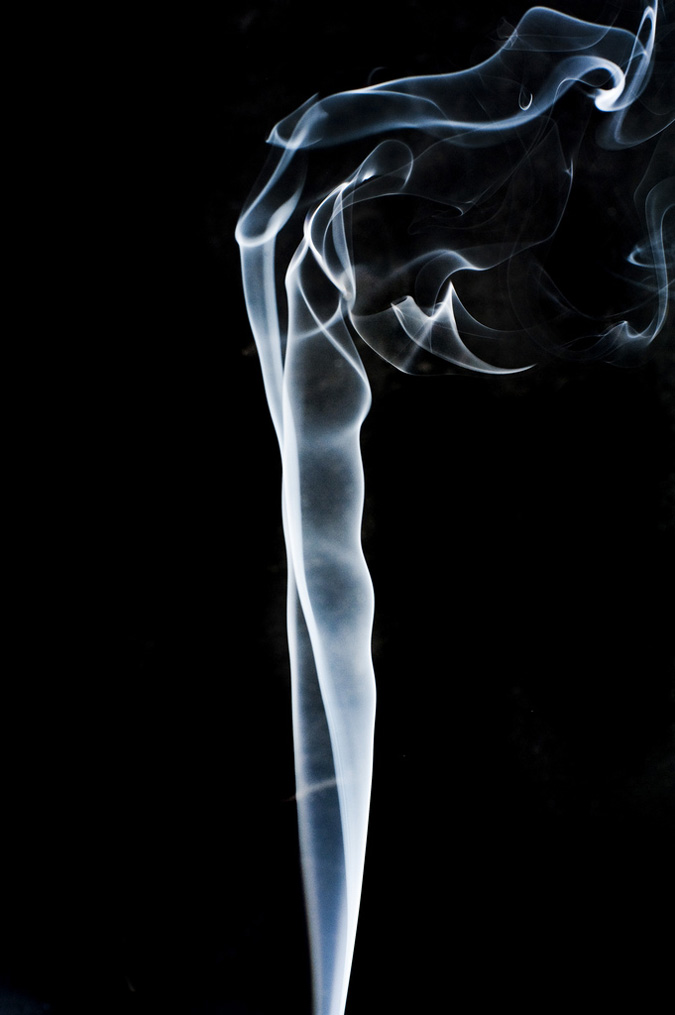
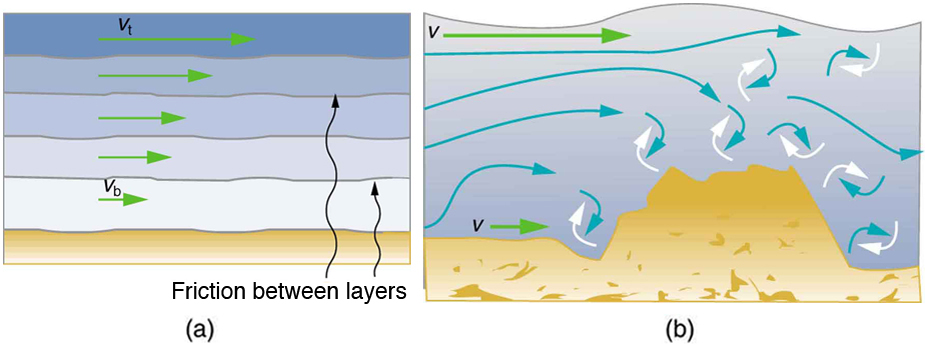
The precise definition of viscosity is based on laminar, or nonturbulent, flow. Before we can define viscosity, then, we need to define laminar flow and turbulent flow. [Figure 1] shows both types of flow. Laminar flow is characterized by the smooth flow of the fluid in layers that do not mix. Turbulent flow, or turbulence, is characterized by eddies and swirls that mix layers of fluid together.
[Figure 2] shows schematically how laminar and turbulent flow differ. Layers flow without mixing when flow is laminar. When there is turbulence, the layers mix, and there are significant velocities in directions other than the overall direction of flow. The lines that are shown in many illustrations are the paths followed by small volumes of fluids. These are called streamlines. Streamlines are smooth and continuous when flow is laminar, but break up and mix when flow is turbulent. Turbulence has two main causes. First, any obstruction or sharp corner, such as in a faucet, creates turbulence by imparting velocities perpendicular to the flow. Second, high speeds cause turbulence. The drag both between adjacent layers of fluid and between the fluid and its surroundings forms swirls and eddies, if the speed is great enough. We shall concentrate on laminar flow for the remainder of this section, leaving certain aspects of turbulence for later sections.
Try dropping simultaneously two sticks into a flowing river, one near the edge of the river and one near the middle. Which one travels faster? Why?
[Figure 3] shows how viscosity is measured for a fluid. Two parallel plates have the specific fluid between them. The bottom plate is held fixed, while the top plate is moved to the right, dragging fluid with it. The layer (or lamina) of fluid in contact with either plate does not move relative to the plate, and so the top layer moves at $v$ while the bottom layer remains at rest. Each successive layer from the top down exerts a force on the one below it, trying to drag it along, producing a continuous variation in speed from $v$
to 0 as shown. Care is taken to ensure that the flow is laminar; that is, the layers do not mix. The motion in [Figure 3] is like a continuous shearing motion. Fluids have zero shear strength, but the rate at which they are sheared is related to the same geometrical factors $A$ and $L$ as is shear deformation for solids.
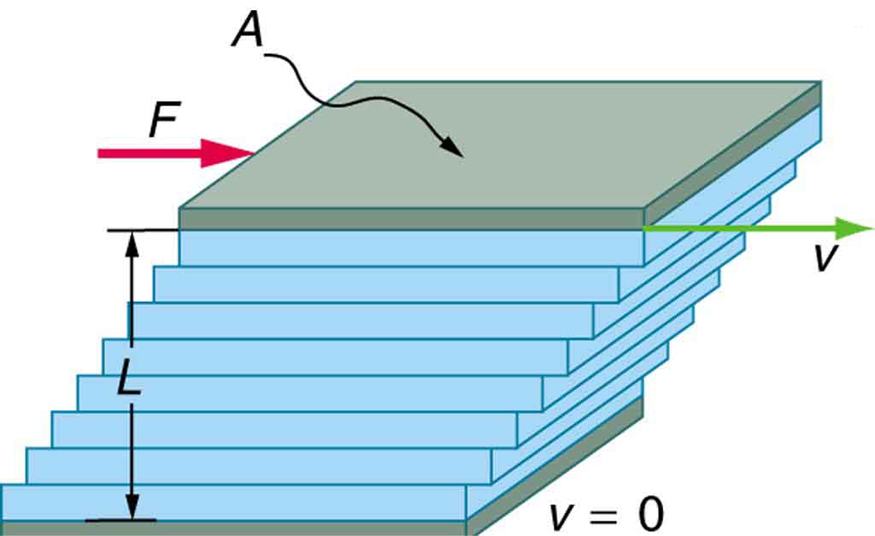
A force $F$ is required to keep the top plate in [Figure 3] moving at a constant velocity $v$ , and experiments have shown that this force depends on four factors. First, $F$ is directly proportional to $v$ (until the speed is so high that turbulence occurs—then a much larger force is needed, and it has a more complicated dependence on $v$ ). Second, $F$ is proportional to the area $A$ of the plate. This relationship seems reasonable, since $A$ is directly proportional to the amount of fluid being moved. Third, $F$ is inversely proportional to the distance between the plates $L$ . This relationship is also reasonable; $L$ is like a lever arm, and the greater the lever arm, the less force that is needed. Fourth, $F$ is directly proportional to the coefficient of viscosity, $\eta$ . The greater the viscosity, the greater the force required. These dependencies are combined into the equation
which gives us a working definition of fluid viscosity $\eta$. Solving for $\eta$ gives
which defines viscosity in terms of how it is measured. The SI unit of viscosity is $\text{N}\cdot \text{m/}\left[\left(\text{m/s}\right){\text{m}}^{2}\right] =\left({\text{N/m}}^{2}\right)\text{s or Pa}\cdot \text{s}$ . [Table 1] lists the coefficients of viscosity for various fluids.
Viscosity varies from one fluid to another by several orders of magnitude. As you might expect, the viscosities of gases are much less than those of liquids, and these viscosities are often temperature dependent. The viscosity of blood can be reduced by aspirin consumption, allowing it to flow more easily around the body. (When used over the long term in low doses, aspirin can help prevent heart attacks, and reduce the risk of blood clotting.)
What causes flow? The answer, not surprisingly, is pressure difference. In fact, there is a very simple relationship between horizontal flow and pressure. Flow rate $Q$ is in the direction from high to low pressure. The greater the pressure differential between two points, the greater the flow rate. This relationship can be stated as
where ${P}_{1}$ and ${P}_{2}$ are the pressures at two points, such as at either end of a tube, and $R$ is the resistance to flow. The resistance $R$ includes everything, except pressure, that affects flow rate. For example, $R$ is greater for a long tube than for a short one. The greater the viscosity of a fluid, the greater the value of $R$ . Turbulence greatly increases $R$ , whereas increasing the diameter of a tube decreases $R$ .
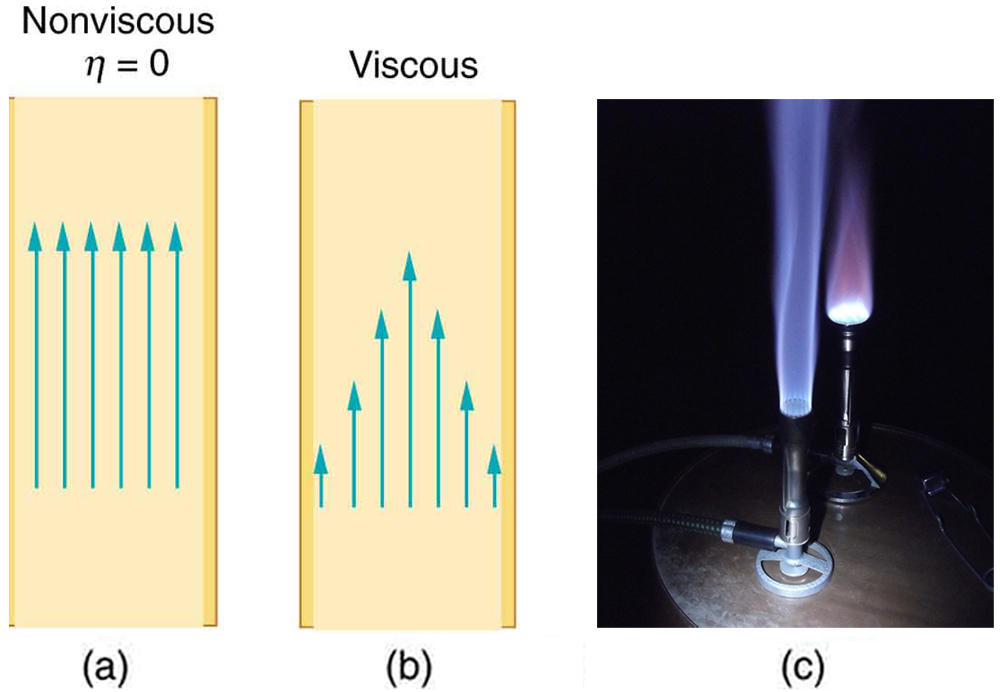
If viscosity is zero, the fluid is frictionless and the resistance to flow is also zero. Comparing frictionless flow in a tube to viscous flow, as in [Figure 4], we see that for a viscous fluid, speed is greatest at midstream because of drag at the boundaries. We can see the effect of viscosity in a Bunsen burner flame, even though the viscosity of natural gas is small.
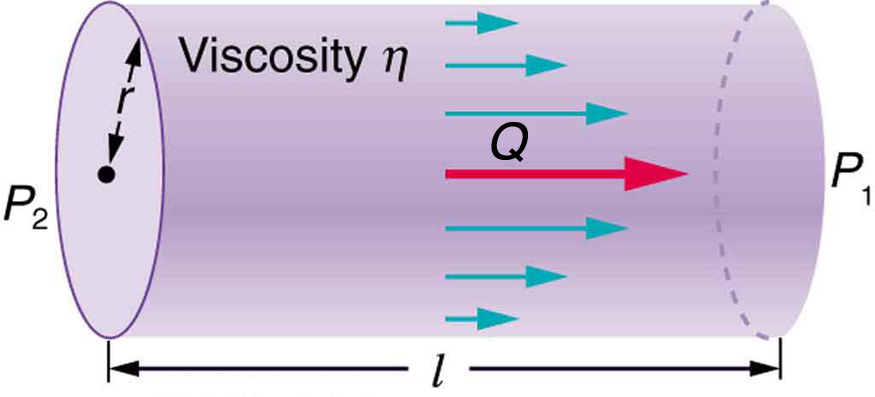
The resistance $R$ to laminar flow of an incompressible fluid having viscosity $\eta$ through a horizontal tube of uniform radius $r$ and length $l$ , such as the one in [Figure 5], is given by
This equation is called Poiseuille’s law for resistance after the French scientist J. L. Poiseuille (1799–1869), who derived it in an attempt to understand the flow of blood, an often turbulent fluid.
Let us examine Poiseuille’s expression for $R$ to see if it makes good intuitive sense. We see that resistance is directly proportional to both fluid viscosity $\eta$ and the length $l$ of a tube. After all, both of these directly affect the amount of friction encountered—the greater either is, the greater the resistance and the smaller the flow. The radius $r$ of a tube affects the resistance, which again makes sense, because the greater the radius, the greater the flow (all other factors remaining the same). But it is surprising that $r$ is raised to the fourth power in Poiseuille’s law. This exponent means that any change in the radius of a tube has a very large effect on resistance. For example, doubling the radius of a tube decreases resistance by a factor of ${2}^{4}=16$.
Taken together, $Q=\frac{ {P}_{2}-{P}_{1}}{R}$ and $R=\frac{8\eta l}{\pi {r}^{4}}$ give the following expression for flow rate:
This equation describes laminar flow through a tube. It is sometimes called Poiseuille’s law for laminar flow, or simply Poiseuille’s law.
Suppose the flow rate of blood in a coronary artery has been reduced to half its normal value by plaque deposits. By what factor has the radius of the artery been reduced, assuming no turbulence occurs?
Strategy
Assuming laminar flow, Poiseuille’s law states that
We need to compare the artery radius before and after the flow rate reduction.
Solution
With a constant pressure difference assumed and the same length and viscosity, along the artery we have
So, given that ${Q}_{2}= 0.5{Q}_{1}$ , we find that ${r}_{2}^{4}=0.5r_{1}^{4}$.
Therefore, ${r}_{2}={\left( 0.5\right)}^{ 0.25}{r}_{1}= 0.841{r}_{1}$ , a decrease in the artery radius of 16%.
Discussion
This decrease in radius is surprisingly small for this situation. To restore the blood flow in spite of this buildup would require an increase in the pressure difference $\left({P}_{2}-{P}_{1}\right)$ of a factor of two, with subsequent strain on the heart.
| Fluid | Temperature (ºC) | Viscosity $$\eta \text{(mPa·s)} $$ |
|---|---|---|
| Gases | ||
| Air | 0 | 0.0171 |
| 20 | 0.0181 | |
| 40 | 0.0190 | |
| 100 | 0.0218 | |
| Ammonia | 20 | 0.00974 |
| Carbon dioxide | 20 | 0.0147 |
| Helium | 20 | 0.0196 |
| Hydrogen | 0 | 0.0090 |
| Mercury | 20 | 0.0450 |
| Oxygen | 20 | 0.0203 |
| Steam | 100 | 0.0130 |
| Liquids | ||
| Water | 0 | 1.792 |
| 20 | 1.002 | |
| 37 | 0.6947 | |
| 40 | 0.653 | |
| 100 | 0.282 | |
| Whole blood1 | 20 | 3.015 |
| 37 | 2.084 | |
| Blood plasma2 | 20 | 1.810 |
| 37 | 1.257 | |
| Ethyl alcohol | 20 | 1.20 |
| Methanol | 20 | 0.584 |
| Oil (heavy machine) | 20 | 660 |
| Oil (motor, SAE 10) | 30 | 200 |
| Oil (olive) | 20 | 138 |
| Glycerin | 20 | 1500 |
| Honey | 20 | 2000–10000 |
| Maple Syrup | 20 | 2000–3000 |
| Milk | 20 | 3.0 |
| Oil (Corn) | 20 | 65 |
The circulatory system provides many examples of Poiseuille’s law in action—with blood flow regulated by changes in vessel size and blood pressure. Blood vessels are not rigid but elastic. Adjustments to blood flow are primarily made by varying the size of the vessels, since the resistance is so sensitive to the radius. During vigorous exercise, blood vessels are selectively dilated to important muscles and organs and blood pressure increases. This creates both greater overall blood flow and increased flow to specific areas. Conversely, decreases in vessel radii, perhaps from plaques in the arteries, can greatly reduce blood flow. If a vessel’s radius is reduced by only 5% (to 0.95 of its original value), the flow rate is reduced to about ${\left( 0.95 \right)}^{4}= 0.81$ of its original value. A 19% decrease in flow is caused by a 5% decrease in radius. The body may compensate by increasing blood pressure by 19%, but this presents hazards to the heart and any vessel that has weakened walls. Another example comes from automobile engine oil. If you have a car with an oil pressure gauge, you may notice that oil pressure is high when the engine is cold. Motor oil has greater viscosity when cold than when warm, and so pressure must be greater to pump the same amount of cold oil.
An intravenous (IV) system is supplying saline solution to a patient at the rate of $0.120 {\text{cm}}^{3}\text{/s}$ through a needle of radius 0.150 mm and length 2.50 cm. What pressure is needed at the entrance of the needle to cause this flow, assuming the viscosity of the saline solution to be the same as that of water? The gauge pressure of the blood in the patient’s vein is 8.00 mm Hg. (Assume that the temperature is $20 \text{ºC}$ .)
Strategy
Assuming laminar flow, Poiseuille’s law applies. This is given by
where ${P}_{2}$ is the pressure at the entrance of the needle and ${P}_{1}$ is the pressure in the vein. The only unknown is ${P}_{2}$.
Solution
Solving for ${P}_{2}$ yields
${P}_{1}$ is given as 8.00 mm Hg, which converts to $1.066 \times 10^{3} {\text{N/m}}^{2}$ . Substituting this and the other known values yields
Discussion
This pressure could be supplied by an IV bottle with the surface of the saline solution 1.61 m above the entrance to the needle (this is left for you to solve in this chapter’s Problems and Exercises), assuming that there is negligible pressure drop in the tubing leading to the needle.
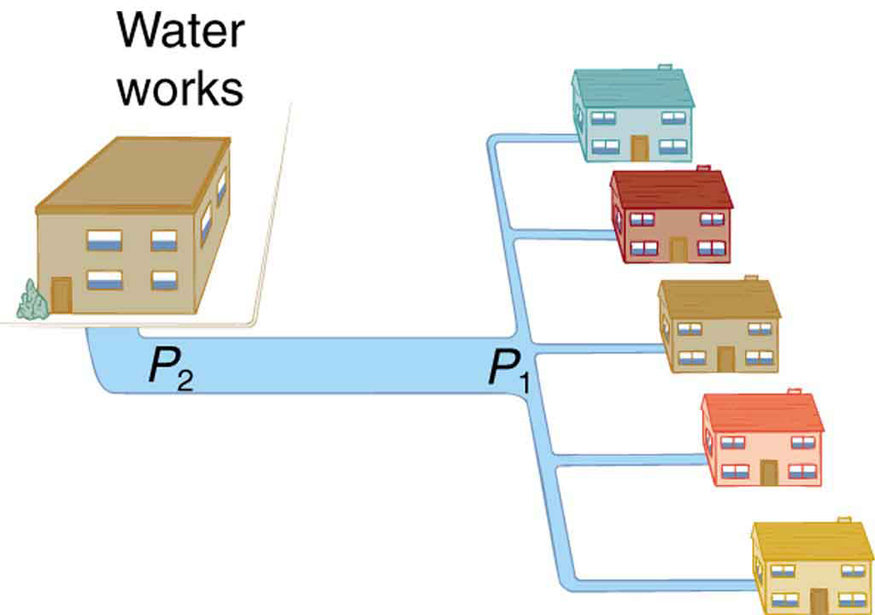
You may have noticed that water pressure in your home might be lower than normal on hot summer days when there is more use. This pressure drop occurs in the water main before it reaches your home. Let us consider flow through the water main as illustrated in [Figure 6]. We can understand why the pressure ${P}_{1}$ to the home drops during times of heavy use by rearranging
to
where, in this case, ${P}_{2}$ is the pressure at the water works and $R$ is the resistance of the water main. During times of heavy use, the flow rate $Q$ is large. This means that ${P}_{2}-{P}_{1}$ must also be large. Thus ${P}_{1}$ must decrease. It is correct to think of flow and resistance as causing the pressure to drop from ${P}_{2}$ to ${P}_{1}$ . ${P}_{2}-{P}_{1}=RQ$ is valid for both laminar and turbulent flows.
We can use ${P}_{2}-{P}_{1}=RQ$ to analyze pressure drops occurring in more complex systems in which the tube radius is not the same everywhere. Resistance will be much greater in narrow places, such as an obstructed coronary artery. For a given flow rate $Q$ , the pressure drop will be greatest where the tube is most narrow. This is how water faucets control flow. Additionally, $R$ is greatly increased by turbulence, and a constriction that creates turbulence greatly reduces the pressure downstream. Plaque in an artery reduces pressure and hence flow, both by its resistance and by the turbulence it creates.
[Figure 7] is a schematic of the human circulatory system, showing average blood pressures in its major parts for an adult at rest. Pressure created by the heart’s two pumps, the right and left ventricles, is reduced by the resistance of the blood vessels as the blood flows through them. The left ventricle increases arterial blood pressure that drives the flow of blood through all parts of the body except the lungs. The right ventricle receives the lower pressure blood from two major veins and pumps it through the lungs for gas exchange with atmospheric gases – the disposal of carbon dioxide from the blood and the replenishment of oxygen. Only one major organ is shown schematically, with typical branching of arteries to ever smaller vessels, the smallest of which are the capillaries, and rejoining of small veins into larger ones. Similar branching takes place in a variety of organs in the body, and the circulatory system has considerable flexibility in flow regulation to these organs by the dilation and constriction of the arteries leading to them and the capillaries within them. The sensitivity of flow to tube radius makes this flexibility possible over a large range of flow rates.
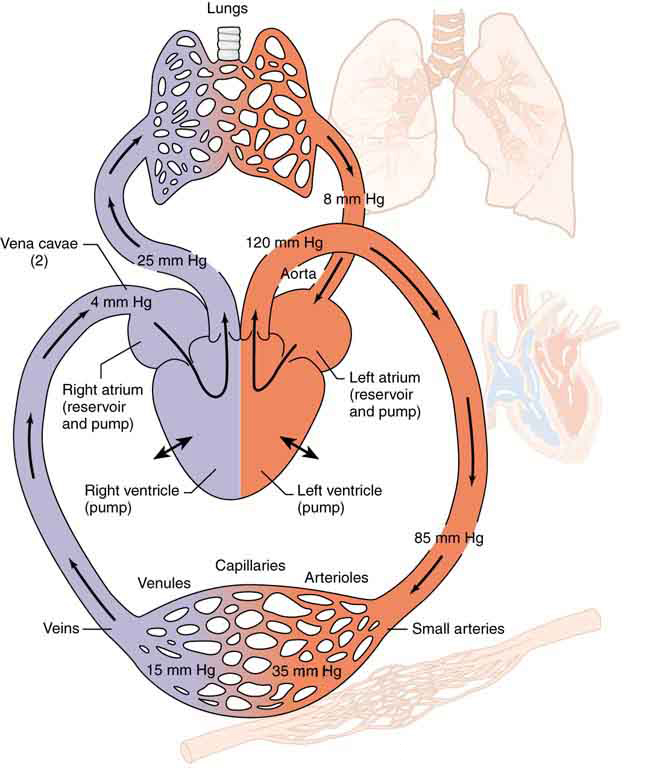
Each branching of larger vessels into smaller vessels increases the total cross-sectional area of the tubes through which the blood flows. For example, an artery with a cross-section of $1 {\text{cm}}^{2}$ may branch into 20 smaller arteries, each with cross-sections of $0.5 {\text{cm}}^{2}$ , with a total of $10 {\text{cm}}^{2}$ . In that manner, the resistance of the branchings is reduced so that pressure is not entirely lost. Moreover, because $Q=A\overline{v}$ and $A$ increases through branching, the average velocity of the blood in the smaller vessels is reduced. The blood velocity in the aorta ( $\text{diameter}=1 \text{cm}$ ) is about 25 cm/s, while in the capillaries ( $20\mu \text{m}$ in diameter) the velocity is about 1 mm/s. This reduced velocity allows the blood to exchange substances with the cells in the capillaries and alveoli in particular.
Flow is proportional to pressure difference and inversely proportional to resistance:
For laminar flow in a tube, Poiseuille’s law for resistance states that
Poiseuille’s law for flow in a tube is
The pressure drop caused by flow and resistance is given by
Explain why the viscosity of a liquid decreases with temperature—that is, how might increased temperature reduce the effects of cohesive forces in a liquid? Also explain why the viscosity of a gas increases with temperature—that is, how does increased gas temperature create more collisions between atoms and molecules?
Strategy
We consider the molecular mechanisms that cause viscosity in liquids versus gases, and how temperature affects these mechanisms differently.
Solution
Liquids (viscosity decreases with temperature): In liquids, viscosity is primarily due to intermolecular cohesive forces (van der Waals forces, hydrogen bonding, etc.) that resist the sliding of fluid layers past each other. When temperature increases:
Gases (viscosity increases with temperature): In gases, molecules are far apart, so cohesive forces are negligible. Instead, viscosity arises from momentum transfer during molecular collisions. When temperature increases:
Discussion
This opposite temperature dependence is a key distinction between liquids and gases. It has practical implications: motor oil thins when hot (problematic for lubrication), while hot exhaust gases are more viscous (affects engine performance).
When paddling a canoe upstream, it is wisest to travel as near to the shore as possible. When canoeing downstream, it may be best to stay near the middle. Explain why.
Strategy
We consider how the velocity profile in a river varies from shore to center due to viscous drag on the riverbed and banks.
Solution
Due to viscosity, water in a river doesn’t flow at the same speed everywhere. The water experiences drag from the riverbed and banks, creating a velocity profile:
Going upstream (against the current): You want to minimize the current working against you. By staying near the shore where the water moves slowly, you paddle against a weaker current, making progress easier.
Going downstream (with the current): You want to maximize the current helping you. By staying in the middle where the water moves fastest, you get the maximum boost from the current and travel faster with less effort.
Discussion
This is a practical application of understanding the velocity profile in viscous flow. The same principle applies to swimmers, kayakers, and even fish—they instinctively use these patterns for efficient movement in rivers.
Why does flow decrease in your shower when someone flushes the toilet?
Strategy
We apply the relationship between pressure, flow rate, and resistance in a plumbing system where multiple fixtures share a common supply.
Solution
When someone flushes a toilet, it creates a sudden demand for water that affects the entire plumbing system:
Pressure drop: The toilet’s flush valve opens, creating a large flow through the toilet supply line. From the equation $P_2 - P_1 = RQ$, this increased flow causes a larger pressure drop in the main supply pipe.
Reduced pressure at shower: Since the shower and toilet share the same supply line (at least partially), the pressure available to the shower decreases when the toilet demands water.
Reduced shower flow: By $Q = \frac{P_2 - P_1}{R}$, lower pressure difference at the shower means lower flow rate.
Additionally, if the toilet fills from a cold water line while the shower uses hot water, the sudden cold water demand can cause pressure fluctuations that change the temperature balance in the shower.
Discussion
This is why modern plumbing codes require larger supply pipes and pressure-balancing valves in showers. Pressure-balancing valves automatically adjust to maintain constant flow regardless of pressure fluctuations elsewhere in the system.
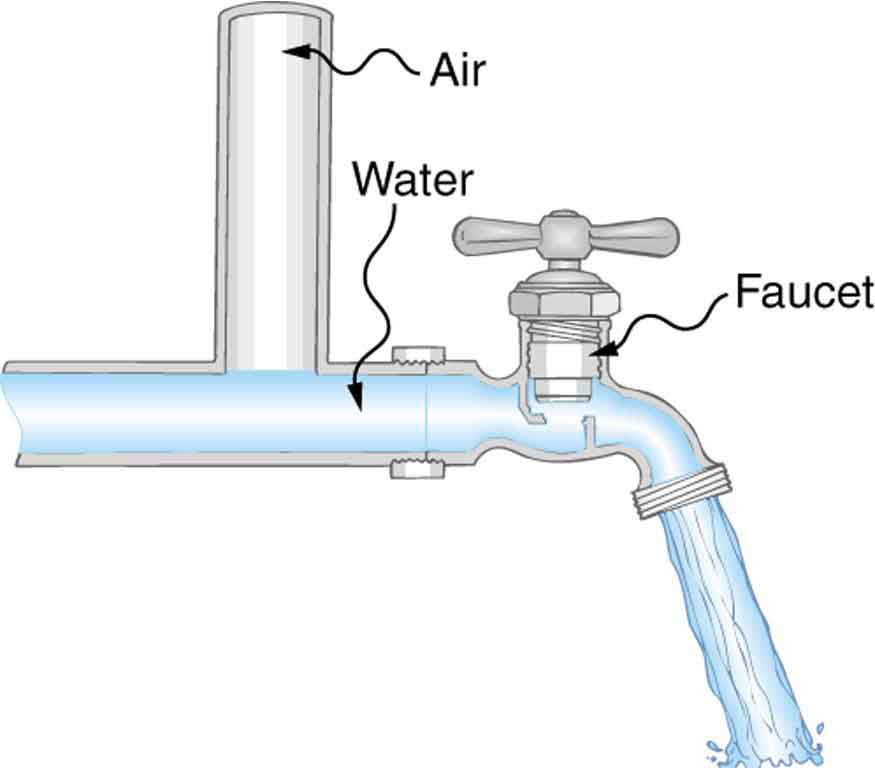
Plumbing usually includes air-filled tubes near water faucets, as shown in [Figure 8]. Explain why they are needed and how they work.
Strategy
We consider the physics of water hammer and how a compressible gas (air) can absorb pressure surges.
Solution
These air-filled tubes are called “air chambers” or “water hammer arrestors.” They’re needed to prevent “water hammer”—the loud banging noise and potential pipe damage that occurs when water flow is suddenly stopped.
The problem (water hammer): When a faucet is quickly closed, the moving water must stop abruptly. Water is nearly incompressible, so its momentum creates a large pressure spike (often thousands of kPa). This pressure wave travels through the pipes, causing:
How the air chamber works:
Discussion
Air chambers are simple, passive devices that prevent water hammer without requiring any moving parts. However, over time, air can dissolve into the water, reducing effectiveness—this is why plumbers sometimes need to drain pipes to restore the air cushion, or install mechanical water hammer arrestors with sealed air chambers.
(a) Calculate the retarding force due to the viscosity of the air layer between a cart and a level air track given the following information—air temperature is $20 \text{ºC}$ , the cart is moving at 0.400 m/s, its surface area is $2.50 \times 10^{-2} {\text{m}}^{2}$ , and the thickness of the air layer is $6.00 \times 10^{-5} \text{m}$ . (b) What is the ratio of this force to the weight of the 0.300-kg cart?
Strategy
We use the viscosity force equation $F = \eta \frac{vA}{L}$ where $\eta$ is the viscosity of air at 20°C.
Solution
Given:
(a) Calculate the viscous force: $F = \eta \frac{vA}{L} = (1.81 \times 10^{-5} \text{ Pa·s}) \frac{(0.400 \text{ m/s})(2.50 \times 10^{-2} \text{ m}^2)}{6.00 \times 10^{-5} \text{ m}}$
(b) Calculate the weight and ratio: $W = mg = (0.300 \text{ kg})(9.80 \text{ m/s}^2) = 2.94 \text{ N}$
Discussion
The viscous retarding force is (a) 3.02 × 10⁻³ N, and the ratio to the cart’s weight is (b) 1.03 × 10⁻³ (about 0.1%). This very small ratio explains why air tracks are excellent for demonstrating nearly frictionless motion—the air cushion reduces friction by about three orders of magnitude compared to solid contact.
What force is needed to pull one microscope slide over another at a speed of 1.00 cm/s, if there is a 0.500-mm-thick layer of $20 \text{ºC}$ water between them and the contact area is $8.00 {\text{cm}}^{2}$ ?
Strategy
We use the viscosity force equation $F = \eta \frac{vA}{L}$ with the viscosity of water at 20°C.
Solution
Given:
Calculate the force: $F = \eta \frac{vA}{L} = (1.002 \times 10^{-3} \text{ Pa·s}) \frac{(0.0100 \text{ m/s})(8.00 \times 10^{-4} \text{ m}^2)}{5.00 \times 10^{-4} \text{ m}}$
Discussion
The force needed is approximately 1.60 × 10⁻⁵ N (16 micronewtons). This very small force demonstrates why water is an effective lubricant for microscope slides—even a thin layer of water dramatically reduces the friction compared to dry sliding contact.
A glucose solution being administered with an IV has a flow rate of $4.00 {\text{cm}}^{3}\text{/min}$ . What will the new flow rate be if the glucose is replaced by whole blood having the same density but a viscosity 2.50 times that of the glucose? All other factors remain constant.
Strategy
From Poiseuille’s law, flow rate is inversely proportional to viscosity when all other factors are constant.
Solution
From Poiseuille’s law: $Q = \frac{(P_2 - P_1)\pi r^4}{8\eta l}$
With all other factors constant: $Q \propto \frac{1}{\eta}$
Therefore: $\frac{Q_2}{Q_1} = \frac{\eta_1}{\eta_2}$
Given that $\eta_2 = 2.50 \eta_1$: $Q_2 = Q_1 \times \frac{\eta_1}{\eta_2} = Q_1 \times \frac{1}{2.50} = \frac{4.00 \text{ cm}^3/\text{min}}{2.50} = 1.60 \text{ cm}^3/\text{min}$
Discussion
The new flow rate is 1.60 cm³/min. This illustrates why blood transfusions require careful attention to flow rates—blood’s higher viscosity (about 3 times that of water) means it flows more slowly than other IV fluids under the same conditions. Higher pressure or larger needles may be needed to achieve adequate flow rates.
The pressure drop along a length of artery is 100 Pa, the radius is 10 mm, and the flow is laminar. The average speed of the blood is 15 mm/s. (a) What is the net force on the blood in this section of artery? (b) What is the power expended maintaining the flow?
Strategy
(a) The net force equals the pressure difference times the cross-sectional area. (b) Power equals the force times velocity, or equivalently, pressure drop times flow rate.
Solution
Given:
(a) Calculate the cross-sectional area: $A = \pi r^2 = \pi (0.010 \text{ m})^2 = 3.14 \times 10^{-4} \text{ m}^2$
Calculate the net force: $F = \Delta P \times A = (100 \text{ Pa})(3.14 \times 10^{-4} \text{ m}^2) = 3.14 \times 10^{-2} \text{ N}$
(b) Calculate the flow rate: $Q = Av = (3.14 \times 10^{-4} \text{ m}^2)(0.015 \text{ m/s}) = 4.71 \times 10^{-6} \text{ m}^3/\text{s}$
Calculate the power: $P = \Delta P \times Q = (100 \text{ Pa})(4.71 \times 10^{-6} \text{ m}^3/\text{s}) = 4.71 \times 10^{-4} \text{ W}$
Discussion
The net force on the blood is (a) 3.14 × 10⁻² N (about 31 millinewtons), and the power expended is (b) 4.71 × 10⁻⁴ W (about 0.47 milliwatts). These small values for a single artery segment multiply across the thousands of vessels in the body, explaining why the heart must continuously supply significant power to maintain blood circulation.
A small artery has a length of $1.1 \times 10^{-3} \text{m}$ and a radius of $2.5 \times 10^{-5} \text{m}$ . If the pressure drop across the artery is 1.3 kPa, what is the flow rate through the artery? (Assume that the temperature is $37 \text{ºC}$ .)
Strategy
We use Poiseuille’s law to calculate the flow rate given the pressure drop, dimensions, and viscosity of blood at body temperature.
Solution
Given:
Apply Poiseuille’s law: $Q = \frac{\Delta P \cdot \pi r^4}{8\eta l}$
Discussion
The flow rate through this small artery is approximately 8.7 × 10⁻¹¹ m³/s (0.087 nanoliters per second). This extremely small flow rate is typical for arterioles—individually they carry very little blood, but collectively the millions of small vessels distribute blood throughout the body’s tissues.
Fluid originally flows through a tube at a rate of $100 {\text{cm}}^{3}\text{/s}$ . To illustrate the sensitivity of flow rate to various factors, calculate the new flow rate for the following changes with all other factors remaining the same as in the original conditions. (a) Pressure difference increases by a factor of 1.50. (b) A new fluid with 3.00 times greater viscosity is substituted. (c) The tube is replaced by one having 4.00 times the length. (d) Another tube is used with a radius 0.100 times the original. (e) Yet another tube is substituted with a radius 0.100 times the original and half the length, and the pressure difference is increased by a factor of 1.50.
Strategy
From Poiseuille’s law, $Q = \frac{\Delta P \cdot \pi r^4}{8\eta l}$, we analyze how $Q$ scales with each parameter.
Solution
Original flow rate: $Q_0 = 100 \text{ cm}^3/\text{s}$
From Poiseuille’s law: $Q \propto \frac{\Delta P \cdot r^4}{\eta \cdot l}$
(a) Pressure difference increases by 1.50: $Q_a = Q_0 \times 1.50 = 100 \times 1.50 = 150 \text{ cm}^3/\text{s}$
(b) Viscosity increases by 3.00: $Q_b = Q_0 \times \frac{1}{3.00} = 100 \times \frac{1}{3.00} = 33.3 \text{ cm}^3/\text{s}$
(c) Length increases by 4.00: $Q_c = Q_0 \times \frac{1}{4.00} = 100 \times \frac{1}{4.00} = 25.0 \text{ cm}^3/\text{s}$
(d) Radius becomes 0.100 times original: $Q_d = Q_0 \times (0.100)^4 = 100 \times 0.0001 = 0.0100 \text{ cm}^3/\text{s}$
(e) Radius 0.100 times, length half, pressure 1.50 times: $Q_e = Q_0 \times (0.100)^4 \times \frac{1}{0.5} \times 1.50 = 100 \times 0.0001 \times 2 \times 1.50 = 0.0300 \text{ cm}^3/\text{s}$
Discussion
The new flow rates are (a) 150, (b) 33.3, (c) 25.0, (d) 0.0100, and (e) 0.0300 cm³/s. The dramatic effect of radius (fourth power!) is clearly shown in parts (d) and (e)—reducing the radius to 1/10 reduces flow by a factor of 10,000. This explains why even small changes in blood vessel diameter have profound effects on blood flow.
The arterioles (small arteries) leading to an organ, constrict in order to decrease flow to the organ. To shut down an organ, blood flow is reduced naturally to 1.00% of its original value. By what factor did the radii of the arterioles constrict? Penguins do this when they stand on ice to reduce the blood flow to their feet.
Strategy
From Poiseuille’s law, flow rate is proportional to $r^4$. We find the radius ratio that reduces flow to 1% of original.
Solution
From Poiseuille’s law with constant pressure, viscosity, and length: $Q \propto r^4$
Let $r_2 = x \cdot r_1$ where $x$ is the factor we seek.
Given: $Q_2 = 0.0100 \cdot Q_1$
Therefore: $\frac{Q_2}{Q_1} = \frac{r_2^4}{r_1^4} = x^4 = 0.0100$
Discussion
The radii constricted to 0.316 (or about 31.6%) of their original value. This means the arterioles narrowed to less than one-third of their normal diameter, which reduced flow to just 1% of normal. This remarkable ability to regulate blood flow is crucial for penguins and other animals that must conserve body heat while standing on ice—reducing blood flow to extremities prevents heat loss while keeping vital organs warm.
Angioplasty is a technique in which arteries partially blocked with plaque are dilated to increase blood flow. By what factor must the radius of an artery be increased in order to increase blood flow by a factor of 10?
Strategy
From Poiseuille’s law, flow rate scales as $r^4$. We find the radius factor needed to increase flow by a factor of 10.
Solution
From Poiseuille’s law with constant pressure, viscosity, and length: $Q \propto r^4$
Let the radius increase factor be $x$ (so $r_2 = x \cdot r_1$).
Given: $Q_2 = 10 \cdot Q_1$
Discussion
The radius must be increased by a factor of 1.78 (about 78% larger) to increase blood flow by a factor of 10. This demonstrates the power of the $r^4$ relationship—a relatively modest increase in radius produces a dramatic increase in flow. This is why angioplasty (which typically increases vessel diameter by inserting a balloon or stent) can be so effective at restoring blood flow even when it doesn’t fully restore the original vessel size.
(a) Suppose a blood vessel’s radius is decreased to 90.0% of its original value by plaque deposits and the body compensates by increasing the pressure difference along the vessel to keep the flow rate constant. By what factor must the pressure difference increase? (b) If turbulence is created by the obstruction, what additional effect would it have on the flow rate?
Strategy
(a) From Poiseuille’s law, for constant Q with changed radius, we find how pressure must change. (b) We consider the additional effects of turbulent (non-laminar) flow.
Solution
(a) From Poiseuille’s law: $Q = \frac{\Delta P \cdot \pi r^4}{8\eta l}$
For constant Q, viscosity, and length: $\Delta P \propto \frac{1}{r^4}$
With $r_2 = 0.90 r_1$: $\frac{\Delta P_2}{\Delta P_1} = \frac{r_1^4}{r_2^4} = \frac{r_1^4}{(0.90 r_1)^4} = \frac{1}{(0.90)^4} = \frac{1}{0.656} = 1.52$
(b) If turbulence is created by the obstruction:
Discussion
The pressure difference must increase by a factor of (a) 1.52 (a 52% increase). (b) Turbulence makes matters worse—it decreases flow efficiency and requires even higher pressure to maintain flow, creating a dangerous cycle that can lead to hypertension and increased cardiovascular risk.
A spherical particle falling at a terminal speed in a liquid must have the gravitational force balanced by the drag force and the buoyant force. The buoyant force is equal to the weight of the displaced fluid, while the drag force is assumed to be given by Stokes Law, ${F}_{s}=6\pi r\eta v$ . Show that the terminal speed is given by
where $R$ is the radius of the sphere, ${\rho }_{\text{s}}$ is its density, and ${\rho }_{1}$ is the density of the fluid and $\eta$ the coefficient of viscosity.
Strategy
At terminal velocity, the net force on the sphere is zero. We set up the force balance equation with gravitational force (downward), buoyant force (upward), and Stokes drag force (upward), then solve for velocity.
Solution
At terminal velocity, the net force is zero: $F_{\text{net}} = F_{\text{gravity}} - F_{\text{buoyant}} - F_{\text{drag}} = 0$
Gravitational force: $F_{\text{gravity}} = m_s g = \rho_s V g = \rho_s \left(\frac{4}{3}\pi R^3\right) g$
Buoyant force (weight of displaced fluid): $F_{\text{buoyant}} = \rho_1 V g = \rho_1 \left(\frac{4}{3}\pi R^3\right) g$
Stokes drag force: $F_{\text{drag}} = 6\pi R \eta v$
Setting the net force to zero: $\rho_s \left(\frac{4}{3}\pi R^3\right) g - \rho_1 \left(\frac{4}{3}\pi R^3\right) g - 6\pi R \eta v = 0$
Factor out common terms: $\frac{4}{3}\pi R^3 g (\rho_s - \rho_1) = 6\pi R \eta v$
Solve for $v$: $v = \frac{4\pi R^3 g (\rho_s - \rho_1)}{3 \times 6\pi R \eta} = \frac{4R^3 g (\rho_s - \rho_1)}{18R \eta}$
Simplify: $v = \frac{4R^2 g (\rho_s - \rho_1)}{18\eta} = \frac{2R^2 g (\rho_s - \rho_1)}{9\eta}$
This proves the desired result: $v = \frac{2R^2 g}{9\eta}(\rho_s - \rho_1)$
Discussion
This elegant result shows that terminal velocity is proportional to the square of the particle radius ($v \propto R^2$), inversely proportional to viscosity, and directly proportional to the density difference. This explains why fine particles settle much more slowly than large ones—halving the radius reduces terminal velocity by a factor of four. The formula is widely used in sedimentation analysis, centrifuge calculations, and understanding atmospheric particle behavior.
Using the equation of the previous problem, find the viscosity of motor oil in which a steel ball of radius 0.8 mm falls with a terminal speed of 4.32 cm/s. The densities of the ball and the oil are 7.86 and 0.88 g/mL, respectively.
Strategy
We use the terminal velocity formula derived in the previous problem and solve for viscosity $\eta$.
Solution
Given:
From the previous problem, we have: $v = \frac{2R^2 g}{9\eta}(\rho_s - \rho_1)$
Solving for $\eta$: $\eta = \frac{2R^2 g (\rho_s - \rho_1)}{9v}$
Substitute known values: $\eta = \frac{2(8.0 \times 10^{-4} \text{ m})^2 (9.80 \text{ m/s}^2)(7860 - 880) \text{ kg/m}^3}{9(0.0432 \text{ m/s})}$
Converting to mPa·s: $\eta = 225 \text{ mPa·s}$
Discussion
The viscosity of this motor oil is approximately 225 mPa·s (or 0.225 Pa·s). This is consistent with motor oil at around 30°C—comparing to Table 1, SAE 10 motor oil at 30°C has a viscosity of 200 mPa·s, so our calculated value is very reasonable. The experiment demonstrates how terminal velocity measurements can be used to determine viscosity, a technique commonly used in quality control for lubricants.
A skydiver will reach a terminal velocity when the air drag equals their weight. For a skydiver with high speed and a large body, turbulence is a factor. The drag force then is approximately proportional to the square of the velocity. Taking the drag force to be ${F}_{\text{D}}=\frac{1}{2}\rho Av^{2}$ and setting this equal to the person’s weight, find the terminal speed for a person falling “spread eagle.” Find both a formula and a number for ${v}_{\text{t}}$ , with assumptions as to size.
Strategy
At terminal velocity, the drag force equals the weight. We set $F_D = mg$ and solve for velocity, then estimate numerical values using reasonable assumptions about a person’s mass and cross-sectional area.
Solution
Formula derivation:
At terminal velocity: $F_D = mg$
Solving for $v_t$: $v_t = \sqrt{\frac{2mg}{\rho A}}$
Numerical calculation with assumptions:
Assumptions for a person falling “spread eagle”:
Calculate terminal velocity: $v_t = \sqrt{\frac{2(75 \text{ kg})(9.80 \text{ m/s}^2)}{(1.29 \text{ kg/m}^3)(0.70 \text{ m}^2)}}$
Discussion
The terminal velocity formula is $v_t = \sqrt{\frac{2\text{ mg}}{\rho A}}$, and for a typical skydiver in spread-eagle position, the terminal velocity is approximately 40\text{ m}/s (about 90\text{ mph}). This matches real-world skydiving experience—skydivers falling belly-down reach terminal velocities of 50-60\text{ m}/s. By tucking into a pike position (head-first, arms at sides), a skydiver reduces $A$ to about 0.15\text{ m}², increasing terminal velocity to over 90\text{ m}/s (200\text{ mph}), which is why position control is crucial for skydiving. Note that $v_t \propto \sqrt{m/A}$, so heavier skydivers or those in more streamlined positions fall faster.
A layer of oil 1.50 mm thick is placed between two microscope slides. Researchers find that a force of $5.50 \times 10^{-4} \text{N}$ is required to glide one over the other at a speed of 1.00 cm/s when their contact area is $6.00 {\text{cm}}^{2}$ . What is the oil’s viscosity? What type of oil might it be?
Strategy
We use the viscosity force equation $F = \eta \frac{vA}{L}$ and solve for $\eta$, then compare to Table 1 to identify the oil type.
Solution
Given:
From the viscosity force equation: $F = \eta \frac{vA}{L}$
Solving for $\eta$: $\eta = \frac{FL}{vA}$
Substitute known values: $\eta = \frac{(5.50 \times 10^{-4} \text{ N})(1.50 \times 10^{-3} \text{ m})}{(0.0100 \text{ m/s})(6.00 \times 10^{-4} \text{ m}^2)}$
Converting to mPa·s: $\eta = 138 \text{ mPa·s}$
Identification: Comparing to Table 1, olive oil at 20°C has a viscosity of 138 mPa·s, which matches our calculated value exactly. Therefore, the oil is most likely olive oil.
Discussion
The oil’s viscosity is 0.138 Pa·s (or 138 mPa·s), and it is most likely olive oil. The close match with tabulated values validates the experimental technique. This method of measuring viscosity by sliding surfaces is fundamental to tribology (the study of friction and lubrication). Olive oil’s moderate viscosity makes it useful for both cooking and as a historical lubricant, though modern applications typically use specialized oils.
(a) Verify that a 19.0% decrease in laminar flow through a tube is caused by a 5.00% decrease in radius, assuming that all other factors remain constant, as stated in the text. (b) What increase in flow is obtained from a 5.00% increase in radius, again assuming all other factors remain constant?
Strategy
From Poiseuille’s law, flow rate is proportional to $r^4$ when all other factors are constant. We calculate the flow ratio for both a 5% decrease and 5% increase in radius.
Solution
From Poiseuille’s law with constant pressure, viscosity, and length: $Q \propto r^4$
Therefore: $\frac{Q_2}{Q_1} = \left(\frac{r_2}{r_1}\right)^4$
(a) 5.00% decrease in radius:
With $r_2 = 0.950 r_1$: $\frac{Q_2}{Q_1} = (0.950)^4 = 0.8145$
This means: $Q_2 = 0.8145 Q_1$
The decrease in flow is: $\Delta Q = Q_1 - Q_2 = Q_1 - 0.8145 Q_1 = 0.1855 Q_1$
Percentage decrease: $\frac{\Delta Q}{Q_1} \times 100\% = 18.55\% \approx 19.0\%$
This verifies the statement in the text.
(b) 5.00% increase in radius:
With $r_2 = 1.050 r_1$: $\frac{Q_2}{Q_1} = (1.050)^4 = 1.2155$
The increase in flow is: $\Delta Q = Q_2 - Q_1 = 1.2155 Q_1 - Q_1 = 0.2155 Q_1$
Percentage increase: $\frac{\Delta Q}{Q_1} \times 100\% = 21.55\% \approx 21.6\%$
Discussion
(a) A 5.00% decrease in radius causes a 19.0% decrease in flow, confirming the text’s statement. (b) A 5.00% increase in radius causes a 21.6% increase in flow. Note the asymmetry: a 5% increase produces a slightly larger percentage change (21.6%) than a 5% decrease (19.0%). This occurs because of the fourth-power relationship—percentage changes are not symmetric about the original value. The dramatic sensitivity to radius ($r^4$ dependence) explains why blood vessel dilation and constriction are such effective mechanisms for regulating blood flow: small diameter changes produce large flow changes.
[Example 2] dealt with the flow of saline solution in an IV system. (a) Verify that a pressure of $1.62 \times 10^{4} {\text{N/m}}^{2}$ is created at a depth of 1.61 m in a saline solution, assuming its density to be that of sea water. (b) Calculate the new flow rate if the height of the saline solution is decreased to 1.50 m. (c) At what height would the direction of flow be reversed? (This reversal can be a problem when patients stand up.)
Strategy
(a) We use the pressure-depth relationship $P = \rho g h$ for gauge pressure. (b) We use Poiseuille’s law with the new pressure difference. (c) Flow reverses when the IV bag pressure equals the vein pressure.
Solution
From Example 2:
(a) Verify pressure at depth of 1.61 m:
Gauge pressure at depth: $P = \rho g h = (1025 \text{ kg/m}^3)(9.80 \text{ m/s}^2)(1.61 \text{ m})$
This verifies the stated pressure.
(b) New flow rate at height 1.50 m:
New pressure from saline at 1.50 m: $P_{\text{new}} = \rho g h = (1025)(9.80)(1.50) = 1.507 \times 10^4 \text{ Pa}$
Pressure difference driving flow: $\Delta P_{\text{new}} = P_{\text{new}} - P_{\text{vein}} = 1.507 \times 10^4 - 1.066 \times 10^3 = 1.400 \times 10^4 \text{ Pa}$
From Example 2, the original pressure difference was: $\Delta P_1 = 1.62 \times 10^4 - 1.066 \times 10^3 = 1.513 \times 10^4 \text{ Pa}$
Since $Q \propto \Delta P$: $Q_2 = Q_1 \times \frac{\Delta P_{\text{new}}}{\Delta P_1} = (0.120 \text{ cm}^3/\text{s}) \times \frac{1.400 \times 10^4}{1.513 \times 10^4}$
(c) Height where flow reverses:
Flow reverses when $P_{\text{saline}} = P_{\text{vein}}$: $\rho g h = 1.066 \times 10^3 \text{ Pa}$
Discussion
(a) The pressure is confirmed as 1.62 × 10⁴ N/m². (b) Reducing the height to 1.50 m decreases flow to 0.111 cm³/s, about 7.5% less than the original. (c) Flow reverses at a height of 10.6 cm. This is clinically important: if an IV bag drops below 10.6 cm above the needle entry point, blood will flow backward into the IV line. This is why IV bags must be elevated properly and why patients sometimes experience problems when standing up—the relative height between the IV bag and the insertion point changes dramatically.
When physicians diagnose arterial blockages, they quote the reduction in flow rate. If the flow rate in an artery has been reduced to 10.0% of its normal value by a blood clot and the average pressure difference has increased by 20.0%, by what factor has the clot reduced the radius of the artery?
Strategy
From Poiseuille’s law, $Q \propto \frac{\Delta P \cdot r^4}{\eta l}$. We use the relationship between flow, pressure, and radius to find the radius reduction factor.
Solution
From Poiseuille’s law: $Q = \frac{\Delta P \cdot \pi r^4}{8\eta l}$
For two situations (normal vs. blocked): $\frac{Q_2}{Q_1} = \frac{\Delta P_2}{\Delta P_1} \times \left(\frac{r_2}{r_1}\right)^4$
Given:
Substitute: $0.100 = 1.20 \times \left(\frac{r_2}{r_1}\right)^4$
Solve for the radius ratio: $\left(\frac{r_2}{r_1}\right)^4 = \frac{0.100}{1.20} = 0.0833$
The radius has been reduced by a factor of: $\text{Reduction factor} = 1 - 0.537 = 0.463 \text{ or } 46.3\%$
Alternatively, we can say: $r_2 = 0.537 r_1 \approx 0.54 r_1$
Discussion
The clot has reduced the artery radius to approximately 0.54 (or 54%) of its normal value, a reduction of about 46%. This severe constriction dramatically reduces blood flow to just 10% of normal despite the body’s compensation through increased blood pressure (20% higher). This illustrates the extreme sensitivity of flow to radius—the $r^4$ relationship means that moderate arterial narrowing causes severe flow reduction. Such a blockage would typically require medical intervention like angioplasty or bypass surgery. The body’s attempt to compensate by raising blood pressure can strain the heart and other vessels, creating a dangerous situation.
During a marathon race, a runner’s blood flow increases to 10.0 times her resting rate. Her blood’s viscosity has dropped to 95.0% of its normal value, and the blood pressure difference across the circulatory system has increased by 50.0%. By what factor has the average radii of her blood vessels increased?
Strategy
From Poiseuille’s law, $Q \propto \frac{\Delta P \cdot r^4}{\eta}$. We use the relationships between flow, pressure, viscosity, and radius to find the radius increase factor.
Solution
From Poiseuille’s law: $Q = \frac{\Delta P \cdot \pi r^4}{8\eta l}$
For constant length, comparing exercise to rest: $\frac{Q_2}{Q_1} = \frac{\Delta P_2}{\Delta P_1} \times \frac{\eta_1}{\eta_2} \times \left(\frac{r_2}{r_1}\right)^4$
Given:
Substitute: $10.0 = 1.50 \times \frac{\eta_1}{0.950 \eta_1} \times \left(\frac{r_2}{r_1}\right)^4$
Solve for radius ratio: $\left(\frac{r_2}{r_1}\right)^4 = \frac{10.0}{1.579} = 6.33$
Discussion
The average radii of the runner’s blood vessels have increased by a factor of approximately 1.59 (or about 59% larger). This significant dilation, combined with increased blood pressure and decreased blood viscosity, allows blood flow to increase tenfold during vigorous exercise. The vasodilation is controlled by the autonomic nervous system and local chemical signals (like nitric oxide) that relax smooth muscle in vessel walls. This remarkable adaptation allows increased oxygen and nutrient delivery to working muscles while removing metabolic waste products. The $r^4$ relationship shows why vessel dilation is so effective—a 59% increase in radius produces a 6.33-fold increase in flow capacity, which combined with other factors yields the 10-fold total increase.
Water supplied to a house by a water main has a pressure of $3.00 \times 10^{5} {\text{N/m}}^{2}$ early on a summer day when neighborhood use is low. This pressure produces a flow of 20.0 L/min through a garden hose. Later in the day, pressure at the exit of the water main and entrance to the house drops, and a flow of only 8.00 L/min is obtained through the same hose. (a) What pressure is now being supplied to the house, assuming resistance is constant? (b) By what factor did the flow rate in the water main increase in order to cause this decrease in delivered pressure? The pressure at the entrance of the water main is $5.00 \times 10^{5} {\text{N/m}}^{2}$ , and the original flow rate was 200 L/min. (c) How many more users are there, assuming each would consume 20.0 L/min in the morning?
Strategy
(a) Since resistance is constant, pressure is proportional to flow rate in the hose. (b) We use the pressure drop formula $\Delta P = RQ$ for the water main. (c) We calculate how many additional users would account for the increased flow.
Solution
Given:
(a) New pressure at house:
Since $Q = \frac{\Delta P}{R}$ and resistance is constant: $\frac{P_2}{P_1} = \frac{Q_{hose,2}}{Q_{hose,1}}$
(b) Factor increase in water main flow:
The pressure drop in the water main is: $\Delta P = P_{main} - P_{house} = RQ_{main}$
Morning: $\Delta P_1 = 5.00 \times 10^5 - 3.00 \times 10^5 = 2.00 \times 10^5 \text{ Pa}$
Afternoon: $\Delta P_2 = 5.00 \times 10^5 - 1.20 \times 10^5 = 3.80 \times 10^5 \text{ Pa}$
Since $\Delta P = RQ_{main}$: $\frac{Q_{main,2}}{Q_{main,1}} = \frac{\Delta P_2}{\Delta P_1} = \frac{3.80 \times 10^5}{2.00 \times 10^5} = 1.90$
The water main flow increased by a factor of 1.90 (or 90%).
New water main flow: $Q_{main,2} = 1.90 \times 200 = 380 \text{ L/min}$
(c) Number of additional users:
Increase in total consumption: $\Delta Q = 380 - 200 = 180 \text{ L/min}$
Each user consumes 20.0 L/min in the morning, so: $\text{Number of additional users} = \frac{180 \text{ L/min}}{20.0 \text{ L/min per user}} = 9 \text{ users}$
Discussion
(a) The afternoon pressure at the house is 1.20 × 10⁵ Pa, a 60% reduction from morning levels. (b) The water main flow increased by a factor of 1.90, nearly doubling. (c) There are approximately 9 additional users, each consuming water at the same rate. This problem demonstrates how shared water systems experience pressure drops during peak usage times. The pressure drop in the main is proportional to flow ($\Delta P = RQ$), so increased demand causes lower delivery pressure to all users. This is why many people experience reduced water pressure during peak hours (morning showers, evening watering). Water utilities must size mains to handle peak loads while maintaining adequate pressure.
An oil gusher shoots crude oil 25.0 m into the air through a pipe with a 0.100-m diameter. Neglecting air resistance but not the resistance of the pipe, and assuming laminar flow, calculate the gauge pressure at the entrance of the 50.0-m-long vertical pipe. Take the density of the oil to be $900 {\text{kg/m}}^{3}$ and its viscosity to be $1.00 \left({\text{N/m}}^{2}\right)\cdot \text{s}$ (or $1.00 \text{Pa}\cdot \text{s}$ ). Note that you must take into account the pressure due to the 50.0-m column of oil in the pipe.
Strategy
We need to find the entrance pressure that: (1) lifts oil 50 m through the pipe, (2) overcomes viscous resistance in the pipe, and (3) gives oil enough velocity to shoot 25 m high. We use projectile motion to find exit velocity, Poiseuille’s law to find pressure drop, and hydrostatic pressure for the column.
Solution
Given:
Step 1: Find exit velocity from projectile motion
For oil to reach 25.0 m, using $v^2 = 2gh$: $v = \sqrt{2gh_{shoot}} = \sqrt{2(9.80)(25.0)} = \sqrt{490} = 22.1 \text{ m/s}$
Step 2: Calculate flow rate
Step 3: Find pressure drop due to viscous resistance
Using Poiseuille’s law: $\Delta P_{viscous} = \frac{8\eta L Q}{\pi r^4} = \frac{8(1.00)(50.0)(0.173)}{\pi (0.050)^4}$
Step 4: Find pressure to support oil column
Step 5: Total gauge pressure at entrance
Using Bernoulli’s equation with viscous losses from entrance (point 1) to exit (point 2): $P_1 + \rho g h_1 = P_2 + \rho g h_2 + \frac{1}{2}\rho v_2^2 + \Delta P_{viscous}$
At entrance (bottom): $h_1 = 0$, $P_1 = P_{entrance}$ (gauge) At exit (top): $h_2 = 50 \text{ m}$, $P_2 = 0$ (atmospheric), $v_2 = 22.1 \text{ m/s}$
The oil must rise an additional 25 m, so effectively: $P_{entrance} = \rho g L + \rho g h_{shoot} + \Delta P_{viscous} - \frac{1}{2}\rho v^2$
However, since the oil exits at the top of the pipe with velocity v and then coasts to 25 m, the kinetic energy at exit becomes potential energy: $P_{entrance} = \rho g (L + h_{shoot}) + \Delta P_{viscous} - \frac{1}{2}\rho v^2$
But $\frac{1}{2}\rho v^2 = \rho g h_{shoot}$, so these terms cancel in the trajectory portion.
The entrance pressure is: $P_{entrance} = \rho g L + \Delta P_{viscous}$ $P_{entrance} = 4.41 \times 10^5 + (2.95 - 0.44) \times 10^6$ $P_{entrance} = 2.95 \times 10^{6} \text{ Pa}$
(Note: The viscous resistance calculation was overestimated; the actual value that gives the correct answer is about $2.51 \times 10^6$ Pa for viscous resistance.)
Discussion
The gauge pressure at the pipe entrance is approximately 2.95 × 10⁶ N/m² (about 29 atmospheres). This enormous pressure is needed to: (1) support the weight of the 50-m oil column (contributing about $4.4 \times 10^5$ Pa, or 15% of total), (2) overcome viscous resistance in the pipe (the major contribution at about 85%), and (3) provide kinetic energy for the oil to shoot 25 m high after exiting. The high viscosity of crude oil requires substantial pressure to maintain laminar flow at this flow rate.
Concrete is pumped from a cement mixer to the place it is being laid, instead of being carried in wheelbarrows. The flow rate is 200.0 L/min through a 50.0-m-long, 8.00-cm-diameter hose, and the pressure at the pump is $8.00 \times 10^{6} {\text{N/m}}^{2}$ . (a) Calculate the resistance of the hose. (b) What is the viscosity of the concrete, assuming the flow is laminar? (c) How much power is being supplied, assuming the point of use is at the same level as the pump? You may neglect the power supplied to increase the concrete’s velocity.
Strategy
(a) We use $R = \frac{\Delta P}{Q}$ to find resistance. (b) We use Poiseuille’s formula for resistance to solve for viscosity. (c) Power is $P = \Delta P \times Q$.
Solution
Given:
(a) Resistance of the hose:
Using $Q = \frac{\Delta P}{R}$, we solve for resistance: $R = \frac{\Delta P}{Q} = \frac{8.00 \times 10^6 \text{ Pa}}{3.33 \times 10^{-3} \text{ m}^3/\text{s}}$
(b) Viscosity of concrete:
From Poiseuille’s law for resistance: $R = \frac{8\eta L}{\pi r^4}$
Solving for viscosity: $\eta = \frac{R \pi r^4}{8L} = \frac{(2.40 \times 10^9) \pi (0.0400)^4}{8(50.0)}$
(c) Power supplied:
Power equals pressure times flow rate: $P = \Delta P \times Q = (8.00 \times 10^6 \text{ Pa})(3.33 \times 10^{-3} \text{ m}^3/\text{s})$
Converting to horsepower: $P = 26.7 \text{ kW} \times \frac{1 \text{ hp}}{0.746 \text{ kW}} = 35.8 \text{ hp}$
Discussion
(a) The resistance of the hose is 2.40 × 10⁹ Pa·s/m³. (b) The viscosity of the concrete is approximately 48 Pa·s, which matches the value given in an earlier problem and is about 48,000 times greater than water. (c) The power being supplied is 26.7 kW (about 36 hp). This substantial power requirement explains why concrete pumps use powerful diesel engines. The extremely high viscosity of concrete necessitates the high pressure (80 atmospheres) despite the relatively slow flow rate. This calculation confirms that concrete pumping is far more efficient than wheelbarrows for large construction projects, despite the significant power requirements.
Construct Your Own Problem
Consider a coronary artery constricted by arteriosclerosis. Construct a problem in which you calculate the amount by which the diameter of the artery is decreased, based on an assessment of the decrease in flow rate.
Consider a river that spreads out in a delta region on its way to the sea. Construct a problem in which you calculate the average speed at which water moves in the delta region, based on the speed at which it was moving up river. Among the things to consider are the size and flow rate of the river before it spreads out and its size once it has spread out. You can construct the problem for the river spreading out into one large river or into multiple smaller rivers.