You have no doubt heard the word pressure being used in relation to blood ( high or low blood pressure) and in relation to the weather (high- and low-pressure weather systems). These are only two of many examples of pressures in fluids. Pressure $P$ is defined as
where $F$ is a force applied to an area $A$ that is perpendicular to the force.
Pressure is defined as the force divided by the area perpendicular to the force over which the force is applied, or
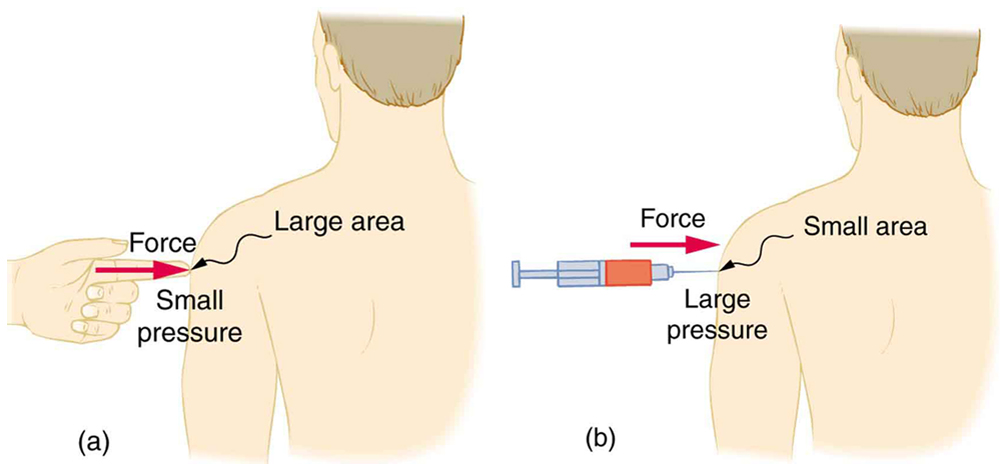
A given force can have a significantly different effect depending on the area over which the force is exerted, as shown in [Figure 1]. The SI unit for pressure is the pascal, where
In addition to the pascal, there are many other units for pressure that are in common use. In meteorology, atmospheric pressure is often described in units of millibar (mb), where
Pounds per square inch $\left({\text{lb/in}}^{2} \text{ or } \text{psi}\right)$ is still sometimes used as a measure of tire pressure, and millimeters of mercury (mm Hg) is still often used in the measurement of blood pressure. Pressure is defined for all states of matter but is particularly important when discussing fluids.
An astronaut is working outside the International Space Station where the atmospheric pressure is essentially zero. The pressure gauge on her air tank reads $6.90 \times 10^{6} \text{Pa}$ . What force does the air inside the tank exert on the flat end of the cylindrical tank, a disk 0.150 m in diameter?
Strategy
We can find the force exerted from the definition of pressure given in $P=\frac{F}{A}$ , provided we can find the area $A$ acted upon.
Solution
By rearranging the definition of pressure to solve for force, we see that
Here, the pressure $P$ is given, as is the area of the end of the cylinder $A$ , given by $A=\pi r^2$ . Thus,
Discussion
Wow! No wonder the tank must be strong. Since we found $F=PA$ , we see that the force exerted by a pressure is directly proportional to the area acted upon as well as the pressure itself.
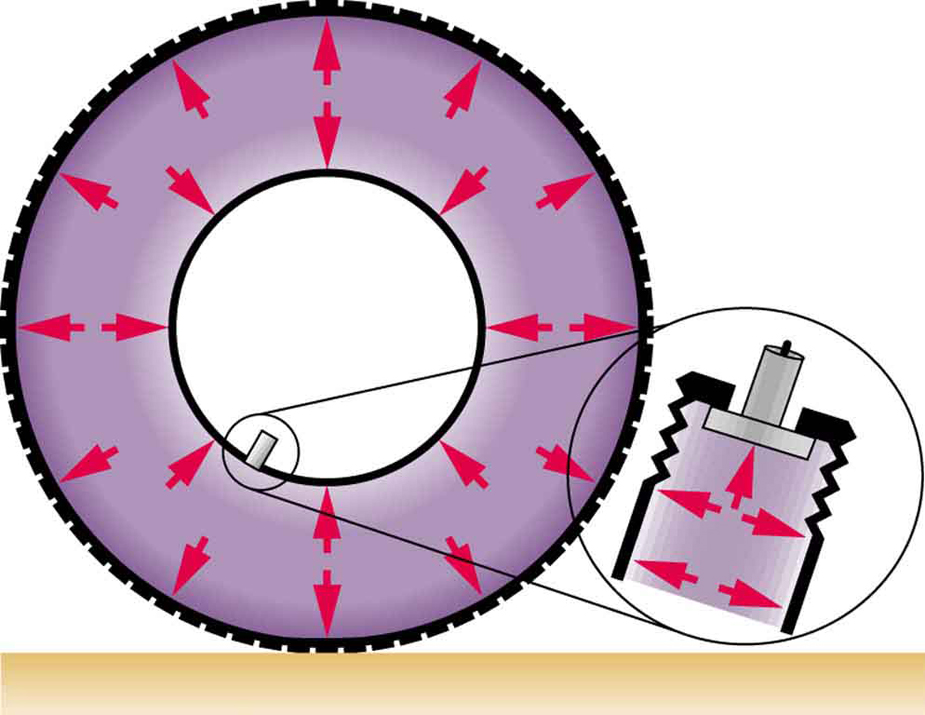
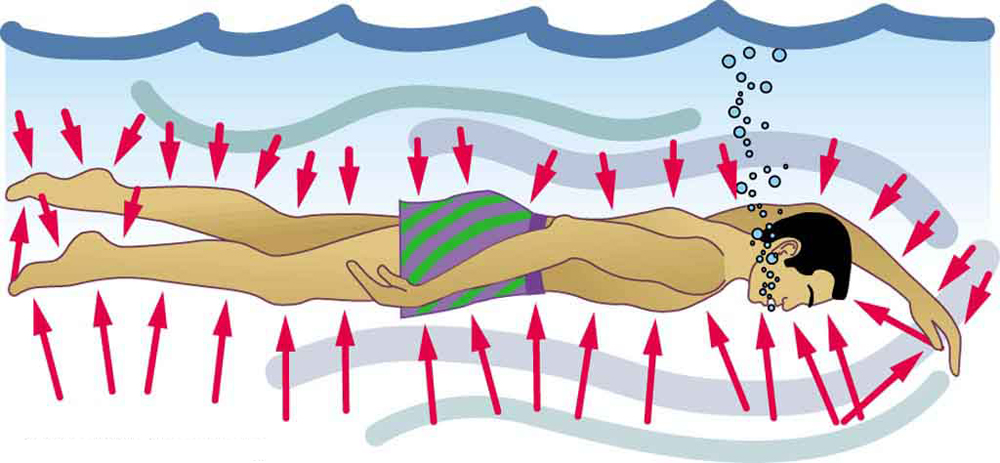
The force exerted on the end of the tank is perpendicular to its inside surface. This direction is because the force is exerted by a static or stationary fluid. We have already seen that fluids cannot withstand shearing (sideways) forces; they cannot exert shearing forces, either. Fluid pressure has no direction, being a scalar quantity. The forces due to pressure have well-defined directions: they are always exerted perpendicular to any surface. (See the tire in [Figure 2], for example.) Finally, note that pressure is exerted on all surfaces. Swimmers, as well as the tire, feel pressure on all sides. ( See [Figure 3].)
Pump gas molecules to a box and see what happens as you change the volume, add or remove heat, change gravity, and more. Measure the temperature and pressure, and discover how the properties of the gas vary in relation to each other.
Pressure is the force per unit perpendicular area over which the force is applied. In equation form, pressure is defined as
The SI unit of pressure is pascal and $1 \text{Pa}=1 {\text{N/m}}^{2}$ .
How is pressure related to the sharpness of a knife and its ability to cut?
Strategy: Apply the pressure equation $P = F/A$ to understand how the contact area affects the pressure generated by a given force.
Solution: A sharper knife cuts better because a sharper blade has a smaller contact area, which produces greater pressure for the same applied force.
From the pressure equation $P = F/A$:
For example, if a dull blade has 10× the edge area of a sharp blade:
Discussion: This is why we sharpen knives—sharpening removes material to create a thinner edge, reducing contact area and increasing cutting pressure. This same principle explains why cutting boards should be softer than knife blades, why sharp scissors cut paper better than dull ones, and why a razor blade can easily cut skin while a butter knife cannot, even with similar applied forces.
Why does a dull hypodermic needle hurt more than a sharp one?
Strategy: Consider how needle sharpness affects both the contact area and the force required for penetration, using the pressure relationship.
Solution: A dull hypodermic needle hurts more because:
Larger contact area requires more force: A dull needle has a larger tip area. From $P = F/A$, to achieve the same penetration pressure, a larger area requires greater force: $F = P \times A$
More tissue deformation: The dull tip cannot cut cleanly through tissue. Instead, it must push and deform more tissue aside, stretching and compressing nerve endings over a larger area.
Greater tissue damage: A sharp needle slices cleanly between cells with minimal trauma. A dull needle tears tissue, causing more inflammation and pain response.
Longer penetration time: Healthcare workers must push harder and longer with dull needles, prolonging the painful stimulus.
Discussion: This is why single-use needles are standard practice—even one use can slightly dull a needle. Studies show that injection pain correlates strongly with needle sharpness. The same physics explains why paper cuts hurt: paper edges are microscopically sharp, creating high pressure that cuts through skin cleanly, but the wound’s irregular edges and exposed nerve endings cause significant pain despite minimal visible damage.
The outward force on one end of an air tank was calculated in [Example 1]. How is this force balanced? (The tank does not accelerate, so the force must be balanced.)
Strategy: Apply Newton’s first law: for the tank to remain stationary, all forces must balance. Consider all surfaces where pressure acts.
Solution: The outward force on one end of the tank is balanced by internal tensile forces in the tank walls (material stress).
Here’s the force analysis:
Pressure acts on both ends: The internal pressure creates equal and opposite outward forces on both flat ends of the cylindrical tank.
These forces are transmitted through the walls: The curved cylindrical walls experience tensile (stretching) stress as the pressure tries to push the ends apart.
The wall material provides the restoring force: The molecular bonds in the tank material (typically steel or aluminum) resist stretching, providing an inward force that balances the outward pressure force.
Force balance on each end cap: $F_{\text{pressure}} = F_{\text{tension in walls}}$
Discussion: This is why pressure vessels must be made of strong materials with adequate wall thickness. The calculated force of $1.22 \times 10^5 \text{ N}$ (about 27,000 pounds!) would cause a weak container to rupture. Tank designers calculate the required wall thickness using the tensile strength of the material. This also explains why pressure tanks are inspected regularly—any weakness in the walls could lead to catastrophic failure. The cylindrical shape is preferred because it distributes stress evenly, unlike sharp corners which concentrate stress.
Why is force exerted by static fluids always perpendicular to a surface?
Strategy: Consider the defining property of fluids (they cannot resist shear forces) and what would happen if a force component existed parallel to a surface.
Solution: The force exerted by static fluids is always perpendicular to a surface because fluids cannot sustain shear (tangential) forces without flowing.
Logical argument:
Mathematically, if the force had a tangential component: $\vec{F} = F_\perp \hat{n} + F_\parallel \hat{t}$
For static equilibrium: $F_\parallel = 0$, leaving only $\vec{F} = F_\perp \hat{n}$
Discussion: This fundamental property is why pressure (force per area) is a scalar, not a vector—it has magnitude but its direction is always determined by the surface orientation. This perpendicularity is essential for hydraulic systems to work: pressure applied anywhere transmits equally in all directions (Pascal’s principle), allowing hydraulic lifts and brakes to function. It also explains why a fluid in a tilted container always has a horizontal surface at rest—gravity’s tangential component causes flow until the surface becomes perpendicular to the net force.
In a remote location near the North Pole, an iceberg floats in a lake. Next to the lake (assume it is not frozen) sits a comparably sized glacier sitting on land. If both chunks of ice should melt due to rising global temperatures (and the melted ice all goes into the lake), which ice chunk would give the greatest increase in the level of the lake water, if any?
Strategy: Apply Archimedes’ principle to the floating iceberg and compare with the land-based glacier’s contribution when melted.
Solution: The glacier on land would give the greatest increase in lake level. The floating iceberg would cause essentially no change in water level when it melts.
Analysis:
Floating iceberg:
Glacier on land:
Discussion: This distinction is crucial for understanding sea level rise due to climate change:
The Antarctic and Greenland ice sheets contain enough ice that, if completely melted, would raise global sea levels by approximately 70 meters. Sea ice melting has other important effects (reducing Earth’s reflectivity, affecting ecosystems) but does not directly contribute to sea level rise.
How do jogging on soft ground and wearing padded shoes reduce the pressures to which the feet and legs are subjected?
Strategy: Consider how both factors affect contact area and stopping time/distance, and how these relate to pressure and force.
Solution: Both soft ground and padded shoes reduce pressure on feet and legs through two mechanisms:
1. Increased contact area (reduces pressure)
From $P = F/A$:
2. Increased stopping distance (reduces force)
From impulse-momentum: $F \cdot \Delta t = \Delta p$
Combined effect example:
Discussion: This explains why runners often choose grass or track surfaces over concrete, and why running shoe technology focuses heavily on cushioning. The impact forces during running can reach 2-3 times body weight, and reducing the resulting pressure helps prevent stress fractures, joint damage, and soft tissue injuries. The same principles apply to protective equipment in other sports—helmets, padding, and mats all work by increasing contact area and impact time.
Toe dancing (as in ballet) is much harder on toes than normal dancing or walking. Explain in terms of pressure.
Strategy: Compare the contact areas supporting body weight during toe dancing (en pointe) versus normal standing or walking, then calculate the pressure difference.
Solution: Toe dancing creates much higher pressure on toes because the entire body weight is supported by an extremely small area—just the tips of the toes.
Quantitative comparison for a 50 kg dancer:
Normal standing (both feet flat):
Toe dancing (en pointe on one foot):
The pressure while en pointe is approximately 30 times greater than normal standing!
Discussion: This extreme pressure explains why ballet dancers:
The toe box of a pointe shoe helps distribute force over a slightly larger area, but the pressure remains far higher than normal. Professional dancers frequently experience stress fractures, bunions, and other foot problems due to these sustained high pressures.
How do you convert pressure units like millimeters of mercury, centimeters of water, and inches of mercury into units like newtons per meter squared without resorting to a table of pressure conversion factors?
Strategy: Use the hydrostatic pressure formula $P = \rho gh$ with the known density of the reference fluid and the given column height.
Solution: Pressure units like “mm Hg” or “cm H₂O” represent the pressure at the bottom of a column of that fluid with that height. To convert to pascals (N/m²), use:
where:
Example conversions:
760 mm Hg (standard atmosphere):
10 cm H₂O:
30 inches Hg:
Discussion: This method requires knowing only the fluid’s density and basic unit conversions. The approach works because these pressure units were historically defined by manometer measurements—literally the height of a fluid column that a pressure could support. Mercury is commonly used because its high density (13.6× water) gives convenient column heights, while water columns are used for lower pressures. Understanding this conversion method also helps in reading manometers and barometers directly.
As a woman walks, her entire weight is momentarily placed on one heel of her high-heeled shoes. Calculate the pressure exerted on the floor by the heel if it has an area of $1.50 {\text{cm}}^{2}$ and the woman’s mass is 55.0 kg. Express the pressure in Pa. (In the early days of commercial flight, women were not allowed to wear high-heeled shoes because aircraft floors were too thin to withstand such large pressures.)
Strategy: Calculate the woman’s weight (force) and divide by the contact area using $P = F/A$.
Solution:
Step 1: Calculate the woman’s weight
Step 2: Convert area to m²
Step 3: Calculate pressure
Converting to lb/in²:
Discussion: The pressure exerted is approximately 3.59 × 10⁶ Pa (or 521 psi), which is about 35 times atmospheric pressure! This enormous pressure results from concentrating the woman’s entire weight on the tiny contact area of a high heel. This explains the early aviation restriction—thin aircraft floors could be punctured or permanently dented by such concentrated forces. The same physics explains why snowshoes work (large area = low pressure) and why stiletto heels can damage wooden floors and soft surfaces.
The pressure exerted by a phonograph needle on a record is surprisingly large. If the equivalent of 1.00 g is supported by a needle, the tip of which is a circle 0.200 mm in radius, what pressure is exerted on the record in ${\text{N/m}}^{2}$ ?
Strategy: Calculate the force (weight) supported by the needle, find the contact area of the circular tip, then apply the pressure formula $P = F/A$.
Solution: Step 1: Calculate the force (weight)
Step 2: Calculate the contact area
The tip is circular with radius $r = 0.200 \text{ mm} = 0.200 \times 10^{-3} \text{ m} = 2.00 \times 10^{-4} \text{ m}$
Step 3: Calculate the pressure
Discussion: The pressure exerted by the phonograph needle is approximately 7.80 × 10⁴ Pa (or about 78 kPa, which is roughly 11 psi). This is indeed surprisingly large—nearly 80% of atmospheric pressure—from just one gram of force! The pressure is high because the contact area is extremely small (about 0.13 mm²). This high pressure is necessary for the needle to follow the microscopic grooves in the record (typically 40-50 micrometers wide). However, it also explains why records wear out with repeated playing and why proper needle maintenance is important for preserving vinyl records.
Nail tips exert tremendous pressures when they are hit by hammers because they exert a large force over a small area. What force must be exerted on a nail with a circular tip of 1.00 mm diameter to create a pressure of $3.00 \times 10^{9} {\text{N/m}}^{2}$ ? (This high pressure is possible because the hammer striking the nail is brought to rest in such a short distance.)
Strategy: Use $P = F/A$ to solve for force, where the area is that of the circular nail tip.
Solution:
Step 1: Calculate the nail tip area
Diameter = 1.00 mm, so radius $r = 0.500 \text{ mm} = 5.00 \times 10^{-4} \text{ m}$
Step 2: Solve for force
From $P = F/A$:
Discussion: The required force is approximately 2360 N (about 530 pounds). This seems like a modest force compared to the enormous pressure it creates—3 GPa is roughly 30,000 times atmospheric pressure! This pressure is sufficient to exceed the compressive strength of wood, allowing the nail to penetrate. The key is the tiny contact area of the nail tip (less than 1 mm²), which concentrates force into extreme pressure. When a hammer strikes a nail, it briefly exerts thousands of newtons over a very short stopping distance, transferring its kinetic energy to drive the nail. The same principle applies to all pointed tools—axes, chisels, and drill bits all work by concentrating force into small areas.