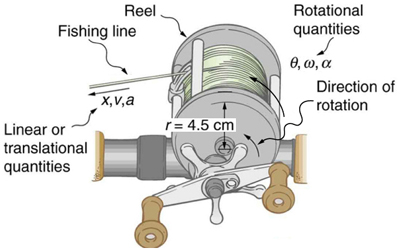
Just by using our intuition, we can begin to see how rotational quantities like $\theta$, $\omega$, and $\alpha$ are related to one another. For example, if a motorcycle wheel has a large angular acceleration for a fairly long time, it ends up spinning rapidly and rotates through many revolutions. In more technical terms, if the wheel’s angular acceleration $\alpha$ is large for a long period of time $t$, then the final angular velocity $\omega$ and angle of rotation $\theta$ are large. The wheel’s rotational motion is exactly analogous to the fact that the motorcycle’s large translational acceleration produces a large final velocity, and the distance traveled will also be large.
Kinematics is the description of motion. The kinematics of rotational motion describes the relationships among rotation angle, angular velocity, angular acceleration, and time. Let us start by finding an equation relating $\omega$, $\alpha$, and $t$. To determine this equation, we recall a familiar kinematic equation for translational, or straight-line, motion:
Note that in rotational motion $a= a\_{\text{t}}$, and we shall use the symbol $a$ for tangential or linear acceleration from now on. As in linear kinematics, we assume $a$ is constant, which means that angular acceleration $\alpha$ is also a constant, because $a= r\alpha$. Now, let us substitute $v=r \omega$ and $a= r\alpha$ into the linear equation above:
The radius $r$ cancels in the equation, yielding
where $\omega\_{0}$ is the initial angular velocity. This last equation is a kinematic relationship among $\omega$, $\alpha$, and $t$ —that is, it describes their relationship without reference to forces or masses that may affect rotation. It is also precisely analogous in form to its translational counterpart.
Kinematics for rotational motion is completely analogous to translational kinematics, first presented in One-Dimensional Kinematics. Kinematics is concerned with the description of motion without regard to force or mass. We will find that translational kinematic quantities, such as displacement, velocity, and acceleration have direct analogs in rotational motion.
Starting with the four kinematic equations we developed in One-Dimensional Kinematics, we can derive the following four rotational kinematic equations (presented together with their translational counterparts):
| Rotational | Translational | Conditions |
|---|---|---|
| $\theta= \overline{\omega} t$ | $x = \overline{v} t$ | |
| $\omega=\omega_0 + \alpha t$ | $v = v_0 + a t$ | constant $\alpha$, constant $a$ |
| $\theta=\omega_0 t + \frac{1}{2} \alpha t^2$ | $x = v_0 t + \frac{1}{2} a t^2$ | constant $\alpha$, constant $a$ |
| $\omega^2= \omega_0^2 + 2 \alpha \theta$ | $v^2 =v_0^2 + 2 a x$ | constant $\alpha$, constant $a$ |
In these equations, the subscript 0 denotes initial values ($\theta_{0}$, $x_{0}$, and $t\_{0}$ are initial values), and the average angular velocity $\overline{\omega }$ and average velocity $\overline{v}$ are defined as follows:
The equations given above in Table 1 can be used to solve any rotational or translational kinematics problem in which $a$ and $\alpha$ are constant.
A deep-sea fisherman hooks a big fish that swims away from the boat pulling the fishing line from his fishing reel. The whole system is initially at rest and the fishing line unwinds from the reel at a radius of 4.50 cm from its axis of rotation. The reel is given an angular acceleration of $110 \radss$ for 2.00 s as seen in Figure 1.
(a) What is the final angular velocity of the reel?
(b) At what speed is fishing line leaving the reel after 2.00 s elapses?
(c) How many revolutions does the reel make?
(d) How many meters of fishing line come off the reel in this time?
Strategy
In each part of this example, the strategy is the same as it was for solving problems in linear kinematics. In particular, known values are identified and a relationship is then sought that can be used to solve for the unknown.
Solution for (a)
Here $\alpha$ and $t$ are given and $\omega$ needs to be determined. The most straightforward equation to use is $\omega =\omega\_{0} +\alpha t$ because the unknown is already on one side and all other terms are known. That equation states that
We are also given that $\omega_{0} =0$ (it starts from rest), so that
Solution for (b)
Now that $\omega$ is known, the speed $v$ can most easily be found using the relationship
where the radius $r$ of the reel is given to be 4.50 cm; thus,
Note again that radians must always be used in any calculation relating linear and angular quantities. Also, because radians are dimensionless, we have $\m ×\text{rad}=\m$.
Solution for (c)
Here, we are asked to find the number of revolutions. Because $1 \text{rev}=2 \pi \text{rad}$, we can find the number of revolutions by finding $\theta$ in radians. We are given $\alpha$ and $t$, and we know $\omega_{0}$ is zero, so that $\theta$ can be obtained using $\theta =\omega_{0} t+\frac{1}{2} \alpha t^{2}$.
Converting radians to revolutions gives
Solution for (d)
The number of meters of fishing line is $x$, which can be obtained through its relationship with $\theta$:
Discussion
This example illustrates that relationships among rotational quantities are highly analogous to those among linear quantities. We also see in this example how linear and rotational quantities are connected. The answers to the questions are realistic. After unwinding for two seconds, the reel is found to spin at 220 rad/s, which is 2100 rpm. (No wonder reels sometimes make high-pitched sounds.) The amount of fishing line played out is 9.90 m, about right for when the big fish bites.
Now let us consider what happens if the fisherman applies a brake to the spinning reel, achieving an angular acceleration of $–300 \radss$ . How long does it take the reel to come to a stop?
Strategy
We are asked to find the time $t$ for the reel to come to a stop. The initial and final conditions are different from those in the previous problem, which involved the same fishing reel. Now we see that the initial angular velocity is $\omega_{0}=220 \rads$ and the final angular velocity $\omega$ is zero. The angular acceleration is given to be $\alpha =-300 \radss$. Examining the available equations, we see all quantities but t are known in $\omega =\omega_{0}+ \alpha t,$ making it easiest to use this equation.
Solution
The equation states
We solve the equation algebraically for t, and then substitute the known values as usual, yielding
Discussion
Note that care must be taken with the signs that indicate the directions of various quantities. Also, note that the time to stop the reel is fairly small because the acceleration is rather large. Fishing lines sometimes snap because of the accelerations involved, and fishermen often let the fish swim for a while before applying brakes on the reel. A tired fish will be slower, requiring a smaller acceleration.
Large freight trains accelerate very slowly. Suppose one such train accelerates from rest, giving its 0.350-m-radius wheels an angular acceleration of $0.250 \radss$. After the wheels have made 200 revolutions (assume no slippage): (a) How far has the train moved down the track? (b) What are the final angular velocity of the wheels and the linear velocity of the train?
Strategy
In part (a), we are asked to find $x$, and in (b) we are asked to find $\omega$ and $v$. We are given the number of revolutions $\theta$, the radius of the wheels $r$, and the angular acceleration $\alpha$.
Solution for (a)
The distance $x$ is very easily found from the relationship between distance and rotation angle:
Solving this equation for $x$ yields
Before using this equation, we must convert the number of revolutions into radians, because we are dealing with a relationship between linear and rotational quantities:
Now we can substitute the known values into $x= r\theta$ to find the distance the train moved down the track:
Solution for (b)
We cannot use any equation that incorporates $t$ to find $\omega$, because the equation would have at least two unknown values. The equation $\omega^{2}=\omega\_{0}^{2}+2 \alpha \theta$ will work, because we know the values for all variables except $\omega$:
Taking the square root of this equation and entering the known values gives
We can find the linear velocity of the train, $v$, through its relationship to $\omega$:
Discussion
The distance traveled is fairly large and the final velocity is fairly slow ( just under 32 km/h).
There is translational motion even for something spinning in place, as the following example illustrates. Figure 2 shows a fly on the edge of a rotating microwave oven plate. The example below calculates the total distance it travels.
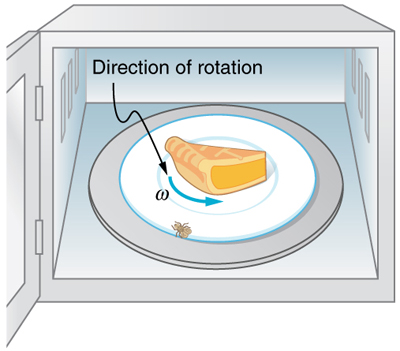
A person decides to use a microwave oven to reheat some lunch. In the process, a fly accidentally flies into the microwave and lands on the outer edge of the rotating plate and remains there. If the plate has a radius of 0.15 m and rotates at 6.0 rpm, calculate the total distance traveled by the fly during a 2.0-min cooking period. (Ignore the start-up and slow-down times.)
Strategy
First, find the total number of revolutions $\theta$, and then the linear distance $x$ traveled. $\theta =\overline{\omega }t$ can be used to find $\theta$ because $\overline{\omega }$ is given to be 6.0 rpm.
Solution
Entering known values into $\theta =\overline{\omega }t$ gives
As always, it is necessary to convert revolutions to radians before calculating a linear quantity like $x$ from an angular quantity like $\theta$:
Now, using the relationship between $x$ and $\theta$, we can determine the distance traveled:
Discussion
Quite a trip (if it survives)! Note that this distance is the total distance traveled by the fly. Displacement is actually zero for complete revolutions because they bring the fly back to its original position. The distinction between total distance traveled and displacement was first noted in One-Dimensional Kinematics.
Rotational kinematics has many useful relationships, often expressed in equation form. Are these relationships laws of physics or are they simply descriptive? (Hint: the same question applies to linear kinematics.)
Rotational kinematics (just like linear kinematics) is descriptive and does not represent laws of nature. With kinematics, we can describe many things to great precision but kinematics does not consider causes. For example, a large angular acceleration describes a very rapid change in angular velocity without any consideration of its cause.
With the aid of a string, a gyroscope is accelerated from rest to 32 rad/s in 0.40 s.
(a) What is its angular acceleration in $\radss$?
(b) How many revolutions does it go through in the process?
Strategy
For part (a), we use the definition of angular acceleration: α = Δω/Δt. For part (b), we use a rotational kinematic equation to find the angular displacement, then convert to revolutions.
Solution
(a) The angular acceleration is:
(b) Using the kinematic equation $\theta = \omega_0 t + \frac{1}{2}\alpha t^2$ with $\omega_0 = 0$:
Converting to revolutions:
Discussion
The gyroscope makes exactly one complete revolution while spinning up to 32 rad/s. The angular acceleration of 80 rad/s² is quite large, reflecting the rapid spin-up from the string pull. This is a typical way to start a gyroscope—a quick pull on a string wrapped around its axis.
Answer
(a) The angular acceleration is 80 rad/s².
(b) The gyroscope makes 1.0 revolution during spin-up.
Suppose a piece of dust finds itself on a CD. If the spin rate of the CD is 500 rpm, and the piece of dust is 4.3 cm from the center, what is the total distance traveled by the dust in 3 minutes? (Ignore accelerations due to getting the CD rotating.)
Strategy
The CD rotates at a constant angular velocity of 500 rpm for 3 minutes. We find the total number of revolutions, convert to radians, and then use the relationship between arc length and angle to find the total distance traveled.
Solution
First, calculate the total number of revolutions:
Convert to radians:
The distance traveled is:
Discussion
The dust particle travels about 405 meters (roughly a quarter mile) while riding on the spinning CD for just 3 minutes. This illustrates how even a modest angular velocity can produce significant linear distances when sustained over time.
Answer
The dust particle travels a total distance of 405 m in 3 minutes.
A gyroscope slows from an initial rate of 32.0 rad/s at a rate of $0.700 \radss$.
(a) How long does it take to come to rest?
(b) How many revolutions does it make before stopping?
Strategy
The gyroscope is decelerating, so α = −0.700 rad/s². For part (a), we use ω = ω₀ + αt with ω = 0. For part (b), we use ω² = ω₀² + 2αθ to find the angular displacement.
Solution
(a) Using $\omega = \omega_0 + \alpha t$ with $\omega = 0$:
(b) Using $\omega^2 = \omega_0^2 + 2\alpha\theta$ with $\omega = 0$:
Converting to revolutions:
Discussion
The gyroscope takes 45.7 seconds to come to rest, making 116 complete revolutions in that time. The relatively small angular deceleration (0.700 rad/s²) compared to the initial angular velocity (32.0 rad/s) means the gyroscope coasts for a long time and distance. This is typical of gyroscopes, which have low friction bearings and can spin for extended periods.
Answer
(a) The gyroscope takes 45.7 s to come to rest.
(b) It makes 116 revolutions before stopping.
During a very quick stop, a car decelerates at $7.00 \mss$.
(a) What is the angular acceleration of its 0.280-m-radius tires, assuming they do not slip on the pavement?
(b) How many revolutions do the tires make before coming to rest, given their initial angular velocity is $95.0 \rads$ ?
(c) How long does the car take to stop completely?
(d) What distance does the car travel in this time?
(e) What was the car’s initial velocity?
(f) Do the values obtained seem reasonable, considering that this stop happens very quickly?

Strategy
We use the relationship between linear and angular quantities, along with rotational kinematics. Since the tires don’t slip, we have $a = r\alpha$ and $v = r\omega$.
Solution
(a) The angular acceleration is related to linear acceleration by:
The negative sign indicates the tires are decelerating.
(b) Using $\omega^2 = \omega_0^2 + 2\alpha\theta$ with $\omega = 0$:
Converting to revolutions:
(c) Using $\omega = \omega_0 + \alpha t$ with $\omega = 0$:
(d) The distance traveled is:
(e) The car’s initial velocity was:
(f) Yes, the values are reasonable. The initial velocity of 26.6 m/s is about 96 km/h (60 mph), which is a typical highway speed. Stopping in 3.80 s over a distance of 50.5 m (about 166 feet) with a deceleration of 7.00 m/s² (about 0.7g) represents a hard but achievable emergency stop for a car with good brakes and tires.
Discussion
This problem demonstrates the power of connecting rotational and translational motion. By analyzing the tire rotation, we can determine all aspects of the car’s motion. The no-slip condition (where the tire’s contact point with the pavement has zero velocity) is crucial for this analysis and explains why anti-lock braking systems work—they prevent wheel lockup to maintain this no-slip condition, allowing maximum braking force.
Answer
(a) Angular acceleration: −25.0 rad/s²
(b) Number of revolutions: 28.7 rev
(c) Time to stop: 3.80 s
(d) Distance traveled: 50.5 m
(e) Initial velocity: 26.6 m/s (about 96 km/h or 60 mph)
(f) Yes, these values are reasonable for a hard emergency stop from highway speed.
Everyday application: Suppose a yo-yo has a center shaft that has a 0.250 cm radius and that its string is being pulled.
(a) If the string is stationary and the yo-yo accelerates away from it at a rate of $1.50 \mss$, what is the angular acceleration of the yo-yo?
(b) What is the angular velocity after 0.750 s if it starts from rest?
(c) The outside radius of the yo-yo is 3.50 cm. What is the tangential acceleration of a point on its edge?
Strategy
The string wraps around the center shaft, so the linear acceleration of the yo-yo relates to angular acceleration by a = rα, where r is the shaft radius. For part (b), we use ω = ω₀ + αt. For part (c), we use a_t = Rα with the outer radius.
Solution
(a) The shaft radius is r = 0.250 cm = 0.00250 m. Using $a = r\alpha$:
(b) Starting from rest ($\omega_0 = 0$), after t = 0.750 s:
(c) At the outer edge, R = 3.50 cm = 0.0350 m:
Discussion
The angular acceleration is quite large (600 rad/s²) because the shaft radius is so small. After only 0.750 s, the yo-yo is spinning at 450 rad/s (about 4,300 rpm). The tangential acceleration at the outer edge (21.0 m/s²) is much larger than the yo-yo’s linear acceleration (1.50 m/s²) because the outer radius is 14 times larger than the shaft radius. This large difference in accelerations at different radii is characteristic of rotating objects.
Answer
(a) The angular acceleration is 600 rad/s².
(b) The angular velocity after 0.750 s is 450 rad/s (about 4,300 rpm).
(c) The tangential acceleration at the outer edge is 21.0 m/s².